
Learn Trading Online for Free: Practise With Play Money and Real Prices
The first stage of learning to trade costs nothing if you set it up properly: play money, real prices and fixed rules before the first euro is at stake.



Which topics should we dive deeper into?
Select what genuinely interests you. Your picks feed directly into our editorial planning.
Crypto news that's actually worth your time.
Weekly. 60 seconds. Carefully curated by our editors: no hype, no promo flood, no spam.
 Crypto brokers compared: leverage, costs, regulation
The information provided in this article is for informational purposes only and does not constitute financial advice. Cryptocurrency investments carry a high degree of risk.
Few subjects are started the wrong way as often as trading. The typical route looks like this: open an account with a broker, deposit three hundred euros, watch a handful of videos and begin. Two weeks later the money is gone, and the only lesson that sticks is frustration. That first stage can be completed without any money at all: with play money, real prices and fixed rules. Here is how to set it up, which four points matter at the start, and where a practice account reaches its limits.
Why Theory on Its Own Is Not Enough
Nobody is short of knowledge. What leverage is, what a stop loss does, how a short position works: all of it is explained in five minutes and understood in ten. Most beginners still fail, and what defeats them is the execution.
Trading is less a body of knowledge than a craft. Defining a stop loss is trivial. Leaving it where it is while the price runs against your position and your mind hunts for reasons to move it down "just this once" is a different matter entirely. That ability comes from repetition alone, from hundreds of decisions taken under realistic conditions.
Then there is a factor no course conveys: how you personally handle losses. After three red trades in a row, hardly anyone still makes the decisions they made that morning. Positions grow larger to make up lost ground, rules get bent to fit the situation. Recognising that pattern in yourself is the precondition for working on it.
The European supervisor has put a number on what this learning curve costs with real money. When ESMA agreed to restrict CFD trading for retail clients on 27 March 2018, it cited analyses by national authorities showing that 74 to 89 percent of retail accounts lost money, with average losses per client between €1,600 and €29,000. The sequence is what decides the outcome: build the routine first, put capital at risk afterwards, and never the other way round.
Getting Started Without Signing Up: Ten Minutes
A practice account funded with virtual money solves the problem, as long as the market data behind it is genuine. Static sample charts achieve little, because they leave out the most uncomfortable part of the job: the movement that happens while you are sitting in the position.
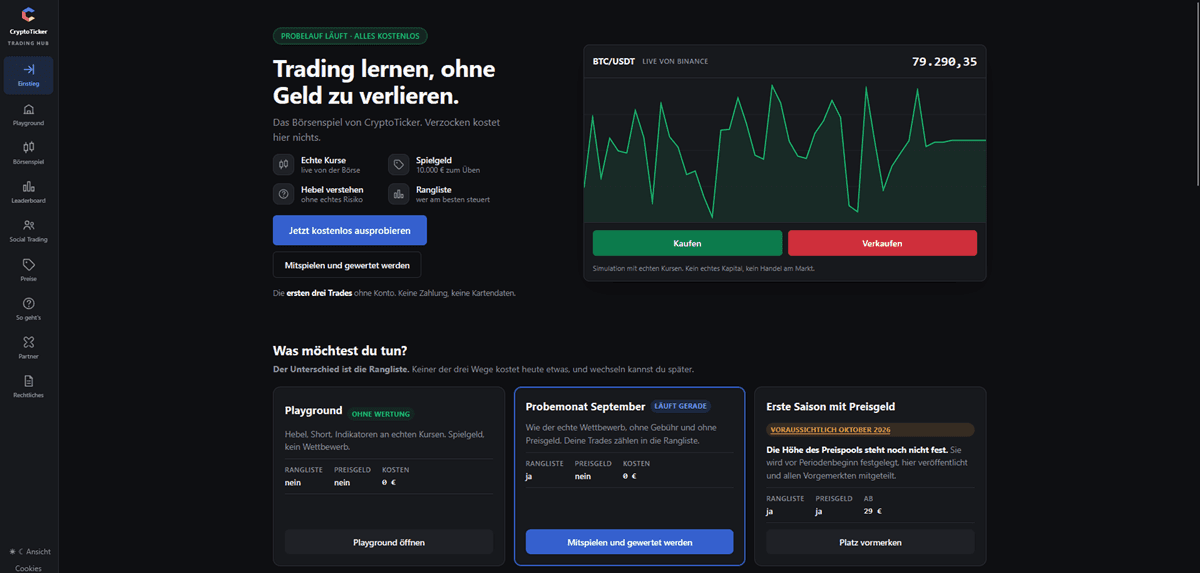
The CryptoTicker Trading Hub is built for exactly that. You trade with €10,000 in play money, the prices come live from the exchange, and the cockpit matches what you will later find at a real broker: an order ticket with stop loss and take profit, a chart with indicators, leverage and short positions. Getting it wrong costs nothing beyond the insight. This is how the start works, as of 22 September 2026:
- Open the cockpit. No account, no e-mail, no payment details. The €10,000 starting capital is ready.
- Place the first three trades. They work without an account. Pick one of the 50 coins, decide long or short, and enter stop loss and take profit before you click buy, not afterwards.
- Create the account if you want to continue. After the third trade, one click creates the account, without e-mail or password. You can add an e-mail address or Google sign-in later so you find your account on a second device.
- Choose ranked or practice only. If you want to compete, you trade in the cockpit in one of two leagues (up to 10× or up to 100× leverage) and appear on the leaderboard under your pseudonym once you make your profile public. If you only want to practise, the unranked practice mode has no scoring and no elimination.
The Four Points That Really Count at the Start
- What leverage actually means. Tenfold leverage sounds like tenfold profit and amounts, in practice, mainly to one thing: a drastically shortened distance to liquidation. Working out once that a two percent move against you costs twenty percent of the margin teaches the concept far faster than any explanation.
- How short positions feel. Betting on falling prices is mechanically simple and psychologically uncomfortable, because the loss potential behaves differently. When too many participants are short and the price rises anyway, they have to buy back, which is the classic short squeeze. Living through one leaves a mark.
- Why a stop loss is dull and still correct. Risk management is the least spectacular part of the craft and the only part that decides the outcome over time. A daily limit that halts trading once losses reach a set level may feel excessive in a practice account. In earnest it separates a bad day from an empty account.
- That the highest return does not automatically win. Someone who goes flat out for forty percent and has to sit through a twenty percent drawdown along the way has worked less well than someone with a steady twelve percent. The Trading Hub scores precisely that: the CT score sets the result against the largest drawdown. Internalising that ratio is worth more to a beginner than any entry strategy.
What a Practice Account Can and Cannot Do
A practice account with real prices reproduces price movement, leverage, liquidation and fees. The Trading Hub charges trading fees against the result, so nobody learns a strategy that only works when trading is free. Three things no practice account reproduces, and knowing them keeps you from overrating your practice results:
| What is missing | Why it matters | What you can do about it |
|---|---|---|
| The pain of real losses | A 20 percent drawdown is bearable with play money, rarely with real money | Practise with a fixed rulebook, not your gut, and write down every broken rule |
| Execution in thin markets | Large orders move real prices, play-money orders do not | Stay with liquid coins and position sizes you would actually trade later |
| The temptation to simply restart | A fresh play-money account is one click, a fresh real account is a bank transfer | Keep one account running for weeks instead of resetting after every loss |
App or Browser
Many people look for an app to practise trading. The Trading Hub runs in the browser, on the phone as well as on the desktop, and can be added to the home screen as a web app. No app store installation is needed, and once an e-mail address is linked, the practice account lives in your login rather than on the device. Broker demo accounts usually ask for a registration with e-mail and phone number for the same purpose and often expire after a few weeks.
A Four-Week Practice Plan
Practising without a plan is clicking. A simple plan for four weeks, each with a task in the practice account:
- Week 1: orders and stops. Open every trade with a stop loss and a take profit, never move a stop down. The goal is not profit but ten trades without a broken rule.
- Week 2: position size. Risk at most one percent of the account per trade, which at €10,000 in play money means €100 between entry and stop. Leverage follows from the calculation, not the other way round.
- Week 3: shorts and leverage. Go short once on purpose, set leverage to 10× once and watch how quickly the distance to liquidation shrinks.
- Week 4: review. Go through all trades of the three weeks: how often did you break the rule, how large was your biggest drawdown, how does your result compare to it? Only when these numbers hold up is real money worth a thought.
Competition Keeps You at the Table
The practical drawback of a demo account is the missing consequence. Without a stake there is no incentive to work cleanly; you click around, lose interest and stop.
A leaderboard supplies that incentive without exposing any capital. In the Trading Hub you can practise unranked or enter one of the two leagues with scored trades. A prize pool has been announced for the ranked seasons; its size is not yet fixed. Until the first ranked season starts, everything is free to play; after that, taking part in the ranking costs from €29 per month according to the terms of participation, while practising unranked stays free (as of 22 September 2026). Measuring yourself against others creates the seriousness that unstructured experimenting never produces.
Conclusion
Learning to trade online has little to do with putting real money to work as quickly as possible. It is about making the standard beginner mistakes where they cost nothing: leverage, position size and exit discipline. Practise consistently with live prices for a few weeks and you enter the real market with a routine instead of a hope.
FAQ
Can I really learn trading without money?
Yes. In the CryptoTicker Trading Hub you trade €10,000 in play money at real exchange prices, and the first three trades work without an account. No money changes hands and no payment details are stored, as of September 2026.
Do I need an app to practise trading?
No. The Trading Hub runs in the browser on phone and desktop and can be added to the home screen as a web app. No app store installation is required.
How long should I practise with play money before using real money?
At least until you keep your rules for several weeks without breaking them and know your largest drawdown. Four weeks with the plan above are a start, not a finish.
Is a practice account the same as a broker demo account?
Both simulate trades at real prices. Broker demo accounts belong to one provider, usually require registration and serve the broker as a path to the real-money account. The Trading Hub belongs to no broker and scores you on a leaderboard instead.
What does the trading game in the Trading Hub cost?
Nothing during the current trial month; there is no prize money and no payment. Until the first ranked season starts, everything is free to play; after that, taking part in the ranking costs from €29 per month according to the terms of participation, while practising unranked stays free (as of 22 September 2026).
If you want to go deeper after the practice account, the guide to crypto trading for beginners covers order types, charts and risk step by step, and the comparison of the best crypto brokers answers where trading with real money would later be cheapest, including fees and regulation.
Sources
- ESMA, press release of 27 March 2018: "ESMA agrees to prohibit binary options and restrict CFDs to protect retail investors", https://www.esma.europa.eu/press-news/esma-news/esma-agrees-prohibit-binary-options-and-restrict-cfds-protect-retail-investors
- CryptoTicker Trading Hub, start page and terms of participation, https://trading.cryptoticker.io/en/start and https://trading.cryptoticker.io/agb (retrieved 22 September 2026)
CryptoTicker trading game: try it freeTransparency note: This article was produced with the assistance of artificial intelligence and reviewed by our editorial team before publication. All figures and claims were checked against the primary sources linked in the text.
Related articles
Which topics should we dive deeper into?
Select what genuinely interests you. Your picks feed directly into our editorial planning.
Crypto news that's actually worth your time.
Weekly. 60 seconds. Carefully curated by our editors: no hype, no promo flood, no spam.
More from CryptoTicker