
Crypto Trading for Beginners: Order Types, Charts and Risk Explained
Trading is a different exercise from buying and holding. This introduction explains the three order types, what a chart really shows, how position size is calculated and what trading triggers for your taxes.



Which topics should we dive deeper into?
Select what genuinely interests you. Your picks feed directly into our editorial planning.
Crypto news that's actually worth your time.
Weekly. 60 seconds. Carefully curated by our editors: no hype, no promo flood, no spam.
Most people who own cryptocurrencies bought them and then left them alone. That is not trading, it is investing, and for the vast majority it is the better route. Trading means something else: you try to make a profit from price moves within hours, days or weeks. It is a different activity, with different tools, different risks and a different tax position.
This piece explains the basics without telling you what to do. It sets out which order types exist and what they are for, what a chart actually displays, how position sizes are calculated, and where most beginners lose money. By the end you will know whether trading suits you. Either answer is a good result.
What is crypto trading and how does it differ from buying?
When you invest, you buy because you believe in the value. When you trade, you buy and sell because you expect a move. The difference lies in the holding period and in what decides the outcome; the market is the same one.
An investor needs a view that spans years. A trader needs a view that spans days, plus a rulebook for the case where that view turns out to be wrong. Beginners tend to lack exactly this rulebook, which is why the most common mistake is rarely the wrong forecast. It is the missing reaction to it.
Three terms mark out the usual styles:
- Day trading: positions are opened and closed on the same day. High time commitment, plenty of fees, a heavy demand on discipline.
- Swing trading: positions run for days or weeks. Less screen time, but longer stretches in which you have to sit with an open position.
- Position trading: weeks to months. The line to investing blurs here, and for private investors in Germany the one-year holding period is the decisive tax question.
That last point is rarely mentioned and it is expensive. Anyone who trades frequently gives up the tax exemption that arrives after twelve months and attaches to every single purchase. Every sale within a year counts as a private disposal and is charged at your personal income tax rate.
Which order types exist in crypto trading?
Three order types cover almost everything: a market order buys immediately at the next available price, a limit order buys only at the price you name, and a stop-loss order sells automatically once a loss reaches a set boundary.
The differences sound technical and decide the outcome in practice:
- Market order: it executes at once, though not necessarily at the price you saw. In quiet markets the deviation is tiny; in hectic ones it can become noticeable. That deviation is called slippage.
- Limit order: you name the price at which you are willing to trade. It executes when the market reaches that level, and otherwise not at all. The price is certain, the execution is not.
- Stop-loss: it sits below your entry and triggers a sale once the price reaches it. It offers no protection against every loss, because in a fast falling market the execution can land below the mark.
A fourth variant appears on almost every exchange: the stop-limit order. It combines the two, triggering at one mark and then executing only up to a limit. That guards against poor execution and carries the risk that nothing is sold at all.
Which order types your exchange offers, and what it charges for them, varies considerably. The exchange comparison lists the fees and the feature range of the regulated providers.
 Crypto exchanges compared
What does a crypto chart actually show?
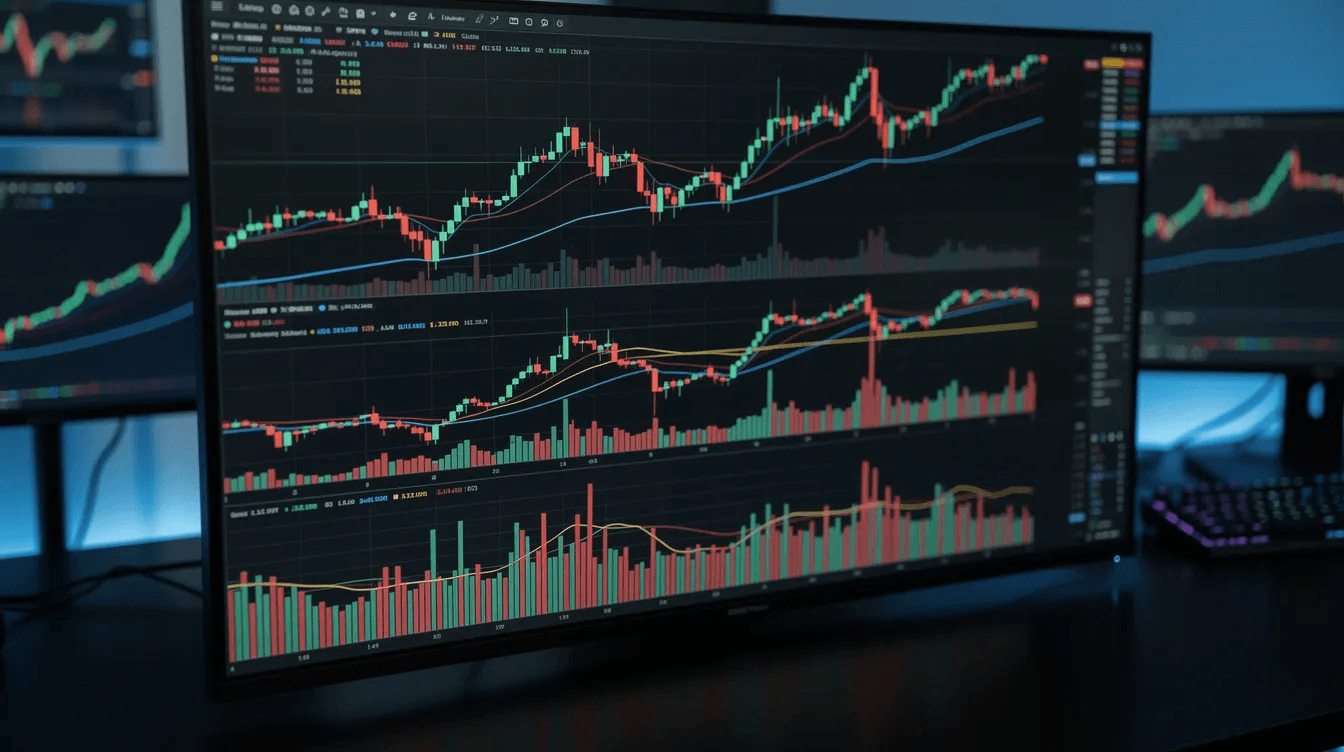
A candlestick chart shows four values per time period: the opening price, the highest price, the lowest price and the closing price. Everything else drawn on a chart is a calculation based on those values.
That is the most important sentence for beginners, because it puts the indicators in their place. A moving average is the mean of the last closing prices, nothing more. The 200-day average is so widely watched simply because many market participants look at the same line and react to it in similar ways. The number 200 carries no special power of its own.
Three tools are enough to start with:
- Moving averages: they smooth the path and show the direction. Above the line the trend points up, below it the trend points down. They say no more than that.
- Volume: how much was traded in a given period. A move on high volume has more participation behind it than one on low volume.
- RSI: a number between 0 and 100 that measures how strong the recent upward moves were against the downward ones. Above 70 counts as overbought, below 30 as oversold. Both are clues rather than signals.
What a chart cannot do: it says nothing about the future. It describes what has happened, in a form that makes patterns visible. Whether a pattern repeats is for the market to decide.
Spot or leverage: where does the difference lie?
In spot trading you buy the coins and own them. In leveraged trading you borrow capital to move a larger position than your balance supports. Leverage magnifies gain and loss to the same degree.
An example with round numbers: with 1,000 euros of capital and five times leverage you move 5,000 euros. If the price rises by 10 percent, you gain 500 euros instead of 100. If it falls by 20 percent, your stake is gone entirely. That point is called liquidation, and it arrives sooner than most people expect.
For beginners this leads to a simple boundary: anyone who has yet to master the order types has no business on the leverage market. Spot trading maps the same moves, only without the option of losing everything in a single night.
How large should a position be?
The most widespread rule says that no single trade risks more than one to two percent of total capital. The position size follows backwards from that figure, and it is never estimated.
The calculation is short. Suppose your capital is 5,000 euros and you risk one percent of it, so 50 euros. Your stop-loss sits 5 percent below the entry. Then the position may be 1,000 euros in size, because 5 percent of that amount is exactly the 50 euros you are prepared to lose.
This calculation is the real difference between trading and gambling. It answers before the entry what a failed trade costs. Skip it, and you find out afterwards.
Where can you practise trading without risking money?
A demo account or a trading game reproduces the mechanics without a loss costing real money. What it does not reproduce is how a loss feels, and that is where most people come unstuck.
That is no small matter. It is the core of the problem: someone who loses 500 euros in a demo account simply clicks on. Someone who loses 500 real euros takes the next decision differently. Practice is still worthwhile, because it clears away the manual errors before they cost money: the accidental market order in place of the limit order, the forgotten stop-loss, the miscalculated position size.
Most regulated providers offer a demo account, and CryptoTicker is working on its own trading game in which you trade against others with a starting balance. The prices in it are real, the money is not. Only one thing matters here: practise with the same position size you would genuinely use later on. Playing with ten times the amount in a demo account trains the opposite of what you need.
Which mistakes cost beginners the most money?
Four mistakes turn up in almost every beginner's story, and none of them has anything to do with a wrong forecast.
- No stop-loss. The position is held because it might recover. Sometimes it does. The one case in which it does not costs more than all the others brought in.
- Averaging down into losses. The entry price is lowered, the position grows, and the risk grows with it. A small mistake turns into a large one.
- Too many positions at once. With five open trades, none of them gets proper attention. The market punishes inattention more reliably than it punishes wrong opinions.
- Ignoring fees. At twenty trades a month, 0.2 percent per side adds up to 8 percent over a year before anything at all has been earned. A look at the broker fee overview pays off before the first trade, not after the twentieth.
What does trading mean for your taxes?
In Germany, every sale within a year is a private disposal transaction under section 23 of the Income Tax Act. The gain is charged at your personal income tax rate rather than at the flat withholding tax rate.
For traders that is the least comfortable feature of German law: active trading forfeits, on every position, the tax exemption that would have arrived after twelve months of holding. There is an exemption limit of 1,000 euros per calendar year, and it is reached quickly.
Then there is the documentation duty. Every single trade needs a date, a price and a quantity, and with several hundred trades a year that can no longer be managed by hand. Which tools take this over and what they cost is set out in the comparison of tax tools.
Whether the one-year holding period survives is currently open: the budget draft of July 6, 2026 provides for a reclassification, while the Income Tax Reform Act 2027, adopted by the cabinet on September 2, 2026, contains nothing on the subject. We track the state of play in our article on the crypto holding period.
Learning crypto trading: what to take away
Trading is a skill with a flat learning curve at the start and a very steep one after that. The mechanics are understood in an afternoon: three order types, a chart with four values per candle, one calculation for the position size. What takes years is the discipline to stick to your own rulebook when a position runs against you.
Anyone who wants to start needs three things before the first trade runs: an exchange whose fees and order types they know, a rule for the position size, and an idea of what trading triggers in tax terms. Everything else comes with practice.
(As of September 9, 2026. This article is not investment advice. Prices and fee structures change; check the terms with the provider before you buy.)
 Document your trades properly
Transparency note: This article was produced with the assistance of artificial intelligence and reviewed by our editorial team before publication. All figures and claims were checked against the primary sources linked in the text.
Related articles
- Setting Crypto Order Types Correctly: Market, Limit and Stop-Loss Compared
- Bitcoin ETP Trading Hours Before the Fed Decision: When Your Venue Is Really Open
- Top Crypto Tax-Free Countries in 2024: A Guide for Crypto Investors
- Five crypto apps for beginners: costs and custody compared
- Bitpanda Launches Bitpanda Fusion 2.0: Here's What to Expect...
Which topics should we dive deeper into?
Select what genuinely interests you. Your picks feed directly into our editorial planning.
Crypto news that's actually worth your time.
Weekly. 60 seconds. Carefully curated by our editors: no hype, no promo flood, no spam.

December 29, 2025 2:53 PM
Bitcoin Price Swings: Market Manipulation or Just How Trading Works?
Bitcoin’s sharp price swings spark manipulation claims, but traders see opportunity. Zooming out reveals how BTC volatility really works.
February 18, 2026 11:00 AM

Top 5 Tax Reporting Tips to Prepare for the 2026 Season
Prepare for the 2026 crypto tax season with our top 5 tips on reporting, tax-loss harvesting, and new IRS rules to avoid penalties.

October 13, 2025 12:09 AM
OKX Launches Bot Trading Promo With Loss Protection
OKX introduces a limited-time offer for new users to try trading bots risk-free. Get USDC back if your bot makes a loss and earn token rewards while trading.

September 23, 2026 10:11 AM
Kraken: 45 coins are on cancel only, 21 were announced – what to check when trading pairs are blocked
On September 23, 2026 we counted the public market directories of three trading venues. At Kraken, 82 of 1,450 trading pairs are listed as cancel only, a state in which an order can only be cancelled and no longer executed. The 45 underlying assets affected include just 21 that appear in the delisting notice we reported on September 3.

March 5, 2026 8:11 PM

What are AI Agents? Why the Machine Economy Needs Crypto in 2026
AI agents are evolving from chatbots to autonomous employees. Discover why crypto and the x402 protocol are essential for the future of the machine economy.
January 12, 2026 9:45 PM
XRP Price Analysis (January 2026): Ripple Dips to $2.07 as Regulatory Clouds Gather
XRP slipped to $2.07 on 12 January 2026 ahead of a planned Senate debate on the CLARITY Act. The debate was called off, the bill failed in September, and XRP trades near $1.57.
August 10, 2024 6:02 PM

Ethereum Price Prediction: Amid Mixed Signals What To Expect For ETH Price?
Ethereum faces volatility and competition, but signs of bullish activity and whale accumulation suggest potential recovery. How does it compare to Solana, and what does the future hold for ETH?
June 12, 2024 12:48 PM

Notcoin Price Prediction: Has the Dump of Notcoin (NOT) Ended?
With the huge surge in Notcoin (NOT) recently, the latest drawback has been very intriguing. Will it be the launch of a new surge with new targets or a fallback to new lows?

February 4, 2024 2:20 PM

Solana Reveals Chapter 2: The Next Saga Phone
Discover the new Solana Saga Phone 2 - a more affordable, crypto-focused smartphone launching in 2025. Preorder now for exclusive perks.
November 30, 2022 12:28 PM
Understanding Crypto Types – Which Crypto is the BEST?
In this article, we will be looking into the different crypto types in the cryptocurrency market and some examples of these tokens.

July 9, 2019 1:04 AM
Legally Evade Crypto State Taxes? US Supreme Court Trust Decision
The United States Internal Revenue Service (IRS) considers all Cryptocurrencies as property. This means one thing, taxes on every transaction at both sender and receiver ends. Crypto investors store their currencies in either legal entities such as corporations, partnerships or […]
May 4, 2019 5:44 PM

Microsoft Hackers Stole Crypto Using Victims Emails
Another batch of crypto users have lost money recently through an unlikely breach. Recently, Microsoft services such as Hotmail, MSN, and Outlook have been hit by a breach. It was later learned that the breach was due to an employee’s […]
October 19, 2026 7:16 PM

Only 1.59 percent of Shiba Inu trading runs in euros: SHIB vs Bitcoin in the order book
A proprietary analysis of the hundred largest SHIB trading pairs on October 19, 2026 shows the euro carrying 1.59 percent of turnover and the Turkish lira 6.54 percent. Between the cheapest and the most expensive euro pair, the bid-ask spread differs 30-fold on the same day.
October 15, 2026 4:32 AM
Which cryptocurrency to buy? Five criteria that matter before the coin
22,260 cryptocurrencies are on sale across 1,504 trading venues, and most guides start with the name. We reverse the order and set out the five criteria, from market capitalisation to the holding period, that come before the coin.
September 26, 2026 10:12 AM
Canton Jumps 15.6 Percent to $0.13: What to Check on Trading Volume Before You Order
Canton (CC) gains 15.64 percent in 24 hours to $0.13443, making it the strongest mover in the top 25. Our own count shows that CC trades at just 0.94 percent of its market capitalisation, a fifth of the median.

September 20, 2026 7:20 PM

Coinbase Fees: What a Purchase Really Costs, and Where the Spread Is Hidden
The fee Coinbase shows you before a purchase is not the whole price. Alongside it sits the spread, built into the rate, and limit orders add another percent on top. We read the current terms at the source and show the four places where the exchange earns.
August 20, 2026 4:29 AM

Euro Trading Pairs at Crypto Exchanges: At Coinbase Exchange 34 of 399 Assets Have a Euro Order Book
On August 17, 2026 we counted the market directories of four crypto exchanges: 2,629 active trading pairs, 821 base assets. Where the euro pair is missing, one purchase turns into a chain of two trades, and the intermediate step is a separate transaction for tax.
March 22, 2026 1:16 PM
Bitcoin Price Prediction: This Might Be the BEST TIME to Trade BTC for Profit...
Bitcoin price hovers near $69,000 as volatility returns. Here are the latest Bitcoin price predictions and professional strategies to profit from this market phase.
July 22, 2025 9:28 AM
XRP Price Prediction: Is Now the Right Time to Buy XRP After the Dip?
XRP price pulled back -2.6% in the last 24 hours following a sharp +22% weekly surge. Should you buy the dip or wait for a better entry?
July 21, 2025 5:00 AM

Cardano Price Prediction: ADA Finally Wakes Up After Bitcoin ATH
Cardano has been lagging — until now. While Bitcoin topped out weeks ago, ADA is just starting to move. What’s next for the ADA price?
March 15, 2024 1:24 PM
Bitcoin Slumps to $67K, Crypto Market Loses $250 Billion as Asia Trades
Discover why Bitcoin fell to $67K and caused a $250B loss in the crypto market, revealing broader economic impacts and investor concerns.
December 22, 2023 3:48 AM

Vitalik Buterin’s $29 Million Loss in Six Days
Discover how Ethereum co-founder Vitalik Buterin lost $29M in six days, highlighting the volatile nature of crypto investments.
August 7, 2023 4:54 PM

Is Bitcoin Digital Gold still? This Chart Says it Differently…
Bitcoin's value and function have been the subjects of ongoing debate among investors and market specialists. Is Bitcoin Digital Gold?

August 11, 2022 2:17 PM
How to participate in ThorChain Liquidity Pool (Rune) To Make Money?
In this article, we will talk about how to participate in ThorChain liquidity pool, what impermanent loss is, what are liquidity pools
April 8, 2022 7:14 PM

Terra LUNA Price reaching $150 soon?? THIS Chart confirms it…
Should you BUY LUNA? We at CryptoTicker are giving you a new Terra Luna price prediction to assess the current situation. Check it out.
April 6, 2019 10:37 AM
You can avoid Bitcoin taxes using Crypto loans
From the dawn of Bitcoin, concerns were raised over tax compliance due to the decentralized nature of cryptocurrency and their pseudo-anonymous characteristics. And once the price of cryptocurrencies exploded, efforts to collect tax from crypto really started gaining momentum. This […]
More from CryptoTicker