
Buying Bitcoin under 18 in Germany: what parents and exchanges can do
Under 18 there is no account of your own at the large crypto exchanges in Germany, and a purchase without parental consent stays provisionally invalid. This guide shows what the pocket-money rule covers, how a gift to a child works and who pays the tax in the end.





Which topics should we dive deeper into?
Select what genuinely interests you. Your picks feed directly into our editorial planning.
Crypto news that's actually worth your time.
Weekly. 60 seconds. Carefully curated by our editors: no hype, no promo flood, no spam.
Buying Bitcoin under 18 does not work on your own in Germany. No statute stops a 16-year-old from owning Bitcoin, yet the providers who handle the purchase will not take minors as customers, and a contract concluded without parental consent remains provisionally invalid. Two clean routes are left: the parents buy in their own name, or they buy and then gift the coins to the child. Which of the two is chosen decides who owns the coins, who pays the tax and who is liable if anyone later disputes the deal.
The question comes up more often than the legal position suggests. Teenagers hear about crypto assets at school, on video platforms and from friends, and many parents want to set something aside for their child that goes beyond a savings account. The obstacle sits in ordinary civil law. It has governed what minors can validly agree for more than a century, and it holds no special rule for crypto assets.
Can a 16-year-old buy Bitcoin in Germany?
The law separates ownership from the act of contracting. A minor may hold crypto assets. There is no age limit on owning Bitcoin, any more than there is on owning a bicycle. The catch sits in the acquisition. Anyone aged between seven and 17 has limited legal capacity, and under Section 107 of the German Civil Code (BGB) they need their legal guardian's consent for every declaration of intent that does not bring them a purely legal benefit. A purchase contract always carries an obligation too, namely payment, so it is never purely beneficial.
Where consent is missing, Section 108 BGB makes the contract dependent on the parents' subsequent approval. Lawyers call this interim state provisional invalidity. If the counterparty calls on the parents to declare themselves, they have two weeks to answer; silence counts as refusal. For a crypto purchase that means the deal hangs in the balance for as long as the parents withhold approval, whether the price has risen or fallen in the meantime.
Section 110 BGB: what the pocket-money rule covers in a crypto purchase
The best-known way out is Section 110 BGB, known in everyday German as the pocket-money paragraph. Its wording: a contract concluded without consent is valid from the outset if the minor performs their side using means given to them for that purpose or placed at their free disposal. Anyone who receives pocket money and buys a game in a shop with it concludes a valid contract the moment they pay. The official text of Section 110 BGB runs to three lines and demands exactly two things: the minor's own means, and performance in full.
Applied to a crypto purchase, that quickly becomes a problem. The provision assumes performance has already been rendered. A one-off payment out of pocket money satisfies it. An ongoing relationship does not.
Why the account counts differently from the single trade
Buying at an exchange or a broker takes more than a single payment. It takes an account first, which is a framework agreement with continuing duties on both sides: custody, identification, notifications, fees. A continuing obligation of that kind is precisely not performed in full at the moment it is signed, so Section 110 BGB does not cover it. The pocket-money rule saves the chocolate bar at the till; it does not save account opening at a financial services provider. This is where the independent route for minors ends, before the providers' own rules even come into play.
Why providers in Germany verify only from the age of 18
The second hurdle is contractual, and harder than the first because it leaves no grey area. The large trading venues exclude minors in their terms. The Bitpanda user agreement states under its customer restrictions that you may not register an account if you are not at least 18 years old or live in a country that prescribes a higher statutory minimum age. Other providers word it along the same lines.
The classification matters. This age limit comes from the providers' terms of business, not from any crypto regulation. Neither the European market regulation MiCA nor anti-money-laundering law names a minimum age of 18. What they require is unambiguous identification of the customer. Companies draw the line at the age of majority because otherwise they would have to check parental consent for every single transaction and carry the risk of approval being refused. To see which platforms are licensed in Germany and what they cost, the overview sits in the crypto exchange comparison. Either way, the account can only be opened by an adult account holder.
Routing the purchase through the verified account of a friend or an older sibling is no solution. It breaches the terms of every reputable provider, and it creates a practical problem that cannot be unwound later: balances and withdrawals run in the account holder's name. Who owns the coins in economic terms is of no interest to the platform, but it is very much of interest to the tax office.

The parent account: who legally owns the coins
The usual route looks like this. A parent opens an account in their own name, buys Bitcoin there and privately treats the holding as the child's money. In law it is not, at least not at first. The exchange's counterparty is the parent, and so is the owner and beneficial holder. In this arrangement the child has no claim as long as nothing has been transferred.
That gap between intention and legal position has consequences few people consider at the time of purchase. If the parent enters personal insolvency, the holding belongs to the insolvency estate. On death it falls into the estate and is divided among all heirs. In a divorce it counts towards the equalisation of accrued gains. Anyone who really wants the holding to sit with the child has to transfer it, and that transfer is a gift with rules of its own.
Parents represent their child jointly under Section 1629 BGB. Where both parents have custody, both act when a contract is concluded for the child. For a step that someone might later question, that is not a formality but the difference between valid and open to attack.
 Compare exchanges for your first Bitcoin purchase
Junior accounts and crypto ETNs: the detour via a securities account
Alongside the direct purchase there is a second route, and it runs in the child's name. Banks and brokers maintain securities accounts for minors, often called junior accounts. The child is the holder, the parents manage it. Depending on the provider, exchange-traded notes on crypto assets can be held in one, known as ETNs. An ETN tracks the price without anyone holding coins in custody; in return the holder carries the risk that the issuer defaults.
Whether a particular institution permits crypto ETNs in a minor's account is set out in its terms and its product list, not in legislation. Many banks restrict which classes of security can be traded in a child's account. That question belongs before the account is opened rather than after, and the answer belongs in the file in writing. The difference from a direct purchase is larger than it looks: an ETN falls under the flat-rate withholding tax on investment income, while a directly held coin falls under the taxation of private disposal transactions with its one-year holding period. The same economic wish therefore leads to two entirely different tax regimes.
Gifting instead of buying on their behalf: a 400,000 euro allowance per parent
The cleanest way to get assets into the child's hands is a gift. Section 16 of the German Inheritance and Gift Tax Act (ErbStG) exempts acquisitions by children up to 400,000 euros, and that figure applies per parent. A mother and a father can therefore transfer 800,000 euros to one child with no gift tax falling due. Section 14 ErbStG does, however, aggregate several transfers from the same person within ten years. The allowance refills, but only once that period has run. The step-by-step process is set out in the article on gifting Bitcoin to children.
For the valuation, what counts is the moment of execution, when the coins actually reach the child. In a market that can swing by double digits in a single day, that is no detail: transferring during a weak phase uses up less of the allowance for the same number of coins.
The three-month notice to the tax office
Section 30 ErbStG obliges the recipient to notify the competent tax office in writing of every taxable acquisition within three months of becoming aware of it; with a gift, the duty also falls on the person whose assets the acquisition came from. The notice should state names, tax identification number, date, the object and value of the acquisition and the family relationship. An exception applies to gifts recorded by a notary. Where a transfer stays inside the allowance no tax arises at the end, but the duty to notify does not disappear with it.
Section 23 EStG: who pays the tax when the child sells
If the coins belong to the child, the child is the taxpayer. It has its own tax number, its own assessment and its own allowances. A gain on sale is attributed to the child, not to the parents. Crypto assets fall under Section 23 of the Income Tax Act (EStG): a sale within one year of acquisition is a private disposal transaction, and once the year has passed the gain is tax-free.
For gifted coins, the sentence that matters here sits in Section 23(1), third sentence, EStG: on a gratuitous acquisition, the predecessor's acquisition is attributed to the successor in title. If a parent bought the coins three years ago and transfers them to the child today, the one-year clock does not start again. The child can sell tax-free immediately. The reverse holds just as firmly: freshly bought coins bring the child a fresh one-year period. Which records of purchase date and purchase price are needed later is shown by the comparison of crypto tax software; reconstructing acquisition data years after the fact costs twice over.
The 1,000 euro threshold and the basic allowance: two limits on the child's side
Two figures decide whether any tax arises at all. The first sits in Section 23(3), fifth sentence, EStG: gains from private disposal transactions stay tax-free if the total gain in the calendar year comes to less than 1,000 euros. That is an exemption threshold, not an allowance. At 999 euros of gain everything stays tax-free; at 1,000 euros the full amount becomes taxable.
The second figure is the basic personal allowance. Section 32a EStG sets it at 12,348 euros from the 2026 assessment period. A child with no significant other income pays no income tax up to that line. In practice the combination of the two means that a child's account attracts no tax in most years. Only when a larger holding is sold inside the one-year period does the calculation start to move, and then the child's personal tax rate applies, which is as a rule lower than the parents'.
One practical note on sequence. Gifting first and letting the child sell afterwards shifts the gain to the child and into that low rate. If the parents sell first and gift the proceeds, the gain has already arisen with them. The sequence decides the tax burden, whatever the intention behind it.

Section 1642 BGB: what parents owe when investing a child's assets
Anyone managing money that belongs to a child works to a statutory standard. Section 1642 BGB requires parents to invest the child's money under their management according to the principles of sound asset management, so far as it is not to be kept available for expenditure. The old tie to trustee-grade investments has gone, but the current wording is no blank cheque. Sound asset management means diversification and a risk that fits the investment horizon. A child's entire savings in one highly volatile asset is hard to measure against that.
Section 1643 BGB comes on top. It makes certain transactions subject to approval by the family court by referring to the catalogue that applies to legal guardians. An ordinary securities or crypto purchase out of existing funds does not fall under that reservation; it becomes relevant for transactions of greater consequence, such as taking on credit for the child. Investing small amounts regularly is untouched by it. How such a standing order is set up and what it costs is set out in the comparison of Bitcoin savings plans.
The question becomes concrete on the 18th birthday at the latest. Parental responsibility for the assets ends there, and the child can dispose of the holding freely. Parents who have documented their management can show on that day what they bought, when, and why they invested it the way they did.
 Set up a Bitcoin savings plan for your child
Student finance and welfare: when 15,000 euros of assets become a problem
One point is almost always overlooked when investing for children: assets held in the child's name count later towards income- and asset-tested benefits. Section 29 of the German Federal Training Assistance Act (BAföG) leaves 15,000 euros of assets out of account for students under 30. What matters are the circumstances at the time of application. Parents who build a holding above that threshold over the years may reduce their child's later entitlement, at exactly the moment the money is needed.
A similar mechanism applies to basic subsistence benefits, where the household's own assets are taken into account; the detail sits in the article on crypto holdings and German welfare benefits. None of this is an argument against saving for a child. It is an argument for choosing the amount and the timing of the transfer deliberately, instead of automatically putting everything in the child's name straight away.
Custody: who holds the private key for a child
If the coins stay on the platform, the provider there holds them, and the account holder is the adult parent. Move them to a self-custody wallet and the private key governs access. For a minor child that means the parents hold the key in trust until the child comes of age. A child who keeps their own recovery words can lose them, and a lost key is final.
That leads to a task with nothing to do with the price: access has to outlive the parents. Where the key is kept, who besides the parents knows about it and how the child can reach it in an emergency belongs in the same folder as the purchase records. How to put such access in order for an estate is described in the article on passing on crypto assets. Honesty also requires the reminder that a total loss is possible: crypto assets carry no deposit protection, the price can sit below the purchase price for years, and a holding meant for an education can be worth considerably less at the wrong moment.
Bitcoin under 18: without a parent account, every purchase stays open to attack
The independent purchase founders on Section 107 BGB and on the providers' terms, not on any crypto regulation. Two routes are workable, and both run through the parents. Three steps bring order to them:
- Open the account in a parent's name and record its purpose. Which platforms licensed in Germany come into question, and what trading and withdrawals cost, is shown by the exchange comparison. Note from the outset which purchase is intended for whom.
- Set the transfer to the child up as a gift. Record the date, the number of coins and the market value, file the notice under Section 30 ErbStG within three months, and secure the predecessor's acquisition data. Which tools keep that history cleanly is set out in the comparison of tax software.
- Spread the amount over a period rather than a single day. That smooths the entry price and keeps the child's holding below thresholds such as the 15,000 euros in Section 29 BAföG for as long as that makes sense. The terms for this are set out in the savings plan comparison.
(As of October 27, 2026. This article is not investment advice. Prices and fee structures change; check the terms with the provider before you buy.)
Frequently asked questions about Bitcoin under 18
Transparency note: This article was produced with the assistance of artificial intelligence and reviewed by our editorial team before publication. All figures and claims were checked against the primary sources linked in the text. The feature image was generated with AI.
Related articles
- Gifting Bitcoin to Children: Allowance, Holding Period and the Tax Office Report
- FOMC and Crypto: How Can the First FOMC Meeting Under Trump Affect the Crypto Market?
- Gifting Bitcoin in Austria: When You Must Report the Gift
- Gifting Bitcoin to Children: Tax Rules in Austria
- Top 10 Altcoins to Buy in May 2026 as Bitcoin Recovers
Which topics should we dive deeper into?
Select what genuinely interests you. Your picks feed directly into our editorial planning.
Crypto news that's actually worth your time.
Weekly. 60 seconds. Carefully curated by our editors: no hype, no promo flood, no spam.

January 10, 2025 11:00 PM
Bitget Token Price Surge amid Market Downturn: New 2025 BGB ATH?
In this week's turbulent crypto market taken by downward pressure, BGB made it the top gainer with an impressive price surge. Will it end the week with a new ATH in 2025?

August 16, 2026 9:11 PM
Swapping Bitcoin for Stablecoins: Does Austria Charge Tax?
Anyone swapping bitcoin for USDT or another stablecoin usually pays no tax in Austria yet. When the swap does become taxable after all.
January 28, 2026 12:56 PM
Top 5 Altcoins to Buy in February 2026: Massive Discounts from ATH
With Bitcoin consolidating around 90K, discover the top 5 altcoins currently trading at a massive discount from their all-time highs for February 2026.
March 8, 2025 1:00 PM
Top 3 Altcoins to Buy in March After the Crypto Summit’s Market Drop
The crypto market reacted negatively after the much-anticipated Crypto Summit. As the dust settles, here are the top 3 altcoins to buy once the price correction stabilizes.
March 27, 2025 5:00 AM
Bitcoin or Stablecoins: Which Is the Best to Hold in 2025?
GameStop adds Bitcoin to its treasury while Fidelity explores launching a new stablecoin. But what's in it for investors, and which is the best to hold in 2025?
September 22, 2026 7:23 AM
Gifting Bitcoin to Your Spouse: Allowance, Holding Period and the Report to the Tax Office
Thanks to a 500,000 euro allowance, a gift to a spouse is almost always free of gift tax, and it is not a disposal either. What matters is what travels with it: your purchase date, your purchase price and with them the state of the one-year holding period.
September 22, 2026 1:37 AM

Swapping Bitcoin for Gold: What Happens for Tax in Germany
Moving from coins into gold is a sale in the eyes of the tax office, and the one-year period decides the bill. Where bars, gold ETCs and tokenised gold diverge for tax, and which records you need.
July 19, 2026 1:59 PM
Top 5 Altcoins to Buy in July 2026 if the Crypto Recovery Holds
Bitcoin found support near its 21-month low around $58K. Here are 5 altcoins under $2B with real utility that could outperform if July's recovery holds.
August 18, 2026 4:22 AM
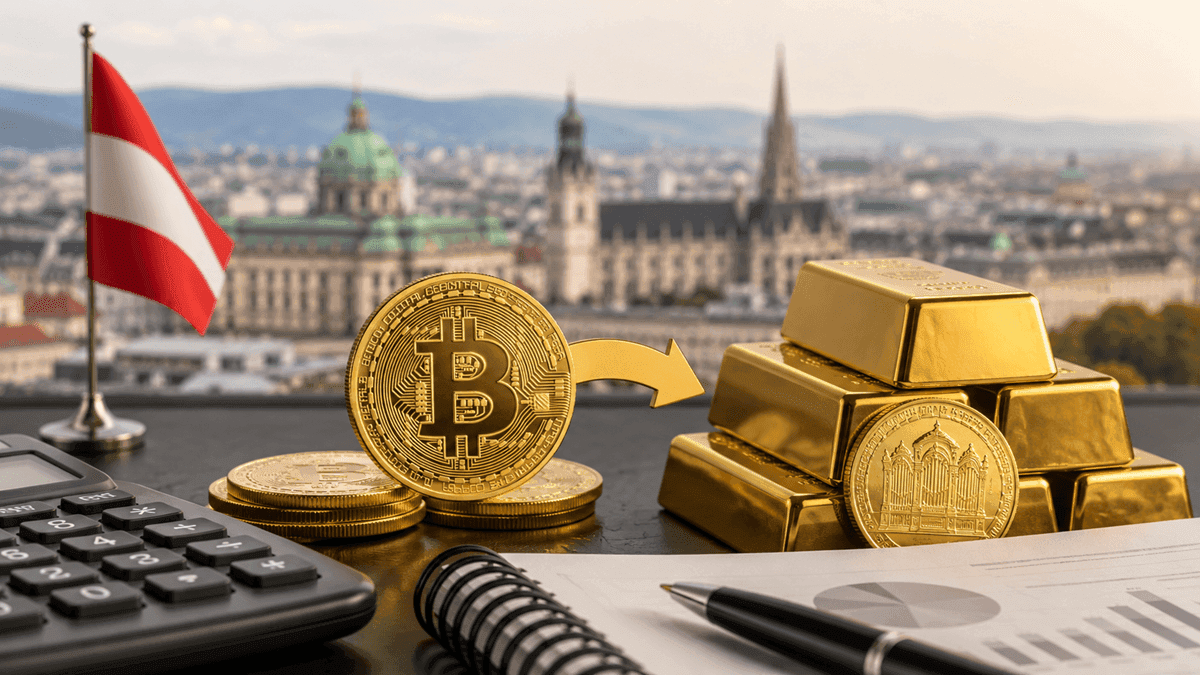
Bitcoin for gold: is the swap taxable in Austria?
Swapping bitcoin directly for gold? In Austria this can already trigger 27.5 percent tax on the capital gain. What investors should know.
June 23, 2024 2:57 PM
Bitcoin Price Crash: Who is Buying the Dip?
Bitcoin price crashed and fell below its psychological price of $70,000. Despite this price dip, some investors are still buying Bitcoin. Who are they?
November 11, 2024 7:25 PM
Bitcoin Price Prediction: BTC Price of $86,000 REACHED! What Next?
Bitcoin has shattered its previous record, skyrocketing past $86,000 and reigniting a buying frenzy among crypto investors.
June 7, 2026 11:00 AM
How to Buy Bitcoin with No KYC in 2026: 3 Ways to Do It
Protect your data and maintain privacy. Here are the three most secure ways to buy Bitcoin without identity verification (KYC) in 2026.
March 18, 2026 7:30 AM
Top 5 Cryptos to Buy in March 2026: Best Undervalued Altcoins
Bitcoin is 50% down from its ATH, creating a massive opportunity. Explore the top 5 cryptos to buy in March 2026 as the market prepares for a reversal.
March 31, 2025 10:57 AM
Top 3 Reasons Why NOW Is a Good Time to Buy Cryptos
Crypto prices have dropped over 20% in the past month, but smart investors see this as an opportunity. Here’s why now is the perfect time to buy cryptos before the next surge!
October 5, 2026 1:40 AM
Crypto at comdirect: 29 certificates with no order fee in a savings plan, but not a single coin
comdirect puts crypto into your securities account as a certificate, not as a coin. Our count of October 4, 2026 shows 29 securities from five issuers on 12 cryptocurrencies. On a one-off purchase the minimum fee of 9.90 euros amounts to 9.90 percent on 100 euros invested; in a savings plan the 1.5 percent is waived until the end of 2027.

September 22, 2026 4:12 PM

Nearly $1 Billion Into Bitcoin ETFs: What to Check on ETNs, Portfolio and Holding Period
US spot bitcoin ETFs took in a net $999 million on September 21, the third consecutive day of inflows. German investors cannot reach these funds: what ETNs, the holding period and your buying route mean for you.
September 15, 2024 5:01 PM
Top 3 Cryptocurrencies Under $1 To Turn A $1000 Crypto Investment Into $100,000 By 2025
Are you looking to turn a small investment into a fortune by 2025? This is your chance to turn a $1000 crypto investment now, to grow up to $100,000 potentially!
October 6, 2026 4:32 AM
Bitcoin for a gift card: what paying with crypto means for your holding period
Paying for a gift card with Bitcoin is a sale for tax purposes. What counts as the disposal proceeds, when the twelve-month holding period bites, and the four records the tax office expects.
September 25, 2026 10:26 PM
Selling bitcoin privately: the tax in Germany and the records you need
A direct sale to a private individual falls under the same one-year rule as an exchange sale, but there is no tax report to go with it. This guide walks through the calculation, the 1,000 euro threshold and the records the tax office wants to see.
September 22, 2026 1:12 PM
Buying Bitcoin With PayPal in Germany: What Really Works and What It Costs
PayPal runs no crypto service of its own in Germany, but it works as a deposit route at regulated exchanges. What the detour costs, which withdrawal hold follows it and why buyer protection does not apply here.

September 19, 2026 4:19 AM
Bitcoin Cash Jumps by Double Digits: What the Grayscale ETF Filing Really Means for You in Germany
Bitcoin Cash gained double digits on September 18 because Grayscale wants to convert its BCH trust into an exchange-traded product. The filing itself, however, states that the basis for it has not been approved at all.
February 11, 2025 1:00 PM
Altcoin News: Is Altcoin Season Finally Here? Here’s How to Capitalize on It
Altcoin season might be here as technical indicators are showing positive changes. What is alt season, how to prepare for it, what are the top altcoins to watch, and how to buy altcoins? Here's what you need to know.
December 5, 2024 11:00 PM
BGB Price Prediction: Bitget Token Price UP by more than 25%
Bitget is a top crypto exchange, with its native token BGB surging over 24% in the last 24 hours. Learn why Bitget stands out, what BGB offers, and how you can get started.
September 24, 2026 10:28 PM

Can Bitcoin Be Seized? What Creditors and Insolvency Administrators May Do with Crypto Assets
Crypto assets can be seized in Germany, and the Berlin Higher Regional Court has confirmed it at appellate level. What matters is the route of access: if the coins sit with a provider, an attachment order suffices; with self-custody the law reaches for the debtor in person.
September 27, 2026 4:12 AM
Bitcoin ETF Inflows Turn 2026 Positive: How to Tell If the Demand Holds
US spot Bitcoin ETFs took in roughly $2.4 billion in the week to September 25, the strongest week since October 2025, and that turns the 2026 year-to-date balance positive. Why the daily inflow fell 87 percent within the same week, and what to check on buying route, holding period and custody.
September 22, 2026 1:27 AM
Bitcoin ATM in Germany: Fees, BaFin Authorisation and Tax
Bitcoin ATMs stand in kiosks and shopping arcades, and buying there costs a multiple of the online route. What BaFin demands of the operator, at what amount your ID becomes due, and how you evidence the purchase for tax.
More from CryptoTicker