
Bitcoin ETF Outflows Top $3.4 Billion in November as BlackRock's IBIT Posts Record Withdrawal
US spot bitcoin ETFs recorded more than $3.4 billion in net outflows in November, and BlackRock's IBIT suffered its largest one-day withdrawal. With Friday's provisional figure, November would be the second-worst month since 2024. The numbers, the causes and how this compares with earlier waves.


Which topics should we dive deeper into?
Select what genuinely interests you. Your picks feed directly into our editorial planning.
Crypto news that's actually worth your time.
Weekly. 60 seconds. Carefully curated by our editors: no hype, no promo flood, no spam.
US spot bitcoin ETFs recorded more than $3.4 billion in net outflows in November: $3.47 billion through Thursday, November 19, according to data from Farside Investors. BlackRock's IBIT, the largest fund, lost $541.1 million that Thursday, its biggest one-day withdrawal since launch. Outflows came on 13 of 15 trading days. For Friday, November 20, Farside shows outflows of $124.5 million, a provisional figure published on Saturday at 12:20 UTC without BlackRock's IBIT. Including that provisional figure, the month's total reaches $3.59 billion, more than in February 2025 ($3.56 billion), which would make November the second-worst month since the funds launched in January 2024, behind June 2026 ($4.51 billion). The final ranking depends on IBIT's figure for Friday.
The withdrawals coincide with bitcoin's slide below $60,000 on Friday for the first time since July, as our report on bitcoin below $60,000 shows.
Bitcoin ETF outflows: the November numbers
| Session | All ETFs | of which IBIT (BlackRock) |
|---|---|---|
| Nov. 13, 2026 | −185.4 $m | −143.5 $m |
| Nov. 16, 2026 | 7.9 $m | 76.5 $m |
| Nov. 17, 2026 | −239.9 $m | −209.5 $m |
| Nov. 18, 2026 | −306.5 $m | −148.7 $m |
| Nov. 19, 2026 | −582.3 $m | −541.1 $m |
| Nov. 20, 2026 (provisional) | −124.5 $m | not published |
| November through Nov. 19 (final) | −3,467.8 $m | |
| November through Nov. 20 (provisional) | −3,592.3 $m | −2,940.7 $m (excluding Nov. 20) |
| June 2026 (record) | −4,509.7 $m | |
| February 2025 | −3,560.4 $m | |
| November 2025 | −3,466.7 $m | |
| Cumulative since January 2024 | +53,456 $m | +63,370 $m |
Net flows in millions of dollars. Source: Farside Investors, read on Nov. 21, 2026; monthly totals: own calculation from daily totals.
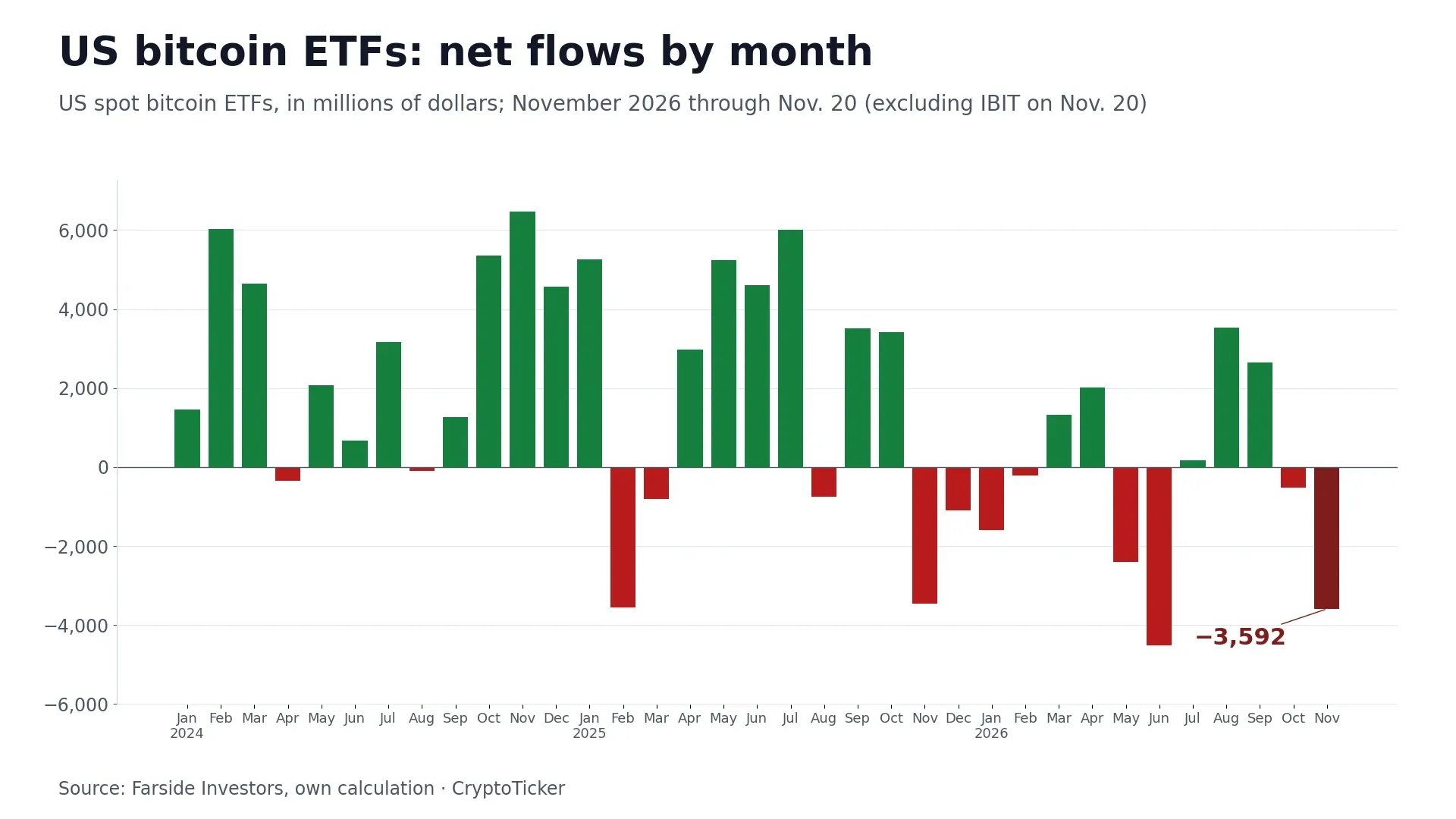
Despite the outflows, the overall balance remains clearly positive: since January 2024, the ETFs have attracted about $53.46 billion in net inflows. According to The Block, citing SoSoValue, they held $76.6 billion in assets on Thursday, equal to 6.1% of bitcoin's market value.
Why investors are pulling money out
The outflows follow the sell-off in technology stocks. On Friday, the Nasdaq fell 5.3% and wiped out its entire 2026 gain, as our report on the AI bubble shows. Bitcoin is trading like a tech stock rather than a safe haven: gold also fell more than 4%, a sign that investors above all need cash.
Rates add to the pressure. Markets expect the Federal Reserve to raise rates by a quarter point at its meeting on December 8 and 9, and UBS expects two hikes, in December and March. Higher rates make non-yielding assets such as bitcoin less attractive. Not every issuer is losing money, though: according to The Block, Morgan Stanley's MSBT took in $49.6 million on November 19, and Hong Kong's bitcoin ETFs have seen small inflows since the start of November.

Earlier waves of outflows
Bitcoin ETFs have been through several months of heavy withdrawals before. In February 2025 they lost $3.56 billion, in November 2025 $3.47 billion and in June 2026 $4.51 billion, the record so far. After February 2025, flows turned positive again in April; after November 2025, it took until March 2026; after June 2026, July was slightly positive and August brought $3.54 billion in inflows, according to Farside data. These episodes say nothing about what comes next, but they show that heavy outflows have not so far marked the end of investor interest.
What analysts say
In a note on Friday, UBS said the risk-reward in equities had become more balanced, while remaining cautious about rates. David Kelly, chief global strategist at JPMorgan Asset Management, told CNN he expects the correction to pass within a week or two, like a mild cold. Others see more risk: James Reilly of Capital Economics expects stocks to fall further, according to the CNBC live blog.


What comes next
- IBIT figure: Farside has yet to publish the flow of BlackRock's fund for Friday; it will complete the November tally.
- Federal Reserve: the next rate decision is due on December 9.
- Next week: ETF flows from Monday to Wednesday come ahead of the Thanksgiving holiday, with a shortened session on Friday, November 27.
- Weekend: ETFs do not trade, bitcoin does; the moves minute by minute are in our Bitcoin crash live blog.
Trading the crash: long and short
If you want to trade the move, you can bet on rising prices (long) or falling prices (short). Leverage multiplies every price change in both directions: at 10x, a 10 percent move changes the position by 100 percent; at 100x, about 1 percent is enough for liquidation. A stop-loss and a small position size limit the risk. The basics are explained in our guide to long and short positions.
- Bitget: futures with long and short, plus copy trading.
- OKX: spot and futures with long and short.
- Kraken: spot trading and futures, in the market since 2011.
- XTB: CFDs on crypto, long and short, quick account opening. 78% of retail investor accounts lose money when trading CFDs with this provider.
Risk warning: trading with leverage can lead to the loss of your entire stake. This section explains options and is not investment advice. These are partner links; if you open an account through them, cryptoticker.io earns a commission at no cost to you.
More providers with fees and regulation are listed in our crypto exchange comparison and our crypto broker comparison.
Partner links: some links on this page are partner links. If you become a customer through one of them, we may earn a commission at no extra cost to you. Selection, ratings and ranking are decided independently by our editorial team. Ethics and Independence · Ownership and Funding
Researched and compiled with AI. Before an article goes live, automated systems check the source links and hold back quotes and attributions without a verified source. Responsible editor: Dennis Weidner. The feature image was generated with AI. How we use AI
For later? Save this article and find it again in your profile.
More on Bitcoin: All Bitcoin news at a glance
Related articles
- Bitcoin breaks its $57,700 summer low as a record $950 billion of capital sits at a loss
- Bitcoin price slides to $61,400, its lowest level since July
- Bitcoin just under $65,000 before Waller speaks: markets now bet on a December hike
- Bitcoin price holds $64,800 before Warsh speaks: the level that decides is $61,946
- Bitcoin week ahead: the key dates from November 16 to 22
Which topics should we dive deeper into?
Select what genuinely interests you. Your picks feed directly into our editorial planning.
Crypto news that's actually worth your time.
Weekly. 60 seconds. Carefully curated by our editors: no hype, no promo flood, no spam.

November 15, 2026 3:44 AM

Crypto news, November 13: bitcoin down 6 percent, more than $1.3 billion liquidated
Bitcoin lost just over 6 percent overnight into Friday and is trading below $70,000, with more than $1.3 billion in leveraged positions wiped out. The morning's crypto news and its drivers: liquidations, ETF outflows, the dollar and thin order books.

November 15, 2026 1:17 AM

Fed hike bets and $1.07 billion in ETF outflows: why bitcoin keeps falling
Bitcoin has dropped to $63,500 as markets price in a Fed rate hike, US bitcoin ETFs bleed cash and the stablecoin supply shrinks. Each cause is set out with its source, along with the price levels that will decide what happens next.
November 14, 2026 5:21 PM

Bitcoin price breaks below the 200-week line: how low can BTC go?
Bitcoin falls below the 200-week line at around $67,755 on Saturday and hits $65,020, its lowest intraday level since August 19. Liquidations of more than $1.2 billion, ETF outflows and a Fear and Greed Index reading of 13 set the tone.
November 14, 2026 11:15 AM

Bitcoin price prediction: IBIT logs outflows for an 11th straight session
US spot bitcoin ETFs lost money on Friday for the seventh session in a row, and BlackRock's IBIT for the eleventh. Bitcoin is holding at around $67,200, with sentiment stuck in extreme fear.
November 13, 2026 8:06 AM

Why Is Crypto Crashing? The 3 Reasons Behind This Brutal Sell-Off
Crypto is bleeding red and billions in leveraged bets just got wiped out. Here are the 3 forces behind the crash and where prices stand right now.
November 13, 2026 5:15 AM

Bitcoin price falls below $70,000 as $1.3 billion in leveraged bets are wiped out
Bitcoin dropped below $70,000 overnight into Friday for the first time since August, and more than $1.3 billion in leveraged positions were liquidated within 24 hours. The price levels, the triggers and what investors should consider on leverage, custody and record-keeping.
November 12, 2026 5:42 PM

Bitcoin price falls below $72,000: the reasons behind the drop
Bitcoin fell below $72,000 and its 200-day moving average on Thursday, its lowest level since August 20. The Nvidia CEO's resignation, MSCI's removal of Strategy, ETF outflows and rate worries all hit on the same day.
November 12, 2026 5:19 AM

Bitcoin price at $73,700: what to watch after eight days of IBIT outflows
Outflows from US bitcoin ETFs have shrunk to $95 million, but BlackRock's IBIT is losing money for an eighth straight trading day. On Friday, US producer prices follow as the next inflation test before the Fed meeting in December.
November 11, 2026 5:13 AM

Bitcoin price at $73,700: outflows from BlackRock's IBIT show no sign of stopping
Analysis: Bitcoin trades at around $73,700 on Wednesday morning, just above its 200-day moving average. BlackRock's bitcoin fund IBIT has lost money for seven trading days in a row, $1.66 billion in total, while equities rallied.
November 10, 2026 9:24 PM

Bitcoin price prediction: lowest level since August, will the $72,000 zone hold?
Analysis: bitcoin falls to its lowest level since August 20 after the US inflation data and tests the 200-day average at $73,150. What ETF outflows, the options market and the Fed mean for the zone between $72,000 and $75,000.
November 10, 2026 5:21 AM

Bitcoin price at $74,600: what matters in the US consumer price data
Analysis: bitcoin starts Tuesday at around $74,600 after the 200-day average held on Monday. US consumer prices for October are due at 2:30 pm CET, without an official annual rate because of the 2025 shutdown, and the market is pricing in a December rate hike.
November 9, 2026 5:13 AM

Bitcoin price holds $74,800 as the 200-day average at $73,170 faces US inflation data
Analysis: Bitcoin starts the week at around $74,800 after briefly dropping to $73,477 on Sunday evening, its lowest level since August 21. The 200-day moving average sits just below, and US inflation data is due on Tuesday.

November 8, 2026 6:06 AM

Crypto News This Week: What Happened Since November 1 and the Key Dates for November 9 to 15
Midterms, bitcoin above $80,000 and back below $76,000, a hot jobs report and $1.28 billion in ETF outflows: what happened in crypto since November 1, where prices stand, which dates matter through November 15 and what the new Congress means for crypto rules.
November 8, 2026 5:12 AM

Five Losing Weeks in a Row Loom as Bitcoin Price Sits at $75,800
Analysis: Bitcoin trades at $75,800 and looks set to close its fifth straight losing week tonight. Since 2017 that has happened only twice, and the market went lower once and higher once afterwards.
November 7, 2026 10:59 PM

Will Bitcoin Go Back Up? Three Scenarios to Year-End: $70,000, $80,000 or $100,000
Bitcoin (BTC) is 40% below its record, ETFs are bleeding cash and the Fed may hike. What happened since early November, which levels decide between $70,000, $80,000 and $100,000, and what price history says about the 53 days to New Year's Eve.
November 7, 2026 9:46 AM

Crypto Crash: Why Bitcoin, Ethereum, XRP and Solana Fell This Week and What Comes Next
Bitcoin lost its post-election gains, ETH hit a 10-week low and XRP led the losses. The four drivers behind this week's crypto crash and the levels to watch.
November 6, 2026 9:19 PM

Bitcoin price prediction: $430 million outflow pushes the 2026 ETF balance below zero
Analysis: US bitcoin ETFs lost $869.8 million in four trading days, and the balance for 2026 is back below zero. What the outflows reveal about the price at $75,800, which levels count until the end of November and what investors in Germany can make of it.
November 4, 2026 8:36 PM

Bitcoin Price Jumps Above $80,000: Why the Market Rose After the Midterms
Bitcoin (BTC) jumped above $80,000 although Trump and the Republicans clearly lost the midterms. Oil, Wall Street and $378 million in short liquidations explain the move. Which levels count now and what could tip the picture.
November 4, 2026 7:42 AM

Bitcoin ETF Outflows Pass $1 Billion: Why Institutions Are Selling After the Midterms
Spot Bitcoin ETFs bled over $1 billion in three sessions as the Binance hack and the midterms spooked institutions. Where does BTC go next?
November 2, 2026 5:33 PM

Bitcoin ETFs Lost $643 Million in One Day: Most of 2026’s Gains Gone
US spot Bitcoin ETFs saw their biggest outflow since June on Friday, wiping out most of this year’s net inflows. Why it happened and what it means for the BTC price.
November 2, 2026 6:26 AM
Bitcoin price at $78,443: BlackRock vs Fidelity in October's ETF tally
Analysis: US spot bitcoin ETFs ended October with net outflows of $515.0 million, even though the month was still in positive territory before its final trading day. Behind the total lies a rotation between providers, and for German investors it raises a tax question.
October 26, 2026 7:36 AM

Bitcoin Price Crash: Top 3 Reasons Why BTC Price Dropped Below $80,000
Bitcoin price crashed below $80,000 over the weekend. Oil, ETF outflows and a wave of liquidations explain the move, and the Fed decides this week.
October 23, 2026 10:15 AM

IBIT takes in $665 million in a day while Bitcoin stays below $82,000
BlackRock's Bitcoin ETF IBIT took in a net $665.16 million on October 19, 2026, its largest daily inflow in a year. Bitcoin still trades at $81,421, below the range the money flowed into.
October 20, 2026 7:21 PM

BlackRock files a Bitcoin ETF with a 10 percent loss buffer: who is allowed to buy PBIT?
BlackRock registered a Bitcoin fund on October 19 that is meant to cushion the first 10 percent or so of a loss and caps the gain in return. PBIT stays out of reach for retail investors in Germany, and the reason has nothing to do with bitcoin.
October 10, 2026 1:19 PM

Crypto ETF Outflows Pass $1 Billion in October: Is Wall Street Dumping Bitcoin and Ethereum?
Bitcoin and Ethereum ETFs just bled over $1 billion in October. Here is who is selling, who is still buying, and what it means for your coins.
October 8, 2026 1:26 PM

Bitcoin ETFs Lose $487 Million in a Single Day: the Reasons Behind the Outflow
Around $487 million flowed out of the US spot ETFs on Bitcoin on net on October 7, 2026, while the price tests the zone around $82,000. What the figure actually measures, why two data providers give two daily values, and what investors in Germany should check on an ETP.

More from CryptoTicker