
Bitcoin price prediction: IBIT logs outflows for an 11th straight session
US spot bitcoin ETFs lost money on Friday for the seventh session in a row, and BlackRock's IBIT for the eleventh. Bitcoin is holding at around $67,200, with sentiment stuck in extreme fear.


Which topics should we dive deeper into?
Select what genuinely interests you. Your picks feed directly into our editorial planning.
Crypto news that's actually worth your time.
Weekly. 60 seconds. Carefully curated by our editors: no hype, no promo flood, no spam.
US spot bitcoin ETFs lost money for the seventh session in a row on Friday, November 13: net outflows of $185.4 million, according to data from Farside Investors. That is less than on the two previous days, but the direction has not changed. The bitcoin price stood at around $67,200 on Saturday morning at about 10:50, according to CoinGecko, roughly €61,100. For the bitcoin price prediction over the coming days, one question is central: will redemptions at the big funds stop, or will issuers keep selling bitcoin into the market week after week?
The short answer: as long as the outflows continue, the market lacks the biggest buyer of the past two years. If the streak breaks, it would be the first good news since early November. The next flow data will only arrive after the weekend, because US funds do not trade on Saturdays and Sundays.
Bitcoin price on Saturday: $67,200 and a Fear and Greed Index of 13
Bitcoin has steadied slightly after the overnight slide, but there is no sign of a recovery. Over the past 24 hours the range ran from around $66,500 to $70,000, according to CoinGecko. Over seven days the cryptocurrency is down almost 12 percent, over 30 days nearly 18 percent. That leaves it around 47 percent below its record high of $126,080, reached on October 6, 2025.
Sentiment matches the numbers. The alternative.me Fear and Greed Index stood at 13 points on Saturday, after 20 on Friday and 28 on Thursday. The index is a sentiment gauge that condenses volatility, trading volume, bitcoin's market share and other factors into a value between 0 and 100. Readings below 25 count as extreme fear. It is not a buy-signal machine: it describes how the market feels, not where it goes next.
Bitcoin ETF outflows: $185.4 million on Friday, seven days in a row
A spot bitcoin ETF is an exchange-traded fund that buys and holds actual bitcoin. When new investors come in, the issuer has to buy more bitcoin. When investors redeem their shares, it sells bitcoin or hands it over to trading partners. That is why daily net flows are seen as one of the most important indicators of demand from the US.
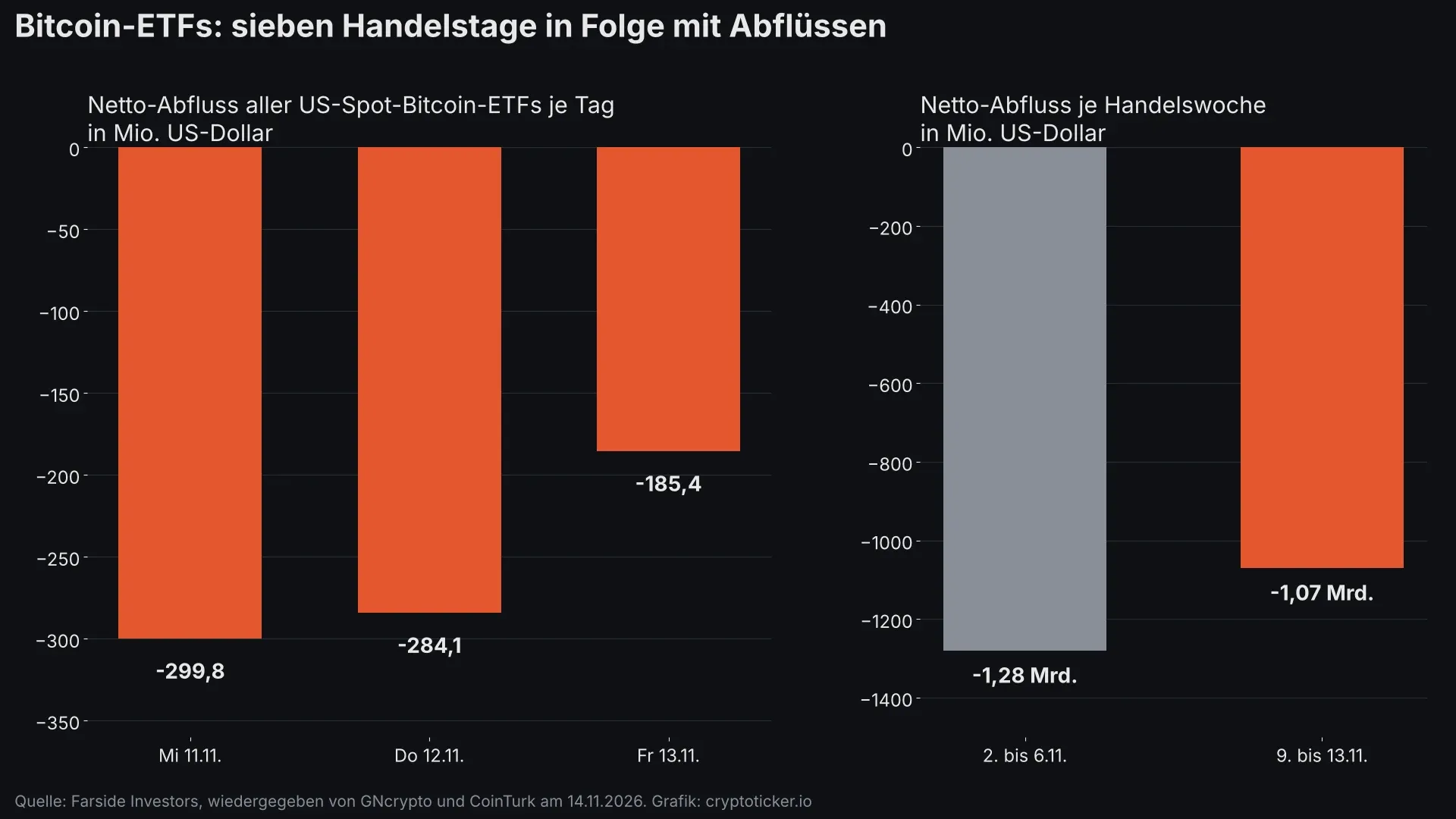
This week's figures show how stubborn the selling is. According to Farside data, compiled among others by GNcrypto on Saturday, the funds lost $299.8 million on Wednesday, $284.1 million on Thursday and $185.4 million on Friday. From Monday, November 9, to Friday, redemptions added up to around $1.07 billion. The week before had already seen about $1.28 billion. Together that is roughly $2.35 billion pulled from US spot bitcoin ETFs in two weeks.
Since November 5 there has not been a single trading day with net inflows. Over these seven sessions, outflows total around $1.71 billion. According to GNcrypto, the week to November 13 was the largest weekly outflow since the end of June.
IBIT outflow streak: BlackRock's fund accounts for about 90 percent of November redemptions
BlackRock's iShares Bitcoin Trust, traded under the ticker IBIT, is by far the largest bitcoin ETF. It recorded outflows of $143.5 million on Friday, its eleventh straight session of net redemptions. The Fidelity Wise Origin Bitcoin Fund (FBTC) accounted for $41.9 million on the same day. Between them, the two funds explain almost all of Friday's outflow.
In November, IBIT has lost around $2.12 billion according to the compiled Farside data, about $1.21 billion in the first week of the month and around $908 million in the second. That is roughly 90 percent of all net redemptions across US spot bitcoin ETFs this month. The selling is therefore concentrated in the fund through which large asset managers and pension funds typically invest.
Anyone weighing the outflows should keep two things apart. First, the funds do not publish the reasons for individual redemptions. Market observers cite profit-taking, risk reduction and interest rates, but none of that is proven in any single case. Second, the outflows are shrinking day by day. $299.8 million, then $284.1 million, then $185.4 million is a streak losing force, not one that is accelerating.
 Buy bitcoin for less: exchanges compared on fees
Why ETF redemptions weigh on the bitcoin price
An ETF outflow is more than a sentiment signal; it has a direct effect on supply. When an institutional investor redeems IBIT shares, a so-called authorized participant, an approved trading partner of the fund, cancels the shares. In return, the fund delivers or sells bitcoin. Some of those coins end up on the open market, where sellers already outnumber buyers.
For long stretches of 2024 and 2025 this mechanism ran the other way: inflows forced issuers to buy and supported the price. If that buyer disappears, or even turns seller, another group has to fill the gap. That could be retail investors, companies with bitcoin on their balance sheets or traders betting on a rebound. So far their demand is evidently not enough.
Bitcoin price prediction: two scenarios that hinge on ETF flows
At the weekend, a serious bitcoin price prediction can only speak in conditions, not in dated price targets. Based on the available figures, two paths are emerging. Both are assessments by the editorial team, not forecasts.
Stabilisation scenario: the outflow streak breaks
If Farside reports a day of net inflows again on Monday or Tuesday, the run of seven negative days would be over. One argument for this is that daily outflows have fallen by almost 40 percent since Wednesday. A single day of inflows would not reverse the trend on its own, but it would show that large buyers are stepping back in at prices around $67,000. In that case the $70,000 mark comes into view as the first hurdle.
Continuation scenario: IBIT keeps losing money
If outflows from IBIT persist and the bitcoin price drops below the 24-hour low of around $66,500, last night's support is gone. With the Fear and Greed Index at extreme fear, such moves can be amplified by liquidations of leveraged positions. A liquidation is the forced sale of a position funded with borrowed money once the posted collateral no longer covers it.
Bitcoin levels: $66,500 below, $70,000 above
For the coming days, the data point to two zones that traders are watching. The first is the low of the past 24 hours at around $66,500, where the price turned overnight into Saturday. The second is $70,000, the high of the same range and a round number that attracts many sell orders.
The gap between the two levels is just over 5 percent. For bitcoin in a phase of fear, that is narrow. A breakout in either direction is therefore possible at any time, especially at the weekend, when trading volumes are thinner and US funds are idle. If you use stop orders, factor in that lower liquidity: a stop just below a closely watched level is triggered more easily in thin markets.
If you want to buy bitcoin directly in this situation or sell part of a position, you need an exchange with tight spreads and fast withdrawals. Our comparison of the best crypto exchanges gives an overview of fees and licensing.


Bitcoin ETFs in Europe: retail investors turn to ETNs and crypto exchanges
Retail investors in the EU generally cannot buy US spot ETFs such as IBIT or FBTC directly. The funds lack the key information document required under EU law, which is why most European brokers do not offer them. Anyone who wants bitcoin exposure through a brokerage account turns instead to exchange-traded products from Europe, usually ETNs or ETPs. An ETN is a debt security whose value is linked to the bitcoin price; many of these products are backed by actual coins.
Which products are available, what they cost and how they differ is covered in our guide to buying crypto ETFs. If you would rather hold bitcoin next to shares in the same account, look at the order fee per trade when choosing a broker and check whether the product is physically backed by bitcoin.
One point matters for reading the US figures: flows at the American funds move the global market price, and therefore the price at which you buy or sell in Europe as well. Whether you invest via a crypto exchange or an ETN makes no difference to that. What differs is cost, custody and tax.
Leverage, taxes and custody when bitcoin sells off
In a falling market gripped by extreme fear, three points decide the outcome more than picking the right day to buy.
Leverage: futures and other leveraged products multiply gains and losses. With 10x leverage, a move of around 10 percent against the position is enough to wipe out the collateral. Bitcoin has lost almost 12 percent over the past seven days. If you trade, work out the liquidation price before opening a position and only commit an amount whose total loss you can bear.
Taxes: how gains and losses on bitcoin are taxed depends on the country you live in, and the rules for coins held directly often differ from those for ETNs in a brokerage account. Tax tools make it easier to keep track of purchase dates and costs.
Custody: if you buy on a platform, check whether it holds a licence under the EU's Markets in Crypto-Assets Regulation, MiCA. In periods of high volatility, exchanges occasionally delay withdrawals, so larger holdings are safer in a wallet of your own.
Bitcoin ETF flows: the next figure lands overnight into Tuesday
US funds are idle at the weekend, so the bitcoin price is moving without its largest institutional buyer. Flow data for Monday, November 16, will be available after the US market close, which in Europe means overnight into Tuesday. Until then, the levels at $66,500 and $70,000 set the frame. If you want to trade, take these three steps:
- Sort out access: you can invest in bitcoin directly through an exchange with a MiCA licence. Our comparison of regulated crypto exchanges shows the options.
- Limit leverage: if you use derivatives to bet on the next move, compare the fees, funding and liquidation rules of the venues. Our comparison of the best perp DEXs provides an overview.
- Record your purchases: note the purchase date and price of each tranche so you can document them later for your tax return. Crypto tax software and portfolio trackers help with this.
(As of November 14, 2026. This article is not investment advice. Prices and fee structures change; check the terms with the provider before you buy.)
Frequently asked questions about bitcoin ETF outflows
Partner links: some links on this page are partner links. If you become a customer through one of them, we may earn a commission at no extra cost to you. Selection, ratings and ranking are decided independently by our editorial team. Ethics and Independence · Ownership and Funding
Transparency note: This article was produced with the assistance of artificial intelligence and reviewed by our editorial team before publication. All figures and claims were checked against the primary sources linked in the text. The feature image was generated with AI.
For later? Save this article and find it again in your profile.
More on Bitcoin: All Bitcoin news at a glance
Related articles
- Solana price prediction: 15 percent below the 200-day line, can Breakpoint help?
- Ethereum price prediction: Lighthouse flags a Glamsterdam bug as ETH falls below $1,900
- Ethereum price prediction: Foundation wallet sells for a fourth time, ETF outflows 87 times larger
- Ethereum Price Crashes Below $2,000: How Low Can ETH Go?
- Why Is Crypto Crashing? The 3 Reasons Behind This Brutal Sell-Off
Which topics should we dive deeper into?
Select what genuinely interests you. Your picks feed directly into our editorial planning.
Crypto news that's actually worth your time.
Weekly. 60 seconds. Carefully curated by our editors: no hype, no promo flood, no spam.

November 13, 2026 7:46 AM

Crypto news, November 13: bitcoin down 6%, over $1.3 billion liquidated
Bitcoin lost a little over 6% overnight and trades below $70,000, with more than $1.3 billion in leveraged positions wiped out. This morning's crypto news with the drivers: liquidations, ETF outflows, the dollar and thin order books.

November 13, 2026 5:21 AM

XRP price prediction: can record whale wallets offset $18 million in ETF outflows?
Analysis: XRP briefly fell below $1 overnight into Friday. Santiment counts more large wallets than ever, while US ETFs lost $18 million over two days.

November 13, 2026 5:15 AM

Bitcoin price falls below $70,000 as $1.3 billion in leveraged bets are wiped out
Bitcoin dropped below $70,000 overnight into Friday for the first time since August, and more than $1.3 billion in leveraged positions were liquidated within 24 hours. The price levels, the triggers and what investors should consider on leverage, custody and record-keeping.
November 12, 2026 7:25 PM

Ethereum price prediction: Huang's exit pushes ETH below $2,000 as ETF outflows hit day five
Analysis: The surprise resignation of Nvidia CEO Jensen Huang also hit ether on Thursday, with ETH falling as low as $1,983. On top of that came $144.8 million in ETF outflows on the fifth day in a row; which levels count now and what investors can do.
November 12, 2026 5:42 PM

Bitcoin price falls below $72,000: the reasons behind the drop
Bitcoin fell below $72,000 and its 200-day moving average on Thursday, its lowest level since August 20. The Nvidia CEO's resignation, MSCI's removal of Strategy, ETF outflows and rate worries all hit on the same day.
November 12, 2026 5:19 AM

Bitcoin price at $73,700: what to watch after eight days of IBIT outflows
Outflows from US bitcoin ETFs have shrunk to $95 million, but BlackRock's IBIT is losing money for an eighth straight trading day. On Friday, US producer prices follow as the next inflation test before the Fed meeting in December.
November 11, 2026 7:24 PM

Ethereum price prediction: can buyers hold $2,000 as ETF outflows shrink 99 percent?
Analysis: outflows from US ether ETFs shrank to $1.32 million on November 10, after $184.5 million the day before. Why ether is still stuck around the $2,000 zone and what role Friday's producer prices play.
November 11, 2026 5:13 AM

Bitcoin price at $73,700: outflows from BlackRock's IBIT show no sign of stopping
Analysis: Bitcoin trades at around $73,700 on Wednesday morning, just above its 200-day moving average. BlackRock's bitcoin fund IBIT has lost money for seven trading days in a row, $1.66 billion in total, while equities rallied.
November 10, 2026 9:24 PM

Bitcoin price prediction: lowest level since August, will the $72,000 zone hold?
Analysis: bitcoin falls to its lowest level since August 20 after the US inflation data and tests the 200-day average at $73,150. What ETF outflows, the options market and the Fed mean for the zone between $72,000 and $75,000.

November 10, 2026 3:21 PM

Ethereum price prediction: Buterin bets on store of value as Bitmine adds 9,587 ETH
Analysis: Vitalik Buterin wants Ether valued as a store of value rather than a fee-burning token, and Bitmine now holds 4.97 percent of all ETH. Why the price still sits below the 200-day moving average at $2,154 and which levels matter until Friday's expiry.
November 10, 2026 5:21 AM

Bitcoin price at $74,600: what matters in the US consumer price data
Analysis: bitcoin starts Tuesday at around $74,600 after the 200-day average held on Monday. US consumer prices for October are due at 2:30 pm CET, without an official annual rate because of the 2025 shutdown, and the market is pricing in a December rate hike.
November 9, 2026 5:13 AM

Bitcoin price holds $74,800 as the 200-day average at $73,170 faces US inflation data
Analysis: Bitcoin starts the week at around $74,800 after briefly dropping to $73,477 on Sunday evening, its lowest level since August 21. The 200-day moving average sits just below, and US inflation data is due on Tuesday.
November 8, 2026 5:12 AM

Five Losing Weeks in a Row Loom as Bitcoin Price Sits at $75,800
Analysis: Bitcoin trades at $75,800 and looks set to close its fifth straight losing week tonight. Since 2017 that has happened only twice, and the market went lower once and higher once afterwards.
November 7, 2026 10:59 PM

Will Bitcoin Go Back Up? Three Scenarios to Year-End: $70,000, $80,000 or $100,000
Bitcoin (BTC) is 40% below its record, ETFs are bleeding cash and the Fed may hike. What happened since early November, which levels decide between $70,000, $80,000 and $100,000, and what price history says about the 53 days to New Year's Eve.
November 7, 2026 9:46 AM

Crypto Crash: Why Bitcoin, Ethereum, XRP and Solana Fell This Week and What Comes Next
Bitcoin lost its post-election gains, ETH hit a 10-week low and XRP led the losses. The four drivers behind this week's crypto crash and the levels to watch.
November 6, 2026 9:19 PM

Bitcoin price prediction: $430 million outflow pushes the 2026 ETF balance below zero
Analysis: US bitcoin ETFs lost $869.8 million in four trading days, and the balance for 2026 is back below zero. What the outflows reveal about the price at $75,800, which levels count until the end of November and what investors in Germany can make of it.
November 6, 2026 3:25 PM

Solana Price Prediction: Only $1.2 Million in ETF Outflows, Even Though Holders Are Under Water
Analysis: Solana fell 6.5 percent on Thursday, yet only $1.18 million left the US spot ETFs. Investors have paid in $1.467 billion since launch, while the funds' holdings are now worth $1.333 billion.
November 4, 2026 8:36 PM

Bitcoin Price Jumps Above $80,000: Why the Market Rose After the Midterms
Bitcoin (BTC) jumped above $80,000 although Trump and the Republicans clearly lost the midterms. Oil, Wall Street and $378 million in short liquidations explain the move. Which levels count now and what could tip the picture.
November 4, 2026 7:23 PM

Ether ETF buyers sit at an average of $3,200: the Ethereum price levels that count until then
Analysis: According to an estimate by Bloomberg Intelligence, buyers of the US Ether ETFs paid just under $3,200 on average, while Ether trades at $2,425 after the election jump. We recalculate the funds' paper loss, put the outflows in context and show which levels count on the way to the cost basis.
November 4, 2026 7:42 AM

Bitcoin ETF Outflows Pass $1 Billion: Why Institutions Are Selling After the Midterms
Spot Bitcoin ETFs bled over $1 billion in three sessions as the Binance hack and the midterms spooked institutions. Where does BTC go next?
November 3, 2026 7:20 AM

Ethereum price prediction: BlackRock fund sheds 580,145 ETH, and BitMine absorbs only a fraction
Analysis: BlackRock's ETHA fund has shed 580,145 ETH in a month, and US ether ETFs have been losing money for six trading days. We work out how much of it is genuine outflow, why BitMine is not offsetting it and which levels the price now hinges on.
November 2, 2026 5:33 PM

Bitcoin ETFs Lost $643 Million in One Day: Most of 2026’s Gains Gone
US spot Bitcoin ETFs saw their biggest outflow since June on Friday, wiping out most of this year’s net inflows. Why it happened and what it means for the BTC price.
November 2, 2026 6:26 AM
Bitcoin price at $78,443: BlackRock vs Fidelity in October's ETF tally
Analysis: US spot bitcoin ETFs ended October with net outflows of $515.0 million, even though the month was still in positive territory before its final trading day. Behind the total lies a rotation between providers, and for German investors it raises a tax question.
October 26, 2026 7:36 AM

Bitcoin Price Crash: Top 3 Reasons Why BTC Price Dropped Below $80,000
Bitcoin price crashed below $80,000 over the weekend. Oil, ETF outflows and a wave of liquidations explain the move, and the Fed decides this week.
October 10, 2026 1:19 PM

Crypto ETF Outflows Pass $1 Billion in October: Is Wall Street Dumping Bitcoin and Ethereum?
Bitcoin and Ethereum ETFs just bled over $1 billion in October. Here is who is selling, who is still buying, and what it means for your coins.
October 9, 2026 4:16 PM

Bitcoin Price Prediction: Standard Chartered Sticks to $100,000 as ETFs Shed $729 Million in Two Days
Standard Chartered is holding to $100,000 by year-end, yet US spot ETFs lost $729 million on Wednesday and Thursday. Bitcoin stands at around $83,100. What would have to happen by December, and which levels count now.
October 3, 2026 10:16 AM

Bitcoin Price Prediction: ETFs Pull In $2.65 Billion in September While the Price Stalls
The US spot ETFs channelled $2.65 billion into Bitcoin in September, and October has opened with inflows as well. The price has nonetheless moved only between $83,500 and $86,600 for twelve days, so here is what the inflows mean and which levels now count.
More from CryptoTicker