
Trade Republic and Crypto: No Published Spread, No Tax Certificate and No Keys of Your Own
Around 50 cryptocurrencies, transferable to your own wallet since November 2025. But the spread appears in no public document, deposit protection does not apply, and every card payment made with crypto is a sale you have to declare yourself.





Which topics should we dive deeper into?
Select what genuinely interests you. Your picks feed directly into our editorial planning.
Crypto news that's actually worth your time.
Weekly. 60 seconds. Carefully curated by our editors: no hype, no promo flood, no spam.
The information provided in this article is for informational purposes only and does not constitute financial advice. Investing in cryptocurrencies carries a high level of risk.
Trade Republic is Germany’s largest neobroker, and since November 14, 2025 you can not only buy around 50 cryptocurrencies there but also send them to a wallet of your own and receive them from it. That is what the company’s press release of the same day says.
What it does not say is the price. Trade Republic publishes no spread for crypto trading, and the official price overview on the website lists exactly six priced lines, not one of which concerns cryptocurrencies. In the small print the company writes it itself: the full price list is available in the app.
This article is an analysis, not a news item. It rests on three documents that Trade Republic makes public: the customer agreement in version 07.08 as of July 2026, the crypto execution policy of the same date, and the depositor information sheet. Added to that is BaFin’s company database, queried on September 5, 2026. All sources are listed in full at the end.
What actually belongs to you in Trade Republic crypto
The good news first, because it is often misrepresented: at Trade Republic you buy real crypto-assets, not a certificate and not a debt security. The customer agreement expressly assigns the trading to the European crypto regulation MiCAR, specifically to the term “crypto-asset” under Article 3(1)(5).
The qualification follows two paragraphs later. Trade Republic holds all customers’ balances “in one digital omnibus account per supported crypto-asset”, and the crypto-assets of different customers are “not segregated from one another”. The company’s own holdings sit separately, but your balance sits with everyone else’s at the same address.
From that follows the point that matters most to many people: you get no keys. The crypto custody policy puts it verbatim: “Customers do not receive their own public or private keys.” An individual wallet address exists only on request and only for transfers. Self-custody is not provided for at Trade Republic.
Who holds the assets, and why the name is missing from the contract
Trade Republic’s crypto page states that the bulk of holdings sits in cold wallets with the partner BitGo Europe GmbH, a custodian licensed under MiCAR. The same statement appears in the press release of November 14, 2025.
In the 108-page customer agreement, by contrast, the name BitGo does not appear. What it refers to there, in general terms, is “MiCAR-regulated sub-custodians” to which Trade Republic may delegate custody. That is not a contradiction, but it is a distinction worth knowing: the custody partner is a marketing statement and a press statement, not a contractual commitment. It can change without anything in the contract changing.
BitGo Europe GmbH, based in Frankfurt, is indeed regulated. BaFin’s company database lists eleven permission entries for the company, among them the custody and administration of crypto-assets for customers since May 9, 2025 and qualified crypto custody business under the German Banking Act since December 30, 2024.
The authorisation: a banking licence instead of its own CASP licence
Here lies a subtlety that comparison tables almost always miss. Trade Republic Bank GmbH holds four MiCAR permissions in the BaFin database, all since April 24, 2025: custody, execution of orders, reception and transmission of orders, and transfer services.
Those permissions rest on Article 59(1)(b) of the regulation. Point (b) is the route for credit institutions, which may provide crypto services after a notification. Trade Republic therefore holds no standalone authorisation as a crypto-asset service provider; it uses the banking licence it already has. BitGo Europe, by contrast, sits under point (a), which is the standalone authorisation.
For you as an investor that changes little about supervision, since both are supervised by BaFin. For placing them in a provider comparison it is still relevant, because “MiCA-licensed” applies to both and means two different things.
What trading costs, and what Trade Republic does not disclose
The official price overview names the same six items for every asset class:
| Item | Price |
|---|---|
| Order commission | free |
| Settlement fee | 1.00 euro, 2.00 euros for direct pricing on an exchange |
| Execution of savings plans for shares, ETFs or crypto | free |
| Monthly card fee | free |
| Cash withdrawals worldwide | free, 1.00 euro below 100 euros |
| Dividends or corporate actions | free |
This overview is as of September 5, 2026, retrieved from the company’s support page.
An important note on how to read this table: it applies generally and names cryptocurrencies expressly only in the savings-plan line. Whether the 1.00 euro settlement fee also applies to individual crypto orders is nowhere confirmed by Trade Republic in crypto-specific terms. Several trade publications report it consistently, and it fits the logic of the table, but it is not a statement by the provider. The only thing established is that the execution of crypto savings plans is free, because that line names crypto by name.
A dedicated crypto line is missing, and no spread is quantified anywhere. That is not a research failure but demonstrably deliberate: in the full text of the customer agreement, running to 395,744 characters, the word “spread” appears zero times. Trade Republic itself writes in several places that “apart from the spread, no further costs are incurred”, yet names no figure and refers to the price overview and the app.
That is why this article carries no spread figure. Values between 0.5 and 3 percent circulate in the trade press, they contradict each other, and none of them is a published condition. The robust statement is this: the spread is the main cost block in crypto trading, and you see it only in the app before the order. Anyone who wants to compare before opening an account cannot do so for crypto.
What is established: custody itself is free. The customer agreement says Trade Republic charges “no fees for the provision of crypto custody services”. Staking likewise incurs no additional fees.
Transfers to your own wallet: free today, chargeable under the contract
Since November 14, 2025 you can send crypto-assets to external wallets and receive them from there. The website advertises that Trade Republic charges no transaction fees for this. You bear the network fee of the respective blockchain yourself, as you do with every provider.
The customer agreement, however, adds a second sentence: “Trade Republic is entitled to charge a fee for the execution of crypto transfers. The fees stated in the price list and/or in the application at the time the service is provided shall apply.”
Free today, chargeable at any time. This is not hidden small print but a standard clause. It still belongs in your calculation if you are planning on Trade Republic as a permanent route to self-custody.
Three further points from the transfer chapter that matter day to day: transfers are irreversible and, once accepted, can neither be amended nor revoked. Incoming amounts are rounded down from the sixth decimal place. And commercial use of the transfer function is expressly prohibited.
Deposit protection does not apply, yet you are not unprotected
This is often presented in shortened form, so here is the precise position. The depositor information sheet names the compensation scheme of German banks with 100,000 euros per depositor and a repayment period of seven working days. It expressly covers deposits. Crypto-assets do not appear in it, and they are not a deposit within the meaning of the German Deposit Guarantee Act.
Trade Republic draws this line one step earlier and writes of securities that the instruments in the custody account do not fall under deposit protection but are owned by the customer. For crypto-assets that applies all the more.
The protection is instead a matter of insolvency law. The customer agreement says: “In the event of insolvency, customers’ crypto-assets do not form part of Trade Republic’s insolvency estate. They will be transferred to a licensed crypto custodian in accordance with applicable law.” Customers may object and then bear, where applicable, the costs of separation and transfer. Added to that is liability for loss under Article 75(8) MiCAR, capped at the market value at the time of the liability event.
The right way to put it is therefore not “unprotected” but protected differently: no 100,000 euro deposit guarantee, but separation from the insolvency estate and a statutory liability.
Taxes on Trade Republic crypto: the broker expressly does nothing
This is the point that calls for the most action, and the evidence is unambiguous. The customer agreement contains a tax clause of its own in three different places.
On trading, Annex 7 Section A reads: “Trade Republic is not responsible for remitting taxes on the customer’s sale proceeds. The customer must obtain tax advice independently. Trade Republic will, however, provide the customer with overviews of trading in crypto-assets.”
On transfers, Section D: “Trade Republic is not responsible for remitting taxes in connection with the execution of crypto transfers.”
On staking, Section E: “Trade Republic is not responsible for remitting taxes in connection with crypto staking.”
Three things follow from that, with no room for interpretation. First, Trade Republic withholds no capital gains tax on crypto, unlike with shares and ETFs. Second, you receive no tax certificate covering crypto, but expressly only “overviews”. Third, the filing obligation lies entirely with you.
Anyone holding shares and crypto in the same account thus has two completely different tax worlds in one app: with the shares, everything is settled once you sell; with crypto, that is where the work begins.
The case almost nobody has on their radar: paying with crypto
Trade Republic offers the option of paying by card and covering the amount from your crypto holdings. The company writes about this itself: “The use of crypto constitutes a sale of the respective crypto amount and may have tax implications.”
Translated, that means: every coffee you pay for with crypto is a sale. And because Trade Republic remits nothing and issues no tax certificate, you have to document each one of these events yourself, with the acquisition date, the acquisition price and the sale price. With a handful of orders a year that is manageable. With a card used daily it quickly turns into a three-figure number of events.
If you want to use this feature, you need a transaction export and a tool that builds a statement from it, from day one. Which programs do that and what they cost is set out in the comparison of crypto tax tools.
Five clauses you should have read before your first order
These points all appear in the customer agreement. They are not unusual for the industry, but they are rarely quoted.
Dealing on own account. Trade Republic acts as a commission agent and may declare that it is dealing on its own account, becoming your counterparty itself, even where no official exchange or market price has been established. You also agree to execution outside trading platforms for crypto-assets.
No customer instructions. The crypto execution policy states that Trade Republic does not execute crypto orders according to specific instructions from its customers. So you cannot demand a particular execution venue.
Delisting at short notice. If a coin is delisted, you have to sell within a set period, and the contract expressly says this period may be “very short”. After that, Trade Republic may sell on your behalf and is not liable for losses arising from it.
Airdrops and forks without entitlement. If an allocation is “not reasonably possible” in Trade Republic’s discretion, you waive the claim. There is no duty to inform you about blockchain events.
Transfers can be suspended. Trade Republic may refuse or suspend a transfer if the origin of the funds, the identity, or the power of disposal over the target wallet is not evidenced.
Who Trade Republic crypto suits, and who it does not
It suits you if you want to hold shares, ETFs and crypto in one app, save small amounts and use savings-plan execution without execution costs. Entry is possible from 1 euro, and crypto savings plans are free to execute.
It suits you less if you want to know the price in advance, because the spread is not published. It also suits you less if self-custody is your goal: you have been able to send to a wallet of your own since November 2025, but inside Trade Republic you never hold your own keys at any point. And it suits you only with preparation if you trade a lot or pay with crypto, because all of the tax work sits with you.
How Trade Republic stands against other German providers is set out in the comparison of crypto brokers. If you place value on a standalone authorisation as a crypto-asset service provider, you will find those firms in the comparison of regulated crypto exchanges.
Trade Republic crypto: what you take away from this
Three concrete steps:
- Look at the spread in the app before you place your first order, and scale it up to the amount you plan to invest. It is the main cost block, and it appears in no public document. Compare the result with a provider that publishes its terms.
- Set up your tax documentation before you buy, not the following year. Trade Republic remits nothing on crypto and issues no tax certificate, only overviews. Export your transactions regularly.
- Make a deliberate decision about paying by card with crypto. Every single payment is a sale for tax purposes. If you use the feature, you need a tool that records the events automatically.
Frequently asked questions
Do the cryptocurrencies at Trade Republic really belong to me? Yes, these are real crypto-assets under MiCAR and not a derivative. They sit in an omnibus account together with other customers’ holdings, though, and you receive no keys of your own.
Can I withdraw crypto from Trade Republic to my own wallet? Yes, since November 14, 2025. Trade Republic currently charges no fee of its own for this; you bear the network fee. The contract reserves the right to charge a fee in future.
How high is the spread at Trade Republic for crypto? Trade Republic does not publish it. Neither the price overview nor the customer agreement nor the execution policy names a figure. It only becomes visible in the app before the order.
Does Trade Republic remit tax on crypto? No. The customer agreement states expressly in three places that Trade Republic is not responsible for remitting taxes. You receive overviews of your trading, but no tax certificate, and you have to file yourself.
Does deposit protection apply to my crypto-assets? No. The depositor information sheet covers deposits, and crypto-assets are not a deposit. The protection instead consists in crypto-assets not forming part of the insolvency estate, plus liability under Article 75(8) MiCAR.
Is Trade Republic regulated for crypto? Yes. BaFin lists four MiCAR permissions for Trade Republic Bank GmbH since April 24, 2025. They rest on Article 59(1)(b), which is the route via the existing banking licence, not a standalone authorisation as a crypto-asset service provider.
The rules around MiCAR, custody and the taxation of crypto-assets continue to change, and Trade Republic adjusts its terms with every new version of the customer agreement. We follow these changes and summarise them, in German and in English. The current state of play is on the front page of cryptoticker.io.
Sources
- Trade Republic, customer agreement version 07.08 DE-de, as of 7/2026, Annex 7 “Special conditions for the provision of crypto-asset services”: https://assets.traderepublic.com/assets/files/CA_DE-de.pdf
- Trade Republic, crypto execution policy, as of 7/2026: https://assets.traderepublic.com/assets/files/DE_ExecutionPolicy.pdf
- Trade Republic, depositor information sheet: https://assets.traderepublic.com/assets/files/TradeRepublic_InformationsbogenfuerdenEinleger.pdf
- Trade Republic, press release of November 14, 2025 on the crypto wallet: https://assets.traderepublic.com/assets/files/251114_TradeRepublic_Crypto_PressRelease_DE_DE.pdf
- Trade Republic, crypto page with FAQ: https://traderepublic.com/de-de/crypto
- Trade Republic, support page with the official price overview: https://traderepublic.com/de-de/support
- BaFin, company database, query on Trade Republic Bank GmbH and BitGo Europe GmbH: https://portal.mvp.bafin.de/database/InstInfo/
- Regulation (EU) 2023/1114 on markets in crypto-assets (MiCAR), Articles 3, 59 and 75: https://eur-lex.europa.eu/eli/reg/2023/1114/oj

Transparency note: This article was produced with the assistance of artificial intelligence and reviewed by our editorial team before publication. All figures and claims were checked against the primary sources linked in the text. The feature image was generated with AI.
Related articles
- Deutsche Bank to Custody Bitcoin and Ether: Why Retail Clients Are Missing and What to Check in Your Own Custody
- Sparkasse Crypto Custody: Why You Get No Key to Your Bitcoin and What to Check First
- Five crypto apps for beginners: costs and custody compared
- Crypto Mining and Tax: When the Tax Office Treats Your Mining as a Business
- Germany's Crypto Tax: 160 Million Euros for a 555-Billion Budget
Which topics should we dive deeper into?
Select what genuinely interests you. Your picks feed directly into our editorial planning.
Crypto news that's actually worth your time.
Weekly. 60 seconds. Carefully curated by our editors: no hype, no promo flood, no spam.

September 9, 2026 4:22 PM
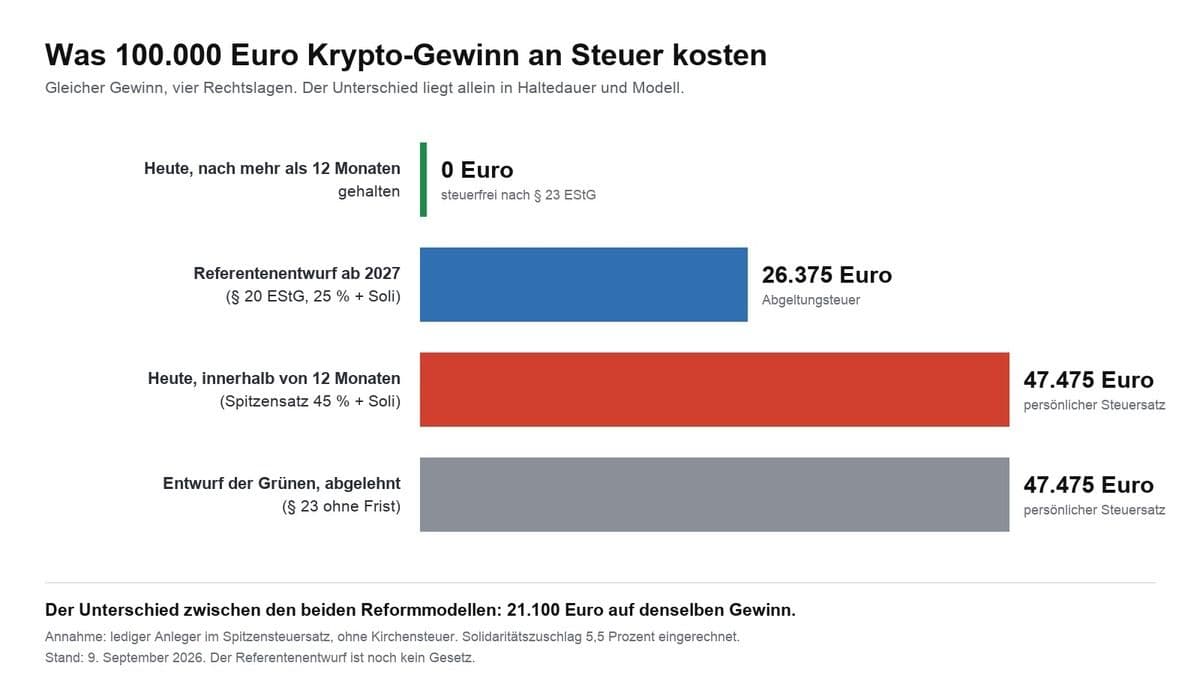
Crypto Tax in Germany: What Applies in 2026 and What Is Set to Change in 2027
Crypto gains are tax-free after twelve months; before that your personal tax rate of up to 45 percent applies. What triggers tax, how the holding period is calculated, what happens with staking and losses, and what the draft bill would change from 2027.
September 26, 2026 1:19 AM

Germany’s Crypto Holding Period Is Wobbling: What to Check Before December 31
A CDU member of the Bundestag makes it plain: the coalition agreement does not guarantee that the one-year holding period for crypto assets will survive. What that means for purchases made before the planned cutoff date of December 31, 2026.

July 1, 2025 2:12 PM

Germany’s Banking Giants Go Crypto: Deutsche Bank and Sparkassen, the 2026 Launch Status
Deutsche Bank plans crypto custody for institutional clients by the end of 2026, the Sparkassen want to offer crypto trading in their app from mid-October. Where both plans stand.
October 12, 2026 7:17 PM

Crypto Futures Tax in Germany: 25 Percent From the First Trade, No One-Year Rule
Crypto futures and perpetuals fall under Section 20 of the German Income Tax Act and therefore a flat 26.375 percent, with no holding period and no 1,000-euro exemption. Since the Annual Tax Act 2024, losses on them can again be offset without limit.
January 1, 2026 3:12 PM

Crypto Taxes 2026 in Germany: Automatic Reporting Under DAC8, What Applies Now
Since 1 January 2026 crypto providers in the EU must record their customers' transactions for the tax authorities. The first report for 2026 follows in 2027. What investors need to know.
October 8, 2026 4:17 AM

Crypto Holding Period: Without a Purchase Record the Tax Withheld Runs Ten Times Too High
The consultation on Germany's crypto tax bill closed on October 6 and the cabinet is to adopt it on October 14, with tax advisers, banks and the Bitcoin Bundesverband having filed their objections. The sharpest concerns everyone whose purchase data the selling platform does not hold: one adviser calculates a withholding ten times the tax owed.
October 1, 2026 7:36 PM

Crypto tax and withholding at source from 2028: what to check now
The German Federal Ministry of Finance’s draft bill goes to cabinet on October 14, 2026. The underexposed part of it is the deduction of tax from 2028: which providers are to withhold the tax on investment income, why self-custody and foreign platforms stay exempt from it, and what you should document by December 31.
August 31, 2026 10:30 PM

Taxing Crypto Lending: Your Personal Rate Instead of Withholding Tax, and the Right Federal Fiscal Court Case Number
According to the only tax court ruling so far, income from crypto lending falls under Section 22(3) of the German Income Tax Act and therefore under your personal tax rate. The appeal is pending at the Federal Fiscal Court under VIII R 22/25, not under the case number given in many professional articles.
September 8, 2026 10:21 PM

Crypto Holding Period and Grandfathering: Why December 31, 2026 Becomes the Cut-Off in Germany's Draft Bill
A ministerial draft bill from Germany's finance ministry names a cut-off date for the first time: crypto assets acquired after December 31, 2026 are to fall under the flat-rate withholding tax. What that means for legacy holdings, running savings plans and staking income, and why nothing has been decided yet.
September 5, 2026 10:24 PM

Fake German Finance Ministry Letters: Why Nobody May Demand 19 Percent VAT on Your Crypto Purchase
Since September 1, 2026, Germany's Federal Ministry of Finance has been warning about forged letters that demand 19 percent VAT on cryptocurrency purchases while citing real transactions. That tax does not exist, and this is how to spot the forgery.
September 26, 2026 7:29 PM

Coins Stolen in an Exchange Hack: What the German Tax Office Accepts as a Loss
After the attack on Bitget on September 24, a question the reports leave out arises for those affected in Germany: can a stolen balance be written off against tax? The answer hangs on a single term in the Income Tax Act, and it is decided by your records.
August 21, 2026 1:42 PM

Writing Off a Total Crypto Loss: When the Tax Office Recognises Worthless Coins
A token that has collapsed only reduces your tax once you actually dispose of it. What applies to delisting, exchange insolvency and worthless holdings under Section 23 of the German Income Tax Act, and how you offset losses.
October 9, 2026 1:18 PM

Bitcoin Tax: One Year Past the $126,080 Peak, Losses No Longer Count
Bitcoin trades at $82,558 on Friday morning, 34.5 percent below an all-time high that is now a good year old. Anyone who bought back then loses more than the prospect of a quick recovery when the one-year period expires: the tax value of the loss goes with it.
September 18, 2026 10:13 AM

Bitcoin and the German Exit Tax: What Applies When You Move Abroad
Anyone emigrating with Bitcoin expects an exit tax on unrealised gains and finds nothing of the sort in the statute. Where the real risks sit is decided at four points: residence, the holding period, the legal form of your investment, and automatic reporting from 2026.
August 21, 2026 4:24 AM

Forced Sale on a Crypto Exchange: Which Moment Counts for the Holding Period and What You Must Document
At Luno, Kraken and Valour the deadlines are running out, after which the provider realises the remaining holding itself. For tax purposes that is a disposal, and what governs it is the exchange's timestamp.
August 11, 2026 9:13 PM

Germany's Crypto Holding Period Faces Abolition: What Petition 201716 and the Draft Bill Mean for Your Tax
Petition 201716 calls for the one-year holding period for crypto assets to be kept and will be heard in public by the Bundestag's Petitions Committee on 12 October 2026. Correction of 8 October: the reform was not decided by the cabinet in July. A draft bill of 30 September would end the holding period for crypto acquired after 31 December 2026, and the cabinet is due to take it up on 14 October.
October 16, 2026 7:25 PM

Crypto holding period for Bitcoin: “That remains to be seen,” says the finance ministry
The federal cabinet did not adopt the draft abolishing the one-year crypto holding period on October 14, 2026; it is still stuck in inter-ministerial consultation. This overview sets out what applies today, which dates follow and why the December 31, 2026 cutoff has no force of law so far.
September 16, 2026 7:12 PM

Borrowing Against Bitcoin Instead of Selling: When German Tax Still Applies
Posting Bitcoin as collateral for a loan is not a sale in Germany, because section 39 of the Fiscal Code keeps the coins attributed to you for tax purposes. Tax arises only when the collateral is liquidated, and then the one thing that decides the bill is how long you held the coins beforehand.
September 7, 2026 7:22 AM

German Crypto Holding Period Set to Go After All: A Separate Draft Targets Purchases From 2027
Correction of 8 October 2026: The Income Tax Reform Act 2027, adopted by the German federal cabinet on 2 September, does not cover crypto assets. That did not mean the holding period stays. A separate draft bill from the Federal Ministry of Finance, dated 30 September, would abolish it for anything acquired after 31 December 2026. The cabinet is due to decide on 14 October.
October 9, 2026 10:50 AM

Crypto holding period: the Bundestag rejects abolition by 445 votes to 132: what investors need to know
On 8 October the Bundestag rejected the Greens' bill to abolish the crypto holding period in a recorded vote, and the Left's motion fell too. The result by parliamentary group, the official speech from the media centre, and why it was the SPD that gave investors the real signal in the debate.
September 19, 2026 7:26 AM

Offsetting Crypto Losses Against Share Gains: What Is Really Allowed in Germany
Crypto losses and share gains sit in separate loss buckets in Germany, and there is no offsetting between them. Where the line runs, why crypto derivatives are the exception, and how you can still use losses through carryback and carryforward.
August 16, 2026 6:14 AM
Crypto Credit Card Tax in Germany: Why Every Payment Is a Disposal
Paying with a crypto credit card means disposing of your coins for tax purposes. What that means for the holding period, the exemption threshold and your record-keeping duties, and which card design keeps the effort small.

July 31, 2026 10:59 AM

German Crypto Tax Return 2025: What You Should Know Now the July 31 Deadline Has Passed
Recap as of September 27, 2026: the deadline for the 2025 German tax return ended on July 31, 2026 at midnight. This article describes the situation on the day of the deadline: what crypto investors had to report and what happens if the deadline is missed.
October 15, 2026 4:13 AM

Crypto holding period: the cabinet date passes without a decision, December 31 stays the cut-off
Germany's federal cabinet did not adopt the expected decision of October 14, 2026 to abolish the one-year crypto holding period; the draft is still in interdepartmental consultation. Until new rules arrive, gains stay tax free after one year of holding, and the December 31, 2026 cut-off named in the draft separates old holdings from new ones.
October 6, 2026 10:24 PM

Germany's Crypto Holding Period Before the Petitions Committee on October 12: What Matters Now
The Bundestag's petitions committee debates the crypto holding period on Monday, October 12, 2026, from 12 noon in a public sitting, with federal government representatives on hand for questions. Two days later the cabinet is to decide on the draft bill that removes the one-year period for purchases from 2027.
October 2, 2026 4:39 AM

Donating bitcoin: when does the full market value count, when only the purchase price?
A bitcoin donation to a charitable organisation is deductible as a donation in kind, and the donation itself produces no taxable gain. The size of the deduction turns solely on whether a sale would have been taxable on the day of the transfer.
September 27, 2026 10:35 AM

Crypto Exchange Tax Report Wrong: How to Correct It Before the Tax Office Does
Missing acquisition costs, transfers booked as sales, holding periods restarted: your exchange's report is an aid and not proof. How to check it, how to correct it and which deadline is running.
More from CryptoTicker