
USDC supply shrinks by $4.08 billion: what matters for holders now
The supply of the second-largest dollar token has fallen by $4.08 billion in 30 days. Our own analysis shows that no other stablecoin lost as much circulating supply, and what that means for your own holdings.





Which topics should we dive deeper into?
Select what genuinely interests you. Your picks feed directly into our editorial planning.
Crypto news that's actually worth your time.
Weekly. 60 seconds. Carefully curated by our editors: no hype, no promo flood, no spam.
The second-largest dollar token in crypto has shrunk by $4.08 billion over the past 30 days. That is how much USDC holders returned to the issuer without an equal amount of new tokens being minted. No other stablecoin lost as much supply over the same period.
This is not a price move. A stablecoin pegged to the dollar still trades at a dollar; USDC stood at $0.9994 on October 27, 2026. What has changed is the number of tokens that exist at all. And for the crypto market that number is a metric in its own right, because it shows how much capital is sitting in dollar form without having left the ecosystem.
Stablecoin supply: $290 billion across the 14 largest dollar tokens
For this article we went through the circulating supply of every stablecoin tracked by DefiLlama, 425 tokens in total, and then looked at the 14 that weigh in above $1 billion. Together those 14 come to $290.19 billion. Across all 425 tokens the figure is $305.10 billion. cryptoticker.io compiled this data itself on October 27, 2026.
Circulating supply is the number of tokens an issuer has put out and not yet taken back in. It rises when someone deposits dollars and receives new tokens in return, and it falls when someone hands tokens back and receives dollars. To compare the individual tokens side by side, see the list of providers in our stablecoin comparison.
Within those 14 tokens the month split in two directions. Seven shrank, seven grew. The declines added up to $7.04 billion.
USDC loses $4.08 billion: the single largest decline
Of that $7.04 billion, $4.08 billion came from USDC alone. That is 58 percent of the entire decline, caused by one token. USDC now stands at $71.30 billion in circulating supply. Another $917 million in redemptions came on top over the past week, so the trend has not turned recently.
Tether, by far the largest stablecoin, also gave ground over the same period, though far less sharply: $1.79 billion against a circulating supply of $181.78 billion. In percentage terms the gap is clear. USDT lost about one percent of its size, USDC a good five percent.
Further declines came at USDe with $383 million, at USD1 with $493 million, and on a smaller scale at DAI, USDG and USDGO.
What a stablecoin redemption actually does
A redemption is the exchange of a token for real money at the issuer. The token is destroyed in the process, circulating supply falls, and the issuer transfers the equivalent value out of its reserves. That is the decisive difference from a sale on an exchange: sell your tokens to another buyer and the circulating supply is unchanged, because the tokens have only changed hands.
A falling supply therefore does not mean that large numbers of investors have sold. It means that, on balance, money has left the detour through the token and is sitting in bank accounts again, parked in government bonds, or has flowed into other assets.

Seven tokens shrink, seven grow: where the money is going
The other half of the data is just as revealing. While the large, established tokens gave up supply, several younger and smaller ones gained. PYUSD grew by $191 million, USDS by $183 million, RLUSD by $108 million and BUIDL by $71 million.
Measured against USDC these are small sums, but the direction is consistent: the movement runs from the two incumbents towards tokens issued by payment companies, by banks or by fund managers. BUIDL, for instance, tracks a money market fund and is therefore not one of the classic payment stablecoins.
 Compare licensed stablecoin issuers
The US interest ban on stablecoins and the January 18, 2027 deadline
Over the same period the legal position on yield has changed. The US law for payment stablecoins, the GENIUS Act, bars a licensed issuer from paying a token holder interest or a return for merely holding the token. The Federal Reserve Bank of Richmond sets out the rule in its overview of the GENIUS Act. Whether the redemptions of the past 30 days are connected to it cannot be read off the supply figures alone.
For a holder, that means the interest the issuer earns on its reserves stays with the issuer. Park your money in a payment stablecoin and you receive nothing from the issuer for it. When the rule bites in US supervisory practice and which transition periods apply, we set out in our article on the US rule on stablecoin interest from January 18, 2027.
To earn a yield, you therefore have to look outside the token itself, through staking and lending products with their own risks attached. Which platforms qualify and what they cost is set out in our comparison of staking platforms. There is no return there without a matching risk: lend out tokens and you carry the counterparty's default risk.
Supply as buying power: what the figure says about the crypto market
Stablecoins are the crypto market's means of payment. Almost every trading pair on a large exchange is quoted in a dollar token, and switching from one coin into another usually runs through a stablecoin. The combined supply of all stablecoins therefore describes how much immediately deployable capital is sitting in the market.
The mechanism behind it is plain. When supply falls, less money is on hand in the form that can buy without the detour through a bank. Every new purchase then has to come either out of existing holdings or bring fresh money in from outside, and fresh money needs a deposit that can take days. That changes nothing about the direction of a price, but it changes how quickly buying can follow.
Bitcoin stood at around $80,800 on October 27, 2026, Ether at about $2,349. Both moved little that day. The 14 large stablecoins lost $1.95 billion in supply over the same week.

The October 28 Fed decision meets a thinner dollar cushion
The US central bank meets on October 27 and 28, 2026, a date set out in the Federal Reserve's official meeting calendar. The decision therefore lands on Wednesday, and it meets a market whose stablecoin cushion has thinned over the preceding four weeks.
For investors, one point matters most here: a rate decision often moves prices within minutes. With less capital sitting ready in stablecoins, the swings can be sharper in both directions, because less counter-offer is immediately available. That says nothing about the direction of a move, but it does say something about its possible width.
 Find a yield outside the token itself
USDC in the EU: the redemption right and the MiCA classification
In the European Union a dollar stablecoin such as USDC falls under the Markets in Crypto-Assets Regulation, MiCA for short. A token of this kind counts there as an e-money token. A right hangs on that which many holders are not aware of: you can return your tokens to the issuer at par at any time, and the issuer has to pay you out at par. That right exists regardless of what an exchange happens to be paying for the token.
That USDC has been classified in the EU as a significant e-money token, and what that means for supervision, we set out on October 16, 2026 in our article on the classification of USDC as a significant e-money token. In concrete terms: check whether the provider you hold your stablecoins through is authorised in the euro area at all, and how it handles redemption.
Tax in Germany: swapping into a stablecoin counts as a sale
In Germany crypto-assets count as other assets. Swap Bitcoin or Ether into a stablecoin and that is a disposal for tax purposes, even though you have not left the crypto market. What decides the outcome is the holding period of the coins sold: after one year of holding, a gain on the sale of a privately held coin is tax-free, and within the year it falls under private disposals.
Switch into stablecoins and back several times during a turbulent week and you create a series of events that matter for tax. That is no reason to avoid it, but it is a reason to record the transactions while the data is still complete.
Custody: where your stablecoins sit and who can reach them
One point has nothing to do with supply and counts all the same right now: stablecoins in an exchange account are reliably yours only as long as the exchange remains solvent and reachable. Stablecoin issuers can also freeze individual addresses when the authorities order it. Both argue against leaving larger holdings on a trading account permanently.
There is also a simple calculation that gains weight from the interest ban: a balance that carries no interest loses real value when there is inflation. If you are parking money for a longer stretch, the sensible comparison for a stablecoin is an interest-bearing euro account rather than another token.
Stablecoin supply: only new inflows create new buying power
The number that counts over the coming weeks is not the price of any single coin, but the circulating supply of the large stablecoins. As long as it is falling, no fresh capital is following into the market. Three steps you can draw from that:
- Check your holdings. Look at which stablecoin your balance sits in and whether the provider is authorised in the euro area. The providers and their terms are set out in our stablecoin comparison.
- Settle how long you are parking. A stablecoin is designed for short parking between two trades. If you park for longer and want a yield, look at the terms and the risks in our comparison of staking platforms.
- Record the transactions. Every swap into a stablecoin is a disposal in Germany. Tools that capture this as you go are listed under tax software and portfolio trackers.
(As of October 27, 2026. This article is not investment advice. Prices and fee structures change; check the terms with the provider before you buy.)
Frequently asked questions about stablecoins
Transparency note: This article was produced with the assistance of artificial intelligence and reviewed by our editorial team before publication. All figures and claims were checked against the primary sources linked in the text. The feature image was generated with AI.
Related articles
- Fed Rules for Stablecoins: What to Check on Backing and the Redemption Right
- GENIUS Act stablecoin rules: what applies today and what stays open until 2027
- GENIUS Act Now in Play: A Turning Point for Crypto Regulation and Stablecoins?
- Stablecoin interest: MiCA article 50 bans it, and lending yield is taxable from 256 euros
- Circle Just Became a Bank: What the OCC Trust Bank Approval Means for USDC
Which topics should we dive deeper into?
Select what genuinely interests you. Your picks feed directly into our editorial planning.
Crypto news that's actually worth your time.
Weekly. 60 seconds. Carefully curated by our editors: no hype, no promo flood, no spam.

October 22, 2026 7:32 AM

US rule on stablecoin interest takes effect January 18, 2027: what changes for investors in Europe
In context: the US banking regulator OCC presented its final rule on payment stablecoins on October 21, 2026, effective January 18, 2027. The surviving interest ban is documented; what the deleted presumption means for reward arrangements is assessed by the editorial desk further down.
October 20, 2026 10:18 AM

Coinbase converts USDT and DAI into USDC on October 30: the swap restarts the one-year holding period
On October 30 Coinbase will convert the remaining USDT, DAI and PYUSD balances in the European Economic Area into USDC. The swap counts as a disposal under section 23 of the German Income Tax Act, and the one-year clock starts again for the new balance.

March 14, 2026 11:00 AM

Stablecoin Market Cap Hits $320 Billion as Institutional Adoption Goes Vertical
The global stablecoin market cap has surged to a record $320 billion in March 2026, driven by the GENIUS Act and massive institutional inflows.
September 22, 2026 10:25 PM
Binance Buys Into Circle: What the USDC Deal Means for Your Balance
Binance is taking a $100 million stake in Circle and extending the USDC agreement by five years. For investors in Germany, the sum matters less than the question of who earns money from stablecoins left sitting idle.
September 22, 2026 10:15 PM

Stablecoin Reserves: Why the ECB Wants the Bank Deposit Rule Scrapped
The European System of Central Banks filed its response to the MiCA review on September 22 and calls in it for an end to the requirement to hold 30 to 60 percent of stablecoin reserves as a bank deposit. What lies behind it, and what you can check on your own token.
October 22, 2026 7:41 AM

CLARITY Act: what the US crypto law would do and where it stands in the Senate
In context: what the CLARITY Act would do, how the House and the Senate voted, and what the SEC and CFTC are pushing ahead without a law. With a timeline, the vote arithmetic and a comparison with the EU regulation MiCA.
October 22, 2026 4:42 PM

USDT or USDC: the key points before the October 30 deadline
Analysis: in the European Economic Area, Coinbase converts remaining balances in USDT, DAI and PYUSD into USDC on October 30, 2026, and from November 12 the EBA supervises the USDC issuer directly. This piece sets out what that means for the choice between the two largest dollar stablecoins, and separates the documented deadlines from the newsroom's assessment.
October 18, 2026 10:27 AM

Stablecoin depeg: will the 1.00 euro peg hold?
A stablecoin depeg is the moment the market price leaves its tie to the euro or the dollar. What the MiCA regulation requires of the reserve and of redemption, how to recognise a token's design, and what a swap into a stablecoin means for your holding period.

October 11, 2026 7:32 PM

Solana loses 6.4 percent of its stablecoin reserves: what counts for your sell order now
Since September 25, $1.12 billion in stablecoins has left the Solana chain, around $70 million a day. That number says more about your next sell order than the price does.
September 29, 2026 10:15 PM

Citi Becomes the Bank Behind Coinbase's Stablecoin Accounts: What Changes for Investors in Europe
Citi and Coinbase announced two products on September 28, 2026 that tie stablecoin payments to a global bank: dedicated payment accounts at Coinbase and stablecoin acceptance for Citi clients. Both launch in the United States. For your balance in Europe, MiCA, the Article 50 interest ban and Section 23 of the German Income Tax Act apply.
October 16, 2026 1:25 AM

USDC becomes the EU's first significant e-money token: what changes for holders on November 12
The European Banking Authority classified USDC as the EU's first significant e-money token on October 14. From November 12 it will examine the issuer's reserve, own funds and liquidity itself, rather than leaving that to the French supervisor alone.
October 15, 2026 4:32 AM

Which cryptocurrency to buy? Five criteria that matter before the coin
22,260 cryptocurrencies are on sale across 1,504 trading venues, and most guides start with the name. We reverse the order and set out the five criteria, from market capitalisation to the holding period, that come before the coin.
October 5, 2026 4:42 PM

deBridge DBR: 618 million tokens come free on October 17, ten trading days of turnover at once
At deBridge the lock-up on 618.3 million DBR ends on October 17, 2026, the eighth quarterly tranche since the token launch. This piece sets the tranche against daily turnover, shows the six pots behind it and places trading and tax for investors in Germany.
October 1, 2026 7:25 AM

US core inflation falls to 3.0 percent: what investors need to know before the Fed decision on October 28
US core inflation ran at 3.0 percent in August, clearly below the expected rate. That shifts expectations for the Fed meeting on October 28 and helps decide how much room the Bitcoin price gets in the fourth quarter.
October 1, 2026 7:16 AM

Bitway (BTW) hits a record $1.43: 27 percent in a week while the market stood still
Bitway marked an all-time high of $1.43 on Monday and trades at $1.32 after a weekly gain of around 27 percent, while the broader market stood still. What carried the jump, when the incentive campaign ends, and what applies to circulating supply, authorisation and tax in Germany.
September 24, 2026 10:11 PM

Bitcoin Price Prediction: What to Check on Levels, Holding Period and Leverage Before the October 28 Rate Decision
Bitcoin is trading at around $83,800, a third below its October 2025 high, while the sentiment index reads greed. Which dates, levels and deadlines over the coming weeks really decide your net gain, and which of them you steer yourself.

July 28, 2026 11:53 AM
Why Is Crypto Down Today? The Real Reasons Behind The Crypto Crash
Bitcoin slipped under $64,000 as a Chinese chip breakthrough crashed the Kospi and traders de-risked before the Fed. Here is what is really driving it.
July 1, 2026 10:47 AM

Crypto News Today: Binance Exits the EU, Circle Craters, and Bitcoin Slides Below $59K
MiCA reshapes the market as Binance leaves the EU, a 140-firm stablecoin rocks Circle, and Bitcoin sags near multi-year lows. Here's what's moving crypto today.

August 11, 2024 6:31 AM
USDT and USDC Supplies Jump $3B During Crypto Market Surge
The combined supply of USDT and USDC surged by $3 billion as the crypto market bounced back. Find out how this rebound is affecting the crypto market!
April 29, 2026 11:33 AM

Fed Rate Decision: Every FOMC Date to 2027 and How Bitcoin Reacted
Analysis: The Fed announces its next rate decision on 28 October 2026 at 2:00 p.m. ET. Here are all FOMC dates to the end of 2027, the current target range and how Bitcoin reacted to the last nine decisions.
October 23, 2026 4:57 PM

South Korea Makes Stablecoins an Official Means of Payment: What the New Rule Really Says
South Korea is rewriting its forex law to classify stablecoins as a means of payment. Crypto Twitter calls it adoption. The fine print says surveillance.
September 23, 2026 7:15 AM

SoFi Settles Card Payments in Stablecoin: What Cardholders Should Check
Since September 22, 2026, the US bank SoFi has run its entire card business through its own stablecoin, SoFiUSD, on the Mastercard network. What sets the model apart from a crypto credit card, and which rules would apply if a European provider followed suit.
August 19, 2026 7:17 PM

MiCA Register of Stablecoin Issuers: 23 Authorised Firms, 43 White Papers and Two Dead Links
The official ESMA register lists 23 authorised issuers of e-money tokens and 43 notified white papers. We called up every document address stored there ourselves and show where the record leads nowhere.
July 25, 2026 12:44 PM
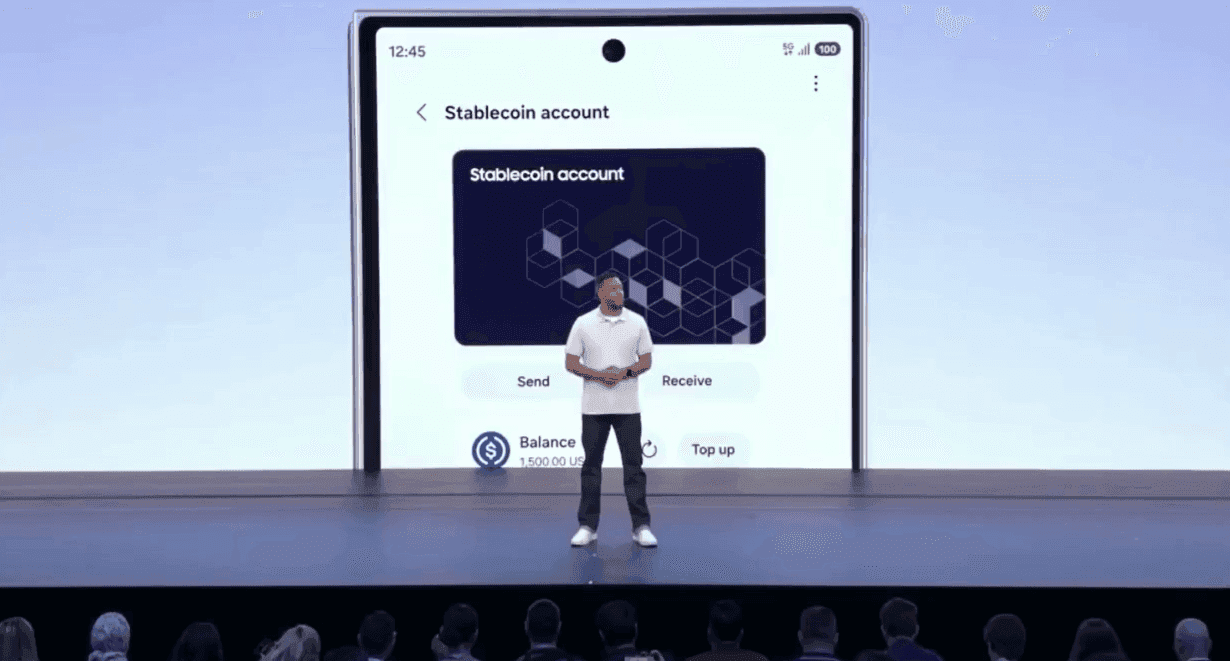
Samsung Puts Stablecoins in Its Wallet: What It Means for Crypto Prices
Samsung Wallet is getting native stablecoin support, with USDC demoed on stage. No launch date yet — but the distribution potential is real.
March 2, 2026 11:30 AM

How to Generate a Steady Income During Crypto Market Volatility
Crypto market crashing hard? Learn how to use stablecoins to generate a reliable income while protecting your capital from market swings.
August 16, 2026 9:11 PM
Swapping Bitcoin for Stablecoins: Does Austria Charge Tax?
Anyone swapping bitcoin for USDT or another stablecoin usually pays no tax in Austria yet. When the swap does become taxable after all.
October 13, 2026 7:19 AM

Financial Stability Board on 300 billion dollars in stablecoins: “untested in severe stress and insolvency”
The Financial Stability Board handed the G20 a status report on stablecoins on 12 October: a market worth 300 billion dollars, 99 percent of it pegged to the US dollar, and a supervisory structure that remains untested in severe stress and insolvency. Here is what the gaps it describes mean for holders in Europe, where MiCA already closes them and which ones stay open.
More from CryptoTicker