
Hashi launches with $500 million for Bitcoin loans: the collateral stays on the Bitcoin chain
Mysten Labs is launching a network on the Sui blockchain through which Bitcoin serves as collateral for loans without leaving the Bitcoin chain. More than $500 million is committed; terms, starting liquidity and the schedule remain open.





Which topics should we dive deeper into?
Select what genuinely interests you. Your picks feed directly into our editorial planning.
Crypto news that's actually worth your time.
Weekly. 60 seconds. Carefully curated by our editors: no hype, no promo flood, no spam.
Hold Bitcoin and need cash and you long had only one option: sell. Since October 9, 2026 a second variant is on the table. Mysten Labs, the development firm behind the Sui blockchain, is launching Hashi, a network through which Bitcoin serves as collateral for loans without leaving the Bitcoin blockchain. More than $500 million in capital commitments from over twenty partners stands behind it, according to CoinDesk. The launch runs in phases through October.
For investors in Europe this is, to begin with, news about a product you will not find in your banking app. It becomes interesting at three points: the question of whom you entrust your Bitcoin to, the tax question around the holding period, and the risk that every collateralised loan carries. Bitcoin trades on Sunday at $83,906, or €74,816.
Hashi launches on Sui: Mysten Labs gathers more than $500 million in commitments
Hashi is a network for Bitcoin finance built by Mysten Labs. Bitcoin finance here simply means that Bitcoin already held is put up as security for borrowing instead of sitting unused in a wallet. The loan is paid out in other assets on the Sui chain, not in Bitcoin itself.
The figure travelling through the reports is $500 million. That number comes from the announcement and describes capital committed by more than twenty partners from the industry. The rollout begins in October and proceeds in stages rather than on a single date.
A commitment is not a deposit: starting liquidity remains unclear
The wording deserves a close look here. A capital commitment is a declaration of intent to provide money. No amount sits in the network yet that could be drawn on. Cointelegraph and CoinDesk both describe the $500 million as committed rather than paid-in capital. How much liquidity is actually available on day one, Mysten Labs has not disclosed.
That is no reproach. With a staged launch it is the normal case. It does change what the number tells you. The figure describes the interest of institutional houses in the venture. About the terms on which a loan eventually comes about, it says nothing.
hBTC without a bridge: how Hashi locks Bitcoin and issues a claim on Sui
The technical core is the part that reveals the most about the risk. Hashi works without a cross-chain bridge. A bridge is an intermediary that freezes a balance on one chain and issues a copy on another; over recent years it has been the point at which a great deal of money was lost.
Instead, the Bitcoin is locked in a multisignature vault on the Bitcoin blockchain. Multisignature means several separate keys have to come together before anything moves. In return, a token called hBTC is created on Sui. To exit, you burn your hBTC and receive the Bitcoin back.
The difference from a classic bridge lies in where the collateral sits. It does not leave the Bitcoin chain. What circulates on Sui is a claim on that locked holding.

The multisignature vault: who holds the keys to the deposited Bitcoin
A vault with several keys is safer than one with a single key. It is not the same as self-custody, though. As long as your Bitcoin sits there, control over it is no longer yours alone; you share it with the parties managing the remaining keys.
That is the central trade-off in every collateralised loan on a crypto basis, and it holds regardless of the provider. For a general grounding, the mechanics behind interest rates and risks are set out in our comparison of lending providers. It also lists the questions worth putting to a provider before handing over a balance.
 Put Bitcoin to work: the providers compared
BitGo, Anchorage Digital and Ledger: the partners behind the launch
The firms involved include, according to the available reports, BitGo, Bullish, Cumberland, FalconX and Ledger. Anchorage Digital is likewise named as a launch partner. These are names from the institutional part of the industry: custodians, trading houses, market makers.
That line-up explains where the capital commitments come from. At the same time, the list tells you who Hashi is primarily aimed at. A network whose launch partners are trading desks and custodians is built for professional counterparties first, not for a private portfolio.
Aftermath, Concrete and Fluid: who is to operate the Hashi vaults
The vaults themselves, meaning the pools from which loans are issued, are to be operated by separate providers. Aftermath, Concrete and Fluid are named. In practice that means Hashi lays the rails and others run on them.
For you that has a consequence which is easily missed: the terms of a loan, meaning the collateralisation ratio, the interest rate and the threshold for forced liquidation, are set by the respective vault operator and not by the network. No figures on these are publicly available at launch.
Certora and CommonPrefix: what the two security reviews cover
Two reviews are documented. Certora examined the smart contracts, meaning the program code executed on Sui. CommonPrefix reviewed the MPC cryptography. MPC stands for multi-party computation, a procedure in which several participants compute jointly without revealing their respective key shares.
An audit is a snapshot of the code reviewed. It evidences that specialists have looked, and it is no promise that nothing will happen in live operation. This year's events have shown in several places that gaps can also appear at the seams between audited components.
A trillion dollars of idle Bitcoin: the market Sui is aiming at
Sui justifies the venture with an estimate of its own: around a trillion dollars in Bitcoin lies unused, without working in financial applications. The number is the provider's assumption about the size of the market, not a measured sum.
The thought behind it is sound. Bitcoin generates no yield of its own. There is no staking in the protocol, no interest from the chain itself. Every form of return on Bitcoin arises because somebody else pays for it, and with that comes counterparty risk.
Borrowing against it instead of selling: the holding period under section 23 EStG
In Germany, the holding period decides the tax treatment of privately held crypto assets. Under section 23 of the Income Tax Act, a gain from a private disposal transaction is tax-free where more than a year lies between purchase and sale. Sell before that and the gain is taxed at your personal rate.
This is precisely where the appeal of a loan against Bitcoin lies: no sale takes place, so the period runs on. Whether that holds in every case depends on the details of the construction. Where the collateral is liquidated, that is a disposal with all its tax consequences. The question of whether locking Bitcoin and issuing a different token is to be treated as a swap for tax purposes also has no blanket answer in such models.
Nobody on the internet will give you reliable advice on this; your tax adviser will, looking at your case. That is no empty phrase: for a product a few days old, no settled administrative practice on this question exists yet.
Liquidation risk: when the price pushes collateral below the threshold
A collateralised loan works as long as the collateral is worth enough. Should the Bitcoin price fall, the value of the security sinks while the debt stays the same. Once the ratio drops below an agreed threshold, the collateral is sold in whole or in part to cover the debt.
That is the point at which an idea meant to avoid a sale turns into a forced sale, and typically at the worst possible moment. Bitcoin has lost 1.76 percent over the past seven days and therefore sits in a quiet phase. That has been different several times over the course of the year.
 Buying Bitcoin: the exchanges at a glance
Authorisation in Europe: MiCA covers trading, not lending
Since the European regulation on markets in crypto assets, MiCA for short, providers of certain services need authorisation. These include trading, custody and the exchange of crypto assets for customers. Issuing loans against crypto assets is not in that catalogue.
One practical consequence for you follows. With an authorised exchange you can look the permission up in a register. With a lending offer on a blockchain there is usually no such checkpoint, and no deposit guarantee either. The protection you take for granted with a bank product is absent here.
Custody: hBTC on Sui is a claim, not your Bitcoin
A token representing a locked holding is economically something other than the holding itself. It depends on the lock holding, on key management working, and on the redemption route staying open. Should one of those elements fail, the token on the other chain will not help you.
If you want to keep your Bitcoin balance permanently outside constructions of this kind, there is no way around holding it yourself. Which devices are suitable for that, and how they differ, is set out in our overview of hardware wallets.

SUI at $1.14: the token carries the network, not the loan
Hashi runs on Sui, so the question of the chain's token arises. SUI trades on Sunday at $1.14, or €1.016. The token pays for transactions in the network and secures it. It is neither the collateral nor the currency of the loan.
A common short circuit runs: more activity on a chain automatically means a higher price for its token. That relationship is not documented. What a phased launch in October brings in actual transaction volume can only be measured once it has run.
What remains open: terms and starting liquidity
Three things are not public as matters stand. First, the terms of the individual vaults, meaning collateralisation ratio, interest rate and liquidation threshold. Second, the liquidity genuinely available on day one. Third, the precise schedule by which the October phases follow one another.
As long as those details are missing, the offer cannot be compared with an existing credit product. Wait until the terms are published and you miss nothing that could not be caught up on later.
Bitcoin loans on Sui: $500 million is committed, not deposited
The news is the launch, not the finished product. Three steps make sense if the topic concerns you:
- Check authorisation before moving a balance. For every provider where you buy or hold crypto assets, the permission can be looked up. Which houses are authorised in Europe is shown in our overview of regulated crypto exchanges.
- Settle the custody question. Bitcoin locked as collateral is no longer in your hands alone. For the holding that is meant to stay with you, our hardware wallet comparison is worth a look.
- Document the holding period. When you bought decides the tax. Keep acquisition dates in order and you can evidence the one-year period; the tax tools and portfolio trackers help with that.
(As of October 11, 2026. This article is not investment advice. Prices and fee structures change; check the terms with the provider before you buy.)
Frequently asked questions about Hashi and Bitcoin loans
Transparency note: This article was produced with the assistance of artificial intelligence and reviewed by our editorial team before publication. All figures and claims were checked against the primary sources linked in the text. The feature image was generated with AI.
Related articles
- Bitcoin as Loan Collateral: When No Tax Applies in Austria
- Crypto as a Down Payment for a German Mortgage: What Banks Require
- Bitcoin-Collateralized Loan Might Help BTC Price Surpass Its $60k Resistance Level
- Fed Rate Decision of September 16: What It Means for Your Bitcoin Savings Plan
- Circle Lends Against Bitcoin via cirBTC: Why the Wrapper Can Cost You the German Holding Period
Which topics should we dive deeper into?
Select what genuinely interests you. Your picks feed directly into our editorial planning.
Crypto news that's actually worth your time.
Weekly. 60 seconds. Carefully curated by our editors: no hype, no promo flood, no spam.

September 16, 2026 7:12 PM

Borrowing Against Bitcoin Instead of Selling: When German Tax Still Applies
Posting Bitcoin as collateral for a loan is not a sale in Germany, because section 39 of the Fiscal Code keeps the coins attributed to you for tax purposes. Tax arises only when the collateral is liquidated, and then the one thing that decides the bill is how long you held the coins beforehand.
September 10, 2026 7:14 AM

Bitcoin Loan Liquidated: Tax Consequences in Austria
If a lender liquidates Bitcoin pledged as loan collateral, a taxable capital gain can arise in Austria. That holds even when the investor never chose to sell.
October 9, 2026 10:50 AM

Crypto holding period: the Bundestag rejects abolition by 445 votes to 132: what investors need to know
On 8 October the Bundestag rejected the Greens' bill to abolish the crypto holding period in a recorded vote, and the Left's motion fell too. The result by parliamentary group, the official speech from the media centre, and why it was the SPD that gave investors the real signal in the debate.
September 9, 2026 4:22 PM
Crypto Tax in Germany: What Applies in 2026 and What Is Set to Change in 2027
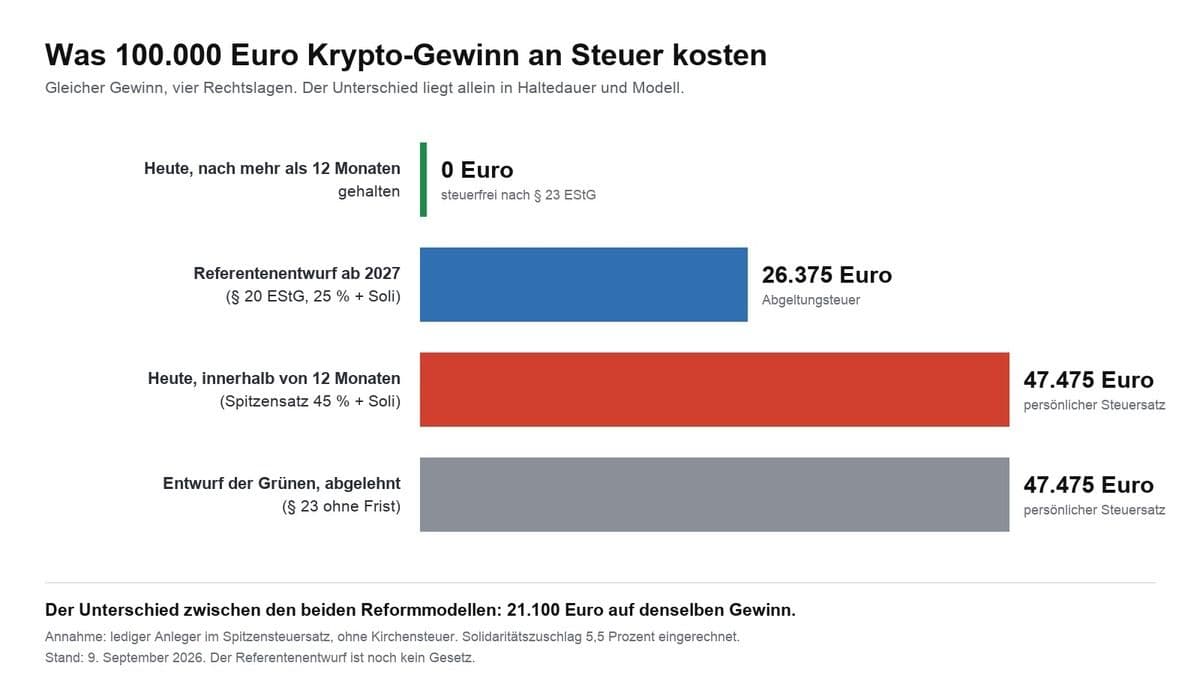
Crypto gains are tax-free after twelve months; before that your personal tax rate of up to 45 percent applies. What triggers tax, how the holding period is calculated, what happens with staking and losses, and what the draft bill would change from 2027.
September 9, 2026 4:13 PM

Bitcoin 29 Percent Below Last Year: Which Crypto Losses You Can Still Use Before the One-Year Holding Period Expires
Nine out of ten major crypto assets trade lower today than exactly twelve months ago, Bitcoin alone by 29.2 percent. We measured the price series ourselves and show why the purchase date alone decides the tax value of your loss.
September 8, 2026 1:19 AM

Germany's Crypto Holding Period: What Happens Now Signing for Petition 201716 Closed on September 15
Recap as of September 27, 2026: the signature period for German parliamentary petition 201716, which asks for the one-year crypto holding period to be preserved, closed on September 15, 2026. This article explains what ended that day, how the petitions committee proceeds and why no investor has to sell because of it.

October 5, 2026 7:21 PM

Bitcoin price at $85,662 one year after the all-time high: what to watch now
Bitcoin stands at $85,662, which is 32.1 percent below the all-time high whose anniversary falls on October 6. In euros the gap is smaller, and for anyone who bought in October 2025 the one-year tax period is running out at the same time.

September 21, 2026 4:15 PM

Sui Jumps 26 Percent: The Strongest Coin In The Top 30
Sui gains around 26 percent within 24 hours and beats every other asset in the top 30. Behind the move sit a prominent bet on the AI economy, a new bitcoin protocol and a rotation into layer 1 chains.
September 9, 2026 4:29 PM
Bitcoin and Taxes in Germany: Holding Period, Savings Plan, ETP and Mining
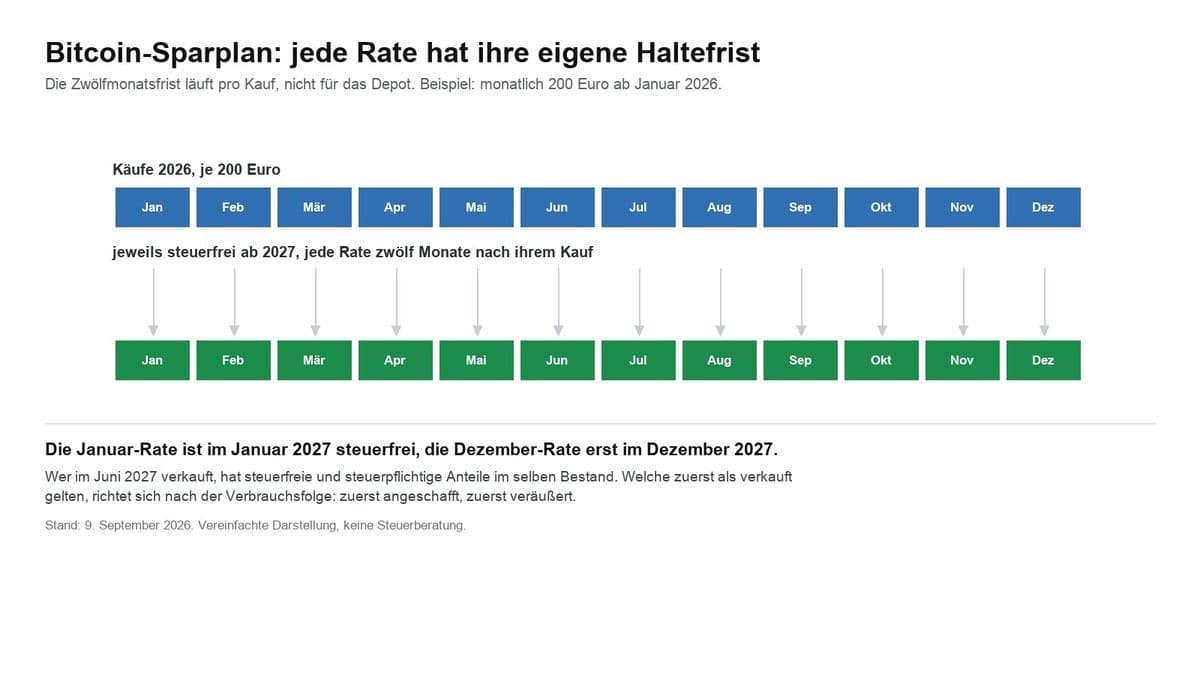
Bitcoin gains are tax-free after twelve months. What that means for a savings plan with twelve deadlines, why ETPs are taxed differently, and what applies to mining, gifts and losses.
October 3, 2026 4:40 PM

Investing in Bitcoin With a Savings Plan or a Lump Sum: What the December 31 Tax Cut-Off Changes
Anyone putting money into Bitcoin now chooses between a lump sum, a monthly instalment and an ETN in a securities account. The German finance ministry’s draft bill would keep the one-year holding period only for holdings bought by December 31, 2026.
September 23, 2026 4:34 PM

A Bitcoin State Reserve by Statute: What the US Bill H.R. 8957 Means for German Holders
On September 16, 2026 the US House financial services committee advanced a bill that would make government Bitcoin holdings unsellable for 20 years. What the text actually says, what Saxony's sale of 49,858 Bitcoin sets against it, and the three points German holders should check now.
September 22, 2026 1:28 PM

Selling Bitcoin and Cashing Out in Euros: How It Works in Germany
Between the sell order and the euros in your current account stand the exchange, your bank and the tax office. Knowing the order of events saves fees, waiting time and, in the best case, the entire tax on the gain.
September 18, 2026 10:14 PM

Bitcoin Back Above $80,000: Buy More, Hold or Take Profits? What to Check Now
Bitcoin is back above $80,000, for the first time since September 7. Whether you buy more, hold or take profits depends less on the daily price than on three things you can check yourself: your holding period, the way you buy, and where your coins are kept.
October 8, 2026 10:39 AM

Bitcoin Cash and the CME Futures Launch on October 19: Will the Listing Carry the Price?
The CME Group plans to introduce futures on Bitcoin Cash on October 19, with a standard contract of 250 BCH. The price stands at $294.93 and has given back the jump from the announcement in full.
October 7, 2026 7:18 AM

Certificate, Bitcoin ETN or the coin itself: what each route means for tax and custody
A Bitcoin certificate, an ETN and the coin itself all lead to the same price, but to three different tax treatments and three different risks. The comparison shows which route fits your portfolio and why December 31, 2026 becomes the cut-off date.
October 6, 2026 1:23 AM

50 euros a month in Bitcoin, 118 instalments since 2017: savings plan vs lump sum
118 monthly instalments of 50 euros since January 2017 add up to €5,900 paid in and around €54,500 today. The same instalment since January 2024 is up only 14.5 percent, and since October 2025 the savings plan beats the lump sum by almost 39 percentage points.
September 27, 2026 4:12 AM

Bitcoin ETF Inflows Turn 2026 Positive: How to Tell If the Demand Holds
US spot Bitcoin ETFs took in roughly $2.4 billion in the week to September 25, the strongest week since October 2025, and that turns the 2026 year-to-date balance positive. Why the daily inflow fell 87 percent within the same week, and what to check on buying route, holding period and custody.
September 24, 2026 10:11 PM

Bitcoin Price Prediction: What to Check on Levels, Holding Period and Leverage Before the October 28 Rate Decision
Bitcoin is trading at around $83,800, a third below its October 2025 high, while the sentiment index reads greed. Which dates, levels and deadlines over the coming weeks really decide your net gain, and which of them you steer yourself.

September 24, 2026 4:11 PM

Bitcoin Cash Falls 5.5 Percent After a 50 Percent Week: Check Your Buy Route, Leverage and Holding Period
Bitcoin Cash fell to $335.19 on September 24, 2026, after gaining almost 50 percent in seven days. The rally was set off by CME's announcement of September 22; what that means for buy route, leverage, holding period and custody is set out here.
September 22, 2026 4:12 PM

Nearly $1 Billion Into Bitcoin ETFs: What to Check on ETNs, Portfolio and Holding Period
US spot bitcoin ETFs took in a net $999 million on September 21, the third consecutive day of inflows. German investors cannot reach these funds: what ETNs, the holding period and your buying route mean for you.
September 20, 2026 1:11 PM

Bitcoin Golden Cross: What Twelve Signals Since 2014 Really Show
Bitcoin's 50-day line has crossed its 200-day line. We evaluated all twelve golden crosses since 2014 ourselves and measured what happened afterwards. The result argues against the common reading of the signal.
August 24, 2026 10:29 AM

Buying More Bitcoin at $77,000: Savings Plan or Lump Sum
Bitcoin stands at $77,256 after gaining 22.78 percent in a week. This guide shows you how to buy more cleanly at this price and which method fits which starting position.
October 10, 2026 1:15 AM

17,733 Bitcoin From US Government Wallets at Coinbase Prime: A Transfer Is Not a Sale
Wallets attributed to the US government moved more than a billion dollars of Bitcoin to the custodian used by the US Marshals in three days, and the market read that as a sale nobody can document. What the on-chain data actually shows, why $1.05 billion in long positions vanished anyway, and which part of it touches your holding period, your leverage and your custody.
October 8, 2026 4:38 AM

Crypto Market Slides: Bitcoin Loses 4.2 Percent and $651 Million of Long Bets Are Liquidated
Bitcoin has lost 4.2 percent since Tuesday afternoon, and ether and XRP more still. Three reasons can be documented: outflows from the US ETFs, $651 million of forcibly closed long bets and Fed minutes holding out the prospect of another rate rise. A crash it is not, and what to check before buying more is set out here.
October 6, 2026 4:32 AM

Bitcoin for a gift card: what paying with crypto means for your holding period
Paying for a gift card with Bitcoin is a sale for tax purposes. What counts as the disposal proceeds, when the twelve-month holding period bites, and the four records the tax office expects.
October 2, 2026 5:02 PM

Bitcoin or Ethereum in the fourth quarter of 2026: the two largest crypto-assets compared
Bitcoin is scarce by protocol rule, Ethereum only as scarce as its utilisation, and on access and tax in Germany the paths part again. This comparison puts the verifiable figures on supply, usage, staking and purchase route side by side, without making a price call.
September 25, 2026 7:24 PM

Bitcoin Forecast: What to Check on Levels, Holding Period and Buying Route Before the Quarter Ends
Bitcoin stands at $83,877 at 16:40 UTC on September 25, 2026, and the measured volatility of the past 30 days spans a band of $73,600 to $94,200 for the coming month. More important than that band before the quarter ends are three checks: holding period, buying route under MiCA and the reporting duty in force since January 2026.
More from CryptoTicker