
34 tranches to July 2029: Falcon Finance releases 203 million FF tokens on October 29
On October 29, 2026 Falcon Finance frees 203,055,556 FF, 6.07 percent of the circulating supply. That date is only one of 34 still to come before the summer of 2029.





Which topics should we dive deeper into?
Select what genuinely interests you. Your picks feed directly into our editorial planning.
Crypto news that's actually worth your time.
Weekly. 60 seconds. Carefully curated by our editors: no hype, no promo flood, no spam.
The FF unlock at Falcon Finance is not a single date but a schedule: 203,055,556 FF come free on October 29, 2026, and after that another instalment follows month by month until July 2029. Thirty-four dates are still outstanding under the release plan. Anyone holding FF or watching the price therefore needs no answer to the question of whether this one day will weigh on the price, but to the question of how long the supply keeps coming and how large it is relative to the market.
The short version: the October 29 instalment equals 6.07 percent of the circulating supply and around $21.3 million. Total FF trading comes to just under $5.5 million a day. Each monthly instalment therefore weighs almost four trading days, and it does so 28 times in a row before it shrinks.
Four FF tranches fall on October 29 at once
October 29 carries four releases, split across two points in the day. At 11:52 UTC the ecosystem tranche of 75,000,000 FF unlocks. At 20:58 UTC three more follow: 60,000,000 FF from the foundation, 55,555,556 FF for the core team and early contributors, and 12,500,000 FF for investors. Together that is 203,055,556 FF.
Measured against a circulating supply of roughly 3.34 billion FF, that is 6.07 percent. At a price of $0.1048 as of October 20, the day's volume of tokens is worth about $21.3 million. FF stands at a market value of around $350 million, ranking 131st among crypto assets. It is a long way from its high of $0.77, reached on the day of its launch in late September 2025.
Cliff, vesting and tranche: the three terms in the FF release plan
A cliff is a lock-up period during which an allocated amount of tokens stays entirely immobile. When it expires, only the first instalment falls; the rest follows spread over the months that come after.
Vesting is the subsequent release in instalments over a set period. For two groups, Falcon Finance's official tokenomics states the same terms: one year of cliff, three years of vesting. Three years in monthly instalments make 36 instalments.
A tranche is one of those instalments and falls at a fixed moment, regardless of where the price happens to stand. If you want to go deeper into the mechanics, the differences between a cliff and rolling monthly instalments are set out in our explainer on token unlocks and vesting.
That the release plan's figures match the official tokenomics can be checked by arithmetic. The core team and early contributors hold 20 percent of 10 billion FF, so 2 billion. Divided by 36 months, that gives 55,555,556 FF. Investors hold 4.5 percent, so 450 million, and divided by 36 that is 12,500,000 FF. Both values match the tranches scheduled for October 29 down to the token. The Falcon Finance tokenomics therefore evidence both the cadence and the size of the instalments, without having to rely on a calendar service.
203 million FF against $5.5 million in daily turnover
A release on its own says little. What counts is how much new selling pressure meets how much demand. FF currently trades for around $5.49 million a day. At $21.3 million, the October 29 instalment is therefore about 3.9 times the size of an entire trading day.
That does not mean all released tokens will be sold at once. Some move into staking, some simply sit, some go to partners and programmes. It does mean that even a small share being sold becomes clearly visible in the order book. If you trade FF through an exchange, know the market depth before placing a larger order; which venues offer how much depth is shown in our crypto exchange comparison.
For comparison from our own coverage: at Plasma the monthly instalment comes to a good 5 percent of the circulating supply, according to our October 15 article. The order of magnitude at FF therefore sits within the usual range for such monthly plans, as the XPL monthly schedule shows. What is unusual at FF is the length of the series.

The monthly series does not end until the summer of 2029
Under the release plan, 34 monthly dates remain outstanding from October 29, 2026, the last of them in July 2029. In total that is 6.45 billion FF coming to a market that today carries 3.34 billion FF, in not quite three years. The circulating supply will therefore close to triple over that period if everything goes to plan.
That is the real difference from September 29, 2026, when the lock-up expired and the first instalment fell. Back then the focus was on a single day. We described that date at the time, in our article on the end of the lock-up at Falcon Finance. What was still open then and can now be read off the plan: that date was the start of a series.
 Compare the best crypto exchanges
From February 2029 the monthly instalment shrinks to 128 million FF
The series is not equally heavy across its whole run. Twenty-eight of the 34 outstanding dates carry the full 203,055,556 FF. In January 2029 the ecosystem tranche of 75,000,000 FF runs out, because that allocation will then be exhausted. For the remaining six months from February to July 2029, the monthly instalment therefore drops to 128,055,556 FF.
In practice that means the heaviest stretch lies ahead, not behind. Anyone planning a holding period of several years has the densest phase of releases, between late 2026 and early 2029, still to come.
Two calendars, two numbers for the same day
Look the date up yourself and you will find conflicting figures. Some calendars list only 75 million FF for October 29. That is not an error but a question of presentation: those services show only the next single event as the next unlock, and on that day it is the ecosystem tranche at midday. The three tranches in the evening appear in the same overview as separate entries further down.
The end of the series is also reported differently. The release schedule at DefiLlama puts the final entry in July 2029, while other calendars name September 2029. The official tokenomics sets out only the framework, one year of lock-up and three years of instalments, and leaves the exact closing day open. What is solid, therefore, is the window: summer 2029.

Falcon USD and FF: one house, two tokens
Falcon Finance issues two different tokens, and they are regularly confused. USDf is the protocol's synthetic dollar, a token designed to track the dollar price. FF is the governance and utility token, the one used for voting and the one that can be staked.
Only FF is subject to the release plan discussed here. Check the price while looking at the stablecoin and you will see a value near one dollar instead of the roughly ten cents FF costs, and you will calculate a release ten times too large. At this project, the similarity of the names is the most common source of error.
FF in Germany: 37 exchanges, not a single euro pair
FF is listed on 37 trading venues. The largest turnover sits with Binance, WhiteBIT, OrangeX and Bybit, alongside decentralised trading via PancakeSwap on the BNB blockchain. It trades against dollar stablecoins such as USDT, USDC and FDUSD, and against Turkish lira, Korean won, Indonesian rupiah and Thai baht.
There is no euro trading pair. For investors in Germany, that has two consequences. First, every purchase and sale additionally carries the exchange-rate risk between the euro and the dollar, even if you never see a dollar. Second, the route always runs through a stablecoin or a conversion, which means an extra layer of fees and, come the tax return, an extra transaction.
Whether your trading venue is licensed in the EU is worth a look before you buy. Since MiCA, providers need authorisation to offer crypto-asset services in the EU, and we have set out the obligations that come with it in our overview of MiCA licensing duties.
 Calculate your crypto tax with the right tool
What an unlock means for holding periods and tax
One widespread misunderstanding first: the release itself triggers no tax for you. Other people's tokens become movable, namely those of the team, the investors and the foundation. Nothing changes in your own holdings, and your acquisition dates stay as they are.
For tax, only what you do yourself counts. Under section 23 of the German Income Tax Act, the gain from a private sale is tax-free if more than a year lies between acquisition and sale. Sell earlier and your personal income tax rate applies, while the exemption limit for all private disposals in a year combined stands at 1,000 euros. Because it is an exemption limit and not an allowance, a total gain of just 1,001 euros makes the full amount taxable.
Two points are easily overlooked. Swapping FF for another token counts as a sale and starts a fresh period for the token received. And income from staking FF falls not under section 23 but under section 22 number 3 of the Income Tax Act, as other income, with its own exemption limit of 256 euros a year.
Anyone buying, swapping and staking across several venues quickly loses sight of the acquisition dates. There are tools for that; we compare the common ones in our crypto tax software comparison.
How to check the FF release schedule yourself
You are not dependent on any calendar service. The framework is in Falcon Finance's official tokenomics: a total supply of 10 billion FF, of which 20 percent goes to the core team and early contributors and 4.5 percent to investors, with one year of lock-up and three years of instalments for both.
From that the cadence follows. Divide the allocation by 36 months and you have that group's monthly instalment. For the core team that is 55,555,556 FF, for investors 12,500,000 FF. If those two figures match what a calendar shows for a given date, the entry is plausible. If they differ, either the date is wrong or the calendar is counting a different group.
Second check: set the tranche against daily turnover, not against market value. Market value says what the holding is nominally worth; daily turnover says how much of it can actually move without shifting the price. At FF, $21.3 million stands against $5.49 million, and it is precisely that ratio which makes the instalment relevant.
FF unlock: the same instalment falls every month until summer 2029
October 29 is not a one-off date but a stop on a series that still has a good two and a half years to run. Three steps make sense now:
- Check your trading venue. See whether your provider lists FF at all, how deep the order book is and whether it is licensed in the EU. You will find an overview of licensed providers among the regulated crypto exchanges.
- Record your acquisition dates. Note the date and amount for every purchase and every swap, so the one-year period stays provable. The right tools are in our crypto tax software comparison.
- Put the next dates in the diary. After October 29 come November 29 and December 29 with the same amount. If you want to buy or sell ahead of one of those days, compare fees and market depth beforehand, for instance in our exchange comparison.
A total loss is possible with a token of this size. Only commit money whose loss you can absorb.
(As of October 20, 2026. This article is not investment advice. Prices and fee structures change; check the terms with the provider before you buy.)
Frequently asked questions about the FF unlock at Falcon Finance
Transparency note: This article was produced with the assistance of artificial intelligence and reviewed by our editorial team before publication. All figures and claims were checked against the primary sources linked in the text. The feature image was generated with AI.
Related articles
- FF Unlock on September 29: What the End of the Lock-Up at Falcon Finance Means
- ZRO Unlock on October 20 Hits 5.92 Percent of the Circulating Supply: Hold or Sell?
- Allora Unlock on November 11: How to Check What of the 160 Million ALLO Really Reaches the Market
- deBridge DBR: 618 million tokens come free on October 17, ten trading days of turnover at once
- Kite unlock in early November: 1.11 billion KITE become tradable, almost half the circulating supply
Which topics should we dive deeper into?
Select what genuinely interests you. Your picks feed directly into our editorial planning.
Crypto news that's actually worth your time.
Weekly. 60 seconds. Carefully curated by our editors: no hype, no promo flood, no spam.

October 18, 2026 10:14 PM

Shiba Inu has 99.96 percent of its supply in circulation, XRP only 63.1 percent
Of every Shiba Inu token that can exist, 99.96 percent is in circulation. At XRP it is only 63.1 percent, at Chainlink 76.7. What that difference means for the SHIB price.

September 13, 2026 10:13 AM

Humanity Protocol Unlock of September 23: What H Holders Should Know Now the Kraken Deadline Has Passed
Recap as of September 27, 2026: Humanity Protocol was scheduled to release 292,857,143 H on September 23, 2026, and Kraken withdrawals for H and HUMANITY ended on September 25. This article recalculates the tranches and describes what holders should have checked before those dates.
September 2, 2026 7:34 AM
DoubleZero Unlock on October 2: 1.655 Billion 2Z Come Free
On October 2, 2026 DoubleZero releases 1.655 billion 2Z from lock-up in one moment, a supply increase of roughly 47.7 percent in a single day. Who receives the tokens, how to calculate the dilution yourself, and why the project publishes no unlock schedule of its own.
September 26, 2026 7:40 AM

The RAIN Token After the Enlivex Termination: What to Check on Access, Forced Sale and Holding Period
Enlivex terminated a share placement of 66,666,667 shares payable in RAIN tokens on September 22, 2026. The token sits 46.4 percent below its all-time high, and at Kraken the withdrawal deadline expired long ago.
September 23, 2026 10:25 AM

Airdrop tax: when free coins are taxable in Germany
Whether you have to pay tax on an airdrop is decided by a single question: did you do something for the coins? This guide takes you through both cases, the valuation at the market price, and the records the tax office has demanded since the 2025 assessment period.
September 26, 2026 10:33 AM

Monad Unlock on November 24: Why 10.7 Billion MON Equal Around 90 Percent of the Circulating Supply
At the first anniversary of the mainnet launch, Monad's one-year lock-up on team tokens ends. This tranche alone reaches around 90 percent of the amount circulating today. What the primary source evidences, which aggregator figure is wrong, and what you can check before the date.
August 14, 2026 6:23 AM

Bitcoin Savings Plan and Tax: How the Holding Period, FIFO and the Exemption Limit Interact on Monthly Buys
Every savings plan instalment is a separate acquisition for tax purposes, with a holding period of its own. How the exemption limit, the order of disposal and record-keeping duties interact on monthly Bitcoin buys, with the sources from the statute and the Ministry of Finance circular.
September 29, 2026 7:13 AM
700 million HYPE sit outside circulation as the September 29 unlock approaches
Several data services list a fresh HYPE release for September 29, yet their figures range from 330,000 to 14.18 million tokens. Our own count of the holdings shows where that spread comes from and which part of HYPE is not in circulation at all.
September 8, 2026 10:21 PM

Crypto Holding Period and Grandfathering: Why December 31, 2026 Becomes the Cut-Off in Germany's Draft Bill
A ministerial draft bill from Germany's finance ministry names a cut-off date for the first time: crypto assets acquired after December 31, 2026 are to fall under the flat-rate withholding tax. What that means for legacy holdings, running savings plans and staking income, and why nothing has been decided yet.
October 20, 2026 1:19 AM

Worldcoin: why WLD is up 7.7 percent after the World ID bank launch
World presented an identity package for banks and financial service providers at Money20/20 on October 18, 2026, and the WLD price gained 7.7 percent to $0.507 in response. A paying bank client and a price are both still missing, and for investors the buying route, custody and the holding period remain the points that count.
October 6, 2026 4:16 AM

13 exchanges list MemeCore, not one euro pair: hold or sell M?
Not one of the 14 markets that list MemeCore trades against the euro: every exit runs through Tether or USDC. What the thin order book, the monthly tranche of 56.1 million M and the holding period mean for your M position.

September 26, 2026 10:12 AM

Canton Jumps 15.6 Percent to $0.13: What to Check on Trading Volume Before You Order
Canton (CC) gains 15.64 percent in 24 hours to $0.13443, making it the strongest mover in the top 25. Our own count shows that CC trades at just 0.94 percent of its market capitalisation, a fifth of the median.
September 26, 2026 7:14 AM

Cardano Before the RealFi Launch on October 1: What ADA Holders Should Check on USDr, MiCA and Tax
On October 1, 2026 the stablecoin platform RealFi goes live on the Cardano mainnet, and ADA has gained 14.67 percent in a week. What is documented about the yield-bearing dollar token USDr, and what investors should settle beforehand.
September 19, 2026 1:38 AM

Uniswap jumps above $9: what UNI holders should check on the fee switch now
The UNI price gains 18.67 percent within 24 hours, driven by the active fee switch and a new exemption from the US securities regulator. What of that can be recalculated, what remains pure expectation, and which three things you should settle now as an investor in Germany.
September 26, 2026 1:19 AM

Germany’s Crypto Holding Period Is Wobbling: What to Check Before December 31
A CDU member of the Bundestag makes it plain: the coalition agreement does not guarantee that the one-year holding period for crypto assets will survive. What that means for purchases made before the planned cutoff date of December 31, 2026.
September 9, 2026 4:22 PM
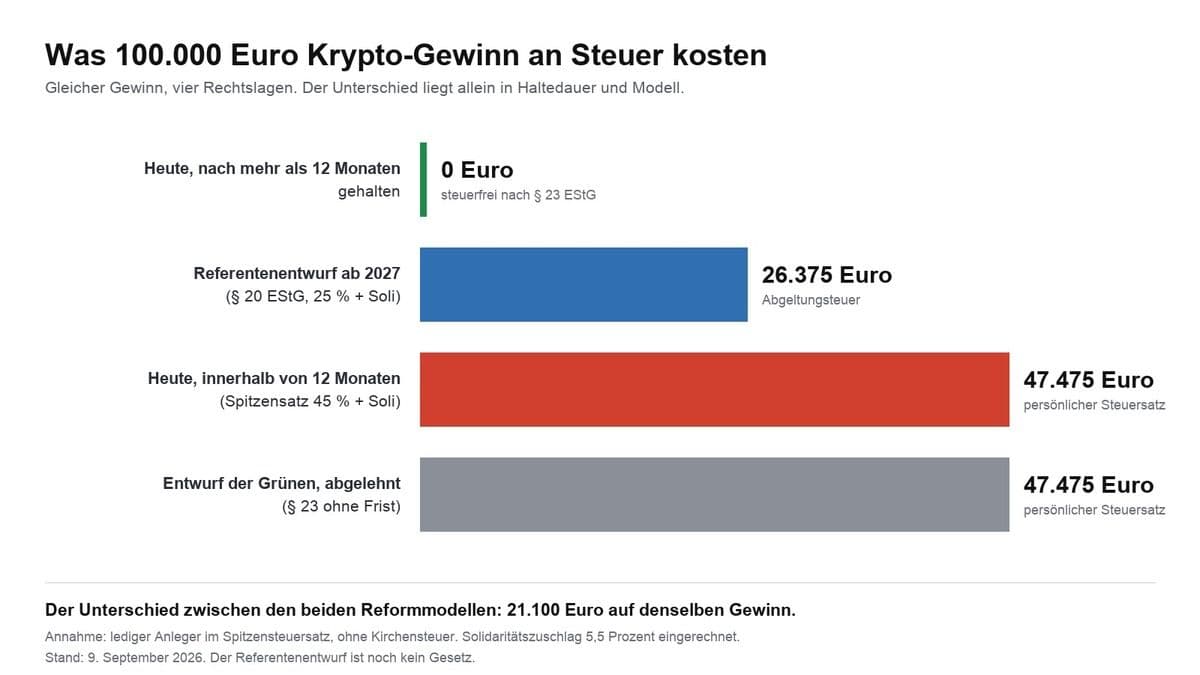
Crypto Tax in Germany: What Applies in 2026 and What Is Set to Change in 2027
Crypto gains are tax-free after twelve months; before that your personal tax rate of up to 45 percent applies. What triggers tax, how the holding period is calculated, what happens with staking and losses, and what the draft bill would change from 2027.
October 9, 2026 10:50 AM

Crypto holding period: the Bundestag rejects abolition by 445 votes to 132: what investors need to know
On 8 October the Bundestag rejected the Greens' bill to abolish the crypto holding period in a recorded vote, and the Left's motion fell too. The result by parliamentary group, the official speech from the media centre, and why it was the SPD that gave investors the real signal in the debate.
September 27, 2026 1:17 PM
Dogecoin Price: What to Check on Holding Period and Custody Before the Year End
The Dogecoin price stands at $0.0977 on September 27, 2026 and has barely moved in a day. That calm is exactly the moment to work through the holding period, the reporting duty from 2026 and custody without any time pressure.
October 20, 2026 1:33 PM

60.6 percent down in twelve months and only 12th by market value: what to check before your purchase anniversary
Dogecoin has lost 60.6 percent over twelve months, more than twice as much as Bitcoin, and now ranks only 12th by market value. For investors in Germany the calendar matters more than the next price level: the anniversary of the purchase decides whether a gain stays tax free and whether a loss still counts at all.
October 16, 2026 7:25 PM

Crypto holding period for Bitcoin: “That remains to be seen,” says the finance ministry
The federal cabinet did not adopt the draft abolishing the one-year crypto holding period on October 14, 2026; it is still stuck in inter-ministerial consultation. This overview sets out what applies today, which dates follow and why the December 31, 2026 cutoff has no force of law so far.
October 15, 2026 4:13 AM

Crypto holding period: the cabinet date passes without a decision, December 31 stays the cut-off
Germany's federal cabinet did not adopt the expected decision of October 14, 2026 to abolish the one-year crypto holding period; the draft is still in interdepartmental consultation. Until new rules arrive, gains stay tax free after one year of holding, and the December 31, 2026 cut-off named in the draft separates old holdings from new ones.
October 11, 2026 7:26 PM

Stablecoin swaps: France plans the tax Germany has had for years
Swapping bitcoin into a stablecoin in France carries no tax so far. That is set to change from 2027, with the finance committee of the National Assembly having given its approval. In Germany such a swap has long been a taxable event, with one consequence many investors miss: the holding period starts again.
September 24, 2026 10:12 AM

XRP Falls 9.7 Percent: What to Check on Holding Period and Buying Route
XRP is down around 9.7 percent on the morning of September 24, twice as much as the typical large crypto asset. Our count of 18 coins shows who the pullback hits and which three things hold true regardless of the price.
September 14, 2026 10:23 AM

Take Ethereum Profits or Wait Out the Holding Period? What the Price Jump Means for Your Tax Bill
Ether reached its highest level since the end of January on September 11, 2026, and many are asking whether to sell now. In Germany the answer hangs on the purchase date first: we work out which tranches are tax free and which of them are showing a gain at all.
September 9, 2026 4:13 PM

Bitcoin 29 Percent Below Last Year: Which Crypto Losses You Can Still Use Before the One-Year Holding Period Expires
Nine out of ten major crypto assets trade lower today than exactly twelve months ago, Bitcoin alone by 29.2 percent. We measured the price series ourselves and show why the purchase date alone decides the tax value of your loss.
September 8, 2026 1:19 AM

Germany's Crypto Holding Period: What Happens Now Signing for Petition 201716 Closed on September 15
Recap as of September 27, 2026: the signature period for German parliamentary petition 201716, which asks for the one-year crypto holding period to be preserved, closed on September 15, 2026. This article explains what ended that day, how the petitions committee proceeds and why no investor has to sell because of it.
August 27, 2026 10:24 AM

Hyperliquid Unlock on September 6: How Much HYPE Really Hits the Market
On September 6, Hyperliquid releases around 9.92 million HYPE to the core contributors, nominally a good $800 million. In March, 173,217 tokens of the same tranche were claimed, or 1.75 percent.
More from CryptoTicker