
Kite unlock in early November: 1.11 billion KITE become tradable, almost half the circulating supply
At Kite the one-year lockup ends in early November, and 1.11 billion KITE come free at once. That is 43 to 46 percent of the circulating supply and the value of almost twelve trading days.





Which topics should we dive deeper into?
Select what genuinely interests you. Your picks feed directly into our editorial planning.
Crypto news that's actually worth your time.
Weekly. 60 seconds. Carefully curated by our editors: no hype, no promo flood, no spam.
At Kite (KITE) the one-year lockup expires in early November 2026, and around 1.11 billion KITE come free in a single tranche. Measured against the total supply of ten billion tokens that is 11.1 percent. Measured against the amount that can actually be traded today it is 43 to 46 percent. The Kite unlock therefore enlarges the circulating supply by almost half in one day, and that is why holders are looking more closely now than they would at an ordinary monthly instalment.
This article works through three things: where the 1.11 billion tokens come from, how the sum compares with daily trading turnover, and which part of the date is actually documented. The most important caveat first: the amounts are fixed, the calendar date is inferred. That is why this article says "early November" and gives no cut-off with a time attached.
What exactly happens at the Kite unlock in early November
A token unlock is the moment at which contractually locked tokens become available to their owners. Until then they exist, but they can be neither sold nor transferred. A cliff is the harshest form of it: instead of a monthly instalment, the lock on a whole block falls away at once, and the amount hits the market within a day.
At Kite both apply. The MiCA white paper of Kite AI Ltd. from October 2025 sets out the rule in one sentence: the team and investors are subject to a one-year lockup followed by a four-year release. Of the ecosystem and community allocation, 30 percent was free immediately and the rest runs off linearly over four years. For the module allocation it was 60 percent immediately. The total supply is capped in the same document at ten billion KITE, and the circulating supply at launch stood at 27 percent of that.
Anyone who wants to run their own numbers before the date will find the procedure step by step in our guide on how to work out a token unlock yourself. The mechanics are the same at every project; only the figures change.
Why 11 percent of the total supply acts like 43 to 46 percent in the market
Most unlock reports quote the share of the total supply. That figure is correct and still the less important one for an investor. Only what is in circulation can be sold, and at a young project the circulating amount is a fraction of the total supply.
At KITE the circulating supply on October 17 sits between 2.391 billion tokens (CoinGecko) and 2.568 billion (CoinMarketCap), depending on the data provider. The two houses count the same tokens differently, which is why a range stands here instead of a smoothed average. Set the 1.110 billion tokens coming free against that and the increase works out at 43.2 to 46.4 percent.
For context: roughly 25.8 percent of the total supply has been unlocked so far. After early November it will be a good 36 percent, and some 6.3 billion KITE remain locked. The cliff does not end the releases. It is their largest single step.
Four cliff pots and one running instalment: where the 1.11 billion KITE come from
The tranche is made up of five items, and they read differently from one another. Four of them are genuine cliffs; one is a running linear instalment that happens to fall on the same date:
- Team: 500 million KITE. Unsellable for twelve months, now available for the first time.
- Investors: 300 million KITE. The same lockup rule as for the team.
- Community airdrop: 200 million KITE. Widely spread, and so a correspondingly large number of individual decisions.
- Modules: 50 million KITE. The share for the operators of the specialist services in the network.
- Ecosystem growth: around 60.4 million KITE. Not a lockup that ends, but the next slice of a running four-year plan.
For the question of selling pressure, the first two items are the decisive ones. 800 million tokens sit at addresses that could not sell anything for a year even if they had wanted to. The widely spread airdrop pot tends to behave differently: many small holders decide one by one, and some of them never claimed their entitlement at all.

$131 million released against $11 million to $17 million in daily turnover
A token count on its own says little. It becomes meaningful only in relation to what the market absorbs on a normal day. At a price of around $0.1185 the tranche is worth some $131.5 million. Against that stands daily turnover of $11.3 million (CoinGecko) to $17.3 million (CoinMarketCap).
That gives a figure worth remembering: the amount coming free equals 7.6 to 11.6 trading days. Alongside it sits the market capitalisation of $283 million to $304 million, ranked 148th and 110th respectively depending on the provider. The release is therefore worth roughly half of the entire circulating supply valued to date.
That expressly does not mean this sum will be sold. Nobody can know how many of the recipients will hold. It means the market could not absorb it in a day if a larger part of it went to the sell side. Holders who want to put their position in order before the date will find the venues, their fees and their deposit routes in our comparison of crypto exchanges.
 Compare exchanges before the lockup ends
The date is softer than the amount: November 1, 3 or 17
Here lies the honest gap in this event. The MiCA white paper states the rule but no calendar date: it speaks of a token launch "expected in November 2025". What is documented is the start of trading itself. The exchange HTX announced on November 3, 2025 the listing of KITE/USDT for trading. One year on, that leads to November 3, 2026.
CoinMarketCap's unlock database, by contrast, puts a day marker on November 1, 2026, without a time. And the same MiCA document names November 17, 2025 as the date of admission to trading, which would be a third possible anchor. Three sources, three readings, and not one of them names a minute.
In practice that means the following for a holder: the window opens on November 1 and is open by November 3 at the latest. Anyone setting an order or a stop level against it takes the earlier marker rather than the later one. A date that arrives two days early costs more than one that arrives two days late.
Is the cliff already in the price? The view over 24 hours and seven days
A market expecting a large unlock often prices it in weeks ahead. At KITE little of that is visible so far. The price stands at about $0.1185 on October 17, down around 1.3 percent on the day and 8.1 to 8.9 percent on the week. That is an ordinary move lower in a weak market and not a pattern that points to anticipation.
No price forecast follows from that, and none stands here. Two readings sit side by side. The first: because the date is barely priced in, it hits the price without warning. The second: because analyst attention for a project ranked between 110th and 148th is thin, the reaction stays thin too, and the large holders sell over weeks instead of in a single day. Which of them applies will only show in November.
How differently such dates turn out is visible in our own coverage. At Rain and its unlock the circulating supply and the trading volume were similarly far apart, and at Plasma (XPL) the one-year cliff was followed by a fixed monthly schedule. A cliff is a test of market absorption rather than a verdict on a project.
The Kite unlock and German tax: what changes for holders
For investors in Germany the tax side hangs on their own acquisition date, not on the project's unlock date. Under section 23 of the Income Tax Act, crypto assets held privately are subject to the one-year holding period: hold for longer than a year and then sell, and no income tax falls on the gain. Sell inside the year and the gain is taxed at the personal rate, provided gains from private disposal transactions in the calendar year exceed the threshold of 1,000 euros.
Anyone who bought KITE at the trading launch in November 2025 therefore reaches the one-year mark at roughly the same time as the cliff. Anyone who came in later sells inside the deadline. The order of purchases counts by acquisition date rather than by instinct, and that is exactly why a clean schedule pays off before a date on which many holders act at the same time. Tools for that are set out in our overview of crypto tax software and portfolio trackers.
Whether the holding period stays in this form is open. The Bundestag rejected its abolition in October 2026, and a cabinet date passed without a decision; our report on the reform of the crypto holding period of October 16, 2026 records where the process stands. For November 2026 the deadline applies unchanged. This section does not replace tax advice.

Kite AI as a layer 1 for AI agents: what KITE is needed for in the network
Behind the token sits a layer 1 network of its own, meaning a blockchain with its own security rather than a layer on top of someone else's. Kite AI describes it as a proof-of-stake network with EVM compatibility, tailored to payments between autonomous AI agents: agents are meant to hold a verifiable identity, keep to fixed spending limits and settle tiny amounts among themselves. Alongside sit what it calls modules, semi-autonomous sub-networks for individual AI services that settle with the main network.
In this structure KITE is the stake for operating roles. The white paper names the thresholds: a module operator has to deposit 30 million KITE, a validator one million, a delegator 166,667. That is relevant to the unlock question, because any token tied up in such a role cannot be sold on the market at the same time. For anyone still unsure what staking means: it describes locking tokens to secure a network, in return for a reward.
Whether the recipients of the cliff tranche take that route cannot be predicted and is not publicly documented. All that can be evidenced is that the route exists.
Where KITE can be traded: MiCA white paper and venue
KITE trades on Binance and HTX among others and is therefore reachable from Germany too. That a MiCA white paper exists for the token is a separate piece of information: the European regulation on markets in crypto assets requires such a document before a token is admitted to trading in the EU. It does not replace supervisory approval. The document itself states expressly that no competent authority of a member state has approved it and that the applicant alone is liable for the content. What MiCA demands of providers and how much of it bites by 2026 is set out in our overview of the MiCA licensing obligations for crypto companies.
For the choice of venue that means the admission of the token and the authorisation of the exchange are two different things. A platform with a MiCA licence falls under the supervision of a European authority, for German customers BaFin, and has to keep client funds segregated. A token with a white paper on an exchange without a licence does not bring that protection with it.
 Document your holding periods and gains cleanly
Kite unlock: from November 1 the market's capacity decides
The amounts are documented, the day only approximately, and nobody knows in advance what the recipients will do. Three things can be prepared:
- Enter the date as a window, not as a day. The tranche can fall between November 1 and November 3. Anyone setting orders or stop levels puts them at the early edge. Which exchange offers which order types and which fees is set out in the exchange comparison.
- Hold your own position size against the range. 7.6 to 11.6 trading days in a single day is the yardstick every position size has to be measured against. Anyone trading a project of this size also checks whether the venue is supervised in Europe; the selection stands in the comparison of regulated crypto exchanges.
- Look up your own purchase date. A sale in November meets an almost expired holding period on a purchase from November 2025, and not on a later one. The evidence for it belongs together before the date rather than after it; the aids are listed in the overview of tax software and portfolio trackers.
A total loss is possible at any time with a token of this size, and a cliff of this size adds to the swings.
(As of October 17, 2026. This article is not investment advice. Prices and fee structures change; check the terms with the provider before you buy.)
Frequently asked questions about Kite (KITE)
Transparency note: This article was produced with the assistance of artificial intelligence and reviewed by our editorial team before publication. All figures and claims were checked against the primary sources linked in the text. The feature image was generated with AI.
Related articles
- FF Unlock on September 29: What the End of the Lock-Up at Falcon Finance Means
- Allora Unlock on November 11: How to Check What of the 160 Million ALLO Really Reaches the Market
- ZRO Unlock on October 20 Hits 5.92 Percent of the Circulating Supply: Hold or Sell?
- deBridge DBR: 618 million tokens come free on October 17, ten trading days of turnover at once
- DoubleZero Unlock on October 2: 1.655 Billion 2Z Come Free
Which topics should we dive deeper into?
Select what genuinely interests you. Your picks feed directly into our editorial planning.
Crypto news that's actually worth your time.
Weekly. 60 seconds. Carefully curated by our editors: no hype, no promo flood, no spam.

September 26, 2026 10:33 AM

Monad Unlock on November 24: Why 10.7 Billion MON Equal Around 90 Percent of the Circulating Supply
At the first anniversary of the mainnet launch, Monad's one-year lock-up on team tokens ends. This tranche alone reaches around 90 percent of the amount circulating today. What the primary source evidences, which aggregator figure is wrong, and what you can check before the date.
September 8, 2026 10:21 PM

Crypto Holding Period and Grandfathering: Why December 31, 2026 Becomes the Cut-Off in Germany's Draft Bill
A ministerial draft bill from Germany's finance ministry names a cut-off date for the first time: crypto assets acquired after December 31, 2026 are to fall under the flat-rate withholding tax. What that means for legacy holdings, running savings plans and staking income, and why nothing has been decided yet.

September 29, 2026 7:13 AM
700 million HYPE sit outside circulation as the September 29 unlock approaches
Several data services list a fresh HYPE release for September 29, yet their figures range from 330,000 to 14.18 million tokens. Our own count of the holdings shows where that spread comes from and which part of HYPE is not in circulation at all.
September 1, 2026 1:31 PM

Plasma XPL Unlock on September 25: 1.81 Billion Tokens Come Free
On September 25, 2026 Plasma's one-year lock-up for team and investors expires: 1,805,555,556 XPL come free on a single day, around 65 percent of the current circulating supply. Here is where the figure comes from, what follows month by month, and how to verify the date yourself.
September 26, 2026 1:19 AM

Germany’s Crypto Holding Period Is Wobbling: What to Check Before December 31
A CDU member of the Bundestag makes it plain: the coalition agreement does not guarantee that the one-year holding period for crypto assets will survive. What that means for purchases made before the planned cutoff date of December 31, 2026.
September 9, 2026 4:22 PM
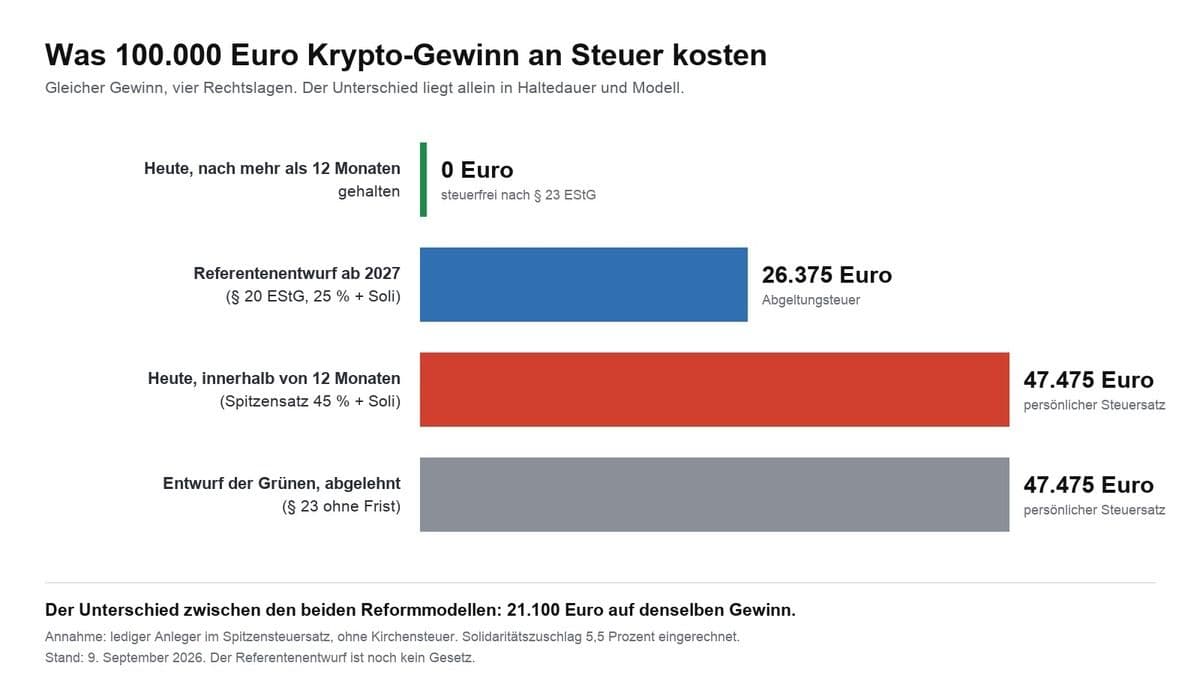
Crypto Tax in Germany: What Applies in 2026 and What Is Set to Change in 2027
Crypto gains are tax-free after twelve months; before that your personal tax rate of up to 45 percent applies. What triggers tax, how the holding period is calculated, what happens with staking and losses, and what the draft bill would change from 2027.
October 17, 2026 1:24 AM
Rain (RAIN) after the unlock: $6.3 billion market cap, $7.1 million in daily turnover
Since the token unlock of October 12, 62.08 percent of the RAIN supply is free and 433.15 billion units remain locked. Against a market value of $6.30 billion stands a daily turnover of $7.14 million, the second thinnest in the top 25.
October 15, 2026 4:32 AM
Which cryptocurrency to buy? Five criteria that matter before the coin
22,260 cryptocurrencies are on sale across 1,504 trading venues, and most guides start with the name. We reverse the order and set out the five criteria, from market capitalisation to the holding period, that come before the coin.
October 1, 2026 1:37 AM

Shiba Inu Forecast: 589 Trillion Tokens and What Matters Now for the Price Target
One cent per SHIB would equal 5.89 trillion dollars in market value, three and a half times Bitcoin. What the circulating supply says about realistic price targets, and which tax deadline is now running for investors in Germany.
October 9, 2026 10:50 AM

Crypto holding period: the Bundestag rejects abolition by 445 votes to 132: what investors need to know
On 8 October the Bundestag rejected the Greens' bill to abolish the crypto holding period in a recorded vote, and the Left's motion fell too. The result by parliamentary group, the official speech from the media centre, and why it was the SPD that gave investors the real signal in the debate.

September 27, 2026 1:17 PM
Dogecoin Price: What to Check on Holding Period and Custody Before the Year End
The Dogecoin price stands at $0.0977 on September 27, 2026 and has barely moved in a day. That calm is exactly the moment to work through the holding period, the reporting duty from 2026 and custody without any time pressure.
September 9, 2026 1:15 AM

Germany's Crypto Tax: 160 Million Euros for a 555-Billion Budget
The German finance ministry's draft bill puts a figure on the crypto tax for the first time: 160 million euros from 2028. What that number means in the 2027 federal budget, how 11.4 billion became 160 million, and what investors can read from it.
October 16, 2026 7:25 PM

Crypto holding period for Bitcoin: “That remains to be seen,” says the finance ministry
The federal cabinet did not adopt the draft abolishing the one-year crypto holding period on October 14, 2026; it is still stuck in inter-ministerial consultation. This overview sets out what applies today, which dates follow and why the December 31, 2026 cutoff has no force of law so far.
October 15, 2026 4:13 AM

Crypto holding period: the cabinet date passes without a decision, December 31 stays the cut-off
Germany's federal cabinet did not adopt the expected decision of October 14, 2026 to abolish the one-year crypto holding period; the draft is still in interdepartmental consultation. Until new rules arrive, gains stay tax free after one year of holding, and the December 31, 2026 cut-off named in the draft separates old holdings from new ones.
September 24, 2026 10:12 AM

XRP Falls 9.7 Percent: What to Check on Holding Period and Buying Route
XRP is down around 9.7 percent on the morning of September 24, twice as much as the typical large crypto asset. Our count of 18 coins shows who the pullback hits and which three things hold true regardless of the price.
September 14, 2026 10:23 AM

Take Ethereum Profits or Wait Out the Holding Period? What the Price Jump Means for Your Tax Bill
Ether reached its highest level since the end of January on September 11, 2026, and many are asking whether to sell now. In Germany the answer hangs on the purchase date first: we work out which tranches are tax free and which of them are showing a gain at all.
September 9, 2026 4:13 PM

Bitcoin 29 Percent Below Last Year: Which Crypto Losses You Can Still Use Before the One-Year Holding Period Expires
Nine out of ten major crypto assets trade lower today than exactly twelve months ago, Bitcoin alone by 29.2 percent. We measured the price series ourselves and show why the purchase date alone decides the tax value of your loss.
September 8, 2026 1:19 AM

Germany's Crypto Holding Period: What Happens Now Signing for Petition 201716 Closed on September 15
Recap as of September 27, 2026: the signature period for German parliamentary petition 201716, which asks for the one-year crypto holding period to be preserved, closed on September 15, 2026. This article explains what ended that day, how the petitions committee proceeds and why no investor has to sell because of it.
August 27, 2026 10:24 AM

Hyperliquid Unlock on September 6: How Much HYPE Really Hits the Market
On September 6, Hyperliquid releases around 9.92 million HYPE to the core contributors, nominally a good $800 million. In March, 173,217 tokens of the same tranche were claimed, or 1.75 percent.
October 6, 2026 10:24 PM

Germany's Crypto Holding Period Before the Petitions Committee on October 12: What Matters Now
The Bundestag's petitions committee debates the crypto holding period on Monday, October 12, 2026, from 12 noon in a public sitting, with federal government representatives on hand for questions. Two days later the cabinet is to decide on the draft bill that removes the one-year period for purchases from 2027.
September 13, 2026 10:13 AM

Humanity Protocol Unlock of September 23: What H Holders Should Know Now the Kraken Deadline Has Passed
Recap as of September 27, 2026: Humanity Protocol was scheduled to release 292,857,143 H on September 23, 2026, and Kraken withdrawals for H and HUMANITY ended on September 25. This article recalculates the tranches and describes what holders should have checked before those dates.
September 4, 2026 4:49 AM
Token Unlock Math: What Comes Free at Capricorn (APR) on October 23
On October 23, 2026 the one-year lock-up for early investors and core developers at Capricorn Tech comes to an end. The project documentation names 92.8 million APR, a widely used unlock calendar almost 150 million — this article shows you how to resolve such contradictions yourself.
August 29, 2026 10:13 AM

EigenLayer Unlock: What Happens to 39.5 Million EIGEN on September 1
On September 1, 2026, 39,488,745 EIGEN leave lock-up, 4.49 percent of circulating supply. The tranche goes entirely to insiders and is the next instalment in a series running to October 2027.
August 11, 2026 9:13 PM

Germany's Crypto Holding Period Faces Abolition: What Petition 201716 and the Draft Bill Mean for Your Tax
Petition 201716 calls for the one-year holding period for crypto assets to be kept and will be heard in public by the Bundestag's Petitions Committee on 12 October 2026. Correction of 8 October: the reform was not decided by the cabinet in July. A draft bill of 30 September would end the holding period for crypto acquired after 31 December 2026, and the cabinet is due to take it up on 14 October.
August 19, 2026 4:36 PM

LayerZero Unlock on August 20: How to Calculate ZRO's Monthly Dilution
On August 20, 2026 the next monthly tranche of LayerZero's ZRO token comes off its lock-up, and not for the first time, because no single deadline ends here at once. How to work out the monthly dilution yourself from allocation, total supply and schedule, why the data platforms report different numbers, and why the amount released is rarely the amount sold.
October 8, 2026 4:17 AM

Crypto Holding Period: Without a Purchase Record the Tax Withheld Runs Ten Times Too High
The consultation on Germany's crypto tax bill closed on October 6 and the cabinet is to adopt it on October 14, with tax advisers, banks and the Bitcoin Bundesverband having filed their objections. The sharpest concerns everyone whose purchase data the selling platform does not hold: one adviser calculates a withholding ten times the tax owed.
August 21, 2026 1:42 PM

Writing Off a Total Crypto Loss: When the Tax Office Recognises Worthless Coins
A token that has collapsed only reduces your tax once you actually dispose of it. What applies to delisting, exchange insolvency and worthless holdings under Section 23 of the German Income Tax Act, and how you offset losses.
More from CryptoTicker