
Allora Unlock on November 11: How to Check What of the 160 Million ALLO Really Reaches the Market
Allora's twelve-month lock-up for core contributors and early backers ends on November 11: 160.2 million ALLO become tradable at once, roughly $41 million against a daily turnover of just over $4 million. Where the figure comes from, why the trackers disagree, and what tells you after the date how much of it was actually sold.





Which topics should we dive deeper into?
Select what genuinely interests you. Your picks feed directly into our editorial planning.
Crypto news that's actually worth your time.
Weekly. 60 seconds. Carefully curated by our editors: no hype, no promo flood, no spam.
On November 11, 2026 the twelve-month lock-up on two large token allocations at Allora expires. According to the Allora Foundation's published tokenomics, 33 percent of 485.5 million ALLO become free on that date in one step, around 160 million tokens. Set against a circulating supply of just over 255 million ALLO, the unlock adds almost 63 percent in a single day. The more telling number sits beside it: at a price of $0.2589 that is roughly $41 million meeting a daily turnover of just over $4 million.
Nowhere is it written that this amount will actually be sold, and that gap is what separates a headline from a calculation. This article sets out where the 160 million come from, why different trackers quote different figures, and which numbers will tell you after November 11 how much of the supply genuinely reached the market.
Allora Unlock on November 11: What the 160 Million ALLO Consist Of
Allora is a network for decentralised artificial intelligence. An inference is the individual prediction a model delivers inside the network, and it is paid for in ALLO. The token therefore serves as the means of payment for predictions, as the stake in staking, and as the reward for everyone who runs models or rates their quality.
Supply is capped at one billion ALLO. Two items of the initial distribution matter for November 11: core contributors at 17.50 percent, the developers of the core protocol, and early backers at 31.05 percent, the early financiers. According to the foundation, both allocations follow a three-year vesting plan built the same way: twelve months fully locked, then a single release of 33 percent, with the remainder spread linearly over the following 24 months.
That pattern has a name of its own. A cliff unlock is the edge at the end of a lock-up where a large block becomes tradable at a stroke instead of arriving over months. Readers who want the mechanics in general terms will find them in our guide to calculating token unlocks.
The Tokenomics Arithmetic: 17.50 Percent Plus 31.05 Percent Equals 485.5 Million
What makes this case unusual is that the release amount does not have to be estimated. Both percentages appear in the published tokenomics, and the maximum supply is fixed. The calculation runs in three steps:
- 17.50 percent plus 31.05 percent gives 48.55 percent of maximum supply.
- 48.55 percent of one billion ALLO is 485.5 million locked tokens.
- 33 percent of that is 160.215 million ALLO, split into 57.75 million for the core contributors and 102.465 million for the early backers.
The check needs nothing beyond a calculator and the Allora Foundation's tokenomics publication. That is what sets this date apart from many other unlock reports, which rest on a calendar entry at a data provider and nothing else.

The Cliff Unlock Against Circulating Supply: 63 to 80 Percent, Depending on the Source
A release amount on its own says little. It becomes meaningful only in relation to circulating supply, the tokens already freely tradable. Here the data providers part ways, and any honest account has to say so.
CoinGecko puts ALLO's circulating supply at around 255 million tokens in early October. On that basis the 160.2 million amount to almost 63 percent. Other providers, among them DropsTab and CoinMarketCap, work with roughly 200.5 million tokens in circulation; there the same block comes to around 80 percent. Both figures are in use, and neither is plainly wrong. The addition therefore falls in a range of just over 60 to about 80 percent of today's tradable supply, and quoting one of the two without the other narrows the picture.
The release amount itself is also reported differently in different places. The tokenomics arithmetic gives 160.2 million ALLO. Vesting trackers quote 163.9 million and 165.4 million for the same day, because they include further smaller tranches from the same period. The range of 160 to 165 million is thus explainable rather than a contradiction between sources.
$41 Million Meets $4 Million in Daily Turnover
Market impact is decided neither by the token count nor by its share of circulating supply, but by the ratio to trading volume. At a price of $0.2589, 160.2 million ALLO come to roughly $41.5 million. Turnover across all venues combined stood at just over $4.1 million in a single day in early October.
The released volume therefore reaches about ten times an average trading day. For a sense of scale: ALLO's entire market capitalisation sits at around $66 million, and the token ranks 393rd among crypto assets by market value. A market of that depth cannot absorb selling pressure worth several days of turnover without the price responding. Whether that pressure arises at all is a separate question.
No Calendar Date in the Primary Source: Where November 11 Comes From
Precision matters more than neatness here. The Allora Foundation's tokenomics describes the structure of the lock-up, twelve months followed by 33 percent. The document names no calendar date.
November 11 is derived from the start of trading. ALLO became tradable on several exchanges simultaneously on November 11, 2025, and CoinGecko dates the all-time high of $1.60 to the same day. Twelve months later, the end of the lock-up accordingly falls on November 11, 2026. Independent vesting trackers list the date exactly that way, among them the DropsTab vesting overview.
The defensible formulation is therefore a twelve-month mark that the trackers date to November 11. It is not an officially fixed deadline with a time of day attached. Anyone keeping the date in a calendar does better to watch the days either side of it as well, because a release can also shift for technical reasons.

After the Cliff: 325 Million ALLO Over 24 Months, 13.5 Million a Month
November 11 brings the largest release, not the last one. After the cliff, around 325.3 million of the 485.5 million locked tokens remain, and those are distributed linearly over 24 months. On average that works out at about 13.55 million ALLO a month.
Measured against today's circulating supply, that is a good five percent per month, every month, through to November 2028. Coverage of cliff dates regularly loses sight of this steady load, even though it carries more tokens into the market over two years than the date itself. For context: only 25.5 percent of maximum supply is in circulation today.
Unlocked Is Not Sold: The Staking Clause in Allora's Tokenomics
An unlock moves tokens out of a vesting contract and into freely available wallets. Nothing has been sold at that point. How wide the gap between the two turns out to be depends on what the recipients do with the tokens, and the protocol itself has a hand in that.
The Allora Foundation names two guiding principles for emissions in its tokenomics. The second states that the yield per staked token should remain stable around large releases, with the explicit aim of keeping those tokens off the market. The network is therefore trying to keep staking attractive at precisely the moment when the largest quantity comes free. Whether the calculation works out can only be measured afterwards.
A second mechanism sits alongside it: fees for inferences go to contributors before new tokens are created. As network usage rises, the share of fresh emissions in rewards falls. This has nothing to do with the cliff on November 11, but a good deal to do with how supply develops in the months that follow.
Circulating Supply, Exchange Inflows and Staking: Four Numbers After November 11
Four observations separate a release from a sale, and all four are publicly available.
- Circulating supply. Does it actually rise at the data providers in the expected order of magnitude in the days after November 11? If it stays more or less unchanged, the release has either been postponed or the tokens have not entered circulation.
- Inflows to the exchanges. Tokens meant to be sold have to reach a trading venue first. A marked rise in exchange balances shortly after the date is the earliest signal visible to the public.
- The staking ratio. If the freed tokens go into the network's staking instead, they stay out of the market for the time being.
- Daily turnover. A price decline on persistently low volume means something different from a decline on multiplied turnover. Only in the second case has selling taken place on any real scale.
We applied the same sequence of checks most recently to Monad (MON), where the difference between release and sale could be read off exactly these figures.
ALLO in a Portfolio: Venue, Custody and the Bridges to Ethereum and Base
ALLO has been listed on several international venues since trading began in November 2025. For European investors, two points weigh more heavily than the question of where the token is currently cheapest.
The first is authorisation. Under the European MiCA regulation, crypto service providers may offer their services in the EU only with a corresponding licence. Whether the venue you intend to buy or sell ALLO through holds one can be checked in the register of your national supervisor and in the platform's own disclosures. An exchange without an EU licence can restrict its offering for customers in the bloc at short notice, quite independently of what the price is doing.
The second is custody. ALLO runs natively on the Allora chain and, according to the foundation, has been reachable via bridges on Ethereum, Base and BNB Chain since launch. Moving tokens across a bridge adds that bridge's risk on top. Ahead of a date with a lot of expected movement, the quieter option is to leave holdings where you control access yourself.
Tax on ALLO Gains in Germany: Section 23 EStG and the One-Year Rule
In Germany, crypto assets count as other economic assets within the meaning of Section 23 of the Income Tax Act. If you sell ALLO at a gain within a year of buying, the transaction is a private disposal and the gain is taxable. After a holding period of more than a year it remains tax-free. There is also a threshold: gains stay tax-free only if the total gain from all private disposals in a year comes to less than 1,000 euros. From 1,000 euros the entire amount is taxable, not merely the part above the line.
For an unlock date this carries a consequence that is easily missed. Buying shortly before November 11 to catch an expected move and selling shortly after keeps you entirely inside the one-year window. What counts is your own acquisition date, not the project's release date. Clean records of every purchase and sale are therefore not a luxury; the crypto tax software and portfolio tracker comparison shows which programmes handle it.
Whether the one-year rule survives is politically open. Abolition has been under discussion for months, though on the published state of the draft Annual Tax Act 2026 it does not appear there. Until a decision is taken, the existing rule continues to apply.
Monad, Plasma and Falcon: The Same Design in Three Cases
The Allora date is not an isolated case but a design that has been repeating for months: a lock-up, a cliff, a share of circulating supply and a ratio to daily turnover. We ran the same arithmetic most recently for Plasma (XPL) and for Falcon (FF).
What that yields is a framework for your own assessment, not a price target: how large the block is relative to circulating supply, how deep the market is, and what follows monthly after the cliff. ALLO trades around 84 percent below its November 2025 all-time high and well above its February 2026 low. Which of those two marks lies closer after November 11 is beyond serious prediction.
Allora Unlock: There Is Time to Do the Maths Before November 11
The date is a good five weeks away. The quantity is settled, the market impact is not. Three steps turn the headline into an assessment of your own.
- Record today's baseline. ALLO's circulating supply, price and daily turnover, plus the venue you would trade the token through. Which platforms hold an EU licence and what they charge is set out in the crypto exchange comparison.
- Consider the staking alternative. If a large share of the released tokens stays in staking, less reaches the market. How staking yields arise and what costs sit behind them is covered in the staking platform comparison.
- Settle custody before the date. Tokens you hold yourself are affected by neither an exchange outage nor a short-notice trading halt. The hardware wallet comparison covers the devices worth considering.
(As of October 8, 2026. This article is not investment advice. Prices and fee structures change; check the terms with the provider before you buy.)
Frequently asked questions about the Allora unlock
Transparency note: This article was produced with the assistance of artificial intelligence and reviewed by our editorial team before publication. All figures and claims were checked against the primary sources linked in the text. The feature image was generated with AI.
Related articles
- FF Unlock on September 29: What the End of the Lock-Up at Falcon Finance Means
- deBridge DBR: 618 million tokens come free on October 17, ten trading days of turnover at once
- DoubleZero Unlock on October 2: 1.655 Billion 2Z Come Free
- Monad Unlock on November 24: Why 10.7 Billion MON Equal Around 90 Percent of the Circulating Supply
- Plasma XPL Unlock on September 25: 1.81 Billion Tokens Come Free
Which topics should we dive deeper into?
Select what genuinely interests you. Your picks feed directly into our editorial planning.
Crypto news that's actually worth your time.
Weekly. 60 seconds. Carefully curated by our editors: no hype, no promo flood, no spam.

August 27, 2026 10:24 AM

Hyperliquid Unlock on September 6: How Much HYPE Really Hits the Market
On September 6, Hyperliquid releases around 9.92 million HYPE to the core contributors, nominally a good $800 million. In March, 173,217 tokens of the same tranche were claimed, or 1.75 percent.
August 29, 2026 10:13 AM

EigenLayer Unlock: What Happens to 39.5 Million EIGEN on September 1
On September 1, 2026, 39,488,745 EIGEN leave lock-up, 4.49 percent of circulating supply. The tranche goes entirely to insiders and is the next instalment in a series running to October 2027.
September 13, 2026 10:13 AM

Humanity Protocol Unlock of September 23: What H Holders Should Know Now the Kraken Deadline Has Passed
Recap as of September 27, 2026: Humanity Protocol was scheduled to release 292,857,143 H on September 23, 2026, and Kraken withdrawals for H and HUMANITY ended on September 25. This article recalculates the tranches and describes what holders should have checked before those dates.

September 26, 2026 7:40 AM

The RAIN Token After the Enlivex Termination: What to Check on Access, Forced Sale and Holding Period
Enlivex terminated a share placement of 66,666,667 shares payable in RAIN tokens on September 22, 2026. The token sits 46.4 percent below its all-time high, and at Kraken the withdrawal deadline expired long ago.
September 29, 2026 7:13 AM
700 million HYPE sit outside circulation as the September 29 unlock approaches
Several data services list a fresh HYPE release for September 29, yet their figures range from 330,000 to 14.18 million tokens. Our own count of the holdings shows where that spread comes from and which part of HYPE is not in circulation at all.
September 9, 2026 4:22 PM
Crypto Tax in Germany: What Applies in 2026 and What Is Set to Change in 2027
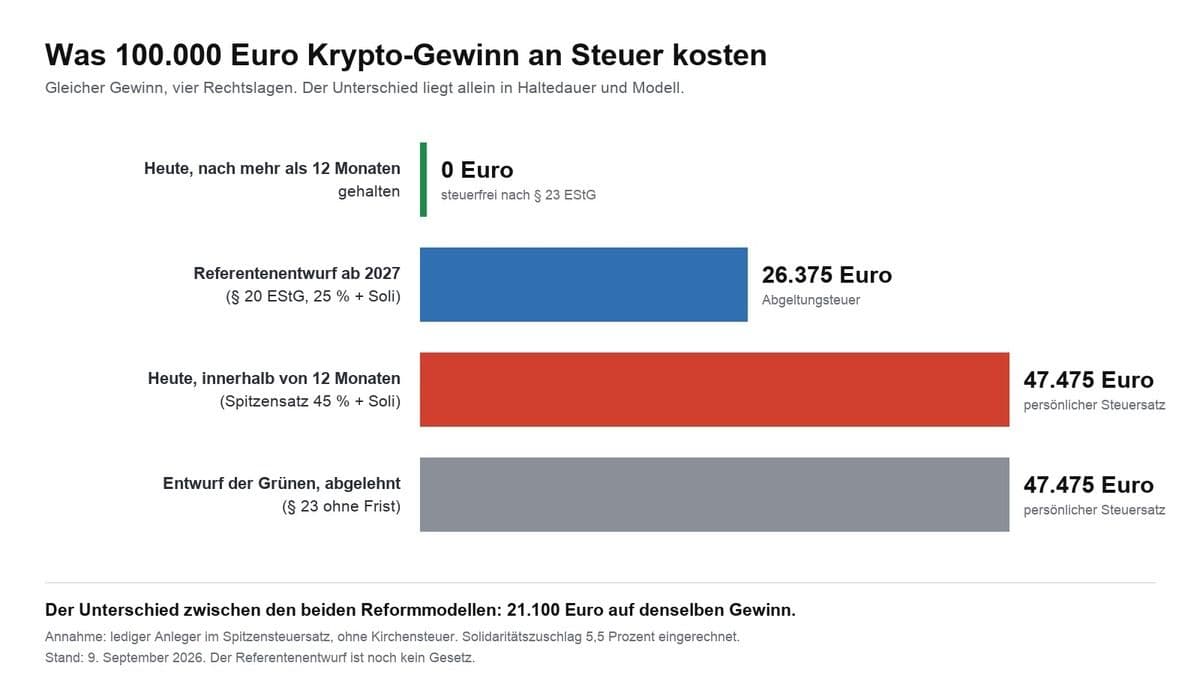
Crypto gains are tax-free after twelve months; before that your personal tax rate of up to 45 percent applies. What triggers tax, how the holding period is calculated, what happens with staking and losses, and what the draft bill would change from 2027.
September 8, 2026 10:21 PM

Crypto Holding Period and Grandfathering: Why December 31, 2026 Becomes the Cut-Off in Germany's Draft Bill
A ministerial draft bill from Germany's finance ministry names a cut-off date for the first time: crypto assets acquired after December 31, 2026 are to fall under the flat-rate withholding tax. What that means for legacy holdings, running savings plans and staking income, and why nothing has been decided yet.
October 6, 2026 4:16 AM

13 exchanges list MemeCore, not one euro pair: hold or sell M?
Not one of the 14 markets that list MemeCore trades against the euro: every exit runs through Tether or USDC. What the thin order book, the monthly tranche of 56.1 million M and the holding period mean for your M position.
October 2, 2026 5:02 PM

Bitcoin or Ethereum in the fourth quarter of 2026: the two largest crypto-assets compared
Bitcoin is scarce by protocol rule, Ethereum only as scarce as its utilisation, and on access and tax in Germany the paths part again. This comparison puts the verifiable figures on supply, usage, staking and purchase route side by side, without making a price call.
September 26, 2026 7:14 AM

Cardano Before the RealFi Launch on October 1: What ADA Holders Should Check on USDr, MiCA and Tax
On October 1, 2026 the stablecoin platform RealFi goes live on the Cardano mainnet, and ADA has gained 14.67 percent in a week. What is documented about the yield-bearing dollar token USDr, and what investors should settle beforehand.
September 19, 2026 1:38 AM

Uniswap jumps above $9: what UNI holders should check on the fee switch now
The UNI price gains 18.67 percent within 24 hours, driven by the active fee switch and a new exemption from the US securities regulator. What of that can be recalculated, what remains pure expectation, and which three things you should settle now as an investor in Germany.
September 26, 2026 1:19 AM
Germany’s Crypto Holding Period Is Wobbling: What to Check Before December 31
A CDU member of the Bundestag makes it plain: the coalition agreement does not guarantee that the one-year holding period for crypto assets will survive. What that means for purchases made before the planned cutoff date of December 31, 2026.

September 27, 2026 1:17 PM
Dogecoin Price: What to Check on Holding Period and Custody Before the Year End
The Dogecoin price stands at $0.0977 on September 27, 2026 and has barely moved in a day. That calm is exactly the moment to work through the holding period, the reporting duty from 2026 and custody without any time pressure.
September 24, 2026 10:12 AM

XRP Falls 9.7 Percent: What to Check on Holding Period and Buying Route
XRP is down around 9.7 percent on the morning of September 24, twice as much as the typical large crypto asset. Our count of 18 coins shows who the pullback hits and which three things hold true regardless of the price.
September 14, 2026 10:23 AM

Take Ethereum Profits or Wait Out the Holding Period? What the Price Jump Means for Your Tax Bill
Ether reached its highest level since the end of January on September 11, 2026, and many are asking whether to sell now. In Germany the answer hangs on the purchase date first: we work out which tranches are tax free and which of them are showing a gain at all.
September 9, 2026 4:13 PM

Bitcoin 29 Percent Below Last Year: Which Crypto Losses You Can Still Use Before the One-Year Holding Period Expires
Nine out of ten major crypto assets trade lower today than exactly twelve months ago, Bitcoin alone by 29.2 percent. We measured the price series ourselves and show why the purchase date alone decides the tax value of your loss.
September 8, 2026 1:19 AM

Germany's Crypto Holding Period: What Happens Now Signing for Petition 201716 Closed on September 15
Recap as of September 27, 2026: the signature period for German parliamentary petition 201716, which asks for the one-year crypto holding period to be preserved, closed on September 15, 2026. This article explains what ended that day, how the petitions committee proceeds and why no investor has to sell because of it.
September 4, 2026 4:49 AM
Token Unlock Math: What Comes Free at Capricorn (APR) on October 23
On October 23, 2026 the one-year lock-up for early investors and core developers at Capricorn Tech comes to an end. The project documentation names 92.8 million APR, a widely used unlock calendar almost 150 million — this article shows you how to resolve such contradictions yourself.
September 9, 2026 1:15 AM

Germany's Crypto Tax: 160 Million Euros for a 555-Billion Budget
The German finance ministry's draft bill puts a figure on the crypto tax for the first time: 160 million euros from 2028. What that number means in the 2027 federal budget, how 11.4 billion became 160 million, and what investors can read from it.
October 2, 2026 1:33 PM

Crypto tax before the cabinet on October 14: “Comments are only possible until October 6”
Germany's Federal Ministry of Finance sent the draft bill on crypto taxation to the associations on September 30, 2026, and the cabinet is to decide on October 14. For your holdings one date counts above all: December 31, 2026.
August 19, 2026 4:36 PM

LayerZero Unlock on August 20: How to Calculate ZRO's Monthly Dilution
On August 20, 2026 the next monthly tranche of LayerZero's ZRO token comes off its lock-up, and not for the first time, because no single deadline ends here at once. How to work out the monthly dilution yourself from allocation, total supply and schedule, why the data platforms report different numbers, and why the amount released is rarely the amount sold.
September 24, 2026 4:28 AM

Crypto Trading Bots and Tax: What Applies With Thousands of Trades a Year
A bot turns one investment decision into hundreds of disposals, and the tax office counts every single one. This guide explains the holding period, FIFO, the exemption limit and the record-keeping duties, and what to set up before the bot makes its first trade.
September 16, 2026 1:20 PM

Crypto Loss Carryforward in Germany: What Happens to Old Losses Under the 2027 Tax Plan
Losses from crypto sales land in a ring-fenced pot and can only be set against gains of the same kind. The draft bill for 2027 moves future gains into a different pot, and we show you what that means for your assessed carryforward and what your tax notice should say.
September 12, 2026 10:11 PM

Crypto CFD or Buying Real Coins? How Leverage, Margin Calls and Tax Differ
With a crypto CFD you own a contract; with a direct purchase you own the crypto asset itself. From that one difference follow the 2:1 leverage cap, forced close-out, the tax burden and the question of who is liable for your money if things go wrong.
September 10, 2026 4:15 PM

BW-Bank Opens Bitcoin Trading Inside the Securities Account: What to Check Before Your First Buy
Since September 9, 2026, BW-Bank customers have been able to trade ten crypto assets through their securities account, executed and held in custody by Bitpanda. The familiar securities-account setting hides three points you should settle before your first order.
September 25, 2026 10:26 PM

Selling bitcoin privately: the tax in Germany and the records you need
A direct sale to a private individual falls under the same one-year rule as an exchange sale, but there is no tax report to go with it. This guide walks through the calculation, the 1,000 euro threshold and the records the tax office wants to see.
September 24, 2026 4:16 AM

Trump-Xi Summit at the White House: The Crypto Positions to Check Before the Meeting
Xi Jinping is on a state visit to Donald Trump today, and the crypto market comes into the meeting carrying the gains of an exceptionally strong week. What to check on leverage, holding period and custody before the first headline runs.
More from CryptoTicker