
3 Reasons Crypto Is Still Holding Strong After the Fed Rate Hike
The Fed hiked, the CLARITY Act died, and crypto barely moved. Here are three reasons the market is consolidating rather than breaking down.





Which topics should we dive deeper into?
Select what genuinely interests you. Your picks feed directly into our editorial planning.
Crypto news that's actually worth your time.
Weekly. 60 seconds. Carefully curated by our editors: no hype, no promo flood, no spam.
This week was supposed to be the one that ended the rally. The Senate killed the crypto industry's biggest legislative push in years on Tuesday. The Federal Reserve raised interest rates for the first time since 2023 on Wednesday. Two catalysts, 24 hours apart, both pointing down.
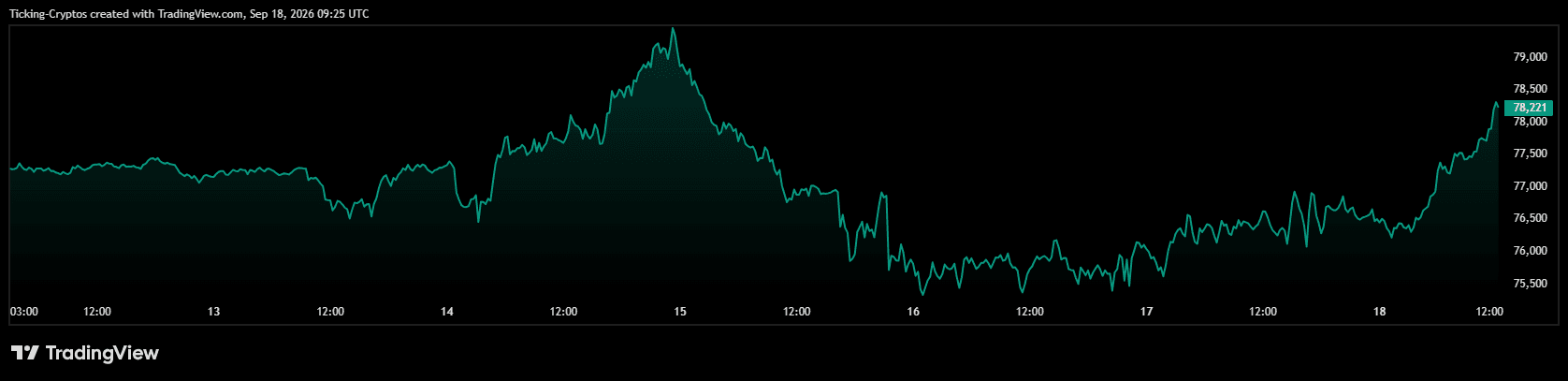
$Bitcoin is trading near $77,900 as of Friday, after a previous close of $76,559 and a day range between $76,289 and $78,051. It gave up ground, took it back, and is now sitting almost exactly where it started the week. That is not weakness. That is consolidation, and there are three solid reasons behind it.
What Is Actually Happening in the Crypto Market Right Now?
Over the past 30 days Bitcoin is up 20.5%, having run from roughly $64,000 in mid-August to the high $70,000s, with an average price of $77,286 across the period. August alone delivered a 25% gain.
A market that has just added a fifth of its value in a month does not usually push straight through. It ranges, it shakes out leverage, and it waits for the next input. That is exactly what the $75,000 to $78,000 band has been doing.
Reason 1: The Bad News Was Already in the Price
The Fed hike was priced at roughly 93% odds in futures markets going into the meeting. When the 12-0 decision landed, Bitcoin spiked to about $76,500 within five minutes and gave the move back within half an hour. A market that barely reacts to a confirmed hawkish event has already absorbed it.
The CLARITY Act was a similar story. Bitwise's CIO had already revised his outlook on the bill and argued the bull market can continue without legislation, pointing out that Bitcoin climbed above $80,000 in early September even as the odds of passage were falling. Traders had been repricing the legislative path for weeks before the vote.
 Compare the best crypto exchanges
Reason 2: Institutional Demand Has Not Left the Table
This is the strongest leg of the argument. Total Bitcoin ETF assets sit above $103 billion after August pulled in $3.52 billion, the best month of 2026.
The altcoin funds tell the same story. On days when spot prices fell, $Ethereum, $Solana and XRP ETFs still posted net inflows of $10.95 million, $10.19 million and $14.38 million, and $XRP funds ran 11 consecutive days of net buying worth roughly $170 million. Nasdaq put $100 million into Payward, Kraken's parent, on September 10 at a $21 billion valuation, and the Canary staked TRX ETF launched on September 9 as the first spot staked crypto fund in the US.
Positioning adds to the case. JPMorgan noted on September 16 that gold ETFs have recovered all of their 2026 outflows while Bitcoin ETFs have recovered only about half, and that short interest in BlackRock's IBIT remains near its highest level of the year. If that hedging pressure unwinds, it becomes fuel rather than drag.
Reason 3: Regulation Is Moving Without Congress
The CLARITY Act failing 49-50 looked like a wall. It is closer to a detour.
The SEC put Regulation Crypto Assets out for comment in August and has since opened a five-year pathway for tokenized US stock trading. The CFTC chair had already instructed staff to build a market-structure regime under existing Commodity Exchange Act authority. Neither depended on the Senate.
 CryptoTicker trading game: try it free
Congress has not gone quiet either. The House Financial Services Committee advanced the American Reserve Modernization Act, H.R. 8957, by 28-21, keeping the US Bitcoin reserve idea alive. Outside the US, Canada's financial regulator clarified that tokenized bank deposits are legally equivalent to traditional deposits. The direction of travel has not reversed, only the vehicle has changed.
What Could Still Break the Bull Case?
Being honest about the other side matters. Bitcoin remains roughly 39% below its October 2025 all-time high of $128,198, and the 52-week range runs from $57,833 to $126,186, so this is still a recovery, not a breakout.
The Fed is the real risk. Sixteen of eighteen officials project at least one more hike this year and four expect two, which puts December in play. With the 10-year Treasury yield near 5% and Bitcoin carrying a 0.89 correlation to the S&P 500 and 0.91 to the Nasdaq, crypto is trading as a risk asset right now, not as a hedge. If equities crack, crypto follows.
Related articles
- Crypto News Today: Bitcoin Holds $76,000 After Fed Hike and CLARITY Act Collapse
- Why Is Crypto Crashing Today? Bitcoin Slides to $76,000 as the CLARITY Act Vote Wobbles
- Bitcoin Price Frozen Near $79,000 as Oil and War Risk Rewrite the Macro Playbook
- Crypto News Today: Hawkish Fed, a $70M Wallet Hack and Bitcoin's Shaky Start to August
- Crypto Price Today: Market Slides Again as Bitcoin Fails at $67,000
Which topics should we dive deeper into?
Select what genuinely interests you. Your picks feed directly into our editorial planning.
Crypto news that's actually worth your time.
Weekly. 60 seconds. Carefully curated by our editors: no hype, no promo flood, no spam.

July 10, 2026 6:11 AM

Why Is Bitcoin Price Up Again Today?
Bitcoin is pushing back toward a key level as regulatory hopes and a major banking move lift the mood. Here is what is driving crypto today.
February 26, 2026 11:03 AM

What Needs to Happen for Crypto to Surge Again? 5 Signals to Watch Before the Next Bull Run
What needs to happen for crypto to surge again? Here are 5 key signals to watch before the next Bitcoin bull run begins.

September 3, 2026 4:04 PM

Bitcoin Price Smashes Back Through $80,000: Here Is What Just Set It Off
Bitcoin price surged to $80,477 in a matter of hours after a dovish Fed signal crushed rate hike bets. Here is the chart and the real driver.
October 21, 2025 4:17 PM

Bitcoin Surges Past $112,000 as the Fed Opens Doors to Crypto: What’s Next?
Bitcoin jumps above $112,000 after the U.S. Federal Reserve hinted at granting crypto firms access to its payment network. Here’s what this means for BTC and the broader market.
August 17, 2026 11:36 AM

Crypto News Today: White House Crypto Summit Collides With Collapsing CLARITY Act Odds
Crypto news today: Trump's White House crypto summit, CLARITY Act odds crashing to 10 percent and 390 million dollars in Bitcoin ETF outflows.
March 9, 2026 10:20 AM

Crypto Market News: Bitcoin Price Battles $67k as US CPI and CLARITY Act Loom
Bitcoin recovers to $67,500 while the market eyes US CPI data and the CLARITY Act. Discover the key events driving crypto prices next week.
June 13, 2024 4:13 PM

Crypto Market DOWN As Bitcoin Price Slides, Ethereum Price Consolidates, And XRP Price Nears New Lows
The recent Federal Reserve decisions and market dynamics impact Bitcoin, Ethereum, and XRP. How to manage and what to monitor amid market volatility and uncertainty?
September 15, 2026 9:20 AM

Crypto Price Today: Bitcoin Stuck Near $77,000 as the Fed and the CLARITY Act Collide
Crypto prices barely moved today, but two events this week decide the next leg: the Senate CLARITY Act vote and a Fed meeting priced for a rate hike.
September 16, 2026 2:03 PM

XRP Price Crashes 9% as CLARITY Act Dies: How Low Can XRP Go?
XRP price crashed almost 9% after the Senate killed the CLARITY Act. Here is why XRP fell harder than Bitcoin, and the XRP price targets that matter now.
September 14, 2024 12:01 PM

Bitcoin Surges Past $60K: The Start of a Major Rally or Just Another Bull Trap?
Bitcoin has surged past $60,000, sparking optimism among investors. But with looming market volatility and whale activity, is this the start of a new rally or just another bull trap?
April 18, 2026 11:17 AM

Bitcoin Price Targets $90,000: Why the $78,000 Weekly Close is Critical
Bitcoin is eyeing a major breakout. A weekly close above $78,000 could trigger a massive rally toward the $90,000 mark in the coming weeks.
November 11, 2025 10:25 AM

US Government Reopens After 41 Days – What It Means for Bitcoin, Crypto, and Global Markets
The US government reopens after a record 41-day shutdown. Rate cuts, QT ending, and new crypto laws could reshape markets—here’s what investors must know.
January 13, 2026 7:13 PM

Did Tariff News Stop the Crypto Bull Run? The January 2026 Rally Revisited
On 13 January 2026 Bitcoin pushed towards $94,000 ahead of an expected Supreme Court tariff ruling. The ruling came on 20 February, and by then the rally was long over.
October 8, 2026 4:38 AM

Crypto Market Slides: Bitcoin Loses 4.2 Percent and $651 Million of Long Bets Are Liquidated
Bitcoin has lost 4.2 percent since Tuesday afternoon, and ether and XRP more still. Three reasons can be documented: outflows from the US ETFs, $651 million of forcibly closed long bets and Fed minutes holding out the prospect of another rate rise. A crash it is not, and what to check before buying more is set out here.
June 5, 2024 5:03 PM

Crypto Market Up: Bitcoin Breaches $71K, Altcoins Follow Suit, Eyes on New Highs
Cryptocurrencies are experiencing a surge, with Bitcoin leading the charge by surpassing $71,000. This bullish trend extends to altcoins, igniting optimism across the market. Will Bitcoin reach new highs?
September 6, 2026 11:19 AM

Bitcoin Price Today: BTC Holds Firm Before The Biggest Week Of The Month
Bitcoin sits near $80,000 after a jobs report killed a four-month high. CPI, the Fed and a Senate vote all land in the next ten days.
September 7, 2026 6:05 PM

Crypto News Today: Bitcoin Holds $79,000 While The Fed, Tether And A Hacker All Make Trouble
Bitcoin is pinned below $80,000 as September hike odds sit at 58%. Plus a warning on Tether's keys and the Coldcard attacker moving funds again.
July 25, 2026 7:02 PM
AI Stocks Went From A Few Trillion To $22 Trillion. Can The CLARITY Act Do The Same For Crypto?
The CLARITY Act is one Senate floor vote from law. Here is what the viral AI-stock comparison gets right — and what it gets badly wrong.
July 22, 2026 1:00 PM

Bitcoin Nears $67K as ETF Inflows Hit $1 Billion and the CLARITY Act Reaches the "1-Yard Line"
Bitcoin ETFs pulled in nearly $1 billion in six days as BTC neared $67K and Bessent said the CLARITY Act is at the "1-yard line." Here's what's driving it.
July 14, 2026 9:55 AM

Bitcoin Price Stuck at $60K: 3 Events This Week Could Unlock the Next Big Move
Bitcoin is pinned to the $60K line as Extreme Fear grips the market. But three catalysts landing over the next 48 hours could finally shake crypto out of its deadlock — here's what to watch.
June 24, 2026 10:37 AM
CLARITY Act Vote: Why Bitcoin's Next Move Could Hinge on the Senate
The Senate is racing to vote on the CLARITY Act before recess. Here's why the crypto market structure bill could decide Bitcoin's next big move.
January 24, 2026 9:42 AM

Bitcoin Briefly Reclaims $91K as Markets Digest Regulatory, Macro, and Institutional Signals
Bitcoin briefly reclaimed $91,000 before pulling back as markets digest US regulation signals, dollar weakness, ETF expansion, and institutional activity.
August 9, 2024 10:16 AM

Bitcoin Price Prediction: After Breaking The $60k Mark, Can BTC Price Surpass $70k Next?
A huge surge in Bitcoin price is on the horizon with multiple signals waving for investors to grab this opportunity. Explore the potential for BTC price...
May 2, 2026 7:00 PM

Crypto Regulation News: Stablecoin Yield Rules Could Trigger the Next Bitcoin Move
New US stablecoin yield rules could reshape crypto regulation, stablecoin adoption, and Bitcoin’s next major market move.
October 18, 2023 2:52 PM

Bitcoin Price Prediction: Will The Bull Run Continue?
Bitcoin price prediction: The crypto market recently experienced a surge in prices, largely attributed to the news of the Bitcoin ETF.

More from CryptoTicker