
Crypto News Today: The CLARITY Act Vote Nears and Bitcoin Holds Its Range
Bitcoin trades near $78,600 with the market cap back above $2.68 trillion. ETF flows turned positive in August, and the CLARITY Act cloture vote lands on 15 September.





Which topics should we dive deeper into?
Select what genuinely interests you. Your picks feed directly into our editorial planning.
Crypto news that's actually worth your time.
Weekly. 60 seconds. Carefully curated by our editors: no hype, no promo flood, no spam.
Bitcoin is holding just under $78,600 this morning, a quiet day at the end of a loud month. August delivered a gain of almost 25%, September has so far delivered a range, and the market is waiting on two things it does not control: the price of oil and the Senate. XRP, BNB and Solana are all softer on the day while their weekly columns stay green, Bitcoin dominance sits at 58.89%, and the flows underneath have turned friendlier than they were in the summer. Here is what matters this morning.
What are crypto prices doing today?
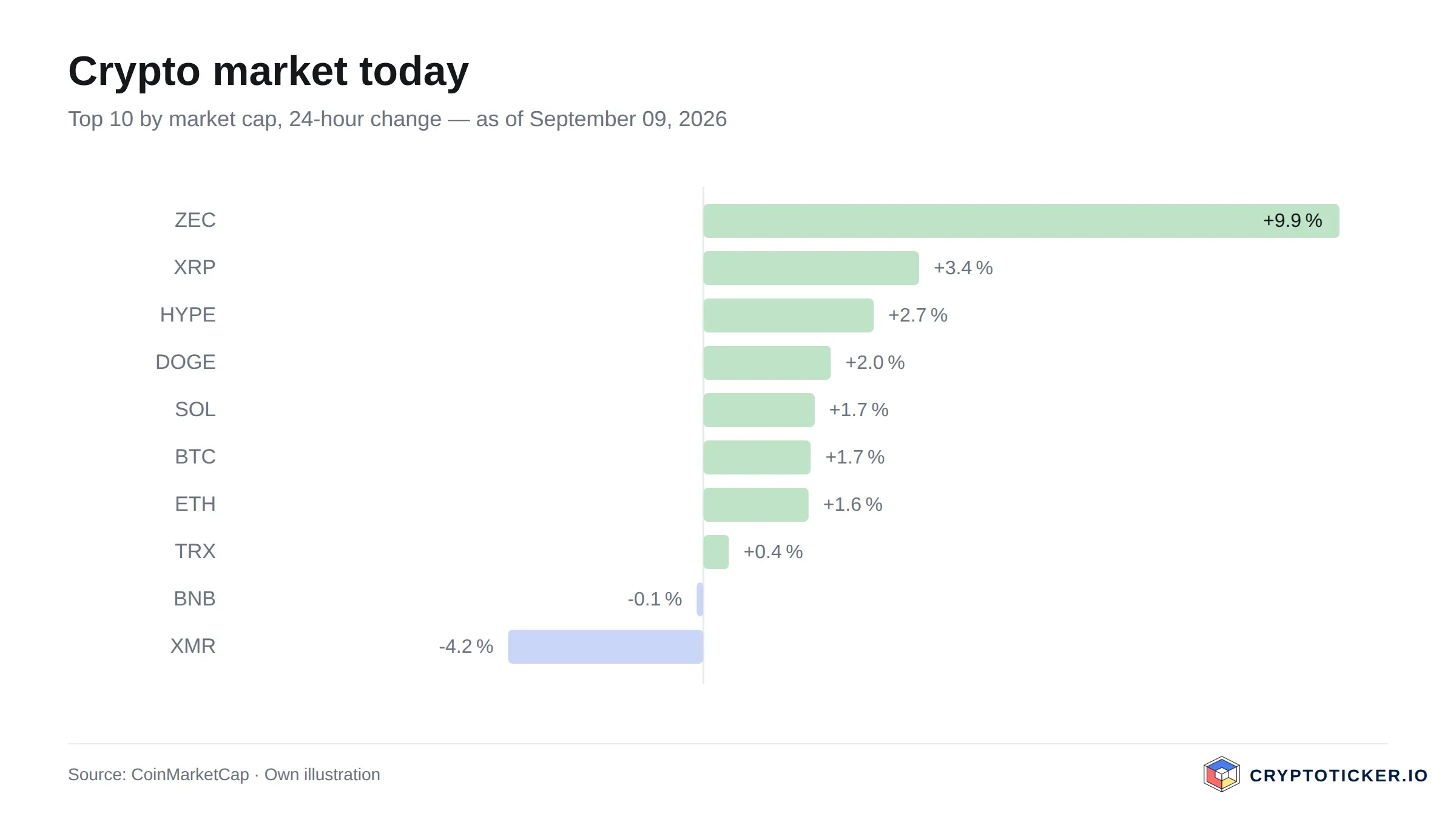
The market is flat to slightly lower on the day and green across the week: Bitcoin trades near $78,598, the total market cap is back above $2.68 trillion, and Bitcoin dominance stands at 58.89%.
🟠 Bitcoin (BTC) | $78,598.14 | -0.31% (24h) | +1.78% (7d) | $1.58 trillion cap
🔵 Ethereum (ETH) | $2,491.14 | -0.32% (24h) | +4.36% (7d) | $304.00 billion cap
🟡 BNB (BNB) | $739.20 | -2.20% (24h) | +7.65% (7d) | $98.43 billion cap
⚪ XRP (XRP) | $1.4184 | -0.61% (24h) | +6.31% (7d) | $89.00 billion cap
🟣 Solana (SOL) | $103.16 | -0.78% (24h) | +4.02% (7d) | $60.48 billion cap
🔴 TRON (TRX) | $0.3383 | -0.32% (24h) | +4.41% (7d) | $32.12 billion cap
🧭 BTC dominance | 58.89%
😀 Fear and Greed Index | 72 out of 100
Dominance at 58.89% is almost exactly where it stood in the middle of August, but everything around it has changed. Back then dominance was rising into a falling market, which is what capital leaving the asset class looks like. Now it is holding steady while the total recovers, which means the money coming back is going into Bitcoin first. Same number, opposite meaning.
$Bitcoin has come back from a 90-day low of $58,550, and $Ethereum has added 4.36% in the past week alone. Daily turnover across the market is $82.07 billion, which is unremarkable, and that is the point: this is a market digesting a move rather than making one.
Sentiment gauges have travelled furthest of all. The Fear and Greed Index reads 72 out of 100, firmly in greed. In mid-August the same index read 29, and the low of this cycle was 10 on 5 February 2026. Greed is a confirmation and a warning in the same number: it arrives after the move, not before it.
Why is Bitcoin struggling to clear $81,000?
The 30-day high at $81,272 is the level that has capped every attempt this month, and Bitcoin has not managed a daily close above it.
The structure below price is now supportive rather than obstructive. Bitcoin at roughly $78,600 trades above its EMA20 at $76,733, its EMA50 at $72,031 and its EMA200 at $72,916. All three flipped from resistance to support during the August advance, and the EMA200 in particular is the line that separated the earlier downtrend from the current phase.
Daily RSI14 near 63 is firm without being stretched, so there is room before the market looks short-term overbought above 70. On the downside, the EMA20 near $76,733 is the first line worth watching, and the 30-day low at $62,830 marks how far the range has run this month.
What has capped the move is not positioning but the macro backdrop. Renewed fighting between the United States and Iran has pushed oil back toward $100 a barrel, which feeds straight into headline inflation one week before the Federal Reserve meets. A central bank absorbing higher energy costs is a central bank in less of a hurry to cut, and crypto has traded as a rate-sensitive asset all year.
How do the Bitcoin ETF flows look now?
US spot Bitcoin ETFs took in $3.52 billion over the course of August, reversing the outflow pattern that dominated the middle of the summer.
This is the clearest change since this article first ran. In mid-August the story was withdrawals: spot Bitcoin ETFs shed more than $385 million in a single week, and three consecutive days of outflows in the days around 15 August removed the market's most reliable source of spot demand. Across the full month the direction reversed, and the $3.52 billion net figure arrived alongside a price gain of almost 25%.
 CoinbaseSponsored
Buy bitcoin on an exchange regulated in the EU
Coinbase is regulated in the EU under MiCA and lists more than 310 cryptocurrencies. Our link gets new customers 15 euros in bitcoin for their first trade. According to the provider the offer runs until 31 December 2026.
Open an account and claim €15 in bitcoin →Crypto is high risk, a total loss is possible. Partner link.
The caveat that applied then still applies now. Institutional 13F headlines are noisy: Jane Street's $630 million accumulation in Q2 2026 reflected its authorised participant role in ETF creation mechanics rather than a directional bet, and one quarter earlier the same firm had cut its Bitcoin ETF holdings by 71%. Flow data is a better guide than any single filing.
What has not happened yet is a September follow-through. The August inflow told you institutions came back during the rally. It does not tell you whether they stay through a month in which the main catalysts sit in Washington rather than on an exchange.
Where does Ethereum stand against Bitcoin?
The ETH/BTC ratio has climbed to roughly 0.0317, up from 0.02994 in mid-August, extending the move that treasury buyers pointed to as their central argument.
Ether at $2,491 against Bitcoin at $78,598 puts the ratio near 0.0317. Tom Lee's Bitmine used the ratio at 0.02994 as the basis for its accumulation case in August, arguing it had broken above a long-term downtrend and was starting to price in tokenisation and agentic AI applications. The ratio has since risen about 6%, which is a point in favour of that argument, though it is a single ratio and not a thesis on its own.
Bitmine reported 5,815,164 ETH as of 16 August, equal to roughly 4.8% of the circulating supply of 120.7 million, alongside crypto, cash and strategic stakes totalling $11.4 billion. Those tokens were valued at a reference price of $1,893 at the time. At today's $2,491 the same position is worth materially more, which is the mechanical effect of a rising market on a leveraged treasury strategy and cuts both ways.
On the ETF side, Fidelity has filed to add staking and quarterly cash payouts to its Fidelity Ethereum Fund, which could stake as much as 100% of its ether, keeping 85% of gross staking rewards with the remaining 15% going to the sponsor, custodians and node operators. The proposal is not yet effective: Fidelity cannot begin staking until the SEC declares the amended registration statement effective.
Is the CLARITY Act still on track?
The decisive Senate cloture vote is set for 15 September at 2:15 p.m. ET, and it needs 60 votes. Prediction markets put the odds of the bill becoming law in 2026 near 16%.
This is the single dated event that matters most for the rest of the month. Republicans hold 53 Senate seats, so at least seven Democrats would have to join a unified GOP conference to clear the cloture threshold, and Democratic opposition to parts of the bill has not softened.
Three disputes are doing the blocking: ethics rules aimed at the president's crypto income, developer liability for DeFi under Section 604, and a stablecoin yield provision that cuts into exchange revenue from USDC rewards. None of the three is close to resolved.
The odds tell the story of the year. Polymarket had the bill at 82% in February and 16% on 6 September. If cloture fails on 15 September, the bill is effectively dead for 2026, because the Senate calendar afterwards is taken up by midterm campaigning, appropriations and the debt ceiling. The next realistic window would be a new Congress in 2027 at the earliest.

What does the exchange business tell us about demand?
Korea's two largest exchanges both reported revenue roughly halving in the first half of 2026, which points to a structural shift in retail behaviour rather than one weak quarter.
Upbit operator Dunamu reported revenue of 408.1 billion Korean won, around $275 million, down 49.1% year on year, with operating profit down 79.7% to 111.5 billion won or roughly $75 million. Bithumb reported a parallel decline of about 50% over the same period. Dunamu attributed it to reduced global digital asset liquidity, with the KOSPI more than doubling in the first half of 2026 and pulling retail capital out of crypto and into equities.
That matters because Korean retail has historically been a meaningful marginal buyer of Bitcoin. It is also worth reading in context: those figures cover a half-year that ended before the August rally, so they describe the market that has just turned rather than the one trading today.
Consolidation continues on the venue side. BitMEX stopped accepting new positions on 26 August and ceases operations entirely at 04:00 UTC on 23 September 2026, with balances left after closure attracting a $50 monthly fee or a 1% annual charge. If you still hold funds there, that deadline is two weeks away. A hardware wallet is the usual destination.
What should traders watch for the rest of the month?
Three things decide September, and two of them are not crypto: the oil price, the Federal Reserve, and the cloture vote on 15 September.
On the chart, the levels are simple. The 30-day high at $81,272 is the ceiling that has to break for the August trend to extend. The EMA20 near $76,733 is the first support, and a loss of the EMA200 near $72,916 would mean the August advance is being given back rather than digested.
Away from the chart, oil near $100 a barrel is the brake, and the Fed decision lands in roughly one week. Between them they set the rate expectation that crypto has followed for the whole of 2026. The cloture vote on 15 September then decides whether the regulatory question that has hung over institutional allocation all year gets an answer or another delay.
Corporate treasury behaviour remains the wildcard. Both MARA and Strategy have been net sellers this year, and a fresh disclosure of treasury liquidation lands harder on a market that is consolidating than on one that is trending.
More on Bitcoin: All Bitcoin news at a glance
Related articles
Which topics should we dive deeper into?
Select what genuinely interests you. Your picks feed directly into our editorial planning.
Crypto news that's actually worth your time.
Weekly. 60 seconds. Carefully curated by our editors: no hype, no promo flood, no spam.

September 17, 2026 10:40 AM

Crypto News Today: Bitcoin Holds $76,000 After Fed Hike and CLARITY Act Collapse
The CLARITY Act died in the Senate, the Fed hiked for the first time since 2023, and Zcash ripped anyway. Here is the full crypto market update.
September 15, 2026 4:24 PM
Why Is Crypto Crashing Today? Bitcoin Slides to $76,000 as the CLARITY Act Vote Wobbles
Bitcoin slid to $76,000 and the entire top 20 turned red as CLARITY Act odds collapsed before today's Senate vote. Here is what is really driving it.
June 5, 2024 5:03 PM

Crypto Market Up: Bitcoin Breaches $71K, Altcoins Follow Suit, Eyes on New Highs
Cryptocurrencies are experiencing a surge, with Bitcoin leading the charge by surpassing $71,000. This bullish trend extends to altcoins, igniting optimism across the market. Will Bitcoin reach new highs?
July 27, 2024 2:34 PM

Why Is The Crypto Market Up TODAY?
With the Bitcoin 2024 Conference taking place now in Nashville, the crypto market is showing bullish signals, intriguing traders around the future of Bitcoin and Altcoins.
July 25, 2026 11:27 AM

Crypto Price Today: Market Slides Again as Bitcoin Fails at $67,000
Bitcoin slipped back under $64,000 after tapping $66,990. Oil, ETF outflows and Fed nerves are dragging the whole crypto market lower.
July 25, 2024 12:35 PM

Ethereum Price Analysis: Why is Ethereum Price Down?
Here is the impact of the recent Ethereum ETF launch on the crypto market, leading to a significant sell-off and a $300 million liquidation event. Not what was expected?
August 12, 2026 4:55 PM

Crypto Prices Today: Only 2 of the Top 10 Coins Are Up in 2026
Bitcoin sits near $63,433 and TRON and Hyperliquid are the only green names on the year. Here are today's prices and the next catalysts.
July 25, 2026 7:02 PM
AI Stocks Went From A Few Trillion To $22 Trillion. Can The CLARITY Act Do The Same For Crypto?
The CLARITY Act is one Senate floor vote from law. Here is what the viral AI-stock comparison gets right — and what it gets badly wrong.
July 14, 2026 9:55 AM
Bitcoin Price Stuck at $60K: 3 Events This Week Could Unlock the Next Big Move
Bitcoin is pinned to the $60K line as Extreme Fear grips the market. But three catalysts landing over the next 48 hours could finally shake crypto out of its deadlock — here's what to watch.
October 8, 2026 5:06 PM

Crypto Crash Reason: Why Bitcoin Fell Below $81,000 and Altcoins Bled Even Harder
Bitcoin slid under $81,000 and Ethereum lost 9% in a week. Here is every crypto crash reason behind the October 2026 selloff explained.
August 2, 2026 10:04 AM

Crypto News Today: Hawkish Fed, a $70M Wallet Hack and Bitcoin's Shaky Start to August
Crypto news today: the Fed split 9-3, a Coldcard flaw drained $70M in BTC, and ETFs turned red. Here is the full week and what lands next.
August 16, 2026 9:05 AM

Crypto Weekly Recap: Bitcoin Slips Below $63,000 as CPI Relief Never Arrives
Bitcoin sits near $62,990 and down 2.7% on the week, ETF flows turned negative and XRP broke $1. Your Sunday crypto recap.
August 14, 2026 10:14 AM
Crypto News Today: Washington Blinked and the Crypto Market Barely Moved
The SEC pulled its biggest crypto rulemaking of the year, ETF flows turned negative, and prices barely reacted. Here is what the market is telling you.
January 2, 2026 12:03 PM

Ethereum Hits a New Yearly High as Volatility Builds Across the Crypto Market
Ethereum breaks to a new yearly high as options expiry injects volatility into the market, with Bitcoin also flashing strength near key levels.
November 5, 2025 1:16 PM

$1 Trillion Wiped: Risk-Off Storm Engulfs Stocks & Crypto
Global markets plunge as tech stocks and crypto crash, wiping over $1 trillion in value amid AI bubble fears and investor risk-off panic.
December 24, 2025 5:30 PM

Crypto Market Analysis: Top 10 Cryptos Go Sideways During Christmas
Crypto prices remain largely flat as Bitcoin, Ethereum, and altcoins drift sideways during the Christmas holidays and low trading activity.

July 21, 2026 10:21 AM

Crypto Market Rebounds: Bitcoin Reclaims $66K and Ethereum Tops $1,900 as Inflation Fears Ease
Bitcoin is back above $66,000 and Ethereum has topped $1,900 as secondary inflation fears fade and ETF inflows return. Here's what's driving today's rally.
July 6, 2026 6:27 AM

Crypto Price Today: Bitcoin Reclaims $63K as July Rebound Gathers Steam
Bitcoin trades near $63,150 today, up 6% on the week as whale accumulation offsets record ETF outflows. Here's what's moving the market.
May 24, 2024 1:47 PM

SEC Approves Ethereum ETFs: A New Era for Crypto Investments
As SEC approves spot Ethereum ETFs, a signal of a new era for crypto investments is launched. But what are the implications expected on the crypto market and what does this mean for investors?
October 10, 2026 1:19 PM

Crypto ETF Outflows Pass $1 Billion in October: Is Wall Street Dumping Bitcoin and Ethereum?
Bitcoin and Ethereum ETFs just bled over $1 billion in October. Here is who is selling, who is still buying, and what it means for your coins.
September 2, 2026 4:28 PM

XRP ETFs Just Had Their Best Week of 2026. So Why Is the Price Still Falling?
US spot XRP ETFs pulled in record weekly inflows while XRP slipped toward $1.38. A Senate vote on September 15 may decide who is right.
January 13, 2026 7:13 PM

Did Tariff News Stop the Crypto Bull Run? The January 2026 Rally Revisited
On 13 January 2026 Bitcoin pushed towards $94,000 ahead of an expected Supreme Court tariff ruling. The ruling came on 20 February, and by then the rally was long over.
October 8, 2026 4:38 AM

Crypto Market Slides: Bitcoin Loses 4.2 Percent and $651 Million of Long Bets Are Liquidated
Bitcoin has lost 4.2 percent since Tuesday afternoon, and ether and XRP more still. Three reasons can be documented: outflows from the US ETFs, $651 million of forcibly closed long bets and Fed minutes holding out the prospect of another rate rise. A crash it is not, and what to check before buying more is set out here.
June 9, 2026 6:39 PM

Crypto Market Crash Deepens as Stocks, Gold, and Bitcoin Sell Off Together
Crypto market crash deepens as Bitcoin, stocks, gold, silver, and oil fall together. Is this panic selling or a deeper market reset?
August 15, 2026 2:02 PM

Crypto Prices Today: Oil Prices Cap the Bitcoin Rally as Chainlink Slips
Bitcoin trades near $78,600 and the crypto market cap is back above $2.68 trillion, but oil near $100 a barrel is keeping a lid on the September move.

More from CryptoTicker