

Play-to-earn (P2E) is a blockchain gaming model in which players earn crypto tokens or NFTs for playing, which they can sell for real money. The model became famous in 2021 through Axie Infinity, when players in the Philippines and other countries used it as a source of income. The first generation did not last: the tokens of the best-known P2E games traded 98.8 to 99.9 percent below their records on 11 November 2026, and the 410 tokens in CoinMarketCap's play-to-earn category were worth $1.74 billion together. Today the industry speaks of "play-and-earn" and "play-to-own": games that have to be fun first, with tokens and NFTs as an extra.
This guide explains what P2E means, how play-to-earn games and their token economies work, why most of them collapsed, how developers make money and what to check before you start. It is written for players and for anyone thinking about building a P2E game.
Play-to-earn: the key facts
- P2E stands for play-to-earn: in-game rewards are crypto tokens or NFTs that belong to the player and can be traded outside the game.
- $1.74 billion: combined market cap of the 410 tokens in CoinMarketCap's play-to-earn category on 11 November 2026.
- 99.5 percent: how far Axie Infinity's token AXS trades below its record of $165.37 from 6 November 2021.
- $620 million: the theft from the Ronin bridge of Axie Infinity in March 2022, which the FBI attributed to North Korea's Lazarus Group.
- Two tokens: many P2E games pay rewards in an inflationary in-game token and use a second, limited token for governance and staking.
- Free to start: after 2022 many new P2E games dropped the expensive entry NFTs, so players can try them without paying first.
What is play-to-earn gaming?
Play-to-earn gaming is a model in which players earn digital assets with real-world value by playing. In traditional games the money flows one way: players pay for the game, for skins or for in-game currency, and everything they collect stays locked inside the game. In P2E games, rewards are issued on a blockchain as cryptocurrencies or NFTs (non-fungible tokens). They belong to the player's own wallet, can be sold on exchanges and marketplaces and keep existing even if the player stops playing. This digital ownership of in-game assets is the real difference to traditional games. Play-to-earn games are also called crypto games, NFT games or blockchain games.
The term P2E is often used together with GameFi, a combination of gaming and decentralized finance. GameFi games add financial features such as staking, lending or yield on in-game assets. "Play-to-own" puts the emphasis on owning items rather than earning income, and "play-and-earn" describes the current approach: the game comes first, earning is optional.
How did play-to-earn games start?
Blockchain games started with collectibles. In late 2017, the cat-breeding game CryptoKitties became so popular that it slowed down the Ethereum network. In 2019, the team of the Chinese game studio MixMarvel presented the idea of combining games and finance at a blockchain conference, and Yearn founder Andre Cronje later popularized the word "GameFi". The breakthrough came with Axie Infinity, developed by the Vietnamese studio Sky Mavis.

| Year | What happened |
|---|---|
| 2017 | CryptoKitties shows that game items can be owned and traded as NFTs on Ethereum. |
| 2018 | Sky Mavis launches Axie Infinity, a battle game with creatures called Axies. |
| 2021 | The P2E boom: Axie's reward token SLP peaks on 1 May, AXS on 6 November at $165.37; The Sandbox, Decentraland and Gala reach their records in late November. |
| 2022 | Attackers steal $620 million from Axie's Ronin bridge; the reward economies collapse as new players stop coming. |
| 2024 | A second, smaller wave: the farming game Pixels and the Ronin token set their records in March. |
| 2026 | The 410 tokens of the play-to-earn category are worth $1.74 billion; studios focus on games that work without the earning promise. |
How do play-to-earn games work?
The mechanism rests on three building blocks. First, NFTs represent characters, items or land; the player owns them in a wallet and can sell them on a marketplace. Second, a reward token is paid out for in-game activity such as winning battles, completing quests or farming resources; players earn tokens and other rewards that have real-world value as long as someone buys them. Third, a governance token with a fixed supply gives holders a vote on the game's future and often a share of its fees through staking. In Axie Infinity, the reward token was SLP and the governance token AXS.
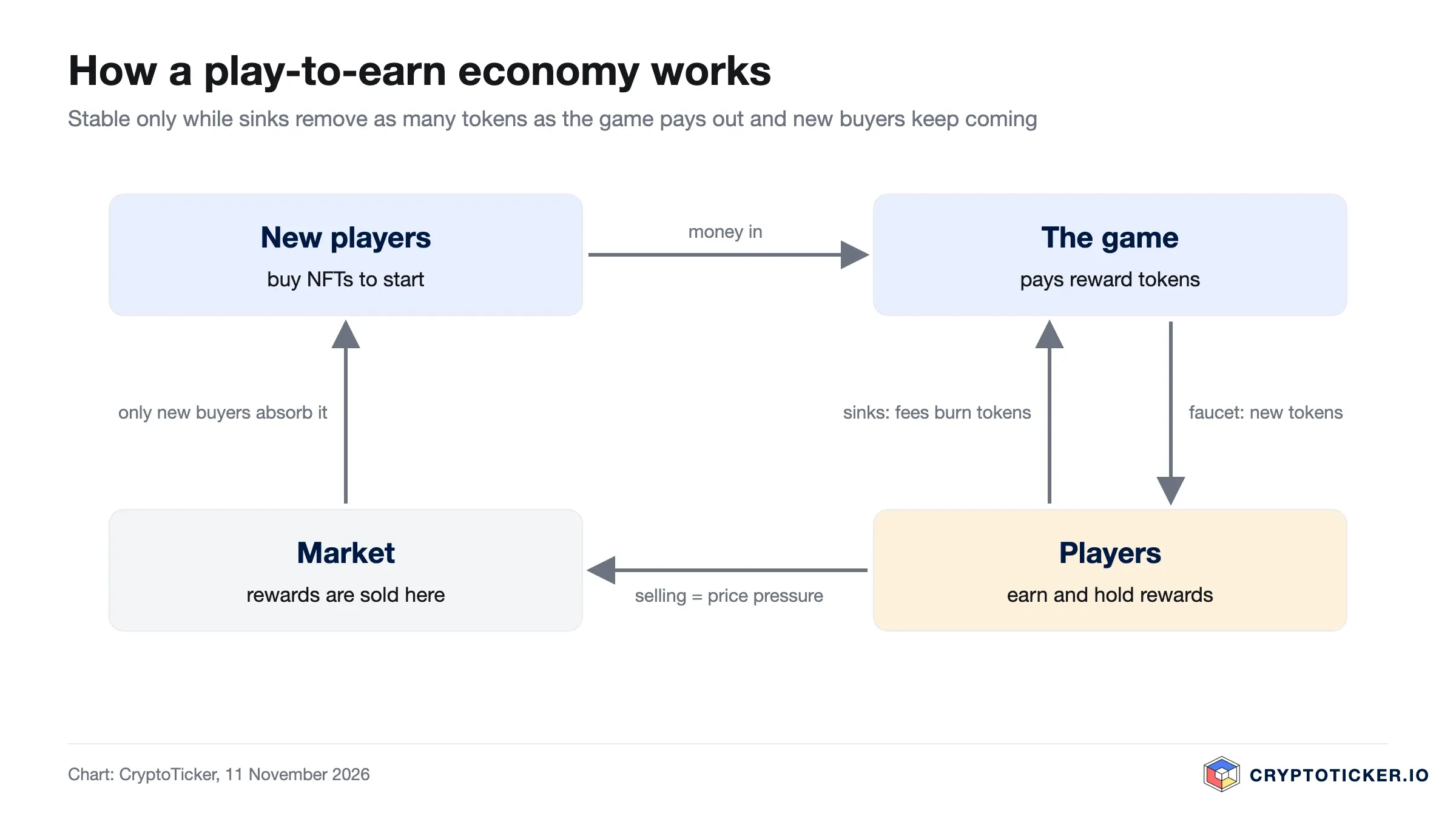
A token economy only works if it is balanced. Game designers speak of faucets and sinks: faucets are everything that creates new tokens, sinks are everything that removes them, for example fees for breeding new creatures, upgrades or entry tickets. If the game pays out more tokens than players spend inside it, the surplus is sold on the market and the price falls. That is exactly what happened in the first wave.
Why is play-to-earn important, and why did the first wave fail?
Play-to-earn introduced an idea that is likely to stay: players can own what they earn in a game, take it with them and sell it, which gives them new revenue streams from their time in the game. For players in countries with low incomes, P2E games in 2021 were briefly a real source of income. So-called scholarship programs, run by guilds such as Yield Guild Games, lent NFTs to players who could not afford them and shared the rewards.
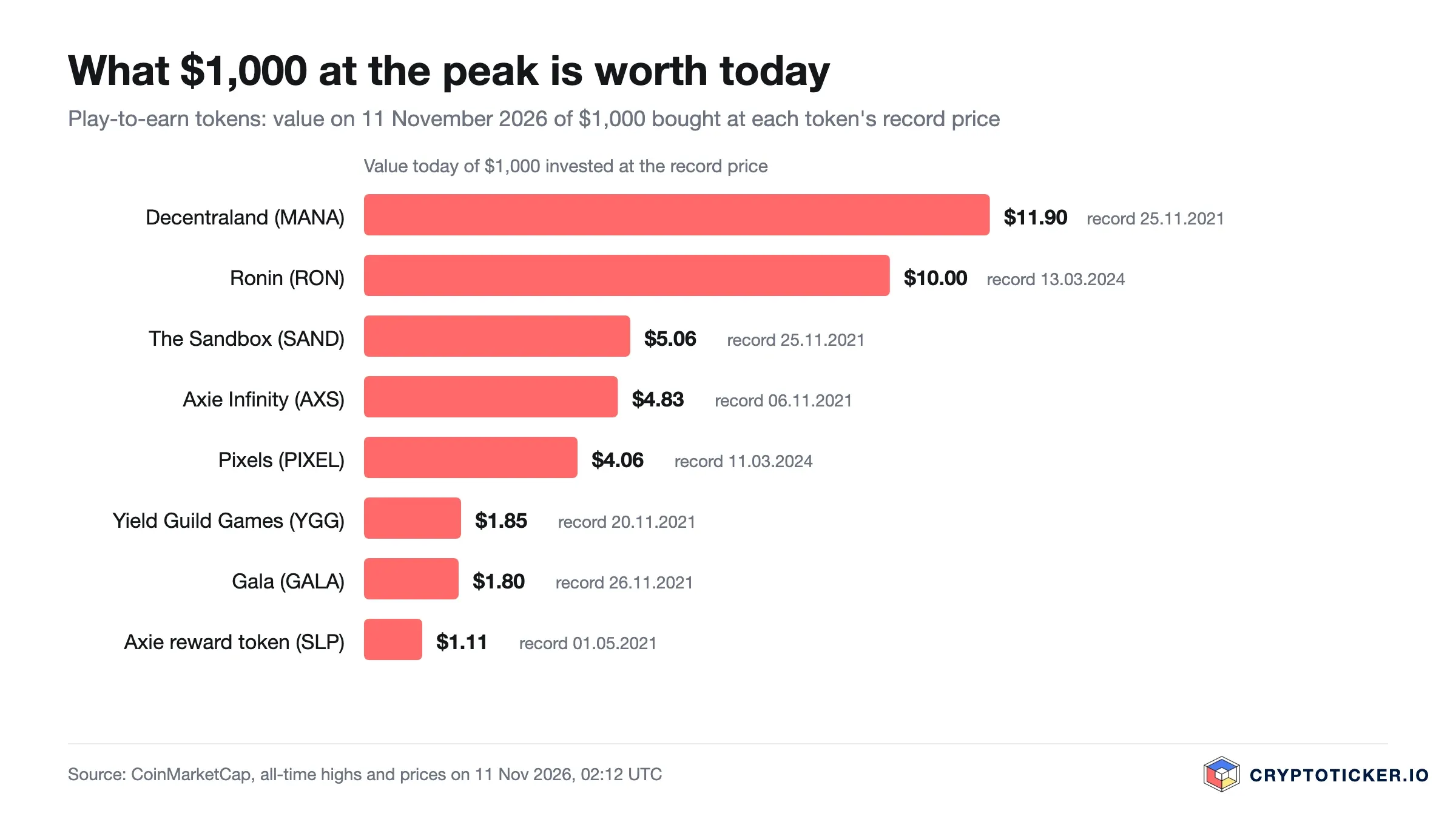
The weakness lay in the money flow. Most rewards were not paid from game revenue but from the money of new players, who had to buy NFTs to take part. As long as more players joined, the system worked. When growth slowed in 2022, the reward tokens were sold faster than anyone bought them, and the Ronin hack destroyed confidence on top. The result is visible in the token prices:
| Game and token | Record price | Date of record | Price on 11 Nov 2026 | Below record |
|---|---|---|---|---|
| Axie Infinity (AXS) | $165.37 | 6 Nov 2021 | $0.80 | 99.5% |
| Axie reward token (SLP) | $0.42 | 1 May 2021 | $0.00046 | 99.9% |
| The Sandbox (SAND) | $8.44 | 25 Nov 2021 | $0.043 | 99.5% |
| Decentraland (MANA) | $5.90 | 25 Nov 2021 | $0.070 | 98.8% |
| Gala (GALA) | $0.84 | 26 Nov 2021 | $0.0015 | 99.8% |
| Yield Guild Games (YGG) | $11.50 | 20 Nov 2021 | $0.021 | 99.8% |
| Pixels (PIXEL) | $1.02 | 11 Mar 2024 | $0.0042 | 99.6% |
| Ronin (RON) | $4.50 | 13 Mar 2024 | $0.045 | 99.0% |
Prices: CoinMarketCap, all-time records and prices on 11 November 2026. The second wave of 2024 followed the same pattern as the first, only faster. Our assessment: a P2E game is only as stable as the reason people play it without the reward. What became of the big names is described in our review of Web3 gaming in 2026.
How does the developer make money in Play2earn?
Since the development of such games costs a lot of money and is mostly financed by private companies, behind every Play2earn game there is also the expectation of a company to make money. But how do companies whose games are free to play make money?

In classic free-to-play games, the developers finance themselves through in-game sales: players pay for the coolest skin or weapon. P2E studios have several sources of income, which they usually combine:
- NFT sales: the first sale of characters, items or land plots brings in money directly. The Sandbox and Decentraland sold virtual land this way.
- Marketplace fees: the studio takes a small percentage of every trade between players on its marketplace.
- Token treasury: the studio holds part of the governance tokens and sells them over time or uses them to finance development.
- In-game spending: fees for breeding, crafting, upgrades or tournaments, paid in the game's tokens. These are also the most important sinks of the economy.
The conflict of interest is obvious: a studio earns most when many new players buy in, which is also the moment when the economy looks healthiest. Who the big Web3 gaming companies are and how they finance themselves is shown in our overview of Web3 gaming companies.
How are P2E games developed? A guide for game developers
Building a P2E game takes the same game development as any other game plus a blockchain layer. For game developers, the main decisions are:
- Blockchain: gaming chains such as Ronin (Axie Infinity, Pixels) or Immutable (IMX) offer cheap transactions and their own marketplaces; Polygon, Solana, BNB Chain and TON are common alternatives. Fees per transaction must stay far below a cent, because games create many small actions.
- Smart contracts: tokens as ERC-20, items as ERC-721 or ERC-1155 NFTs, plus contracts for marketplace and staking. Every contract should be audited; bridges in particular have been the target of the largest attacks.
- Token economy: plan faucets and sinks before the launch, simulate them with expected player numbers and decide how much of the supply goes to the team, investors and players.
- Onboarding: embedded wallets and the option to start without buying anything decide whether players who are not crypto users stay.
- Law: depending on the design, a token can count as a security in the US, and a public token offer in the EU in principle requires a white paper under the Markets in Crypto-Assets Regulation (MiCA). Rewards that depend on chance can fall under gambling law.
How to start with play-to-earn games?
Start with the game, not with the token. Check whether people actually play it: active players, reviews and how long the game has been running. Then set up a crypto wallet that supports the game's blockchain before you start playing, and keep the recovery phrase offline; our guide on how to store crypto explains the options. Download the game only from its official website or a large app store, because fake game sites are a common way to steal wallets.
Begin with the free part of the game and only buy NFTs if you would pay the same amount for a normal game. Assume that the rewards will lose value over time, and sell them regularly rather than waiting for a rally. NFTs in general are explained in our NFT guide, virtual worlds in our metaverse guide.
Popular Play-to-Earn Games
Several P2E games have gained significant popularity:
- Axie Infinity: Inspired by Pokémon, players breed and battle fantasy creatures called Axies. Its home is the Ronin network, described in our report on the Ronin ecosystem.
- Decentraland: A virtual world where players can create, experience, and monetize content and applications.
- The Sandbox: A community-driven platform where creators can monetize voxel assets and gaming experiences.
- Splinterlands: A digital collectible card game.
- Alien Worlds: An NFT DeFi metaverse where players compete using unique digital items. Its token TLM traded 99.9 percent below its record on 11 November 2026.
- Pixels: A farming game on Ronin and the biggest hit of the 2024 wave.
- Aavegotchi: Collectible ghosts that combine NFTs with DeFi; how guilds play it is shown on our Aavegotchi guild page.

Risks and Challenges
Despite its allure, P2E gaming is not without risks and challenges. The most important:
- Price risk: reward tokens of P2E games lost 98.8 to 99.9 percent from their records in the cases above. Whoever holds rewards instead of selling them carries this risk.
- Entry costs: games that require NFTs to start shift the risk to new players; at the peak of 2021, a team of three Axies cost several hundred dollars.
- Hacks: in March 2022 attackers took about $620 million from the Ronin bridge of Axie Infinity; the FBI attributed the theft to the North Korean Lazarus Group. Details are in our report on the Ronin hack. In August 2026 an exploit hit the SAND bridges on Base and BNB Chain, covered in our report on the Sandbox bridge exploit.
- Scams: fake games, fake airdrops and fake marketplace links target players' wallets. Never sign a transaction you do not understand.
- Taxes: in the US, the IRS treats crypto received as payment or reward generally as income at its market value when you receive it, and a later sale can add a capital gain or loss (IRS FAQ on virtual currency). More in our guides on crypto tax in the USA and crypto tax in the UK.
- Regulation: the regulatory landscape for P2E games and their tokens is still evolving, from securities law to gambling rules.
Bottom line: play first, earn second
Play-to-earn proved that game items can belong to players. It also proved that an economy financed by new players collapses as soon as they stop coming. The games with a future are those people would play without any reward. Whoever tries P2E should see the earnings as a bonus, start for free and keep the tokens only as long as they are needed. All of our basics guides are on the guides page.
Play-to-earn FAQ

Rudy Fares
Equity Trader, Financial Consultant, Musician and Blockchain Aficionado. I spend my time doing Technical and Fundamental Analyses for Stocks, Currencies, Commodities and Cryptocurrencies.