
What is a DAO? Token holders vote on a shared treasury through smart contracts
A DAO replaces the board with votes by token holders and rules written into a smart contract. We explain governance tokens, quorum and multisig, the 2016 hack and the unresolved question of liability.


Which topics should we dive deeper into?
Select what genuinely interests you. Your picks feed directly into our editorial planning.
Crypto news that's actually worth your time.
Weekly. 60 seconds. Carefully curated by our editors: no hype, no promo flood, no spam.
A DAO is an organisation whose rules are written into a smart contract on a blockchain and whose members make decisions by vote. The acronym stands for decentralized autonomous organization. There is no board that decides on its own how money is spent or which direction the project takes. Voting rights are usually tied to a token: the more governance tokens you hold, the more weight your vote carries.
For investors, the subject is more tangible than it sounds. Many well-known coins are voting rights in a DAO, including the tokens of large DeFi protocols on Ethereum. Buying such a token buys you a say in decisions, but no share in a company and no claim on profits. Most people buy them on an exchange; an overview of licensed providers is available in our comparison of the best crypto exchanges. This explainer shows how votes work, where the weak points lie and what the legal position looks like.
DAO basics: an organisation run by rules in a smart contract
A smart contract is a program on a blockchain that executes predefined rules automatically once the conditions are met. A DAO uses this technology to model an organisation: who counts as a member, how votes are held and when money is paid out are all set in code. The explainer page on ethereum.org describes a DAO as a collectively owned organisation working towards a shared mission.
At its core sits the shared fund, the treasury. It is held in a smart contract, and nobody can empty it without the group's approval. Once a proposal passes, the contract releases the payment automatically. According to ethereum.org, nobody can change the rules once the contract is running, except through a vote.
Compared with an association or a limited company, a DAO therefore has no managing director, no articles of association on paper and no entry in a company register. Their place is taken by public code, public votes and a public treasury. Anyone can check on the blockchain how much money the DAO holds and how its members voted.
DAO governance tokens: how voting power is distributed
A governance token is a token that grants voting rights in a DAO. The most common form is token-based membership: whoever holds the token may vote, usually one vote per token. Ethereum.org cites MakerDAO's MKR token as an example. The model is open, because anyone can buy the tokens on an exchange.
Two other models exist alongside it. With share-based membership, you apply by contributing tokens or work, and when you leave you take your share of the treasury with you; investment clubs work this way, for instance. With reputation-based membership, you earn voting rights by contributing, and those rights can be neither bought nor transferred.
The token-based variant has an obvious drawback: votes can be bought. Whoever owns many tokens has a lot of influence. In many large DAOs, founders, early investors and venture capital firms hold a substantial share of the tokens, and turnout among the remaining holders is often low.
How DAO voting works: proposal, quorum and automatic execution
A vote usually follows a fixed sequence. First a member submits a proposal, often after a discussion in the DAO's forum. Many DAOs require a minimum number of tokens to do so, so that nobody can flood the process with nonsense. A voting period then opens, during which holders cast their votes with their wallet.
A proposal only passes once the quorum is reached, meaning the minimum number of votes cast, and a majority approves it. Under fully automated governance, the smart contract then executes the decision itself, for example a payment from the treasury or a change to protocol fees. There is often a waiting period in between, during which holders who disagree can still sell or withdraw their tokens.
Many votes are also held off-chain and free of charge using signatures. That lowers costs but shifts execution to a small group that implements the result afterwards.
Delegation and multisig: three models of DAO governance
Because most holders do not follow every vote, many DAOs allow delegation: you assign your voting weight to a representative who stands for the role publicly. The tokens stay in your wallet; only the voting power moves to the delegate. Ethereum.org cites holders of the ENS token as an example.
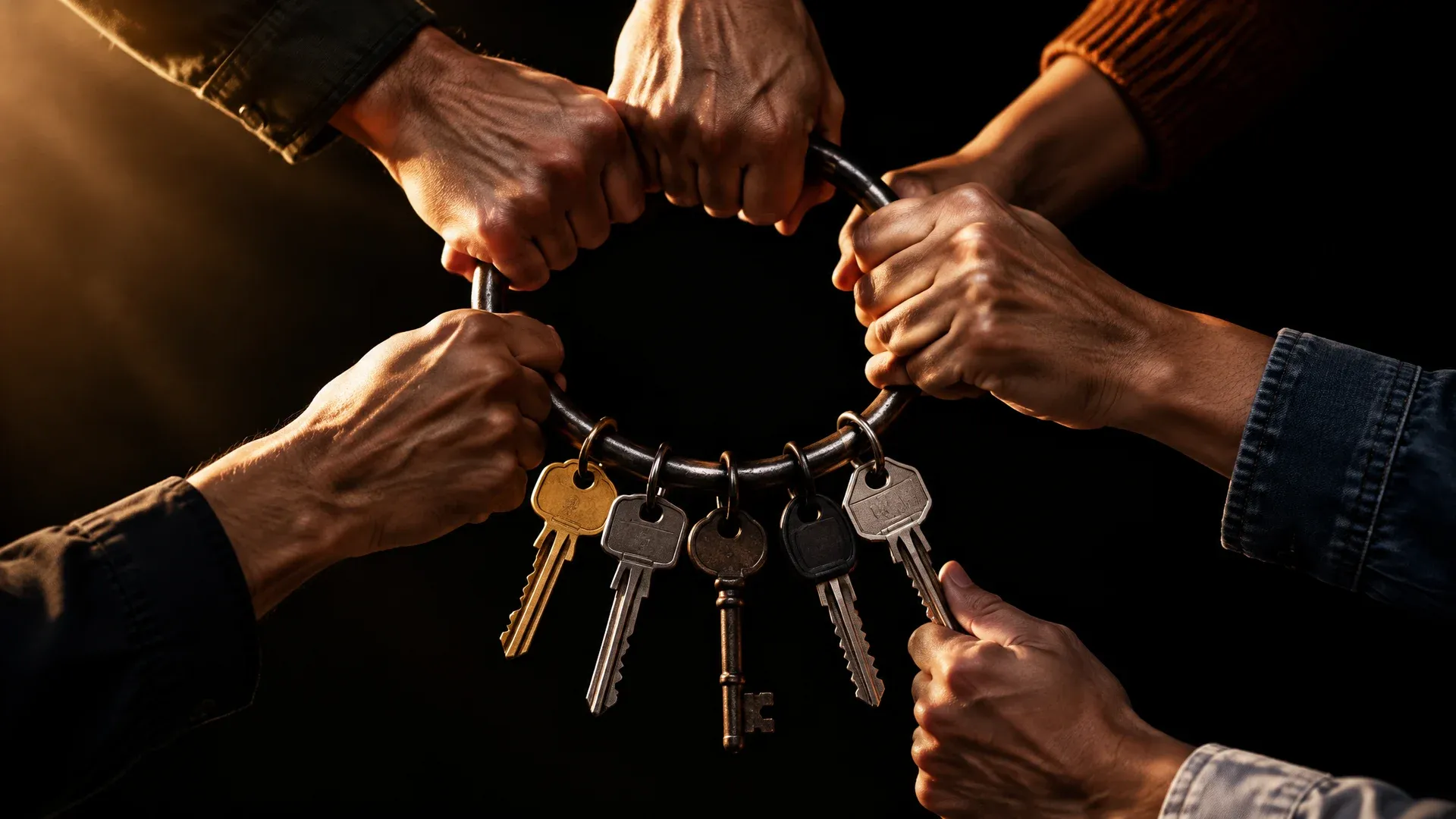
The second model is automatic execution after quorum and majority, as described above. The third is multisig governance. A multisig wallet requires signatures from several keys for every transaction, for example three out of five. According to ethereum.org, under this model 5 to 20 trusted, publicly known members manage the funds and carry out the community's decisions.
In practice, many DAOs combine these forms. The community votes, a multisig committee executes and can step in during emergencies. The more power such a committee holds, the less decentralised the DAO really is.
 Buy governance tokens on a licensed exchange
The DAO hack of 2016: the attack that split Ethereum
The first major DAO was simply called The DAO. In 2016 the project raised ether worth around $150 million in order to vote on investments as a venture capital fund. In June 2016 an attacker exploited a bug in the smart contract and drained around 3.6 million ETH.
The Ethereum community then opted for a hard fork, a change to the rules that is incompatible with the old version. The new blockchain recovered the funds and is today's Ethereum. Those who rejected the change kept running the old blockchain, which became Ethereum Classic. To this day, the case shows the limits of the principle that code is law: when the code failed, people made the final decision.
cryptoticker.io first wrote about DAOs in 2022 as an introduction to the decentralised world economy. Since then the model has changed considerably, above all with regard to liability and attacks carried out through votes.
Well-known DAOs: MakerDAO, Uniswap, Lido and CityDAO
The best-known DAOs govern DeFi protocols, meaning financial applications on the blockchain that work without a bank. MakerDAO manages the DAI stablecoin and renamed itself Sky in 2024. Holders of the UNI token vote on the decentralised exchange Uniswap, and holders of LDO on the staking service Lido.
Other DAOs serve a single purpose. According to ethereum.org, CityDAO used the DAO law of the US state of Wyoming to buy 40 acres of land near Yellowstone National Park. Some blockchains also organise themselves partly like DAOs: on Polkadot, DOT holders vote on spending from the shared treasury, as Referendum 1954 in October showed.
How much power a vote really carries varies widely. Some DAOs decide on budgets running into the millions, others only on fee tiers, while the development team sets the direction.
DAO governance attack: when a majority drains the treasury
A governance attack exploits the vote itself rather than a flaw in the code. Anyone who buys or borrows enough tokens can push through a proposal that transfers the treasury to themselves. Low turnout makes this easier: if only a few holders vote, a relatively small number of tokens is enough for a majority.
How this plays out in practice is shown by the case in which the BONK DAO lost $20 million without any hack. Countermeasures include waiting periods before execution, veto rights for a committee and minimum participation thresholds. Each of them makes the DAO safer and, at the same time, a little less decentralised.
Find a crypto exchange with an EU licence
Legal status of a DAO: Wyoming law, the Ooki ruling and Germany
A smart contract is not a legal person. Several US states have therefore created their own rules: according to ethereum.org, Wyoming, Vermont and the US Virgin Islands have DAO laws in some form, with Wyoming leading the way through its own type of LLC for DAOs.
Without such a legal wrapper, members face consequences. In June 2023 the US regulator CFTC obtained a default judgment against the Ooki DAO before a federal court in California. In its order of June 8, 2023, the court classified the DAO as an unincorporated association that can be sued under US commodities law. According to a CFTC press release, the DAO must pay a civil penalty of $643,542, and the court ordered its website to be shut down. Back in 2022, in an order against the predecessor company bZeroX, the CFTC had already held its two founders liable, as active members of that association, for the DAO's violations.
Germany has no dedicated DAO law. In legal scholarship, some argue that a DAO without a legal form can be treated as a civil-law partnership, with personal liability for those involved. No highest federal court in Germany has yet ruled on the question. Anyone who actively takes part in a DAO's decisions should be aware of the risk; on current understanding, merely holding a token is less sensitive than active participation.
DAO tokens: a say in governance is no claim on profits
Buying a governance token is a bet on the protocol behind it; no dividend comes with it. For anyone who wants to get involved in practice, three steps make sense.
- Buy tokens on an exchange: Many governance tokens are listed on large trading venues. You can compare providers, fees and licences in our overview of the best crypto exchanges.
- Vote from your own wallet: Votes are cast from the wallet that holds the tokens; this is usually not possible from an exchange account. Suitable apps are listed in the software wallet comparison.
- Record purchases and sales: For tax purposes you need every transaction with its value at the time. Crypto tax tools and portfolio trackers handle this for you.
(As of November 11, 2026. This article is not investment advice. Prices and fee structures change; check the terms with the provider before you buy.)
Frequently asked questions about DAOs
Partner links: some links on this page are partner links. If you become a customer through one of them, we may earn a commission at no extra cost to you. Selection, ratings and ranking are decided independently by our editorial team. Ethics and Independence · Ownership and Funding
Transparency note: This article was produced with the assistance of artificial intelligence and reviewed by our editorial team before publication. All figures and claims were checked against the primary sources linked in the text. The feature image was generated with AI.
For later? Save this article and find it again in your profile.
Related articles
- Spot trading explained: real coins without leverage and no liquidation price
- What is Ethereum Classic? The 2016 split and its proof of work
- What Is Open Interest? Crypto Open Interest Explained
- What is Cardano? Ouroboros, ADA and a treasury holding 1.4 billion coins
- Decentraland: MANA, LAND and a metaverse world 98 percent below its record
Which topics should we dive deeper into?
Select what genuinely interests you. Your picks feed directly into our editorial planning.
Crypto news that's actually worth your time.
Weekly. 60 seconds. Carefully curated by our editors: no hype, no promo flood, no spam.

November 13, 2026 8:06 AM
Why Is Crypto Crashing? The 3 Reasons Behind This Brutal Sell-Off
Crypto is bleeding red and billions in leveraged bets just got wiped out. Here are the 3 forces behind the crash and where prices stand right now.

November 13, 2026 5:28 AM

DeFi wallet explained: signature phishing cost users $83.85 million in 2025
A DeFi wallet gives you the key to decentralised applications, and full responsibility for them. What happens when you connect, sign and grant token approvals, and which EU rules apply.
November 10, 2026 11:36 PM

Crypto crash live: Solana and Aave lead the sell-off as markets price a December Fed hike
Hot US inflation data turned a slow slide into a flush: Bitcoin touched its lowest level since August, Solana has lost a quarter of its value in 30 days and Aave fell almost three times as hard as Bitcoin. The live timeline, the reasons and the levels that matter now.
November 10, 2026 9:30 PM
What is Bittensor (TAO)? A market for AI computing power with 21 million tokens
Bittensor pays for AI work from subnets with its TAO token, distributed according to validators' scores. This profile explains Yuma Consensus, alpha tokens, the halving and what applies when buying in Germany.
November 9, 2026 1:31 PM
What is Aave? The largest DeFi lending market, with $28 billion in deposits
Aave lends crypto assets without a bank: depositors earn interest, and borrowers post more collateral than they borrow. This profile explains the technology, the AAVE token, the risks and what applies to investors in Germany.
November 8, 2026 9:40 AM
What Is Sui? The Layer-1 Blockchain With an Object Model and Ten Billion SUI
Sui is a layer-1 blockchain from Mysten Labs that stores data as objects instead of account balances and processes transactions in parallel. This profile explains the technology, the SUI token, staking, risks and what applies to buying and tax in Germany.
November 8, 2026 7:23 AM
Margin trading explained: how trading with borrowed money works
Margin trading means trading a larger position with borrowed money. We work through profit and loss at 2x, 3x and 5x leverage, explain margin level, margin call and liquidation, and show where you can trade with a licence in the EU.
November 7, 2026 11:29 AM

PnL in Trading: Realised Gains Count for Tax, Unrealised Ones Only on Screen
PnL shows how much a trading position gains or loses. What matters is the difference between realised and unrealised PnL, because only the realised gain after fees counts for your account and for the tax office.
November 6, 2026 1:20 PM
Crypto market cap explained: Bitcoin vs gold and Apple
Market capitalization shows how large a coin is valued in the market and exposes the fallacy of cheap unit prices. We explain the formula, Bitcoin dominance and FDV with current figures and show why Bitcoin, at $1.53 trillion, trails far behind gold.
November 6, 2026 5:32 AM

Bear market: what it means, how long it lasts and where stocks and Bitcoin stand in 2026
Bitcoin has been in a bear market since November 2025, and the Nasdaq 100 is closing in on the threshold. What a bear market is, how long it lasts on average, how to spot its end and what you can do now, worked out from 27 S&P 500 bear markets since 1928.
November 6, 2026 1:34 AM

What Is Shiba Inu? SHIB, Shibarium and 410 Trillion Burned Tokens
Shiba Inu is a memecoin on Ethereum that has spawned its own layer-2 blockchain and three side tokens. This profile explains supply, burns, Shibarium and the risks, and sets out what applies to buying, storing and taxing SHIB in Germany.
November 5, 2026 11:14 AM

What is KYC in crypto? The five details no exchange will let you trade without
KYC is the identity check without which no licensed crypto exchange in Germany will open an account. Here you learn which data you hand over, how long it is stored and what the Travel Rule, DAC8 and the AMLR from July 2027 change.
November 3, 2026 11:24 AM
What is VeChain (VET)? The supply-chain blockchain where only staking earns VTHO
VeChain is a blockchain for tracing goods and runs on two tokens, VET and VTHO. Since the Hayabusa upgrade, new VTHO is only generated for staked VET.
November 3, 2026 8:28 AM
Why Is Crypto Down Today? The 5 Reasons Behind the November 3 Sell-Off
Why is crypto down today? Bitcoin sits near $76,000 after the Binance hack, a hawkish Fed and a Nasdaq slide. The five drivers, explained.
November 3, 2026 1:33 AM
Polkadot (DOT): the network behind 2.1 billion tokens and its parachains
Polkadot links independent blockchains under a shared security umbrella, and since 2026 the DOT supply has been capped at 2.1 billion tokens. This profile explains the relay chain, Asset Hub, coretime and the 28-day lock-up for staking.
October 30, 2026 9:39 AM
NEAR Protocol explained: how sharding and 2.5 percent staking work
NEAR Protocol is a layer-1 blockchain that spreads its work across sections running in parallel and is secured by stakes. What the NEAR token does, how staking and custody work and what to check before you buy.
October 29, 2026 9:49 PM
Is This the End? How Low Bitcoin Could Fall After the Binance Hack
About $2.8 billion left a Binance hot wallet and Bitcoin slid below $79,000. Whether this turns into a real crash depends on one question. Three scenarios, the key price levels for Bitcoin, Ethereum and Solana and what to do now.
October 26, 2026 9:31 AM
Coin or token: the 20 largest crypto assets compared
A coin brings its own blockchain, a token borrows somebody else's. What that difference means for fees, withdrawals and tax shows in a look at the 20 largest crypto assets.
October 26, 2026 3:16 AM
What is Chainlink? Oracles, the LINK token and why banks use the network
Chainlink gives smart contracts the data a blockchain cannot see on its own. What the oracle network does, what the LINK token is paid for and what applies when you buy in Germany.
October 25, 2026 3:35 AM
Kaspa: why the KAS block reward drops to 1.945 on November 4
Kaspa works as a proof-of-work BlockDAG with around ten blocks per second, and 96.8 percent of all KAS are already in circulation. On November 4, 2026 the reward per block falls from 2.060 to 1.945 KAS. What the network delivers, where you can trade KAS in euros and what the tax office requires.
October 23, 2026 1:35 PM
What is Tether (USDT)? The stablecoin explained: 182 billion tokens without EU authorisation
With 182.8 billion tokens in circulation, Tether is the largest stablecoin in the world and settles two out of every three crypto dollars traded. In the EU it lacks authorisation as an e-money token, and from January 8, 2027 authorised providers may no longer offer services around it.
October 23, 2026 4:21 AM
What is Solana? The blockchain behind SOL: no supply cap, 589 million tokens in circulation
Solana settles payments in milliseconds and swapped out its voting mechanism on October 21, 2026. What the network is, what SOL is needed for, and what applies in Germany for buying, custody and tax.
October 22, 2026 1:45 PM
Cryptocurrency explained: how digital money works without a bank
A cryptocurrency is an entry in a public ledger that neither a bank nor a central bank controls on its own. This piece explains how that ledger works, what separates Bitcoin from the euro, and which rules apply in Germany to buying, custody and tax.
October 22, 2026 1:36 PM
What is an issuer? Meaning, examples and issuer risk
Context: who the issuer is in the case of a share, an ETF, an ETN, a certificate, a stablecoin and a stock token, what MiCA and prospectus law understand by it, and what an issuer insolvency leaves of 10,000 euros. With tables and a worked example.
October 22, 2026 7:41 AM

CLARITY Act: what the US crypto law would do and where it stands in the Senate
In context: what the CLARITY Act would do, how the House and the Senate voted, and what the SEC and CFTC are pushing ahead without a law. With a timeline, the vote arithmetic and a comparison with the EU regulation MiCA.
October 21, 2026 7:15 PM
What is Hyperliquid? Its own blockchain, the HYPE token and access from Germany
Hyperliquid ranks 11th with a market value of $18.12 billion and runs its order book on a layer-1 blockchain of its own. What HyperCore, HyperEVM and the HYPE token do, what trading costs, and what applies to access from Germany.
More from CryptoTicker