
Michigan Senate Race Results: Abdul El-Sayed vs Mike Rogers in the State With a $20 Million Crypto ETF Stake
Michigan is the only open Democratic-held Senate seat in a state Trump won, and the most expensive race in its history. Where the count stands, how the candidates rate on crypto and what the state pension fund holds in Bitcoin and Ethereum ETFs.


Which topics should we dive deeper into?
Select what genuinely interests you. Your picks feed directly into our editorial planning.
Crypto news that's actually worth your time.
Weekly. 60 seconds. Carefully curated by our editors: no hype, no promo flood, no spam.
At 06:11 CET, Abdul El-Sayed led Mike Rogers in the Michigan Senate race by 37,796 votes, 49.9 to 48.2 percent with 46.4 percent of the expected vote counted, according to NBC News, based on AP data. No winner has been called. Michigan is the only open Democratic-held Senate seat in a state Trump won in 2024, Republicans have not won a Senate race there since 1994, and with more than $243 million in spending it is the most expensive election in the state's history. It also has a direct line to crypto: the state pension fund holds about $20.6 million in Bitcoin and Ethereum ETFs.
Michigan Senate race: the key facts
- Status (06:11 CET): El-Sayed 1,141,075 votes (49.9 percent), Rogers 1,103,279 (48.2 percent), 46.4 percent counted.
- Governor: Jocelyn Benson leads John James 51.6 to 46.6 percent with 46 percent counted.
- 2024: Donald Trump won Michigan in 2024 with 2,816,636 votes to 2,736,533 for Kamala Harris, a margin of 1.4 points.
- Stand With Crypto: Rogers A (score 99), El-Sayed B (score 74).
- Crypto money: $810,700 from First Principles Digital for Rogers, according to Tech Influence Watch.
- Prediction market: El-Sayed 97.2 percent, Rogers 2.9 percent on Polymarket (06:11 CET).
Michigan election results: read the early numbers with care
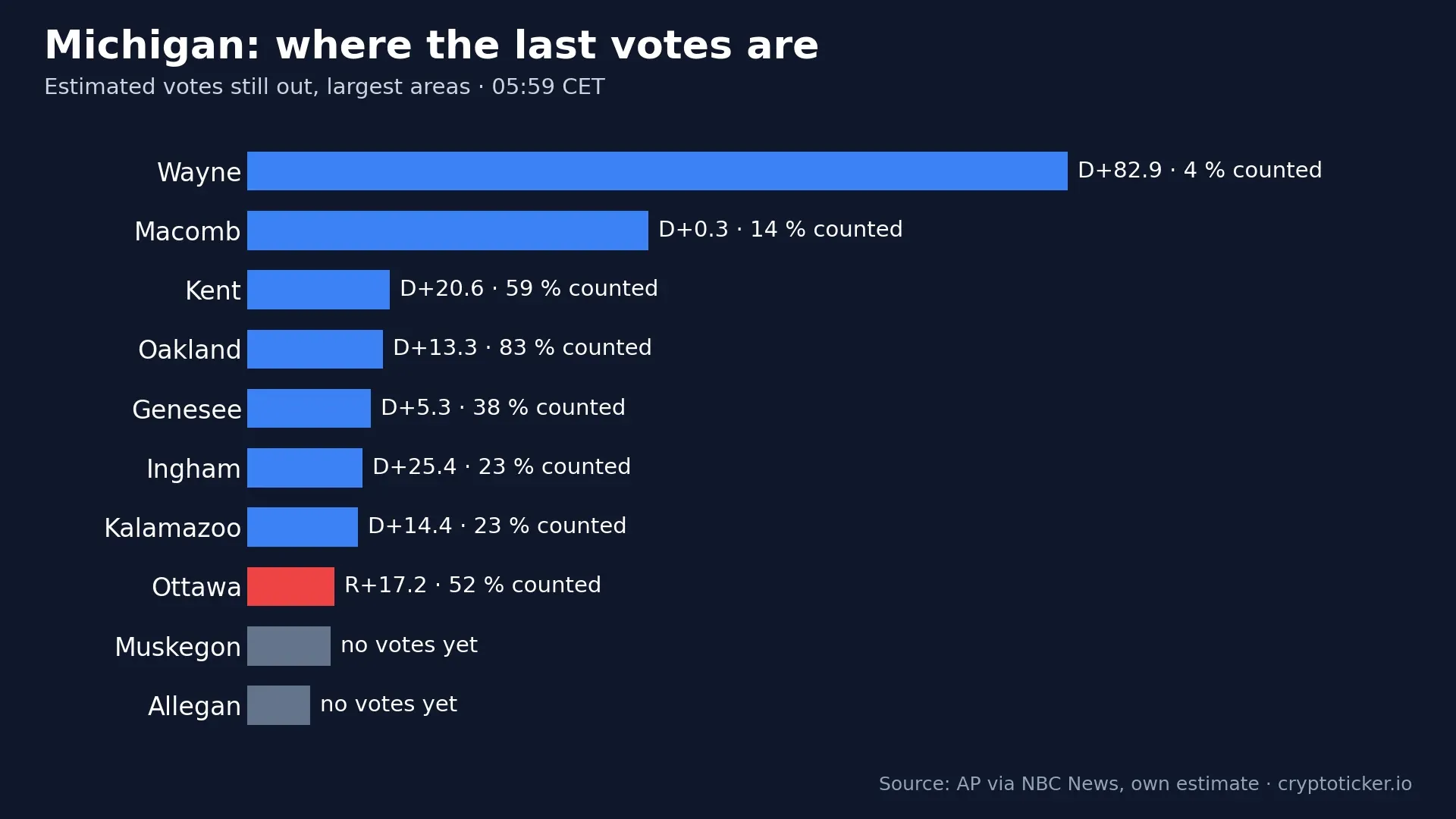
By type of vote, El-Sayed against Rogers so far: mail ballots 62 to 36 percent, early in-person votes 56 to 43 percent, Election Day votes 45 to 53 percent. Most of Michigan closed its polls at 02:00 CET, and the four western Upper Peninsula counties followed at 03:00 CET. We estimate about 2,614,000 votes are still out, most of them in Wayne, Macomb, Kent. County reporting moves unevenly, so a lead at this stage can still shrink or grow.
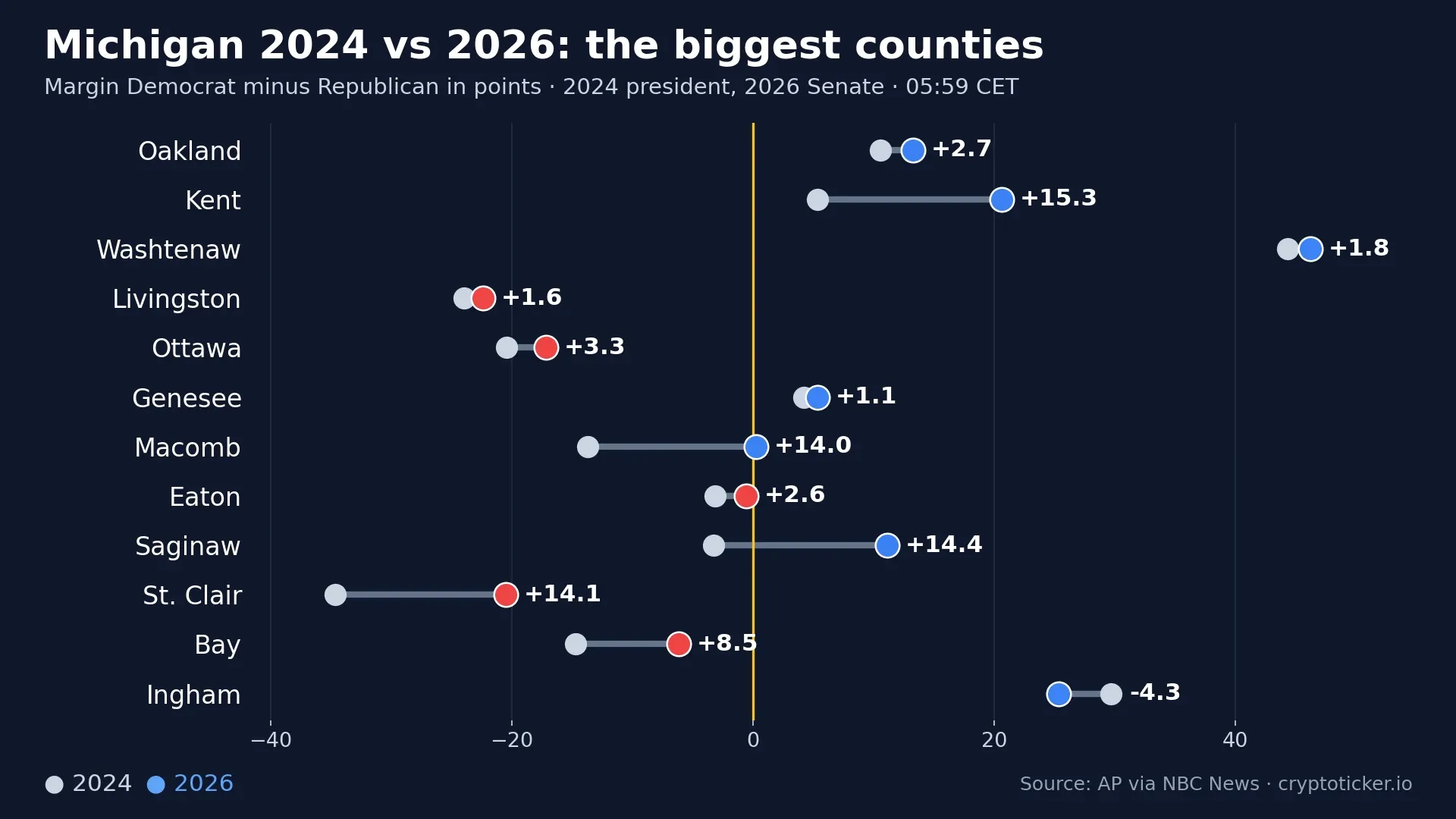
Michigan 2024 vs 2026: where the counties moved
Wayne County, home to Detroit, went from D+29.0 in the 2024 presidential race to D+76.1 now, with 6 percent counted. Oakland County, north of Detroit, went from D+10.6 in the 2024 presidential race to D+13.3 now, with 83 percent counted. Macomb County, the blue-collar suburbs, went from R+13.7 in the 2024 presidential race to D+0.3 now, with 14 percent counted. Kent County, around Grand Rapids, went from D+5.4 in the 2024 presidential race to D+20.6 now, with 59 percent counted. Across the larger areas with at least half of the count in, the margin moved 6.3 points toward Democrats on average. These figures compare a partial Senate count with a full presidential count, so the final swing can still change in either direction.
| County | Trump vs Harris 2024 | Rogers vs El-Sayed 2026 | Counted |
|---|---|---|---|
| Oakland | D+10.6 | D+13.3 | 83 % |
| Kent | D+5.4 | D+20.6 | 59 % |
| Washtenaw | D+44.4 | D+46.2 | 81 % |
| Livingston | R+23.9 | R+22.4 | 95 % |
| Ottawa | R+20.4 | R+17.2 | 52 % |
| Genesee | D+4.2 | D+5.3 | 38 % |
| Ingham | D+29.7 | D+31.1 | 47 % |
| Macomb | R+13.7 | D+0.3 | 14 % |
 Regulated crypto exchanges compared
Who are Abdul El-Sayed and Mike Rogers?
Abdul El-Sayed, a former Wayne County health director, won the Democratic primary on 4 August with 48.5 percent after a tight race against Representative Haley Stevens. Mike Rogers, a former member of Congress, was the Republican nominee in 2024 and the only candidate on his party's primary ballot this year. The seat became open because Democrat Gary Peters is not seeking a third term.
Michigan Senate race and crypto: A against B
Neither candidate runs against crypto. Stand With Crypto rates Rogers A, "strongly supports crypto", with a score of 99, and El-Sayed B, "somewhat supports crypto", with a score of 74. Rogers called the GENIUS Act "a major victory, but it's not the final one". El-Sayed answered the group's questionnaire by backing legislation that clarifies oversight between the SEC and CFTC and sets a framework for stablecoins.
The money is less balanced. Tech Influence Watch, formerly Follow the Crypto, lists $810,700 from the crypto committee First Principles Digital for Rogers and no crypto PAC spending for El-Sayed, who drew $77,550 in direct support from Ripple Labs, Microsoft, Google and one other company or their executives. Fairshake and its affiliates appear in Michigan only in House races: Protect Progress with $2,179,605 in Districts 3 and 13, Fairshake itself with $1,019,166 in District 4, and Defend American Jobs with $662,448 in Districts 4 and 9.
Michigan pension fund: $20.6 million in Bitcoin and Ethereum ETFs
The State of Michigan Retirement System reported to the SEC on 27 October that it held 300,000 shares of the ARK 21Shares Bitcoin ETF worth $8.31 million, 37,418 shares of the Grayscale Bitcoin Trust ETF worth $2.42 million and 460,000 shares of the Grayscale Ethereum Staking ETF worth $9.86 million on 30 September. Together that is about $20.6 million out of $22.6 billion in reported holdings, or 0.09 percent, and the share counts are unchanged from June. The state's Bitcoin reserve bill, HB 4087, has not been voted on: its last step was a move to another House committee on 19 March 2026.
Michigan governor race and the recount rules
Jocelyn Benson leads John James 51.6 to 46.6 percent with 46 percent counted. Democrat Gretchen Whitmer cannot run for a third term, and Jocelyn Benson, the secretary of state, faces Representative John James, who has Trump's endorsement. If a statewide race ends within 0.1 percent, Michigan recounts automatically, and the Board of State Canvassers has to certify by 23 November, according to a certification guide by Protect Democracy.
Why Michigan matters for the Senate majority
Republicans went into the night with 53 seats, so Democrats need a net gain of four for the majority, and losing Michigan would raise that number to five. NBC News projects Democrats to control the Senate, with 52 seats for Democrats and 40 for Republicans at 06:11 CET. For crypto the seat counts twice: the CLARITY Act failed 49 to 50 on 15 September and needs 60 votes, so the next attempt depends on Democrats willing to deal. Follow it in our CLARITY Act explainer, and find all calls in our midterm results live ticker. More from the states: crypto's $50 million bet against Sherrod Brown and Texas and the Bitcoin reserve.
 Crypto brokers compared
What Polymarket says about Michigan
Traders put El-Sayed at 97.2 percent and Rogers at 2.9 percent at 06:11 CET, on a market with $12.5 million in volume. That shows what the market expects and is no forecast from us; prediction markets moved quickly tonight and can overreact to early counts. If you hold coins through a week like this, compare regulated crypto exchanges and crypto brokers first. This article is not investment advice.
FAQ: Michigan Senate race 2026
Transparency note: This article was produced with the assistance of artificial intelligence and reviewed by our editorial team before publication. All figures and claims were checked against the primary sources linked in the text. The feature image was generated with AI.
Related articles
- Georgia Election Results 2026: Ossoff Wins a Second Term, Keisha Lance Bottoms Flips the Governor's Office
- Ohio Election Results 2026: Crypto's $50 Million Bet Against Sherrod Brown
- Florida Governor Race Results: Why Jolly vs Donalds Is So Close in Trump's Home State
- Texas Senate Race Results: Talarico vs Paxton and What It Means for America's Bitcoin State
- Minnesota Election Results 2026: Klobuchar vs Demuth for Governor, Flanagan vs Tafoya for Senate
Which topics should we dive deeper into?
Select what genuinely interests you. Your picks feed directly into our editorial planning.
Crypto news that's actually worth your time.
Weekly. 60 seconds. Carefully curated by our editors: no hype, no promo flood, no spam.

November 4, 2026 4:02 AM
Wisconsin Governor Race Results: David Crowley vs Tom Tiffany and What the Swing State's Pension Fund Holds in Crypto
Tony Evers is leaving, and Wisconsin holds its first governor's race without an incumbent since 2010. Where the count stands, how far the counties moved and why the pension fund that once made headlines with IBIT now holds Coinbase and Riot instead.
November 3, 2026 11:46 PM
Midterm Election Results 2026 Live: Who Wins the Senate and House, and What It Means for Bitcoin
The US midterm results are coming in. We track the Senate and House through the night and explain what each outcome means for the CLARITY Act, Bitcoin, oil and gold.
November 4, 2026 4:25 AM
Democrats Win the Senate: What the Midterm Result Means for Crypto Rules and the CLARITY Act
NBC News projects a Democratic majority in the US Senate. Which seats decided it, what Elizabeth Warren at the Banking Committee means for crypto, and how Bitcoin, gold and oil reacted.
November 4, 2026 4:03 AM
Maine Senate Race Results: Susan Collins vs Troy Jackson and the Republican No on the CLARITY Act
Susan Collins defends the only Republican Senate seat in a state Trump lost. Where the count stands, how ranked-choice voting could decide it and why a crypto lobby group rates her Democratic challenger higher than the incumbent.
November 4, 2026 3:49 AM
California Governor Race Results: Becerra vs Hilton and the Billionaire Tax Vote on Proposition 40
Gavin Newsom cannot run again, and California also votes on a one-time 5 percent tax on billionaires. Where the count stands, how far the counties moved and why Ripple and its co-founder are paying to stop Proposition 40.
November 4, 2026 3:36 AM

South Carolina Senate Race Results: Annie Andrews vs Darline Graham for Lindsey Graham's Seat
NBC News projects Annie Andrews as the winner, the first Democratic Senate win in South Carolina since 1998 in a state Trump carried easily in 2024. How far the counties moved and which crypto and AI money backed Darline Graham.
November 4, 2026 3:48 AM
Democrats Win the House: What the Midterm Result Means for Crypto and the CLARITY Act
Democrats have won the US House. What the result means for the CLARITY Act, the committee that writes crypto rules and the Bitcoin price, and what happens next in the Senate.
November 4, 2026 5:11 AM

Polymarket Midterms: How the Odds Called the Senate, and the One Upset They Missed
Polymarket had Democrats ahead hours before the networks called the House and Senate. We compared the odds before the polls closed with the results, race by race.

November 3, 2025 12:01 AM

Senators Push Crypto Bill Forward, But Not Everyone’s Convinced...
U.S. Senators push crypto market structure bill forward, but official updates show delays and no confirmed November passage.
November 2, 2026 7:33 PM
US Midterms Tomorrow: 5 Scenarios for Bitcoin, XRP and Solana
America votes on Tuesday and crypto has over 170 million dollars riding on it. Five election outcomes and what each one would mean for Bitcoin, XRP and Solana prices.
October 31, 2026 12:38 AM

Midterm Elections 2026: What Is at Stake for Bitcoin and Crypto
On 3 November the US elects a new House and a third of the Senate. Prediction markets see the Democrats ahead, the CLARITY Act is stuck, and crypto money flows into the campaign. What the midterms mean for Bitcoin, and what past elections show.
November 4, 2026 2:36 AM
Midterms 2026 vs 2024: The Biggest Changes Since Trump's Win, From Young Voters to Bitcoin
Two years after Trump's win, young voters, Latinos and men have moved sharply, eggs are cheaper, gasoline is dearer and Bitcoin trails gold. The biggest changes between 2024 and the 2026 midterms, in numbers.
November 11, 2024 7:25 PM

Bitcoin Price Prediction: BTC Price of $86,000 REACHED! What Next?
Bitcoin has shattered its previous record, skyrocketing past $86,000 and reigniting a buying frenzy among crypto investors.

November 3, 2026 5:15 AM

Bitcoin price at $76,887: BTC slips to its 100-day line on US election day
Bitcoin falls to its 100-day average of around $76,540 on the morning of the US election and briefly trades below it for the first time since August. For German buyers from November 2025, the one-year holding period ends at the same time, with consequences for offsetting losses.
December 19, 2024 11:53 PM

El Salvador Agrees to IMF’s $1.4B Loan – Bitcoin Policies Take a Hit
El Salvador has sealed a $1.4 billion loan deal with the IMF, but it came at a cost. The country is now scaling back its Bitcoin-friendly policies, marking a major shift in its crypto strategy.
January 10, 2025 11:00 PM

Bitget Token Price Surge amid Market Downturn: New 2025 BGB ATH?
In this week's turbulent crypto market taken by downward pressure, BGB made it the top gainer with an impressive price surge. Will it end the week with a new ATH in 2025?
August 20, 2024 3:00 PM

New US Senate Proposal Submitted For Crypto Tax Exemption
The US Senate has recently submitted a new proposal to exempt crypto transactions from federal taxes. Here are more details of this submission, and a list of exempted countries it could be joining...
March 23, 2022 6:58 PM

This COUNTRY is running on Bitcoin – Bitcoin El Salvador Success Story
El Salvador received a lot of criticism when they officially incorporated Bitcoin in their economy. Is Bitcoin El Salvador story a success?
September 19, 2026 10:17 AM
Trump's Crypto Empire Just Killed the Clarity Act, But Bitcoin Ripped Past $80,000 Anyway
The Clarity Act is dead and crypto insiders are blaming Trump's own coins. Bitcoin shrugged it off and squeezed past $80,000. Here is what actually changed.
July 4, 2021 1:04 PM

Chivo Wallet – An Overview Of El Salvador’s $30 Bitcoin Airdrop Plan
El Salvador migration to a hybrid Bitcoin/USD monetary system will see each El Salvadorean receive $30 in Chivo wallet, but how would it work?
September 15, 2026 4:24 PM
Why Is Crypto Crashing Today? Bitcoin Slides to $76,000 as the CLARITY Act Vote Wobbles
Bitcoin slid to $76,000 and the entire top 20 turned red as CLARITY Act odds collapsed before today's Senate vote. Here is what is really driving it.
September 2, 2026 4:28 PM

XRP ETFs Just Had Their Best Week of 2026. So Why Is the Price Still Falling?
US spot XRP ETFs pulled in record weekly inflows while XRP slipped toward $1.38. A Senate vote on September 15 may decide who is right.
August 7, 2026 1:08 PM

The Crypto Bill Washington Promised Just Got Pushed Back Again
The Senate walked away from the CLARITY Act before recess. Here is what stalled the crypto market structure bill and what happens in September.
August 5, 2026 11:20 AM
CLARITY Act Countdown: The Senate Has Days Left to Move Crypto's Biggest Bill
The Senate breaks for recess on Friday and the CLARITY Act still has no cloture motion filed. Galaxy just cut its 2026 passage odds from 50 to 30 percent.


More from CryptoTicker