
Dogecoin price 16 percent lower in October: is the strong month a myth?
Analysis: Dogecoin looks set to close October with a loss of 16.1 percent, its second losing month in a row after a gain of 40.3 percent in October 2024. Three trading days remain, and more than a statistic hangs on this monthly close.





Which topics should we dive deeper into?
Select what genuinely interests you. Your picks feed directly into our editorial planning.
Crypto news that's actually worth your time.
Weekly. 60 seconds. Carefully curated by our editors: no hype, no promo flood, no spam.
Here is what is documented: Dogecoin trades at $0.0792 at midday on Wednesday, 16.1 percent below where it stood on October 1. Our assessment follows further down: the numbers are enough to describe October's weakness, but not enough to turn it into a seasonal rule.
October has a reputation in crypto circles as a reliably strong month. That does not hold for Dogecoin this year, and it did not hold last year either. Three trading days still separate the price from the monthly close that enters every annual statistic. Anyone who bought in October is sitting on a paper loss today. Anyone running a savings plan is buying at cheaper rates. The two situations call for different responses, and both rest on numbers you can check yourself.
Where Dogecoin stands at midday on Wednesday
The price is $0.079167, measured on October 28 at 12:51 UTC at CoinGecko. That is a gain of 1.7 percent over 24 hours, a loss of 2.2 percent over the week and a loss of 14.0 percent over 30 days. The daily range ran from $0.0787 to $0.0805. Trading volume over the past 24 hours came to $531 million, and market capitalisation stands at $12.39 billion. That puts Dogecoin twelfth among cryptocurrencies by market value.
Market capitalisation here means circulating supply multiplied by the current price. In Dogecoin's case the circulating supply grows by roughly 5.2 billion coins every year, because the protocol has no cap. A flat price therefore means a rising market value, and a flat market value means a falling price. That feature separates Dogecoin from Bitcoin, whose supply ends at 21 million.
The October record: 26 of 28 days below the month's opening level
Dogecoin closed at $0.094495 on October 1. Since then, 26 of the 28 October closes have come in below that level. The monthly high fell on October 2 at $0.097914, the monthly low on October 24 at $0.074714. The gap between the two is 23.7 percent.
A positive month would require the price to climb 19.2 percent in the three trading days that remain. Dogecoin has not managed a move of that size over any three-day window this year. The calculation sets a boundary rather than sketching a scenario: October 2026 will in all likelihood enter the record books as a losing month for Dogecoin.
For context in both directions: the yearly high dates from January 6 at $0.15645, the yearly low from August 1 at $0.067582. The current price is therefore 49.4 percent below the yearly high and 17.2 percent above the yearly low. Exactly one year ago, on October 28, 2025, Dogecoin stood at $0.19376.
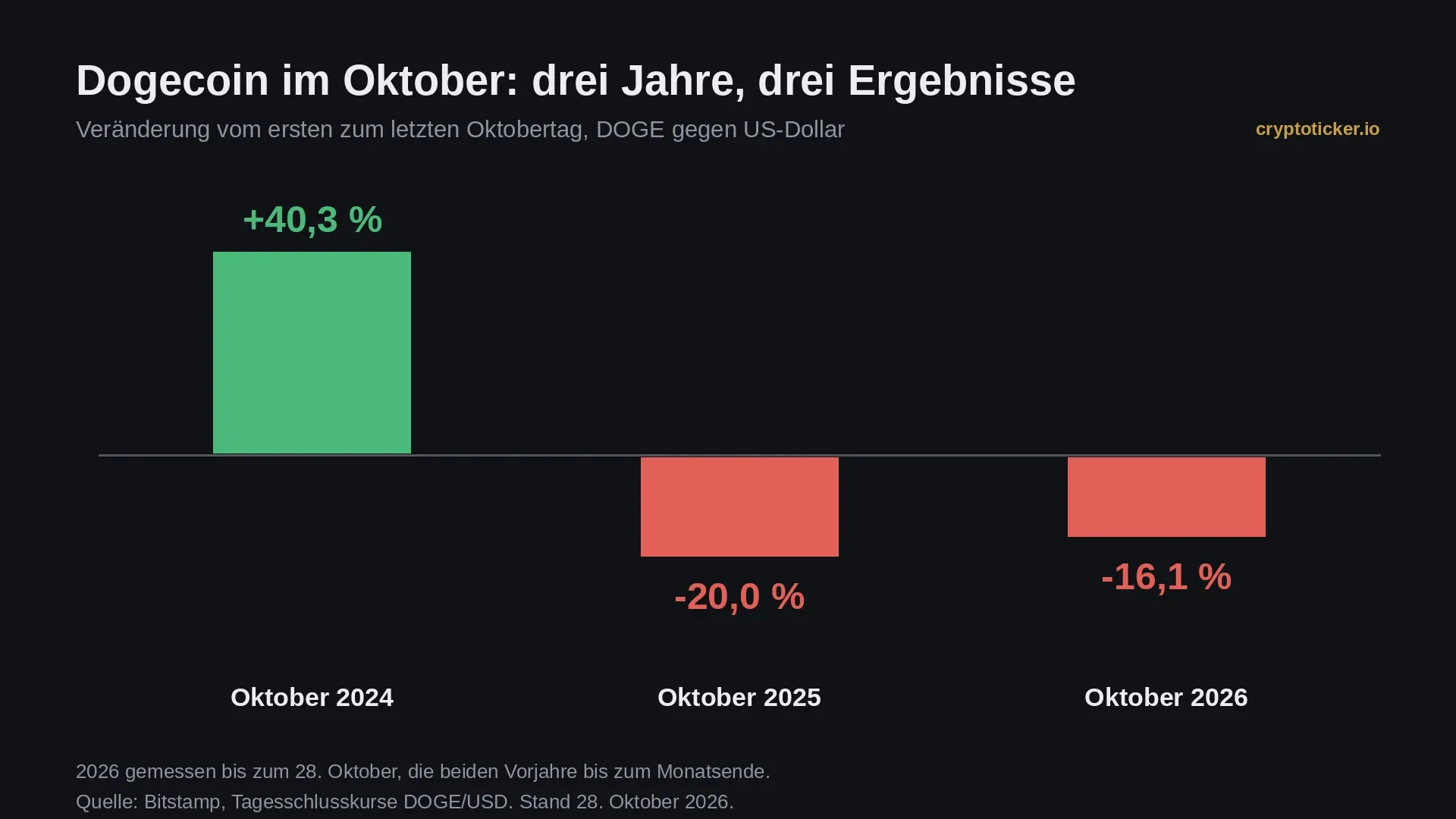
Three Octobers compared: plus 40, minus 20, minus 16
The talk of a strong October can be tested against exactly three fully available years for Dogecoin. The basis is the daily closing prices for the DOGE against US dollar pair at the exchange Bitstamp, measured from the first to the last day of October in each case.
In October 2024 Dogecoin rose from $0.11502 to $0.16137, a gain of 40.3 percent. In October 2025 the price fell from $0.23298 to $0.18639, a loss of 20.0 percent. The current October stands at a loss of 16.1 percent through the 28th. Three years therefore produce one winning month and two losing months, an average gain of 1.4 percent. That average says nothing about next October, and that is the real finding.
Why the October rule does not hold for Dogecoin
Seasonality describes the assumption that one month performs systematically better than others over many years. Two things are needed before such a claim carries weight: a sufficient number of years, and an explanation of why the calendar should act on the price at all.
Both are missing here. Three data points do not make a distribution you can draw anything from, and a range from plus 40 to minus 20 percent shows the spread more clearly than any average. There is also this: Dogecoin trades mostly against the dollar stablecoin Tether and follows the direction of the broader market in day-to-day business. A calendar month is no driver of that mechanism.
What does act on the price can be named: inflows into the American Dogecoin funds, the cost of leveraged positions, news from around the project, and the direction of Bitcoin. Those four factors explain the moves of recent weeks better than a glance at the calendar. A fifth point joins them today: the US central bank decides on its key rate this evening, and dates of that kind move the whole crypto market more than any seasonal rule.
 Compare exchanges for your Dogecoin savings plan
What weighed on October: a trademark dispute, flat fund flows, expensive leverage
Three developments can be backed with numbers. The trademark agreement between the Dogecoin Foundation and the company House of Doge ended on October 25; licence payments of $400,000 were outstanding, as we reported the same day in our article on the terminated trademark agreement. For the price, the amount matters less than the question of who may run commercial projects under the name from here on.
Second, the funds. As of October 21, the American Dogecoin funds had taken in $16.43 million since launch, while their assets had shrunk to $13.38 million. The gap of roughly three million stems from the price decline of the coins held, not from outflows. The figures come from our analysis of fund assets on October 21.
Third, the futures market. Leveraged long positions cost a funding rate of 7.4 percent a year on October 27, as our analysis of leverage costs on October 27 showed. The funding rate is the fee that holders of a leveraged long position pay to the other side as long as the futures price sits above the spot price. The longer a month moves sideways, the more that fee eats into the position.
What has changed since yesterday
Yesterday's closing price was $0.079007; today at midday it is $0.0792. The move amounts to less than a quarter of a percent. The gap to the 200-day line, which we measured at 13.9 percent yesterday, has narrowed to 8.5 percent; the line itself sinks with every weak day that drops out of the calculation. Nothing decisive has shifted as a result: the price remains below that line, and the gap is closing from underneath, because the line is falling rather than the price rising.
The levels that count before the monthly close
On the upside, the first level is the daily high at $0.0805. Above it, the next level with a basis is the month's opening at $0.0945; only there would October be back to even. There has been no closing price between those two values since October 20, so the space is thinly traded.
On the downside stands the monthly low of October 24 at $0.0747. It has held four times since, most recently on October 26. If the price falls through it, the yearly low of August 1 at $0.0676 is the next level from the current year. The two sit 9.5 percent apart.
A level is not a promise. It is the name for a price area where enough buy or sell orders sat in the past to slow a move. Whether orders still sit there today only the next test will show.

A Dogecoin savings plan: minimum instalment, fee and execution date
A falling month acts differently on a savings plan than on a one-off purchase. Investing a fixed amount each month buys more coins for the same money at lower prices and lowers your average entry price. That effect follows from the arithmetic alone and protects against no loss; it works only as long as the instalments actually keep running.
Three points decide what such a plan costs. First the minimum instalment, which runs between 10 and 25 euros depending on the provider; below that the plan cannot be set up. Second the order fee: on an instalment of 25 euros, a difference of one percentage point comes to three euros a year, measured against 300 euros invested. Third the execution date: many plans run at the start of the month, and some can be spread across several dates. Being able to choose the day spreads the risk of a single price across several points in time. Which providers carry Dogecoin in a savings plan at all, and at what rates, is set out in our comparison of the best crypto exchanges.
A note on licensing: under the European regulation on markets in crypto-assets, only providers holding the corresponding licence may offer crypto-assets to retail clients in the EU. Check whether your provider holds that licence before setting up a plan; it appears in the register of the national supervisory authority and in the provider's legal notice.
 Find a tax tool for your crypto report
Tax: why a paper loss in October is not yet a loss
In Germany, crypto-assets count as other economic assets. Gains on a sale are tax-free after a holding period of one year, and taxable within the year as a private disposal once the sum of all such gains in a year reaches 1,000 euros. That exemption threshold has applied since 2024 and replaced the earlier limit of 600 euros.
A sober point follows for the current October: a price decline in your portfolio is not a tax loss. The tax office takes into account only what was actually sold, and sold within the same calendar year. Offsetting a loss from 2026 against gains from 2026 requires the sale to be executed by December 31. After the turn of the year that offset is no longer possible, because losses from private disposals can be set only against gains of the same kind in the same year, or carried forward against future years.
In practice, that means gathering your acquisition data before you calculate. Each position needs its purchase date, purchase price, quantity and fee. Buying across several exchanges makes those details easy to lose track of; the common portfolio programmes read trading data in automatically and produce the annual statement. Which programmes cover the German rules is set out in the tax tool comparison further down. For the filing itself, tax advice remains the competent authority; this section does not replace it.
Our assessment: what the numbers support
In the editorial view, Dogecoin's October weakness carries no statement about November. The evidence points that way: three available October records with a range from plus 40.3 to minus 20.0 percent, a price that has moved in a four percent range since October 22, and trading volume of $531 million that shows nothing unusual against the summer months. What can be documented is a downward move over 30 days and a quiet market for the past week.
Against that, nothing can be waved away: the trademark dispute over House of Doge is unresolved, fund inflows have brought no fresh momentum for months, and the rate decision this evening can turn the direction of the whole market. Building a forecast on that leaves the ground of what is documented. Checking whether your position matches your own holding period, and whether your acquisition data is complete, works with what is known today.
Dogecoin's October: three trading days decide the monthly record
Three trading days remain until the monthly close on October 31. What can usefully be done in that time comes in three steps:
- Gather your acquisition data. Purchase date, price, quantity and fee for every position, across all the exchanges you use. The programmes for the job are listed in the comparison of crypto tax software.
- Review your savings plan terms. Check the minimum instalment, order fee and execution date with your own provider, along with the licence under the European regulation. The overview comes from the comparison of the best crypto exchanges.
- Note the levels. $0.0805 on the upside, $0.0747 on the downside, $0.0945 as the month's break-even. Anyone working with leverage should also project the funding rate across the intended holding period; the crypto broker comparison names the respective rates.
(As of October 28, 2026. This article is not investment advice. Prices and fee structures change; check the terms with the provider before you buy.)
Frequently asked questions about Dogecoin
Transparency note: This article was produced with the assistance of artificial intelligence and reviewed by our editorial team before publication. All figures and claims were checked against the primary sources linked in the text. The feature image was generated with AI.
Related articles
- XRP, DOGE, and ADA Price Prediction: A Fast Recovery BUT How Long Lasting?
- Ethereum price prediction: five strong Octobers since 2018, but the last two closed lower
- Dogecoin Price Prediction: $0.10 as the Ceiling, and What to Watch at a 2.5 Percent ETP Fee
- Can Dogecoin Price Hit $1 and Be the Surprise Winner of 2025?
- Uptober put to the numbers: Bitcoin rose in six of eight Octobers, but not the last one
Which topics should we dive deeper into?
Select what genuinely interests you. Your picks feed directly into our editorial planning.
Crypto news that's actually worth your time.
Weekly. 60 seconds. Carefully curated by our editors: no hype, no promo flood, no spam.

January 17, 2025 10:29 AM

Dogecoin Momentum: DOGE Price reaches $1 ATH SOON with Musk in D.O.G.E.
As Dogecoin momentum takes over major cryptos today, with the recent DOGE price surge ahead of the pro-crypto administration with Musk heading the D.O.G.E, can DOGE price reach $1?
March 3, 2025 8:39 PM

Dogecoin Price Prediction: Can Trump and Musk Drive DOGE Price to $1?
Dogecoin price prediction gains momentum as analysts set a target for DOGE. With Trump’s crypto reserve announcement and Elon Musk’s reaction, and last Trump's latest comment, could the Dogecoin price reach $1?
November 11, 2025 10:14 AM
Dogecoin Price Prediction: Can DOGE Reach $0.40 Before 2025 Ends?
Dogecoin price is consolidating near $0.17, facing resistance at $0.18. Can DOGE realistically reach $0.40 by year-end? Let’s analyze the data.
October 15, 2025 12:59 PM

DOGE Price Prediction 2025: Can DOGE Rebound Strongly After Recent Dip?
Will Dogecoin rise again? Explore the latest DOGE price prediction, support levels, and what 2025 could bring for DOGE investors.
May 12, 2024 3:06 PM

DOGE Price Prediction: Will DOGE Crash Again to $0.10?
Amidst recent fluctuations in the crypto market, investors are closely monitoring DOGE's trajectory. Will DOGE crash to 10 cents again?
November 23, 2024 6:00 PM

Dogecoin Rises 20% in 24 Hours – $0.50 Price Mark Within Reach
Dogecoin is on a rally, gaining over 20% in the past 24 hours and reaching a current price of $0.47. With strong investor momentum, $0.50 is just around the corner.
June 16, 2024 1:12 PM

DOGE Coin or XRP: Which Is Better?
XRP and DOGE coin are among the top altcoins in the market. What will happen next week and what do analysts predict?
April 9, 2025 4:00 AM

What Happened to Dogecoin and Cardano Today?
After the recent crypto market crash, uncertainty looms over the top 10 cryptos. With Dogecoin (DOGE) and Cardano (ADA) already flipped in rankings, could Solana (SOL) be next?
November 6, 2024 3:40 PM
DOGE Price Prediction: Can Dogecoin Price Reach 1$ Before EOY?
Dogecoin has seen a remarkable surge, increasing by more than 20% and reaching highs of $0.2133. With Trump's win how high can the DOGE price go?
October 28, 2024 9:47 AM

Dogecoin Price Surges Amid Bullish Indicators: Will the Rally Continue This Week?
Dogecoin price surge in the past hours is making headlines, fueled by positive market activity and bullish technical signals. Is DOGE on the verge of a major rally?
February 2, 2025 4:00 PM
Dogecoin Price Prediction: Is the Hype Over or Will DOGE Bounce Back?
Dogecoin just dropped below $0.30 as the crypto market tumbles. Is this a fakeout, or will DOGE sink further?
January 19, 2025 12:41 PM

Dogecoin Price Prediction 2025: How Musk’s DOGE Project Could Change Everything
Elon Musk is making waves again, this time with his Department of Government Efficiency (DOGE) project inside the White House. Here's how this move could impact Dogecoin and what traders need to know to stay ahead.

October 21, 2024 11:19 AM
Dogecoin Price Prediction: Bullish Trend Ahead?
The past 30 days have been great for Dogecoin (DOGE), with its price seeing a steady rise. Following the success of the SpaceX launch, Dogecoin has gained momentum.
July 29, 2025 5:14 PM
DOGE Price Prediction: Support Holds After 9 % Plunge, BUT a Rebound Might Come...
Dogecoin (DOGE) tumbled 9.24 %, falling from $0.248 to $0.226 in 24 hours. Institutional sell pressure spiked trading volume to 918 million DOGE.
May 29, 2025 5:01 PM

DOGE News Today: Elon Musk Exit, Congress Cuts, and Price Surge to $1?
Dogecoin (DOGE) surges past $0.22 amid Elon Musk’s government exit and renewed political attention to DOGE-driven spending cuts. With rising momentum, is DOGE finally on track to hit $1 in June?
February 16, 2025 8:23 PM

Dogecoin Price Prediction: Is a New ATH Coming Soon for DOGE Price?
Dogecoin seems to be on track for a significant price surge, with analysts forecasting a potential new ATH. But what are the key factors influencing DOGE's bullish momentum and the potential path to $1.35?

September 20, 2026 1:21 PM

Whales Scoop Up 240 Million Dogecoin While the Price Falls: What Is Behind It
Between September 9 and 14, large addresses bought 240 million DOGE while the price slipped from $0.091 to $0.081. What that figure really says, what the ETFs add to it, and what you should check before getting in.
October 10, 2024 3:31 PM

MEW Price Potential: Can MEW Price Explode Like DogeCoin?
With meme coins impressive gains, like DOGE and SHIB, investors are on the lookout for the next best meme. After the Dog, can the Cat lead the way, and can the MEW price explode like Dogecoin?

April 28, 2026 2:37 PM
Dogecoin Price Analysis: Can DOGE Finally Break the $0.12 Barrier?
Dogecoin (DOGE) is testing key resistance at $0.099. With X Money rumors and new ETF listings, could the meme king finally rally back to $0.12?
January 3, 2026 12:04 PM
Dogecoin Rose 15% in 24 Hours on 3 January 2026 as Memecoins Surged: What Came Next
On 3 January 2026 Dogecoin gained 15% in a day as memecoins rallied. DOGE peaked three days later near $0.152, fell to about $0.069 in August and trades near $0.098.
September 13, 2025 5:08 PM

Dogecoin is Pumping: What’s Next?
Dogecoin is breaking out again, fueled by a $148 million corporate buy and the buzz of the first-ever U.S. DOGE ETF.
May 17, 2025 2:01 PM
Dogecoin Price Prediction: DOGE Price at BUY ZONE?
Dogecoin is back in the spotlight with bullish momentum and big ETF news stirring up the market. Will DOGE price explode again?
January 23, 2025 5:06 PM

Can Dogecoin Price Surge to $15 Following Bitwise DOGE ETF Filing?
After the XRP ETF filing, Bitwise now files for the DOGE ETF. Why the choice of Dogecoin meme coin? Could this move boost DOGE $15 price?
March 29, 2025 8:25 PM

Dogecoin Price Prediction: Will DOGE Price Crash to 1 cent?
Dogecoin tanks over 6% in the last 24 hours as the crypto market faces a bearish wave. Will DOGE bounce back, or is a further drop to $0.15 or lower on the horizon? Here's what to watch out for!
July 18, 2024 6:58 PM

WIF Price Prediction: Big Gains, Why Is Dogwifhat Up?
How did Dogwifhat (WIF) surge past other meme coins with impressive gains? Here are more details on WIF breakout potential and future price predictions...


More from CryptoTicker