
Cryptomus and Heleket Hit the UK Sanctions List: What Matters Now
The United Kingdom sanctioned Cryptomus, Heleket and TokenSpot on October 8, 2026. For investors in Germany, only the EU list is binding, and a severed payment route reaches you without it.



Which topics should we dive deeper into?
Select what genuinely interests you. Your picks feed directly into our editorial planning.
Crypto news that's actually worth your time.
Weekly. 60 seconds. Carefully curated by our editors: no hype, no promo flood, no spam.
On October 8, 2026, the United Kingdom added several crypto payment platforms to its sanctions list. The services affected are Cryptomus and Heleket, both belonging to the Canadian-registered Xeltox Enterprises, along with the Kyrgyz platform TokenSpot. If you hold a balance there or settle payments through a service like this, the most important news is also the most awkward: the British measure does not bind you in Germany, yet it can still close your payout route.
A sanctions listing is an administrative measure. It carries no finding of guilt. The state imposing it freezes assets within its own jurisdiction and bars its own banks and service providers from doing business. For investors in Germany, the binding document is therefore the entry in the European Union's consolidated list. The British list has no force here. That distinction goes missing in the coverage time and again, and it decides whether you have to act or merely watch.
What the British Foreign Office listed on October 8
The measure forms part of a larger Russia package with 38 new listings, reported by CoinDesk on October 9, 2026. In crypto, the report names two strands. The first concerns Xeltox Enterprises, the Canadian-registered company behind Cryptomus, Heleket and Certa Payments. The second concerns TokenSpot, based in Kyrgyzstan.
There are also two payment service providers and one individual: Processing KG, operator of the VexPay service, the firm Tsunami Payments, and Ulan Bukabaev, a director of Processing KG. According to the report, the British government justifies the listings on the grounds that the platforms and payment services may have helped Russia circumvent financial sanctions.
That conditional is not there out of politeness. Sanctions law works to a standard of suspicion, without requiring proof of guilt. The British reasoning speaks of reasonable grounds to believe that the company supported the Russian financial sector. Whether that holds will not be settled by a criminal court; in a dispute it falls to an administrative challenge against the listing.
Why the names get muddled in the reports
Several reports speak of three sanctioned exchanges, others of one company plus TokenSpot. Both can be sourced, because Cryptomus and Heleket appear in the British entry as alternative names for the same firm. An alternative name is a further name under which a listed entity operates; it is not a separate entry, but it carries the same legal effect. So anyone searching for "Heleket" and finding nothing may simply have searched under the wrong name.
Xeltox Enterprises: Cryptomus and Heleket appear as a single entry
Cryptomus is primarily a payment processor rather than a conventional trading venue. Merchants embed the service in their shop, the customer pays in cryptocurrency, the service settles and credits the merchant with the amount. Heleket operates on the same technical foundation. One entry is therefore enough to capture both brands.
In practice that means two things. First, matching the brand name on your payment page is not enough; you need the name of the company standing behind it. Second, a single listing can hit several services at once that appear to have nothing to do with one another.
You will find the operating company's name in the terms and conditions, in the imprint or in the service's privacy policy. That detail is the key to every check you make afterwards. Without it, you search the lists past the brand name.
TokenSpot and the A7 network: what the A7A5 stablecoin has to do with it
A stablecoin is a token whose price is pegged to a currency, usually the US dollar. A7A5 is pegged to the Russian rouble and belongs to the so-called A7 network, a cluster of payment structures that Western governments say serves to circumvent financial sanctions.
According to the CoinDesk report, the British Foreign Office stated that two of the newly listed firms had settled or enabled transactions connected to A7. In the same announcement, the British government points to the network's own claim that A7 moved assets worth more than 90 billion dollars in the previous year. The report qualifies that account elsewhere: blockchain analytics firms dispute that actual activity around A7A5 runs that high. The report gives no solid counter-figure.
For your own reading, that matters more than it sounds. A figure drawn from a sanctioned network's self-presentation carries no weight as a market number. It is evidence of how the network presents itself, and no measure of its volume.

Asset freeze, payment ban, internet block: the legal effects a listing triggers
According to the report, the assets of the named entities in the United Kingdom are frozen, and British financial institutions are prohibited from settling payments to, from or through several of the firms. For users outside the United Kingdom, that payment ban is the consequence you actually feel.
The reason sits in the infrastructure. At some point, a crypto payment service needs a bridge into the banking system to pay out euros or dollars. That bridge often runs through correspondent banks, meaning banks that settle payments abroad on behalf of other banks. When a major financial centre drops out as a conduit, payouts become slower, more expensive or stop altogether, without your own balance ever having been officially frozen.
 Regulated crypto exchanges compared
A British listing does not apply automatically in Germany
Since leaving the European Union, the United Kingdom has maintained a sanctions list of its own. An entry there binds British persons and companies. In Germany, the EU regulations on Russia apply, and what binds you is the entry in the consolidated EU list, which you can reach through the official EU Sanctions Map.
In practice, the lists tend to trail one another rather than move in step. In August 2026 the EU added the exchange HTX to its list, after the United Kingdom had already listed it in May; we described the case at the time in our article on the EU transaction ban of August 21, 2026. Whether the EU follows suit on Cryptomus, Heleket or TokenSpot is open for now. Which is exactly why the list you look up yourself is worth more than any report about it.
How to actually find an entry in the EU list
Searching the consolidated list usually founders on spelling. What helps:
- Use the operating company's name; the service's brand name rarely appears in the list.
- Try the legal form with and without its suffix, so with and without "Ltd" or "CJSC".
- Search the registered address as well, because alternative names often converge on the address.
- Add the name of the managing director if media reports name them; individuals are listed separately.
- Watch the date of the last update, because a new listing appears only once it is published in the Official Journal.
The EU framework: which dealings are already barred to investors in Germany
Whatever treatment the three platforms end up receiving in the EU, prohibitions already apply to you. The EU sanctions against Russia now also cover services around crypto assets, and have done for some time. Transactions with entities on the EU list are barred to persons in the EU, both directly and indirectly. Indirectly means this: the route through a third service that forwards the payment stays prohibited too.
Breaching EU sanctions is a criminal offence in Germany under the Foreign Trade and Payments Act, not a mere administrative fine. The penalty in an individual case depends on intent and scale and belongs in the hands of a specialist lawyer. For your decision, the direction is enough: running a payment through a listed service risks more than a blocked account.
A second front runs in parallel and has nothing to do with Russia. Stablecoins are subject to their own rules in the EU, and the supervisor has set deadlines by which exchanges must drop unauthorised tokens from their offering. So anyone holding a balance in stablecoins checks two things at once: whether the provider is clean, and whether the token itself remains tradable in the EU.

A balance on a listed platform: what to watch in the payout route
A platform whose assets are frozen is not the same as a user whose balance is frozen. Even so, the practical damage almost always starts at the payout route, and long before any authority has even heard your name.
If you hold a balance at one of the named services, work through it in this order. First secure evidence of the holding and the recent entries, meaning the account statement, the transaction list and the addresses you transferred to. Then test a small withdrawal instead of moving the entire holding in one booking; that way you spot a blocked route without tying up the full amount in it. Only then move the remainder, to a provider authorised in the EU or into your own custody.
Own custody, often called self-custody, means the private keys to your coins sit with you and not with a company. A sanction against a service provider does not reach a wallet whose keys you hold yourself. You pay for that advantage with full responsibility for the backup, and that trade-off belongs on the table before any decision.
One limit remains. If the platform itself is on the EU list, you may no longer deal with it at all, not even to get your money out. In that case the route runs through a release from the competent authority, and not through a quick withdrawal. That is the main reason to check the list before you move anything.
 Hardware wallets compared
Merchants accepting crypto: the role the payment processor plays
For online shops that accept cryptocurrencies as a means of payment, the news hits a different nerve. The shop rarely picks an exchange; it picks a payment processor, and that processor determines which routes the money travels. Cryptomus was widespread in that role, particularly among smaller merchants and services with an international audience.
Anyone running a shop should therefore know three details from their contract: the company behind the payment module, where that company is based, and the bank or institution through which the euro payout runs. If one of those details is missing from the paperwork, that is already a finding, independently of any sanctions list.
If it turns out the processor belongs to a listed group, the payment route needs closing, and watching it is no longer enough. Outstanding receivables and balances in the processor account then belong in a schedule you keep. Cases like these are wound up over months, and anyone whose figures are not in order loses them twice.
MiCA licence and the BaFin register: how to recognise a regulated provider
The EU has ordered the market for crypto assets with a regulation of its own, known by the abbreviation MiCA. Anyone offering crypto asset services in the EU needs authorisation from a national supervisor and is entered in its register; in Germany that supervisor is BaFin.
An authorisation is no guarantee against losses. It does shift two things in your favour. There is a supervisor that can compel an institution to provide information, and there is a registered seat in the EU where claims can be enforced. With a processor registered in Canada and an operational trail in Central Asia, both are missing. For an overview of the houses that can show European authorisation, see our comparison of regulated crypto exchanges.
What the supervisor does not take off your hands
No register tells you of its own accord that your provider is in trouble. The duty to check stays with you, and it costs two or three glances a year: once when setting up the account, once on a report like this one, and once when a payout takes longer than usual.
Sanctions lists: only the EU entry binds you
The British listing of October 8 is a signal. It issues you no instruction. What you make of it comes down to three concrete steps:
- Establish the name and check the list. Take the operating company's name from your service's terms and conditions and search for it in the consolidated EU list. If you do not find it there, no prohibition applies and you decide freely. For a move to a house with European authorisation, our comparison of crypto exchanges helps.
- Separate your custody. Do not leave long-term holdings with a payment processor whose business depends on someone else's banking relationships. For the devices that do the job and what they cost, see the hardware wallet comparison.
- Get your records in order. Pull out transaction lists and account balances while access still works. You need that data for your tax return anyway, and in a wind-up it is your only evidence; you will find the tools for it in our overview of crypto tax tools.
Over the coming weeks, watch one thing above all: whether the EU takes over the British entries. Until it does, your position is unchanged, and any decision you take calmly now beats one that a blocked payout takes for you.
(As of October 9, 2026. This article is not investment advice. Prices and fee structures change; check the terms with the provider before you buy.)
Frequently asked questions about crypto sanctions
Transparency note: This article was produced with the assistance of artificial intelligence and reviewed by our editorial team before publication. All figures and claims were checked against the primary sources linked in the text. The feature image was generated with AI.
Related articles
- BIG Crypto News: EU Approves 14 Stablecoin Issuers Under MiCA
- EU Transaction Ban From August 23: These 14 Crypto Platforms Are Blocked
- MiCA Review: What the European Commission Could Change About the EU Crypto Rules
- Breaking: EU Bans Russian Crypto Service Providers
- Bybit's Counterparty List Runs to Over 50 Names: What to Check on Balances, Withdrawals and Custody
Which topics should we dive deeper into?
Select what genuinely interests you. Your picks feed directly into our editorial planning.
Crypto news that's actually worth your time.
Weekly. 60 seconds. Carefully curated by our editors: no hype, no promo flood, no spam.

August 19, 2026 10:26 PM

EU warning list for crypto providers: 167 entries, 165 of them from Italy, none from BaFin
ESMA maintains a Europe-wide register of non-compliant crypto providers. We counted it on August 16, 2026 and called up every web address stored in it. Three of 30 supervisory authorities supply any entries at all, and BaFin is not among them.
September 30, 2026 10:40 PM

ESMA Calls for Advertising Rules on Crypto Influencers: Six Changes Now Sitting With the EU Commission
The EU securities watchdog filed its response to the MiCA review on the final day of the consultation. Among the demands are disclosure on staking, a licensable DeFi gateway and the power to freeze crypto assets.

February 22, 2025 3:35 PM
EU Approves 10 Stablecoin Issuers Under MiCA – But WHY Was Tether Left OUT?
The European Union has approved 10 stablecoin issuers under its MiCA regulations, notably excluding Tether's USDT. This decision raises questions about the future of stablecoin regulation and market dynamics within the EU.
July 2, 2026 8:59 PM
Binance Is Out of the EU: How to Move to a MiCA-Regulated Exchange
Binance has left the EU market. Which exchanges hold a MiCA licence, how to verify an authorisation is real, and how to move your holdings across step by step.
July 1, 2026 10:47 AM

Crypto News Today: Binance Exits the EU, Circle Craters, and Bitcoin Slides Below $59K
MiCA reshapes the market as Binance leaves the EU, a 140-firm stablecoin rocks Circle, and Bitcoin sags near multi-year lows. Here's what's moving crypto today.

June 30, 2026 11:20 PM
How to Switch from Binance to a MiCA Regulated Crypto Exchange
Binance is winding down EU services after missing the MiCA deadline. Here's why it's happening and how to move your funds to a regulated platform safely.
April 7, 2026 11:52 AM
Is Iran Using Crypto to Bypass US Sanctions?
Iran is leveraging cryptocurrency and stablecoins to bypass US sanctions. Here's how the IRGC and Central Bank use blockchain to keep the Iranian economy afloat.
June 17, 2026 7:21 PM
Binance EU Access at Risk: What MiCA Could Mean for BNB and Crypto Users
Binance is facing one of its biggest regulatory tests in Europe as the MiCA deadline approaches. Could this put BNB and EU crypto users under pressure?
September 19, 2026 4:11 PM
MiCA Consultation Closes September 30: What to Check and Submit Before Then
The European Commission is reviewing the MiCA crypto regulation and will accept submissions until September 30, 2026 at 23:59 CEST. Staking, DeFi, lending, stablecoins and custody are all under examination, and you can take part without a lawyer.
May 12, 2025 9:05 PM

US-EU Trade Tensions Rise as US-China Conflict Cools Down
Just as the long-standing US-China trade war appears to ease, new tensions are emerging between the United States and the European Union. With Trump calling Europe “nastier than China,” are we about to witness a new transatlantic trade conflict?
August 6, 2026 3:05 PM
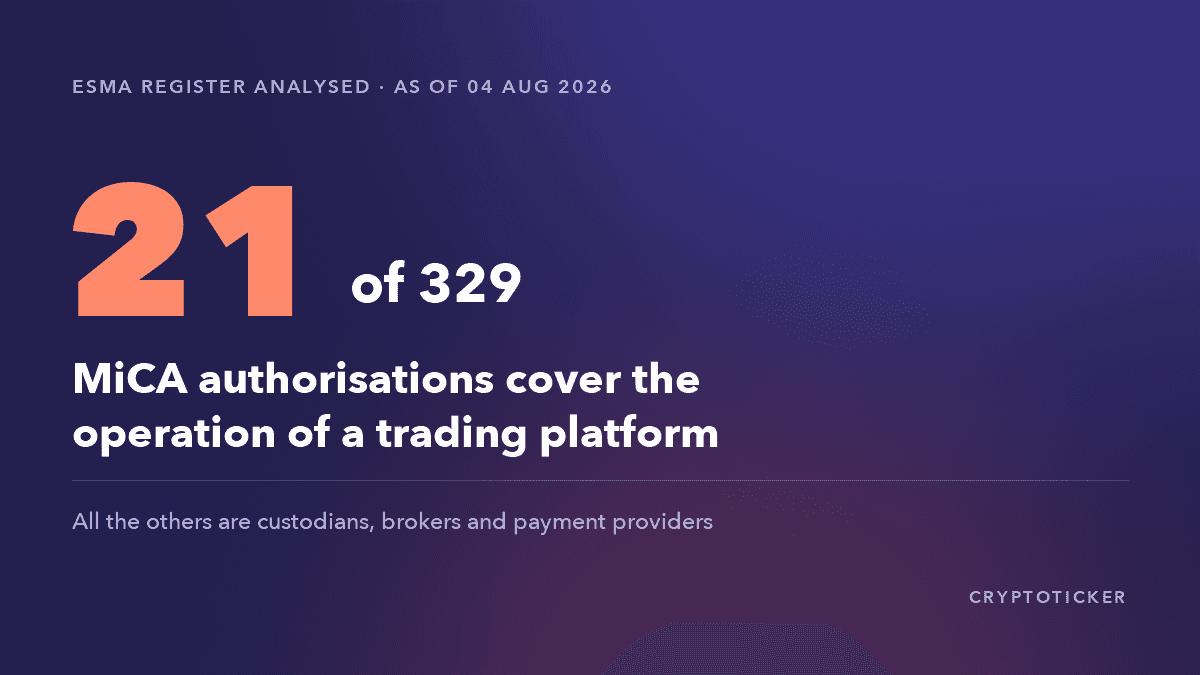
MiCA Register 2026: Only 21 of 329 Licences Are Real Exchanges
ESMA publishes the register of MiCA-authorised providers as an open file. We worked through all of it — and the result is not what the phrase “licensed crypto exchange” suggests.
September 23, 2026 7:15 AM
SoFi Settles Card Payments in Stablecoin: What Cardholders Should Check
Since September 22, 2026, the US bank SoFi has run its entire card business through its own stablecoin, SoFiUSD, on the Mastercard network. What sets the model apart from a crypto credit card, and which rules would apply if a European provider followed suit.
September 20, 2026 4:19 AM

Russia Sanctions and Crypto: Why October 18, 2026 Becomes the Deadline
The signature under H.R. 5334 starts a 30-day clock: by October 18, 2026 the US administration has to set how high the tariffs against Russia will be. What the act says, by what route it reaches Bitcoin, and what you can check before then.
August 19, 2026 1:22 AM

HTX on the EU Sanctions List: Transaction Ban Applies from August 23, 2026
The EU has added HTX to Annex XLV of the Russia sanctions regulation; from August 23, 2026, transactions with the platform are prohibited. Anyone still holding a balance there can withdraw freely until then, and afterwards only with authorisation from the Deutsche Bundesbank.
June 26, 2026 5:35 PM
Binance Is Leaving the EU on July 1 — What It Means for Your Funds
Binance will stop serving EU customers from July 1 after failing to secure a MiCA licence. Here's what it means for your funds and your next move.
September 16, 2025 9:03 PM

US and UK to Announce New Crypto Cooperation Deal: A Turning Point for Digital Assets?
The US and UK are preparing to announce a new crypto cooperation deal, signaling a shift toward regulatory alignment and potentially easing past trade tensions.
September 29, 2026 10:33 AM
ESMA puts reverse solicitation on its 2027 watch list: what investors need to know about exchanges without an EU licence
ESMA presented its work programme for 2027 on September 28, 2026 and made reverse solicitation a supervisory priority. What that means if your coins sit with a provider without EU authorisation, and which three steps make sense now.

September 24, 2026 1:11 PM
Stellar Becomes a Payment Rail at Mastercard's BVNK: What XLM Holders Should Check on Buying Route, Memo and Holding Period
BVNK has switched on Stellar as a payment rail for business customers in more than 130 countries. On the same trading day XLM falls by around seven percent — we separate what the news means from what the pullback means for your portfolio.
July 10, 2026 10:30 AM
Binance Reveals Where Its EU Users Went After MiCA
Binance just revealed where most departing EU users moved their crypto after MiCA — and the answer is raising hard questions about the new rulebook.
June 25, 2026 11:19 AM
Binance Pulls Its EU Licence Bid: What It Means for Your Crypto
Binance just withdrew its MiCA licence application in Greece days before the EU deadline. Here's what it means for users, your funds, and the crypto market.
October 16, 2025 9:45 AM

Global Crypto Turmoil: G20 Regulation Warning, New Crypto Bank Approval, and U.S.–China Tensions Shake Markets
From a $19 billion crypto crash to new stablecoin and tokenization projects, global markets are reeling under U.S.–China trade tensions and rising regulatory pressure.
July 16, 2026 5:34 AM

Trump Just Threw His Weight Behind Stablecoins — And US Banks Are Panicking
Trump backs a UK-US stablecoin pact as the CLARITY Act nears a Senate vote — and banks warn it could drain deposits from smaller lenders. Here's what's at stake.
October 2, 2026 7:30 AM

Revolut EURR Stablecoin: What the Launch in Three Markets Really Means
Revolut is testing the euro stablecoin EURR in Denmark, Poland and Portugal first. Whether it becomes usable in practice depends on access, liquidity, costs and acceptance.
October 1, 2026 2:16 PM

Open USD is live but absent from the EU register: what matters now for investors in Europe
The dollar stablecoin Open USD launched on September 30, 2026, backed by Coinbase, Mastercard, Shopify, Stripe and Visa. On October 1, 2026 the token was not notified in the MiCA register, and that decides what you can do with it in Europe.
July 9, 2026 10:12 AM
MiCA Wiped Out 92% of Europe's Crypto Firms: Here's Who Survived and Who's Cashing In
The July 1 deadline turned 3,000+ EU crypto firms into a few hundred. Binance is out, Tether's gone, and a handful of winners now own the market.
October 8, 2026 10:14 PM

ESMA stablecoin deadline of January 8, 2027: what you can do with USDT now
ESMA decided on October 8, 2026 that authorised EU platforms should no longer offer services for stablecoins that do not comply with MiCA. For USDT, only selling, swapping, transferring and withdrawing remain until January 8, 2027.
October 3, 2026 10:20 PM

2027 start for the UK stablecoin regime: what the Bank of England mandate means
The Bank of England's new innovation objective is a signal for digital payments, not a stablecoin licence. What still decides the outcome are the FCA rules, supervision and the timetable running to 2027.
More from CryptoTicker