
Declaring Crypto Gains Late in Germany: When a Voluntary Disclosure Under Section 371 Still Prevents Prosecution
From 2027 crypto service providers will report 2026 data to Germany's Federal Central Tax Office. If you never declared older gains, you should know when a voluntary disclosure still works and what makes it fail.





Which topics should we dive deeper into?
Select what genuinely interests you. Your picks feed directly into our editorial planning.
Crypto news that's actually worth your time.
Weekly. 60 seconds. Carefully curated by our editors: no hype, no promo flood, no spam.
If you failed to declare gains from Bitcoin or other crypto assets in earlier German tax returns, you face a question with a clear answer: a voluntary disclosure that exempts you from prosecution under section 371 of the German Fiscal Code only works for as long as the offence has not been discovered and none of the statutory blocking grounds applies. That window is currently getting shorter. The German Crypto Asset Tax Transparency Act has applied since January 1, 2026, and in the 2027 calendar year crypto service providers will transmit data for the 2026 reporting period to the Federal Central Tax Office for the first time.
This article explains how a subsequent declaration works in practice, which years are still open at all, what causes a voluntary disclosure to fail and what it costs. It does not replace advice: a voluntary disclosure is a document with criminal law consequences and belongs in the hands of a tax adviser or a lawyer specialising in tax law. Draft it yourself and forget a single year or a single exchange, and you lose the exemption from prosecution for everything.
Why Your Crypto Data Will Sit With the Federal Central Tax Office From 2027
The Crypto Asset Tax Transparency Act, KStTG for short, was adopted on December 22, 2025 and transposes the EU directive DAC 8 into German law. DAC 8 is the eighth version of the EU administrative cooperation directive; it extends the automatic exchange of information between tax authorities to crypto assets. The reporting obligation falls on the service providers themselves: exchanges, brokers, custodians and intermediaries that exchange or transfer crypto assets for customers. Investors themselves report nothing to the authorities.
According to the Federal Central Tax Office, what gets reported is the aggregated transaction data of the wallets, together with name, address, tax residence, tax identification number, date of birth and transaction volumes. Providers deliver to the Federal Central Tax Office by July 31 of the following calendar year in each case, and the office passes the data on to the EU central register and to the partner states of the international framework by September 30. The first of these transmissions covers the year 2026 and takes place in 2027.
For everyday purposes that means two things. First, providers are already asking for tax residence and tax identification numbers; anyone who does not respond must expect restrictions on their account. Second, from 2027 the tax office will hold a body of data that can be matched against the return you filed. A data match is not criminal proceedings, but it is the route by which discrepancies come to light.
What the 2026 Reporting Year Does Not Do
The report covers the period from 2026 onwards. It brings no retroactive analysis of the years 2017 to 2025. That is the most common misconception in this field, and it leads to wrong conclusions in both directions. Anyone who believes old years are thereby automatically exposed panics needlessly. Anyone who believes old years are therefore safe underestimates the collective information requests with which tax authorities have already demanded user lists from individual trading venues in the past.
Section 153 Correction or Section 371 Voluntary Disclosure: What the Difference Is
Both routes correct an incomplete tax return, but they start from different points and carry different consequences.
The duty to notify and correct under section 153 of the Fiscal Code applies where someone subsequently realises, before the assessment period expires, that a return they filed is incorrect or incomplete and that tax may be understated as a result. The wording of the statute requires this to be notified without delay, meaning without culpable hesitation. What is meant is the case without intent: an item was overlooked, an exchange was forgotten, a swap was mistakenly treated as tax free.
The voluntary disclosure under section 371 of the Fiscal Code, by contrast, is the route for cases where tax evasion is in play, meaning deliberate conduct. It leads to exemption from prosecution where three conditions come together: full correction for all unbarred tax offences of one type of tax over the last ten calendar years, no blocking ground, and timely payment of the evaded tax plus interest.
In practice the line between the two cases often cannot be drawn cleanly, because intent is an internal fact. Advisers therefore frequently frame a correction so that it simultaneously meets the requirements of an effective voluntary disclosure. That is the real reason a self-drafted letter to the tax office can be dangerous: it may satisfy section 153 while falling short of the completeness that section 371 demands.

Which Years You Have to Declare: Assessment Period and Limitation on Crypto Gains
Two periods run alongside each other, and they are regularly confused. One decides whether the tax office may still assess the tax. The other decides whether the offence can still be prosecuted.
The assessment period is set out in section 169 of the Fiscal Code. For income tax it is normally four years. In cases of reckless understatement it extends to five years, and in cases of tax evasion to ten years. On top of that comes the suspension of commencement: the period only begins at the end of the year in which the return was filed, and at the latest three years after the tax year. So if you never filed for 2018, you must expect the assessment for that year to still be open.
Limitation under criminal law follows its own rules and is irrelevant to the question of whether back tax has to be paid. What matters is the practical consequence: a year can still be open for tax purposes even though nothing threatens under criminal law. It still has to be paid, plus interest.
How to Work Out Which Years Are Open in Your Case
The starting point is unspectacular: dig out your own tax assessments from the last ten years and lay your trading history alongside them. What counts is the timing of every sale and every swap; the account balance at year end is irrelevant to this. Swapping one coin for another counts as a disposal of the first coin for tax purposes, even though no euro changed hands. It is precisely these swaps that are missing most often from old returns, because they do not feel like a sale.
 Crypto tax tools compared
The Blocking Grounds of Section 371(2): When a Voluntary Disclosure Comes Too Late
Exemption from prosecution does not arise where one of the blocking grounds named in the statute has already occurred. Among others, the law names notification of an audit order under section 196 of the Fiscal Code, notification that criminal or administrative fine proceedings have been opened, the appearance of an official for a tax audit, and discovery of the offence where the offender knew of it or had to reckon with it. A separate blocking ground applies as soon as the understated tax exceeds 25,000 euros per offence.
The blocking ground of discovery is the reason the reporting procedure from 2027 matters for this subject at all. An offence is discovered where the authority holds a suspicion concrete enough to make a conviction appear likely. A blanket data match is therefore not automatically a discovery. But anyone who has already received post from the tax office about specific crypto transactions should assume the clock has run out and take advice before sending any further letter.
The blocking ground of the audit order is equally underestimated. It bites for the audit period, and it does so from notification onwards, not only from the start of the audit. Anyone with an announcement of a field audit in their letterbox who then writes a voluntary disclosure will no longer achieve exemption from prosecution for the audited years.
Completeness Instead of a Partial Disclosure: Why Half a Correction Fails
Since 2011 there has been no such thing as an effective partial voluntary disclosure. The law requires correction in full, for all tax offences of one type of tax over the last ten calendar years. Translated, that means: anyone who reports only the gains from a single exchange and leaves out an account with a second provider has not made an effective voluntary disclosure but has handed the authority part of the evidence.
For crypto holdings this is the hardest requirement of all, because the traces lie scattered. The typical picture is one large exchange, a small secondary account from the early days, a decentralised application, a staking service and a hardware wallet whose transactions appear in no report anywhere. If one of these sources is missing, it is missing from the declaration.
If you first have to establish an overview, the sensible route is a portfolio and tax tool that merges transactions from several sources and produces a report for each year. Which providers can import which exchanges, wallets and protocols is shown in our comparison of crypto tax software and portfolio trackers. The tool does not replace advice, but it supplies the numerical basis without which no adviser can work.
The Most Common Mistake: The Forgotten First Exchange
Many holdings begin with a small account from the years 2017 to 2021, often at a provider that has since left the market or been taken over by another. That is exactly where the purchases sit that determine the acquisition cost of later sales. Without that data the gain cannot be evidenced, and without an evidenced gain the tax office estimates.
From 25,000 Euros of Evaded Tax: The Surcharge Under Section 398a
Where the understated tax exceeds 25,000 euros per offence, the exemption from prosecution falls away. The case is not lost as a result: section 398a of the Fiscal Code provides that prosecution is waived where the evaded tax plus interest is paid and an additional sum is settled on top. Under the wording of the statute this surcharge amounts to 10 percent of the evaded tax up to an evaded amount of 100,000 euros, 15 percent between 100,000 and 1,000,000 euros and 20 percent above 1,000,000 euros.
The surcharge is not refunded if the proceedings are later reopened after all; it can, however, be credited against a fine. What is decisive is the evaded tax, not the gain and certainly not the portfolio value. If you failed to declare 40,000 euros of gains, the tax on that will often fall below the threshold depending on your tax rate.
Which Records You Need From Exchange, Wallet and Tax Tool
A subsequent declaration is, in the end, an arithmetic exercise with supporting evidence. What is needed for each year is a complete transaction list with timestamps, the matching of acquisitions and disposals in order of acquisition, the prices at the relevant time and the fees. Added to that are the records for transactions that are not sales and still count for tax: staking income, lending interest, airdrops and mining rewards.
You obtain the transaction history from the trading venues themselves, usually as a file in the account area. Anyone whose account was with a provider that has since closed needs the support route and should start early. An overview of the regulated trading venues, including the question of who issues usable annual statements, is in our comparison of crypto exchanges. For wallets with no provider behind them, only the blockchain itself helps: collect addresses, export transactions, explain inflows.
A practical note on sequence: first establish the data basis, then calculate, then draft. Work the other way round and set up the letter to the tax office before the analysis, and you risk exactly the incompleteness on which the exemption from prosecution founders. Incidentally, the data basis also determines whether your holdings can evidence the conditions for a tax-free sale after the one-year holding period has elapsed at all.
 Crypto exchanges with a usable annual statement
What the Draft Bill of September 8, 2026 Changes About the Situation
On September 8, 2026 a draft bill from the German Federal Ministry of Finance became known which would in future treat crypto assets as investment income and subject them to the flat-rate withholding tax of 25 percent plus the solidarity surcharge, regardless of the holding period. Under the draft, the new rules would apply only to holdings acquired after December 31, 2026; for holdings acquired before that date the one-year holding period would remain in place. Automatic tax deduction by the service providers is not envisaged until 2028.
None of this has been enacted. A draft bill is a working document from the ministry, not a law; coordination within the federal government is under way, and no bill is before the Bundestag. For the current year 2026 the rule in section 23 of the Income Tax Act with its one-year holding period applies unchanged.
For the question of a subsequent declaration the draft changes nothing about the legal position of the past. It does change the urgency, because it directs the attention of the tax administration to a field that is becoming transparent anyway. Anyone with open years is therefore not choosing between two tax regimes, but between a correction on their own initiative and a correction after being asked.

Evasion Interest and Costs: What a Subsequent Declaration Really Costs
The back payment itself is only the first item. Interest comes on top, and here a close look at the statute pays off. Interest on additional tax claims under section 233a of the Fiscal Code has stood at 0.15 percent for each month since 2019, so 1.8 percent a year. For the remaining interest under the Fiscal Code, which includes evasion interest under section 235, half a percent for each month continues to apply, so 6 percent a year. Over eight or ten years that adds up considerably, and payment of the interest is a condition of the exemption from prosecution, not a later side effect.
Then there are the costs of advice. They depend on the effort of reconstruction and not on the portfolio value; a holding with twenty transactions is worked through in a few hours, a holding with several thousand transactions across five platforms is not. Prepare the data basis cleanly yourself and you will noticeably reduce this item.
What Happens If You Do Nothing
For the time being the assessment stays as it is. If an audit follows later, the blocking grounds have taken effect, the exemption from prosecution is lost, and on top of the tax and the interest criminal proceedings loom. For amounts below the de minimis thresholds such proceedings often end with a monetary condition; above them they do not. The tax itself falls away in none of these cases for as long as the assessment period is running.
Crypto Subsequent Declaration: What to Take Away
The legal position is confusing; the next steps are not.
- Get your data basis together before you write anything to the tax office. Collect the trading history of all accounts and wallets from the last ten years and merge it. Which tools import several sources and issue annual reports is shown in our comparison of crypto tax software and portfolio trackers.
- Request missing records now, not later. Exports from closed or acquired trading venues take weeks. Which providers supply usable annual statements is set out in our comparison of crypto exchanges.
- Have the declaration drafted professionally once the figures are in place. Completeness across all years and all sources decides the exemption from prosecution, and it cannot be repaired afterwards. Calculate the expected tax burden in advance, for instance with the tools from our comparison of crypto tax software, so that the back payment plus interest does not become the second surprise.
The legal bases can be read in the original wording: voluntary disclosure in section 371 of the Fiscal Code and the reporting procedure at the Federal Central Tax Office.
(As of September 12, 2026. This article is not investment advice and not tax or legal advice. Prices and fee structures change; check the terms with the provider before you buy.)
Transparency note: This article was produced with the assistance of artificial intelligence and reviewed by our editorial team before publication. All figures and claims were checked against the primary sources linked in the text. The feature image was generated with AI.
Related articles
- Crypto Exchange Tax Report Wrong: How to Correct It Before the Tax Office Does
- Bitcoin and the German Exit Tax: What Applies When You Move Abroad
- German Crypto Holding Period Set to Go After All: A Separate Draft Targets Purchases From 2027
- Germany’s Crypto Holding Period Is Wobbling: What to Check Before December 31
- Staking Taxes in Germany: The Inflow, the 256-Euro Threshold and the Holding Period
Which topics should we dive deeper into?
Select what genuinely interests you. Your picks feed directly into our editorial planning.
Crypto news that's actually worth your time.
Weekly. 60 seconds. Carefully curated by our editors: no hype, no promo flood, no spam.

September 8, 2026 10:21 PM

Crypto Holding Period and Grandfathering: Why December 31, 2026 Becomes the Cut-Off in Germany's Draft Bill
A ministerial draft bill from Germany's finance ministry names a cut-off date for the first time: crypto assets acquired after December 31, 2026 are to fall under the flat-rate withholding tax. What that means for legacy holdings, running savings plans and staking income, and why nothing has been decided yet.
October 16, 2026 7:25 PM

Crypto holding period for Bitcoin: “That remains to be seen,” says the finance ministry
The federal cabinet did not adopt the draft abolishing the one-year crypto holding period on October 14, 2026; it is still stuck in inter-ministerial consultation. This overview sets out what applies today, which dates follow and why the December 31, 2026 cutoff has no force of law so far.
October 8, 2026 4:17 AM

Crypto Holding Period: Without a Purchase Record the Tax Withheld Runs Ten Times Too High
The consultation on Germany's crypto tax bill closed on October 6 and the cabinet is to adopt it on October 14, with tax advisers, banks and the Bitcoin Bundesverband having filed their objections. The sharpest concerns everyone whose purchase data the selling platform does not hold: one adviser calculates a withholding ten times the tax owed.
October 15, 2026 4:13 AM

Crypto holding period: the cabinet date passes without a decision, December 31 stays the cut-off
Germany's federal cabinet did not adopt the expected decision of October 14, 2026 to abolish the one-year crypto holding period; the draft is still in interdepartmental consultation. Until new rules arrive, gains stay tax free after one year of holding, and the December 31, 2026 cut-off named in the draft separates old holdings from new ones.
September 16, 2026 1:20 PM

Crypto Loss Carryforward in Germany: What Happens to Old Losses Under the 2027 Tax Plan
Losses from crypto sales land in a ring-fenced pot and can only be set against gains of the same kind. The draft bill for 2027 moves future gains into a different pot, and we show you what that means for your assessed carryforward and what your tax notice should say.
October 9, 2026 1:18 PM

Bitcoin Tax: One Year Past the $126,080 Peak, Losses No Longer Count
Bitcoin trades at $82,558 on Friday morning, 34.5 percent below an all-time high that is now a good year old. Anyone who bought back then loses more than the prospect of a quick recovery when the one-year period expires: the tax value of the loss goes with it.
August 21, 2026 4:24 AM

Forced Sale on a Crypto Exchange: Which Moment Counts for the Holding Period and What You Must Document
At Luno, Kraken and Valour the deadlines are running out, after which the provider realises the remaining holding itself. For tax purposes that is a disposal, and what governs it is the exchange's timestamp.
September 8, 2026 1:19 AM

Germany's Crypto Holding Period: What Happens Now Signing for Petition 201716 Closed on September 15
Recap as of September 27, 2026: the signature period for German parliamentary petition 201716, which asks for the one-year crypto holding period to be preserved, closed on September 15, 2026. This article explains what ended that day, how the petitions committee proceeds and why no investor has to sell because of it.
August 11, 2026 9:13 PM

Germany's Crypto Holding Period Faces Abolition: What Petition 201716 and the Draft Bill Mean for Your Tax
Petition 201716 calls for the one-year holding period for crypto assets to be kept and will be heard in public by the Bundestag's Petitions Committee on 12 October 2026. Correction of 8 October: the reform was not decided by the cabinet in July. A draft bill of 30 September would end the holding period for crypto acquired after 31 December 2026, and the cabinet is due to take it up on 14 October.
September 16, 2026 7:12 PM

Borrowing Against Bitcoin Instead of Selling: When German Tax Still Applies
Posting Bitcoin as collateral for a loan is not a sale in Germany, because section 39 of the Fiscal Code keeps the coins attributed to you for tax purposes. Tax arises only when the collateral is liquidated, and then the one thing that decides the bill is how long you held the coins beforehand.

September 27, 2026 1:17 PM
Dogecoin Price: What to Check on Holding Period and Custody Before the Year End
The Dogecoin price stands at $0.0977 on September 27, 2026 and has barely moved in a day. That calm is exactly the moment to work through the holding period, the reporting duty from 2026 and custody without any time pressure.

October 20, 2026 1:33 PM

60.6 percent down in twelve months and only 12th by market value: what to check before your purchase anniversary
Dogecoin has lost 60.6 percent over twelve months, more than twice as much as Bitcoin, and now ranks only 12th by market value. For investors in Germany the calendar matters more than the next price level: the anniversary of the purchase decides whether a gain stays tax free and whether a loss still counts at all.
October 6, 2026 10:24 PM

Germany's Crypto Holding Period Before the Petitions Committee on October 12: What Matters Now
The Bundestag's petitions committee debates the crypto holding period on Monday, October 12, 2026, from 12 noon in a public sitting, with federal government representatives on hand for questions. Two days later the cabinet is to decide on the draft bill that removes the one-year period for purchases from 2027.
October 2, 2026 4:39 AM

Donating bitcoin: when does the full market value count, when only the purchase price?
A bitcoin donation to a charitable organisation is deductible as a donation in kind, and the donation itself produces no taxable gain. The size of the deduction turns solely on whether a sale would have been taxable on the day of the transfer.
September 24, 2026 1:13 AM

Solana DEX Trades Overtake the NYSE: What to Check on Swaps, Tax and Oversight
Solana's decentralised exchanges settled roughly 208 million trades in a single week and overtook the New York Stock Exchange for the first time. The figure is real, but it measures something other than the comparison suggests, and for German investors it carries tax duties that no provider takes on.
September 17, 2026 10:22 PM

Selling Bitcoin at a Loss and Buying It Straight Back: What That Does to Your Holding Period
Germany has no wash sale rule: the loss stays deductible even if you buy back immediately. The buyback, however, restarts the one-year period for every new unit.
August 25, 2026 10:13 AM

Gifting Bitcoin in Austria: When You Must Report the Gift
Austria levies no general gift tax on bitcoin. Above certain value thresholds, however, a notification to the tax office can be required.
August 24, 2026 10:16 AM

Crypto Tax: Why You Have to Secure Your Transaction History Before the Exchange Closes Your Account
Deadlines run out at several crypto exchanges by early September, after which accounts close and holdings are sold off by force. Anyone who does not export the trading record beforehand faces the tax return with no proof of acquisition date and purchase price.
October 6, 2026 4:32 AM

Bitcoin for a gift card: what paying with crypto means for your holding period
Paying for a gift card with Bitcoin is a sale for tax purposes. What counts as the disposal proceeds, when the twelve-month holding period bites, and the four records the tax office expects.
September 22, 2026 10:13 AM

Circle Lends Against Bitcoin via cirBTC: Why the Wrapper Can Cost You the German Holding Period
Circle launched loans against deposited bitcoin on September 21, 2026. In Germany, the detour through the cirBTC token is very likely a swap, and a swap restarts your one-year holding period.
September 13, 2026 4:21 PM

Crypto Reporting Rules: What Your Exchange Reports to the Tax Office, and Why the Total Is Not Your Profit
From the 2026 reporting period onwards, crypto providers transmit aggregated gross amounts per crypto-asset to Germany's Federal Central Tax Office, for the first time by 31 July 2027. The data set holds your trading volume, not your profit; that gap is one you have to close with records of your own.
September 9, 2026 4:13 PM

Bitcoin 29 Percent Below Last Year: Which Crypto Losses You Can Still Use Before the One-Year Holding Period Expires
Nine out of ten major crypto assets trade lower today than exactly twelve months ago, Bitcoin alone by 29.2 percent. We measured the price series ourselves and show why the purchase date alone decides the tax value of your loss.
October 19, 2026 4:15 AM

Crypto FIFO across several exchanges: each wallet counts on its own in Germany
Hold bitcoin on several exchanges and in wallets of your own, and the holding period is calculated per pot, not across the total holding. What paragraph 62 of the BMF guidance orders, and why 31 December 2026 hangs on it.
September 9, 2026 4:22 PM
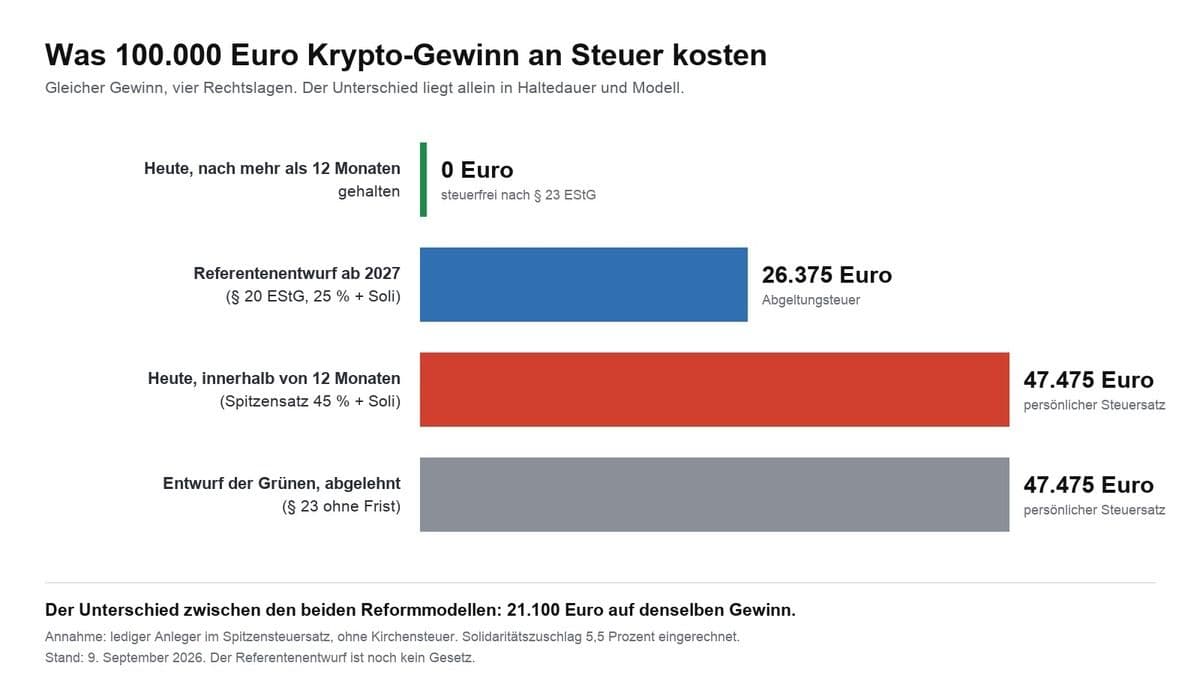
Crypto Tax in Germany: What Applies in 2026 and What Is Set to Change in 2027
Crypto gains are tax-free after twelve months; before that your personal tax rate of up to 45 percent applies. What triggers tax, how the holding period is calculated, what happens with staking and losses, and what the draft bill would change from 2027.
September 24, 2026 10:28 PM

Can Bitcoin Be Seized? What Creditors and Insolvency Administrators May Do with Crypto Assets
Crypto assets can be seized in Germany, and the Berlin Higher Regional Court has confirmed it at appellate level. What matters is the route of access: if the coins sit with a provider, an attachment order suffices; with self-custody the law reaches for the debtor in person.
September 25, 2026 10:26 PM

Selling bitcoin privately: the tax in Germany and the records you need
A direct sale to a private individual falls under the same one-year rule as an exchange sale, but there is no tax report to go with it. This guide walks through the calculation, the 1,000 euro threshold and the records the tax office wants to see.
September 9, 2026 1:15 AM

Germany's Crypto Tax: 160 Million Euros for a 555-Billion Budget
The German finance ministry's draft bill puts a figure on the crypto tax for the first time: 160 million euros from 2028. What that number means in the 2027 federal budget, how 11.4 billion became 160 million, and what investors can read from it.
More from CryptoTicker