

Before you buy, trade or even get involved with meme coins, it is crucial to understand what they are and how they work. Read on to find out more.
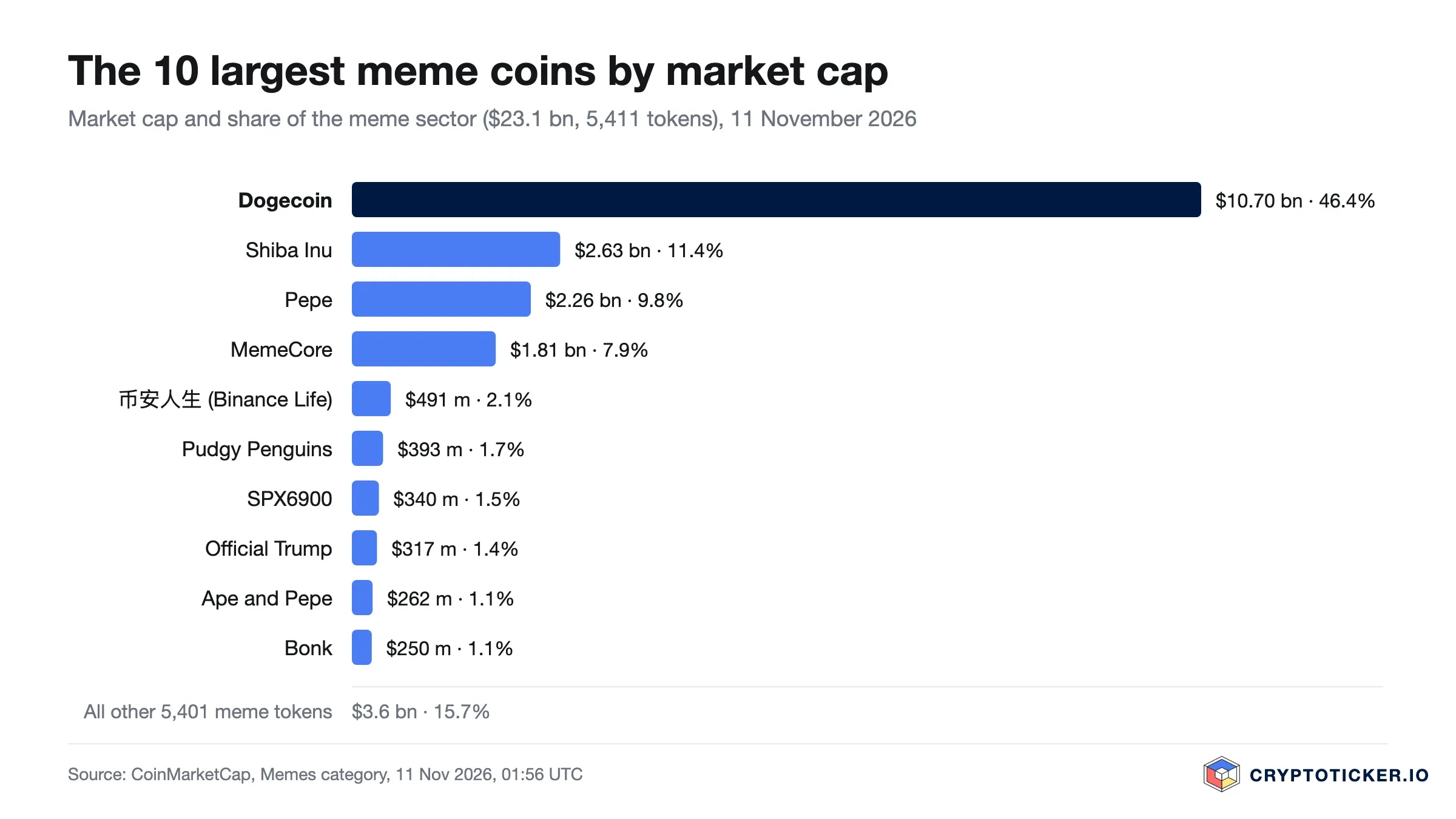
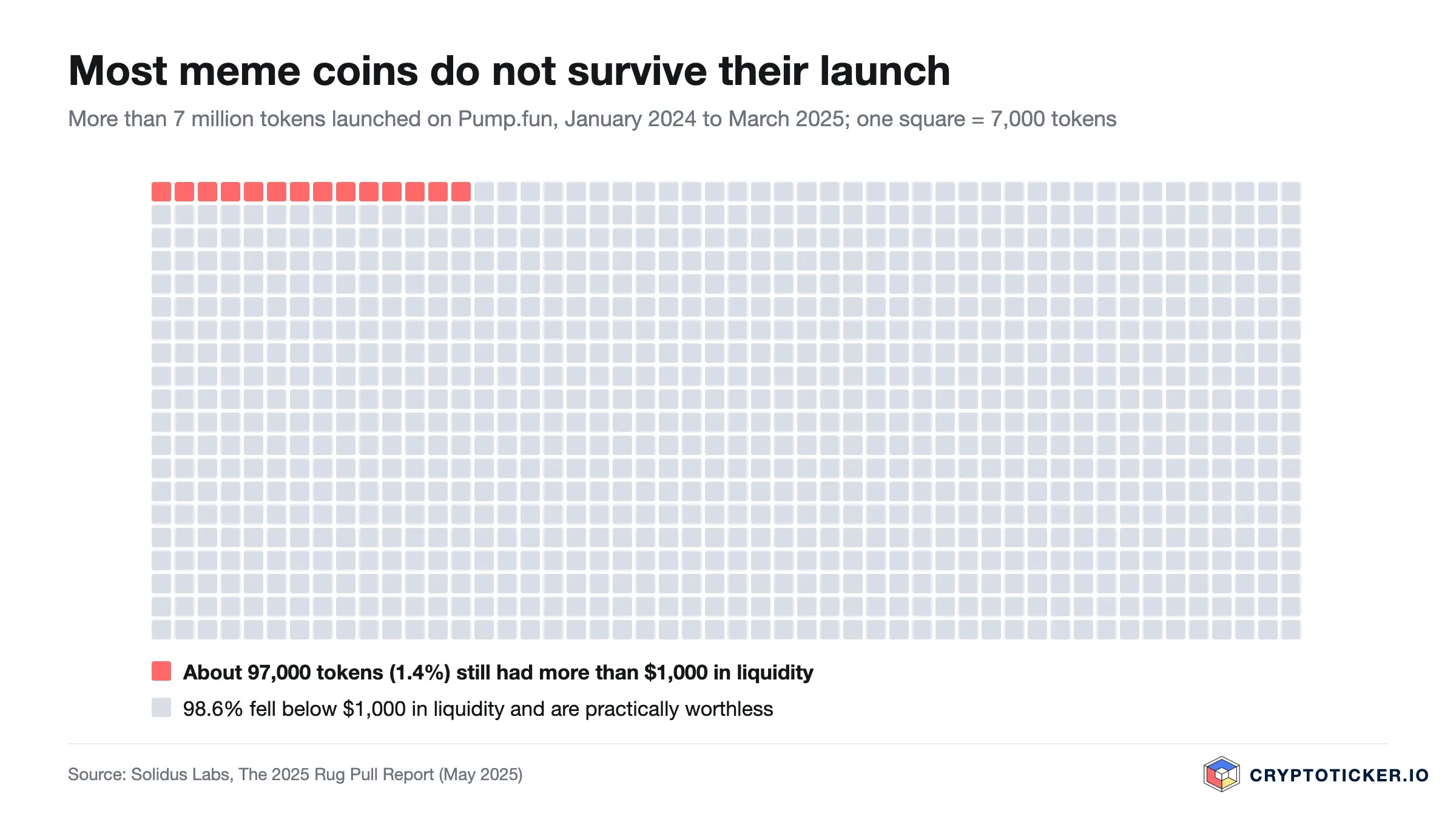
A meme coin is a cryptocurrency that started as an internet joke, a viral image or a pop-culture moment rather than as a technology project. Its price is driven by attention: social media, celebrities and its own community. On 11 November 2026, CoinMarketCap tracked 5,411 meme tokens with a combined market cap of about $23.1 billion. Dogecoin alone accounts for 46 percent of that, and the ten largest meme coins hold 84 percent. Most new meme coins disappear quickly: of more than 7 million tokens launched on the Solana launchpad Pump.fun between January 2024 and March 2025, only about 97,000 still had more than $1,000 in liquidity, according to a study by Solidus Labs.
This guide explains what a meme token is, how meme coins are created and traded, which are the largest today and what to check before you buy one. Live prices for every coin are on our crypto price pages.
Meme coins: the key facts
- $23.1 billion: combined market cap of the 5,411 tokens in CoinMarketCap's meme category on 11 November 2026, about 1.6 percent of Bitcoin's $1.48 trillion.
- 46 percent: Dogecoin's share of the meme sector, ahead of Shiba Inu with 11 percent and Pepe with 10 percent.
- December 2013: Dogecoin, the first meme coin, launched as a joke about the "Doge" Shiba Inu meme.
- 98.6 percent: share of Pump.fun tokens that fell below $1,000 in liquidity, according to the Solidus Labs 2025 Rug Pull Report.
- 91 percent: how far Dogecoin trades below its record of $0.74 from 8 May 2021.
- Not securities: the staff of the US Securities and Exchange Commission said in February 2025 that typical meme coins are not securities. That also means buyers get no protection under securities law.
What is a meme coin?
Meme coins are a type of cryptocurrency inspired by internet memes and popular culture. Unlike traditional cryptocurrencies like Bitcoin and Ethereum, which have clear technological use cases and development roadmaps, meme tokens often start as jokes or internet phenomena. Despite their humorous origins, some have reached market values in the billions, carried by social media hype, celebrity attention and very active communities.
Technically, most meme coins are ordinary tokens on an existing blockchain: ERC-20 tokens on Ethereum (ETH), SPL tokens on Solana (SOL), BEP-20 tokens on BNB Chain (BNB) or tokens on Base. Only a few, such as Dogecoin, run on a blockchain of their own. Creating such a token takes minutes and costs a few dollars, which is why thousands of new ones appear every day. "Meme coin", "memecoin" and "meme token" all mean the same thing.
What a meme coin usually does not have: revenue, a product that needs the token, or a team that promises to build one. Its value rests on the belief of enough buyers that the joke, the mascot or the community will stay popular. That is the core of every meme coin, and it explains both the spectacular rallies and the equally fast crashes.
Meme coin vs Bitcoin: what is the difference?
Bitcoin and meme coins are both cryptocurrencies, but they work on different logic. The table compares Bitcoin with a typical meme coin.
| Bitcoin (BTC) | Typical meme coin | |
|---|---|---|
| Origin | 2009, designed as electronic cash without a bank | An internet meme, a mascot or a news moment |
| Supply | Capped at 21 million coins | Often billions or trillions of units; Shiba Inu has about 589 trillion in circulation |
| Blockchain | Its own network, secured by miners | Usually a token on Ethereum, Solana, BNB Chain or Base |
| Price drivers | Adoption, interest rates, ETF flows | Social media, influencers, exchange listings, community campaigns |
| Effort to create | Years of development | A few minutes on a launchpad |
A common trap is the low unit price. One Shiba Inu token cost $0.0000045 on 11 November 2026, which looks cheap, yet the coin was worth $2.6 billion in total. What counts is the market cap, not the price of a single unit.
When did meme coins start?
The concept of meme tokens can be traced back to the launch of Dogecoin in December 2013. Created by software engineers Billy Markus and Jackson Palmer, Dogecoin was intended as a fun and friendly alternative to Bitcoin. Featuring the Shiba Inu dog from the popular "Doge" meme as its logo, Dogecoin quickly became a hit in online communities. Since then, countless other meme tokens have been created, each leveraging the viral nature of internet culture to gain popularity.

The first meme coins were a joke among a few thousand forum users. Today the sector is a market of its own, with launchpads, dedicated trading apps and coins that are listed on the largest exchanges. The milestones:
| Year | What happened |
|---|---|
| 2013 | Dogecoin launches in December as a parody of Bitcoin. |
| 2020 | Shiba Inu launches on Ethereum in August and starts the wave of dog-themed coins. |
| 2021 | Dogecoin reaches its record of $0.74 on 8 May, Shiba Inu peaks on 28 October. |
| 2023 | Pepe launches in April and makes the frog meme the second big theme after dogs. |
| 2024 | Pump.fun turns launching a token on Solana into a matter of minutes; Pepe sets its record on 9 December. |
| 2025 | The Official Trump coin launches in January and peaks at $75.35 on 19 January; in February the SEC staff publishes its statement on meme coins. |
| 2026 | Meme tokens become a laundering tool: after the Binance hack, the attackers mint their own worthless tokens to move stolen funds. |
Are meme coins a good investment?
Investing in meme tokens can be highly speculative and risky. While some investors have made significant profits, the market for these tokens is extremely volatile. The value of a meme token can skyrocket overnight due to a viral tweet or celebrity endorsement but can also plummet just as quickly. Potential investors should approach meme tokens with caution, conduct thorough research, and only invest money they can afford to lose.
The numbers show how wide the swings are. In the 30 days to 11 November 2026, Pepe gained 31 percent while Dogecoin lost 21 percent and Shiba Inu 18 percent, according to CoinMarketCap. Even the largest meme coins trade far below their records:
| Meme coin | Record price | Date of record | Price on 11 Nov 2026 | Below record |
|---|---|---|---|---|
| Dogecoin (DOGE) | $0.7376 | 8 May 2021 | $0.0682 | 91% |
| Shiba Inu (SHIB) | $0.0000885 | 28 Oct 2021 | $0.0000045 | 95% |
| Pepe (PEPE) | $0.0000282 | 9 Dec 2024 | $0.0000054 | 81% |
| Official Trump (TRUMP) | $75.35 | 19 Jan 2025 | $1.12 | 98.5% |
Why do people buy meme coins anyway? Three reasons come up again and again: the chance of a very large gain with a small stake, the fun of being part of a community, and the speed, because meme coins react to news within minutes. Our view: treat meme coins as play money with a lottery profile, not as savings. Whoever buys one should know the exit before the entry. How a rally builds up and why most buyers come in late is explained in our analysis of meme coin rallies.

Meme coins market capitalization in July 2024. Source: coinmarketcap
Best Exchange for Meme Trading
Bitget stands out as an excellent broker for trading meme tokens. Known for its advanced trading features, competitive fees, and high-security standards, Bitget provides a seamless trading experience. The platform supports a wide range of meme tokens and offers tools for both novice and experienced traders.
There are two ways to buy meme coins. On a centralized exchange you buy with dollars or euros, the exchange holds the coins for you and only lists tokens it has reviewed. That listing is a first quality filter: a coin on a large exchange has a working market and a verified contract. On a decentralized exchange such as Uniswap on Ethereum or Raydium and Jupiter on Solana you trade directly from your own wallet. There you find every new token within minutes of its launch, including the copies and traps. Which providers are licensed is shown in our comparison of regulated crypto exchanges, and how to keep coins safe afterwards in our guide on how to store crypto.
Top 20 Meme Coins by Market Cap
The 20 largest meme coins on 11 November 2026, ranked by market cap. Together they make up 90 percent of the $23.1 billion meme sector. Data: CoinMarketCap meme category, 01:56 UTC.
| # | Meme coin | Blockchain | Market cap | Share of sector | Listed since |
|---|---|---|---|---|---|
| 1 | Dogecoin (DOGE) | own blockchain | $10.70 bn | 46.4% | 2013 |
| 2 | Shiba Inu (SHIB) | Ethereum | $2.63 bn | 11.4% | 2020 |
| 3 | Pepe (PEPE) | Ethereum | $2.26 bn | 9.8% | 2023 |
| 4 | MemeCore (M) | own blockchain | $1.81 bn | 7.9% | 2025 |
| 5 | 币安人生 (Binance Life) | BNB Chain | $491 m | 2.1% | 2025 |
| 6 | Pudgy Penguins (PENGU) | Solana | $393 m | 1.7% | 2024 |
| 7 | SPX6900 (SPX) | Ethereum | $340 m | 1.5% | 2023 |
| 8 | Official Trump (TRUMP) | Solana | $317 m | 1.4% | 2025 |
| 9 | Ape and Pepe (APEPE) | Polygon | $262 m | 1.1% | 2024 |
| 10 | Bonk (BONK) | Solana | $250 m | 1.1% | 2022 |
| 11 | Floki | Ethereum | $201 m | 0.9% | 2021 |
| 12 | Ribbita by Virtuals (TIBBIR) | Base | $160 m | 0.7% | 2025 |
| 13 | dogwifhat (WIF) | Solana | $158 m | 0.7% | 2023 |
| 14 | Useless Coin (USELESS) | Solana | $141 m | 0.6% | 2025 |
| 15 | BUILDon (B) | BNB Chain | $117 m | 0.5% | 2025 |
| 16 | Fartcoin (FARTCOIN) | Solana | $116 m | 0.5% | 2024 |
| 17 | Non-Playable Coin (NPC) | Ethereum | $105 m | 0.5% | 2023 |
| 18 | ApeCoin (APE) | Ethereum | $100 m | 0.4% | 2022 |
| 19 | YZY MONEY (YZY) | Solana | $87 m | 0.4% | 2025 |
| 20 | Dog (Bitcoin) (DOG) | Bitcoin (Runes) | $75 m | 0.3% | 2024 |
1. Dogecoin (DOGE): The original meme token, Dogecoin was created in 2013 by software engineers Billy Markus and Jackson Palmer. It is the only large meme coin with its own blockchain and no supply cap: about 157 billion DOGE are in circulation, and new coins are mined every minute.
2. Shiba Inu (SHIB): Often referred to as the "Dogecoin killer", Shiba Inu runs on Ethereum and has built its own ecosystem around it, including the exchange ShibaSwap and the network Shibarium.
3. Pepe (PEPE): Inspired by the Pepe the Frog meme, PEPE launched in April 2023 and is the largest meme coin without a dog. It is also one of the most traded: on 11 November 2026 its 24-hour trading volume of $766 million was higher than Dogecoin's $552 million, according to CoinMarketCap. How to buy it is explained in our guide to buying Pepe.
4. Official Trump (TRUMP): Often simply called the Trump coin or $TRUMP, it launched on Solana in January 2025. According to the official website, 80 percent of the maximum supply of 1 billion tokens belongs to the creators and CIC Digital, an affiliate of the Trump Organization, released over three years. Why the coin keeps reacting to political news is covered in our TRUMP analysis.
5. Floki (FLOKI), Bonk (BONK) and dogwifhat (WIF): Named after Elon Musk's dog, Floki Inu has gained significant traction due to its association with the tech billionaire. Bonk and dogwifhat stand for the Solana wave of 2023 and 2024, in which meme coins moved from Ethereum to the faster and cheaper Solana network.
What happened to the meme coins on our 2024 list?
When we first published this guide in 2024, it listed 20 meme coins. Many of the smaller dog coins on that list have since lost almost all of their market. The table shows where they stood on 11 November 2026, according to CoinMarketCap.
| Meme coin from the 2024 list | Market cap on 11 Nov 2026 |
|---|---|
| Baby Doge Coin (BABYDOGE) | $53 m |
| Dogelon Mars (ELON) | $22 m |
| Pitbull (PIT) | $5.5 m |
| Kishu Inu (KISHU) | $4.7 m |
| Samoyedcoin (SAMO) | $0.96 m |
| Hoge Finance (HOGE) | $0.74 m |
| Banano (BAN) | $0.68 m |
| Akita Inu (AKITA) | $0.26 m |
| Poodl (POODL) | No market cap reported |
| Husky, Sanshu Inu, DogeCash, Woofy, SafeMoon Inu, Kangal, Tosa Inu | No active market listed on CoinMarketCap |
The lesson: of 16 smaller coins, only two are still worth more than $10 million, and seven no longer have an active market on CoinMarketCap. The four largest names on the old list, Dogecoin, Shiba Inu, Pepe and Floki, are still in the top 20. In meme coins, size and age are the best protection against disappearing.
How are meme coins created?
Most new meme coins today come from launchpads such as Pump.fun on Solana or four.meme on BNB Chain. Anyone can enter a name, a ticker and an image and launch a token within minutes. Buyers then purchase it along a so-called bonding curve: the more they buy, the higher the price. Once enough money has come in, the token moves to a regular trading pool on a decentralized exchange. The model is fast and cheap, which is exactly why it attracts so many short-lived coins.
The Solidus Labs study counted more than 7 million Pump.fun tokens with at least five trades between January 2024 and March 2025. Only about 97,000 of them still had more than $1,000 in liquidity, which makes 98.6 percent practically worthless. On the decentralized exchange Raydium, 93 percent of the liquidity pools showed signs of a so-called soft rug pull, in which the creators quietly withdraw the money. The launchpad business itself is lucrative: how Pump.fun spends its fee income is shown in our report on the Pump.fun buyback.
What are the risks of meme coins?
Meme coins combine all the risks of crypto with a few of their own. These are the most important:
- Rug pulls: The creators sell their tokens or withdraw the liquidity, and the price falls to almost zero within minutes. A prominent example were the fake CR7 tokens that appeared after a rumor about a Cristiano Ronaldo meme coin, covered in our report on the $143 million rug pull.
- Concentration: Often a few wallets hold most of the supply. With the Official Trump coin it is 80 percent for the creators, according to its own website. Every unlock can put pressure on the price.
- Volatility: Moves of 20 or 30 percent in a month are normal for the largest meme coins, and small ones can lose 90 percent in a day.
- Copies and scams: For every successful coin, dozens of copies with the same name appear. Buyers who search by name instead of contract address often get the wrong token. Our guide to protecting yourself from crypto scams shows the most common tricks.
- Money laundering: Criminals use self-made meme tokens to hide stolen funds. After the Binance hack, the attackers minted worthless tokens on Tron and NEAR and traded them through liquidity pools so that the stolen money never moved directly between two of their wallets, according to the blockchain analysis firm Elliptic. On NEAR alone, about $430,000 passed through six such tokens. What the hack cost in total is summarized in our report one week after the Binance hack.
How to check a meme coin before you buy
No check makes a meme coin safe, but these seven questions filter out most traps. Each can be answered in a few minutes with a blockchain explorer or the token page on CoinMarketCap or CoinGecko.
- Is the contract address the official one? Copy it only from the project's own website or a large data provider, never from a reply on social media.
- Who holds the supply? If the ten largest wallets, apart from exchanges and liquidity pools, own more than half of all tokens, a few people can move the price.
- Is the liquidity locked or burned? Otherwise the creators can withdraw it at any time.
- Can more tokens be created? On Solana, check that the mint and freeze authority have been revoked. Otherwise new tokens can be issued or your tokens frozen.
- Can you sell? Some tokens block selling or charge a hidden tax of 10 percent and more. Test with a tiny amount first.
- How old is the coin and how much is traded? A coin that is a few hours old with little volume is a gamble, not a position.
- Is it listed on a regulated exchange? A listing is no guarantee, but it means someone has checked the contract.
Are meme coins legal and how are they taxed?
Buying meme coins is legal in the US, the UK and the EU. In the US, the staff of the Securities and Exchange Commission stated on 27 February 2025 that the typical meme coin is not a security, because buyers do not expect profits from the work of others (SEC staff statement on meme coins). That is not a free pass: fraud remains punishable, and buyers have no claims under securities law. In the EU, meme coins count as crypto-assets under the Markets in Crypto-Assets Regulation (MiCA); whoever offers them to the public or seeks admission to trading has, in principle, to publish a crypto-asset white paper.
For taxes, meme coins are treated like other cryptocurrencies. In the US and the UK, a sale, a swap into another coin or a payment with the coin usually triggers capital gains tax. How to report gains and losses is explained in our guides How to File Crypto Tax, crypto tax in the USA and crypto tax in the UK.
Bottom line: what meme coins are and are not
Meme coins are a reflection of internet culture with a price tag. A few, led by Dogecoin, have lasted for more than a decade and are traded on every large exchange. Most disappear within days. Whoever buys should know the contract address, the distribution of the supply and the exit before the entry, and use only money whose loss would be annoying rather than painful. All guides on crypto basics are collected on our guides page.
MEME FAQ
Partner links: some links on this page are partner links. If you become a customer through one of them, we may earn a commission at no extra cost to you. Selection, ratings and ranking are decided independently by our editorial team. Ethics and Independence · Ownership and Funding