
Bitcoin as a Business Asset in Austria: Private Holding or Company Asset?
Bitcoin held by a business owner in Austria is not automatically a business asset. Here is what decides the classification and what it means for tax on sales, withdrawals and contributions.


Which topics should we dive deeper into?
Select what genuinely interests you. Your picks feed directly into our editorial planning.
Crypto news that's actually worth your time.
Weekly. 60 seconds. Carefully curated by our editors: no hype, no promo flood, no spam.
Holding Bitcoin as a Business Owner: Private or Business Assets?
Business owners in Austria do not have to allocate Bitcoin to business assets automatically. What matters is the purpose the cryptocurrency actually serves. If it is held purely as a personal investment, it can generally remain private property. Where there is a clear link to the business activity, much points towards business assets. The classification has direct consequences for taxation, bookkeeping and the offsetting of losses.

When Do Bitcoin Count as Business Assets?
Bitcoin are likely to be business assets where a company:
- receives them as payment for goods or services,
- uses them regularly for business payments,
- holds them as part of a crypto, mining or trading operation,
- deliberately deploys them as part of a corporate treasury strategy.
If a self-employed consultant buys Bitcoin purely as a private investment, by contrast, the coins do not become business assets simply because the purchase went through the business account. The decisive factor is the actual business function. The source of the payment or the label on a wallet are only indications.
Sole Traders and Limited Companies Are Treated Differently
In a sole proprietorship the owner and the private individual are legally the same person. For tax purposes, private and business assets still have to be kept apart. The position differs for a limited company (GmbH): Bitcoin bought by the company or received as a customer payment belong to the company. The shareholder may not simply move them to a private wallet. Private use of company assets can be treated as a hidden distribution and trigger additional tax.
 Crypto tax software comparison
What Tax Applies When Business Bitcoin Are Sold?
For sole traders, gains on Bitcoin held as business assets can in principle also fall under the special tax rate of 27.5 percent. That does not apply without limits. Where crypto trading or mining forms the core of the business activity, the gains may be taxed at the ordinary progressive income tax rate. In a limited company, profits are first subject to corporation tax. If they are later distributed to the shareholder, capital gains tax can apply on top.
Moving Bitcoin to a Private Wallet Can Be Taxable
Anyone who permanently moves business Bitcoin into private assets makes a withdrawal for tax purposes. This is generally valued at the current market price.
Example:
- Business acquisition cost: 15,000 euros
- Market value at withdrawal: 40,000 euros
- Possible business gain: 25,000 euros
A pure transfer between two business wallets, on the other hand, is generally not a taxable sale. The business allocation does have to remain documented.
Contributing Private Bitcoin to a Business
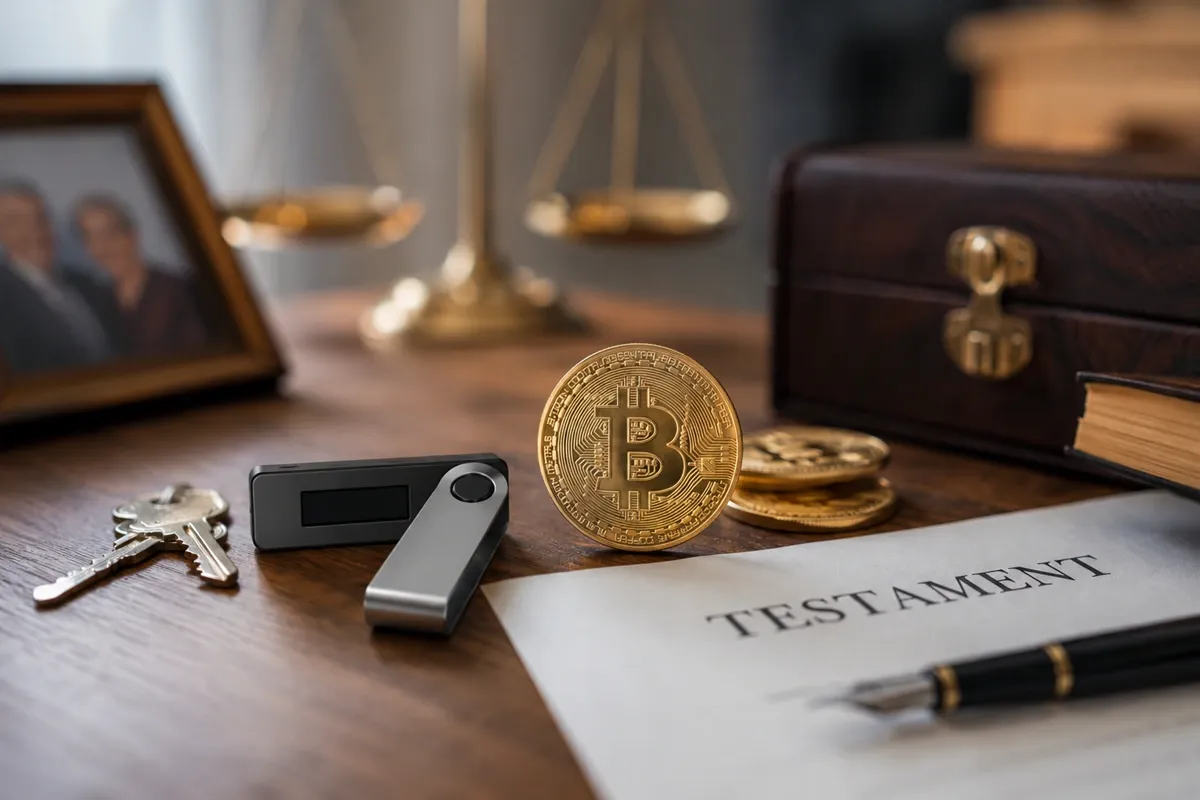
Private Bitcoin can also be contributed to a business. An increase in value that has already accrued privately is not automatically wiped out for tax purposes. As a rule, the existing acquisition costs are carried forward. If the current value sits below the original acquisition cost, the lower figure can be the relevant one instead. A contribution should therefore be documented with the date, the amount of Bitcoin, the wallet address, the acquisition cost and the market value.
See the tax tool comparisonA Clean Split Prevents Bitcoin Tax Problems
Business owners should avoid keeping private and business holdings in the same wallet. Separate wallets, exchange accounts and transaction histories are the sensible route.
What should be documented in particular:
- date of acquisition and purchase price,
- the purpose of the acquisition,
- business deposits and withdrawals,
- wallet transfers,
- contributions and withdrawals,
- fees and sale proceeds.
Conclusion: What Decides Whether Bitcoin Are Business Assets
Whether Bitcoin belong to private or business assets is not decided by the business account alone. What counts is their actual function. Anyone who receives Bitcoin as a customer payment or uses them directly in the business will normally hold them as business assets. A personal investment can remain private property. Particular care is needed with transfers between the company and the private individual, and with Bitcoin held by a limited company. An unclear or retrospectively altered allocation can create additional tax and documentation problems.
(As of August 11, 2026. This article is not investment advice. Prices and fee structures change; check the terms with the provider before you buy.)
See the tax tool comparisonPartner links: some links on this page are partner links. If you become a customer through one of them, we may earn a commission at no extra cost to you. Selection, ratings and ranking are decided independently by our editorial team. Ethics and Independence · Ownership and Funding
Transparency note: This article was produced with the assistance of artificial intelligence. Figures and claims are based on the primary sources linked in the text. The feature image was generated with AI.
For later? Save this article and find it again in your profile.
More on Bitcoin: All Bitcoin news at a glance
Related articles
- Swapping Bitcoin for gold: what it means for your holding period and tax
- Cryptocurrency explained: how digital money works without a bank
- Crypto GmbH: 25.6 percent tax from the first sale, nothing privately after a year: what matters now
- Joint bitcoin wallet: who owns the coins for tax purposes?
- Sequans sells its last 314 bitcoin: what to check if you hold a treasury stock
Which topics should we dive deeper into?
Select what genuinely interests you. Your picks feed directly into our editorial planning.
Crypto news that's actually worth your time.
Weekly. 60 seconds. Carefully curated by our editors: no hype, no promo flood, no spam.

September 23, 2026 4:26 PM

Paid in Bitcoin: How to Tax Crypto Income as a Self-Employed Freelancer
A fee in Bitcoin is perfectly ordinary business income, valued at the euro price on the day it reaches you. The decisive trap comes afterwards: business assets carry no one-year holding period, so every later price move stays taxable.
September 19, 2026 7:12 PM

Bitcoin Sold Without Austrian Tax Withheld: What to Do Next
Sold Bitcoin but no Austrian capital gains tax was withheld? That does not make the sale tax free. When investors have to declare the gain themselves at 27.5 percent.
September 16, 2026 7:12 PM

Borrowing Against Bitcoin Instead of Selling: When German Tax Still Applies
Posting Bitcoin as collateral for a loan is not a sale in Germany, because section 39 of the Fiscal Code keeps the coins attributed to you for tax purposes. Tax arises only when the collateral is liquidated, and then the one thing that decides the bill is how long you held the coins beforehand.
September 14, 2026 1:27 PM

Bitcoin Lost to a Scam: What Counts as a Tax Loss in Austria
Lost bitcoin to a scam? Why Austria generally does not recognise the damage as a tax loss for privately held assets, and when compensation payments start to matter.
September 11, 2026 10:18 AM

Bitcoin Tax Audit: What Proof Austria Requires
Which bitcoin records can the Austrian tax office examine? Purchase dates, wallet transfers, acquisition costs and sale proceeds are what count.
September 10, 2026 7:14 AM

Bitcoin Loan Liquidated: Tax Consequences in Austria
If a lender liquidates Bitcoin pledged as loan collateral, a taxable capital gain can arise in Austria. That holds even when the investor never chose to sell.
September 8, 2026 1:25 PM
Bitcoin Mining in Austria: How Mining Rewards Are Taxed
Bitcoin mining in Austria: when mining rewards are taxed at 27.5 percent, and when a commercial activity brings the progressive income tax rate into play.
September 7, 2026 10:24 AM

Gifting Bitcoin to Children: Tax Rules in Austria
Giving bitcoin to your children? When a gift notification is required in Austria, and which acquisition costs the child takes over.
September 4, 2026 1:34 PM

Bitcoin as Loan Collateral: When No Tax Applies in Austria
Pledging Bitcoin as collateral for a loan? As long as the coins are not realised, no sale arises in Austria in principle.
September 3, 2026 10:21 AM

Bitcoin Lost in a Wallet Hack: What Tax Applies in Austria?
Bitcoin lost to hackers? In Austria, the theft of privately held coins generally does not create a capital loss you can use for tax. Only a later payout can change that.
September 2, 2026 1:39 PM

Bitcoin as Salary in Austria: Which Taxes Arise?
Paid in Bitcoin? In Austria wage tax falls due on the value first. Later Bitcoin price gains can become taxable on top of that.
September 1, 2026 1:25 PM

Bitcoin Tax Report Wrong: What Austrian Investors Can Do
Errors in a Bitcoin tax report are not unusual. This is the data Austrian investors should check, and how a wrong capital gains tax deduction is put right.
August 28, 2026 10:15 AM

Selling Bitcoin Privately: What Tax Applies in Austria
Selling bitcoin directly to another person? In Austria, private sales can still trigger 27.5 percent tax on the realised gain.
August 27, 2026 10:16 AM

Bitcoin Tax Return in Austria: When You Must File
Even with a crypto exchange, a tax return can still be necessary in Austria. Foreign platforms, missing capital gains tax withholding and cross-provider losses are the typical triggers.
August 26, 2026 10:25 PM
Selling Bitcoin at a Loss: Loss Offsetting in Austria
Sold Bitcoin at a loss? Austria allows the loss to be offset against certain investment income. When loss offsetting is possible and which limits apply.
August 25, 2026 10:13 AM

Gifting Bitcoin in Austria: When You Must Report the Gift
Austria levies no general gift tax on bitcoin. Above certain value thresholds, however, a notification to the tax office can be required.
August 24, 2026 10:26 AM

Bitcoin Savings Plan in Austria: How the Purchase Price Is Calculated
Bought bitcoin through a savings plan? For multiple purchases Austria applies the moving average price as a matter of principle when working out taxable gains.
August 21, 2026 1:33 PM

Bitcoin With No Cost Basis: How Austria Taxes the Sale
Bitcoin purchase price no longer provable? How Austria works out the capital gains tax, when a flat-rate cost basis applies and what investors can do.
August 20, 2026 4:24 PM

Bitcoin Across Multiple Wallets: How Austria Works Out the Acquisition Cost
Bitcoin spread across several wallets? How Austria works out the acquisition cost and the rolling average price for tax purposes.
August 18, 2026 7:13 AM
Bitcoin Tax Reporting in Austria 2026: What Applies
Bitcoin tax reporting in Austria: which data investors can request from crypto exchanges in 2026, and when the report matters for the tax return.
August 18, 2026 4:22 AM

Bitcoin for gold: is the swap taxable in Austria?
Swapping bitcoin directly for gold? In Austria this can already trigger 27.5 percent tax on the capital gain. What investors should know.
August 16, 2026 9:11 PM

Swapping Bitcoin for Stablecoins: Does Austria Charge Tax?
Anyone swapping bitcoin for USDT or another stablecoin usually pays no tax in Austria yet. When the swap does become taxable after all.
August 14, 2026 6:18 PM

Bitcoin From a Foreign Exchange to Austria: Which Tax Data You Need
Transferring Bitcoin from a foreign exchange to an Austrian platform: which tax data can be missing for the withholding tax. And what investors need to watch out for.
August 12, 2026 9:12 AM

Bitcoin Losses and Dividends in Austria: How the Tax Offset Works
Can a Bitcoin loss be offset against dividends? This is how loss offsetting works in Austria. It also shows when a tax return is needed for it.
August 11, 2026 5:14 AM

Bitcoin Bought Before March 2021: Is the Sale Tax-Free in Austria?
Bought Bitcoin before March 2021? Why legacy holdings can still be sold tax-free in Austria in 2026, and which exceptions apply.
More from CryptoTicker