
Mantle's treasury holds $2.25 billion while MNT trades 80 percent below its high
The Mantle network manages $2.25 billion, of which around $99 million sits on its own blockchain. What MNT does in the network, where the capital really is, and where you can buy the token against euros.





Which topics should we dive deeper into?
Select what genuinely interests you. Your picks feed directly into our editorial planning.
Crypto news that's actually worth your time.
Weekly. 60 seconds. Carefully curated by our editors: no hype, no promo flood, no spam.
The Mantle network manages a treasure of $2.25 billion, and around $99 million of it sits on its own blockchain. That ratio of roughly 23 to 1 explains more about Mantle than any price level: the organisation behind it is rich, the network beneath it is small. Anyone holding MNT or thinking about it should know both figures, because the token hangs on the first and the utility on the second.
This article works through the network in order: technology, treasury, token, applications, access, trading venues for European investors and risks. cryptoticker.io compiled the figures for capital on the blockchain itself on 13 October 2026 from the public data of DefiLlama; the treasury values come from the project's overview page. How the price has moved since is covered in our Mantle price prediction.
What the Mantle network is and who stands behind it
Mantle is a layer-2 blockchain on Ethereum. A layer 2 settles transactions in a network of its own and passes the bundled result on to Ethereum, so that they become cheaper and faster than they would be directly on Ethereum mainnet. Mantle carries chain ID 5000 and works with Ethereum's developer tooling, so contracts can be ported across with little effort.
The network is carried by an organisation with its own coffers, grown out of the former BitDAO. Those coffers are called the Mantle Treasury and are the real difference from most other layer 2s. Other networks raise capital from investors; Mantle brings an existing stock with it. What happens to it is decided by token holder votes, with governance running through public proposals.
The products under the roof are called Mantle Network for the blockchain itself, mETH Protocol for staking Ether, Function for a Bitcoin connection, Mantle Index Four for a fund product and UR for an app that lets balances be spent and converted back into euros or dollars. The blockchain is therefore one part of the house, not the whole house. That layout later explains why the figures on the blockchain and the figures of the organisation sit so far apart.
From optimistic rollup to ZK validity rollup: what Mantle v2 changed in the technology
A rollup is a blockchain that executes its transactions itself and only presents the result to Ethereum. What matters is how Ethereum learns that this result is correct. An optimistic rollup initially assumes it is, and leaves a window open in which someone can prove the opposite. A validity rollup instead supplies a mathematical proof, a so-called ZK proof, which Ethereum verifies.
Mantle has made that switch. The network's technical documentation describes today's architecture as a ZK validity rollup, introduced with version Mantle v2 under the name Skadi. A service called Mantle-Succinct-Proposer passes the proofs on to a contract on Ethereum at regular intervals. The documentation no longer names a challenge period, because a verified proof does not need one.
For holders that has one practical consequence: on the way back to Ethereum the long waiting time familiar from optimistic rollups falls away. For security it means the validity of blocks hangs on the correctness of the proof programs and the contracts. Anyone wanting to read up on the architecture in detail finds the building blocks described in the same documentation.
Ethereum blobs instead of a data layer of its own: where the transaction data sits today
Every rollup has to store the data of its transactions somewhere, so that the state of the network can be reconstructed even without its operators. That property is called data availability, and it decides whether a network lives on without outside help if the worst happens.
Mantle solved this point through a layer of its own for a long time, Mantle DA, which built on EigenDA's technology. Today's documentation describes a different route: a service called op-batcher writes the rollup data into blob-carrying transactions under the Ethereum standard EIP-4844, directly onto Ethereum. The data therefore sits where the proofs are verified as well.
Mantle is built modularly: execution, data availability and settlement on Ethereum are separate modules that can be swapped out individually. The change of data layer, which left the rest of the infrastructure untouched, shows exactly that. The architecture builds on the OP Stack, an open construction kit for rollups that other layer 2s develop on too. For developers that means short routes: work on Ethereum and you bring your contracts and tools with you, while execution outside mainnet takes care of scalability.
What the documentation leaves open is who operates the sequencer, the service that sets the order of transactions. It describes node operators passing transactions on to it, and that the transaction pool is deliberately not publicly viewable. A statement on whether this service is spread across several independent operators is not there. Young layer 2s usually sit in that position, and it is at the same time the point at which real decentralisation can be measured later.
The treasury holds $2.25 billion, 71.78 percent of it in MNT
The project's treasury page reports a total value of $2,252,971,490 for 13 October 2026. The split: $1,617,206,536 in MNT, which is 71.78 percent, plus $283,593,226 in ETH at 12.58 percent, $237,810,643 in BTC at 10.55 percent, $111,168,807 in stablecoins at 4.93 percent and a small remainder in COOK.
This split carries a risk of its own. Almost three quarters of the treasure consists of the very token whose value the treasury is meant to support. If MNT falls, the coffers shrink in step, and the frequently quoted billion-dollar figure shrinks with them. Truly independent of its own price are only the stablecoins and the Ether and Bitcoin holdings, together around $632 million.
The money is used among other things for distributions to MNT holders via a rewards page of its own. The treasury page lists past distributions for this, including 4,000,000 ENA from a collaboration with Ethena, 570,000 EIGEN from the connection to EigenLayer and 200,000,000 COOK. Alongside that stands an EcoFund, which the project describes as a capital pot of $200 million for applications and technology partners in its own ecosystem.
99 million dollars on its own blockchain: the gap to the treasure
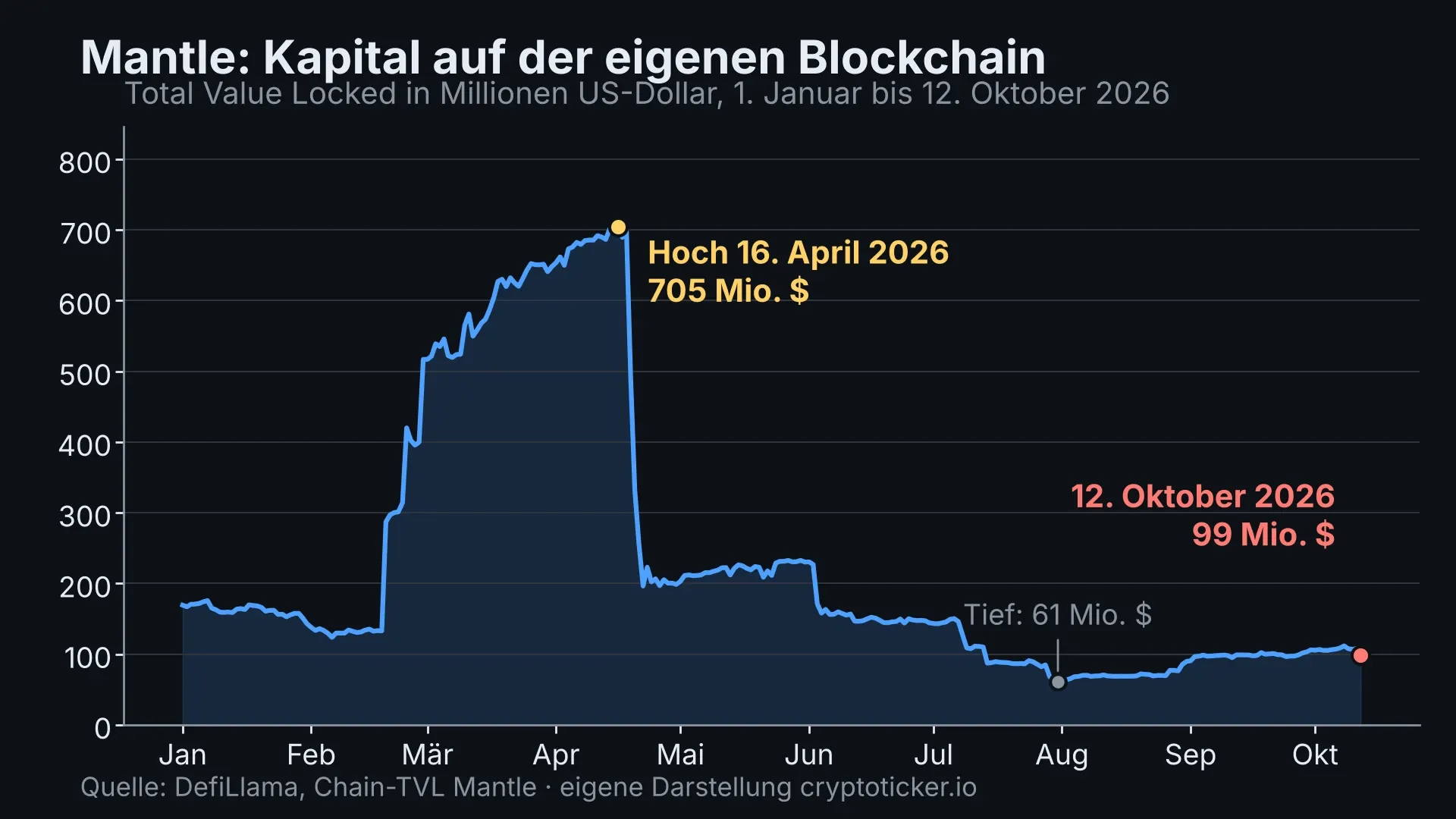
Total value locked, TVL for short, measures how much capital is deposited in the applications of a blockchain. The figure says nothing about profits and little about user numbers, but it does show how much trust capital places in a network. For Mantle, cryptoticker.io analysed the course of 2026 from the public data of DefiLlama, with three verified readings.
At the start of the year $169 million sat on the blockchain. By 16 April the value had risen to $705 million, the highest level of the year. After that it collapsed: on 1 June it was $230 million, on 1 July $143 million, and on 31 July the series marked its lowest point at $61 million. Since then it has been slowly climbing again; on 11 October $108 million was on the books, on 12 October $99 million.
From the April peak to today that is around 86 percent less, while measured from the trough at the end of July it is a good 60 percent more. In the ranking of blockchains by deposited capital, Mantle therefore sits in 28th place. For scale: Ethereum carries around $51 billion, Base a good $6 billion, Arbitrum $1.4 billion and Polygon $675 million.
The treasury is untouched by this. The holdings sit predominantly in MNT, ETH and BTC on Ethereum, so outside the network's own blockchain. That is precisely where the gap between around $2.25 billion and $99 million comes from. Our ecosystem series has described a similar pattern at another network before, when we worked through Ronin after the Karst upgrade.
 Compare where to buy MNT in euros
MNT pays the network fees, 3.3 of 6.2 billion tokens are in circulation
MNT performs two jobs in the network: the token pays the gas fees, meaning the network fees for every transaction, and it counts in votes on the treasury. No claim on profits or earnings of the project comes with it, which holds for most network tokens and matters when weighing the price.
The supply picture, taken from CoinGecko on 13 October 2026: 3,302,003,383 MNT are in circulation, the maximum supply stands at 6,219,316,795 tokens. A good half is therefore in circulation, 53.1 percent. The price stands at 0.47 euros, market capitalisation at around 1.57 billion euros, which means 59th place among all cryptocurrencies. Taking the whole supply at today's price gives a fully diluted valuation of around 2.95 billion euros.
The price record is clearly negative. Over seven days it is down 17.7 percent, over thirty days 5.4 percent, over a year 75.7 percent. From the all-time high of 2.45 euros on 8 October 2025 the price is 80.6 percent away. In trading, around 25 million euros most recently changed hands within a day.
The difference between circulating and maximum supply is the point holders should keep in view: around 2.9 billion MNT are not yet in the market. A large part of that sits in the treasury, and therefore in the hands of the organisation itself.
Aave V3, CIAN and Agni Finance: where the capital on Mantle sits
Behind the $99 million stand concrete applications. The largest positions according to the DefiLlama data of 13 October 2026: the yield manager CIAN Yield Layer holds $107 million, the lending market Aave V3 around $52 million, the exchange Agni Finance $16 million and Merchant Moe $12 million. Behind them follow Fluxion Network with $7 million, the derivatives venue IntentX with $2.3 million and the lending markets INIT Capital and Compound V3 with around $1.7 to $1.9 million each.
That the individual positions add up to more than the value of the blockchain has a technical reason: a yield manager deposits capital in other protocols, and in the TVL of a blockchain such capital is only counted once. The ranking is untouched by that.
As DEXs, meaning decentralised exchanges, Mantle mainly offers Agni Finance, Merchant Moe and Fluxion Network. A launchpad of its own for new tokens, or a notable NFT marketplace with measurable capital, does not appear in the data. Anyone looking for NFTs or fresh tokens currently finds little on Mantle; the weight lies clearly with lending, yields and tokenised assets.
The project sets its priorities there too. Its own page reports for 2026, among other things, the launch of OpenStock with pre-IPO stakes in July, the addition of tokenised equities, the move of its in-house bridge Super Portal from LayerZero to Chainlink CCIP, and since 3 September the stablecoin USDG from issuer Paxos. At its third anniversary in July the project named $116.4 million in tokenised active strategies.
Alongside its own products the house invests in those of others. The EcoFund of $200 million is the tool for that: it finances applications and technology partners building on Mantle, and such investments are the usual route for a young network to keep developers. It becomes visible in the partnerships of recent months, from stablecoin issuer Paxos through tokenisation provider Securitize to Chainlink's bridge technology. Which of these is a pilot and which runs in production is something such lists rarely distinguish; the question is worth asking at every ecosystem.
mETH, Function and Mantle Index Four: the products beside the blockchain
The largest single product of the house does not sit on Mantle but on Ethereum. The mETH Protocol takes in Ether, stakes it and issues the token mETH in return, which remains tradeable. Around $583 million is deposited there according to the DefiLlama data. A variant for restaking, cmETH, and a restaking arm with a further $41 million belong to it. If this form of yield interests you in principle, the providers are in our comparison of staking platforms.
Function is described by the project as a decentralised Bitcoin solution that makes BTC usable for applications on blockchains. Mantle Index Four, MI4 for short, is a fund product launched together with tokenisation provider Securitize in April 2025. The treasury committed up to $400 million as an anchor investment, agreed through a vote. The basket covers Bitcoin, Ether, Solana and dollar stablecoins, is reweighted quarterly and folds in staking yields via mETH, bbSOL and sUSDe. The project does not name a current fund size; the $400 million is a commitment, not a documented holding.
UR, finally, is an app for payments and for converting back into local currency. Taken together the result is a house whose revenue sources stand broader than its own blockchain. For MNT holders that is opportunity and catch at once: the products strengthen the organisation, but the token grants no direct claim on their earnings.

Super Portal, explorer and network fees: how you get onto the Mantle blockchain
The route onto Mantle runs across a bridge. The project operates the Super Portal for this, which takes in balances from Ethereum and further networks and has worked through Chainlink CCIP technology since July 2026. In your wallet you enter the network with chain ID 5000, after which it appears like any other. Which wallet is suitable for it is shown in our comparison of software wallets.
The network fees are paid in MNT. A small holding of it therefore belongs in every wallet that is to do anything on Mantle, otherwise even bridging back stalls. Serving as block explorer, meaning the public register of all transactions and contracts, is mantlescan.xyz; the former link explorer.mantle.xyz redirects there. Every transfer can be traced there and every contract address checked before you grant it anything.
One note on the order: bridge first, application second. Send a balance straight from an exchange to an address on the wrong network and you lose time at best and the amount at worst. The check costs a minute and happens in the explorer.
 Find the right software wallet
MNT in euros: Kraken lists the pair, Coinbase and Bitvavo do not
For investors in Europe what counts in the end is where MNT can be bought at all, ideally against euros and at a provider with European authorisation. cryptoticker.io checked that question itself on 13 October 2026 by querying the public trading registers of several exchanges.
The result: Kraken lists MNT against both euros and US dollars. At Coinbase, MNT does not appear in the register of tradeable pairs, nor does it at Bitvavo, and at Bitpanda no price page for the token exists. Of the large venues authorised in Europe, that leaves above all Kraken for a direct euro purchase.
This situation is typical for MNT and not meant reassuringly: a token tradeable against euros at only a few authorised venues is harder to sell again in case of doubt than a standard asset. If you nonetheless want to buy, compare the fees and the authorisation of providers beforehand in our exchange comparison. A purely price-based view of MNT is also available in our assessment of whether Mantle is a good buy at current prices.
Holding period, staking and total loss: the risks for German investors
For tax purposes German law treats MNT like other crypto assets, as another type of economic asset. Gains from a sale within one year of purchase fall under the private disposal transactions of the Income Tax Act and are taxable above the exemption threshold; once a year has elapsed the gain remains tax-free. Earnings from staking count separately and are recorded in the year they are received. Which program records the transactions cleanly is covered in our comparison of tax tools. An individual case is settled by a tax adviser, not by an article.
The remaining risks lie in the open. First, the concentration risk of the treasury: 71.78 percent in a single token means that treasure and price run in the same direction. Second, the technology: a validity rollup hangs on the correctness of its proof programs and its contracts on Ethereum, and on the distribution of the sequencer the documentation makes no statement. Third, the supply: around 2.9 billion MNT are not yet in circulation. Fourth, tradeability, described above.
There is also the fundamental point that applies to every network token: a total loss is possible. Prices 80 percent below the all-time high count in this market as the normal case for tokens whose usage lags behind expectations.
From the editorial team's view: the treasure does not prove the usage
Mantle is frequently described through the size of its coffers, and the figure is right: $2.25 billion is a lot of money. It is just that those coffers face a network with $99 million on its own blockchain, one that sits in 28th place in the ranking of blockchains and has lost around 86 percent of its deposited capital since April. That the money sits predominantly in MNT, ETH and BTC outside its own blockchain is no reproach, it only shifts the yardstick: Mantle today is more a holding house with an attached blockchain than a layer 2 with full coffers.
In favour of that reading is the fact that the strongest products of the house, mETH with $583 million and the fund product MI4, do not run on Mantle at all. Against it is the fact that the blockchain has gained a good 60 percent again since the trough at the end of July and carries building blocks that attract serious applications, with Aave V3, CIAN and the Paxos stablecoin USDG. Neither case is settled. The direction can be checked against a single figure: if deposited capital moves back towards the $230 million of June in the coming months, the network is growing. If it stays at around $100 million, it is mainly the coffers that carry it. This is expressly not a recommendation to buy or sell.
Mantle: 99 million in usage against a 2.25 billion treasure
Three steps if you want to look into MNT more closely:
- Clarify the venue and its authorisation. Check whether your provider lists MNT against euros at all and what authorisation it holds in Europe. The fees and the authorisation status of the large houses are in the exchange comparison.
- Settle custody before you bridge. A balance on the blockchain needs a wallet that knows the network with chain ID 5000, and a small MNT holding for the network fees. Which wallet fits is shown by the software wallet comparison.
- Record transactions from the start. Purchases, bridge transactions and staking income belong in the documentation without gaps, otherwise the one-year period turns into an arithmetic exercise later. Suitable programs are in the comparison of tax tools.
(As of October 13, 2026. This article is not investment advice. Prices and fee structures change; check the terms with the provider before you buy.)
Frequently asked questions about Mantle (MNT)
Transparency note: This article was produced with the assistance of artificial intelligence and reviewed by our editorial team before publication. All figures and claims were checked against the primary sources linked in the text. The feature image was generated with AI.
Related articles
- Is Mantle a Good Buy at Current Prices?
- OKB at $120, X Layer 10 Percent Below Its Capital Peak: Why One Lending Market Holds 68 Percent
- Sending Crypto: Why the Wrong Network Costs You the Balance on 51 of the 100 Largest Crypto Assets
- Render Jumps 19 Percent: What Really Drives The AI Tokens
- Base Token: No Date, No Quota, but 6.27 Billion Dollars on the Chain
Which topics should we dive deeper into?
Select what genuinely interests you. Your picks feed directly into our editorial planning.
Crypto news that's actually worth your time.
Weekly. 60 seconds. Carefully curated by our editors: no hype, no promo flood, no spam.

September 21, 2026 4:19 PM

Arbitrum Up 150 Percent In A Month: Is Robinhood Carrying The Price?
ARB is the strongest performer of the past four weeks. Behind the advance sit Robinhood's own chain and trading in tokenised assets. Two dates decide whether the rally holds.

September 16, 2026 10:13 AM

USDC on Circle's new Arc chain: what to check before your first transfer
Circle opens the mainnet of its blockchain Arc on September 16, 2026, and on it USDC is the fuel as well. We queried the chain ourselves and show the four points to check before you send USDC there for the first time.

November 25, 2021 11:13 AM
Everything You Need To Know About Polkadot in 2021
Layer 2 solutions have debatable consensus mechanisms. That's where the Polkadot Network is making a difference. Let's talk about Polkadot.
September 21, 2021 12:10 AM
Arbitrum Overtakes The Lightning Network By 23X Crossing $2.6B TVL In 3 Weeks
Arbitrum was launched three weeks ago on Sep 01 and current data indicates that it has crossed $2.6B TVL and overtaken LN by 23X!
May 3, 2026 9:28 AM
LAB Token Crash: Why the Multi-Chain Hub Fell 70% in 24 Hours
LAB token plummeted 70% just hours after hitting an all-time high of $3.64. Was this a "sell the news" event or a coordinated exit?
December 21, 2024 12:23 PM

What is MOVE Token and How It Rose to the Top 100 Cryptos
MOVE token is dominating the charts as one of the best-performing cryptocurrencies this month. Learn how it rose to the top 100 cryptos list despite the market's latest corrections.
June 7, 2026 12:37 PM
Top 5 Altcoins to Buy in June 2026: Best Picks by Crypto Category
Looking for the best crypto to accumulate? Discover the top 5 altcoins to buy in June 2026 across Layer-1, AI, RWA, and Layer-2 sectors.
May 15, 2026 9:47 AM

Top 10 Altcoins to Buy in May 2026 as Bitcoin Recovers
Here are the top 10 altcoins to buy in May 2026 as Bitcoin rebounds near $80K and market momentum shifts.
February 16, 2026 4:00 PM
CC Canton Token Surges Into Top 20 — Can It Break Into the Top 10 Next?
CC Canton token enters the Top 20 after overtaking major altcoins. Can it reach the Top 10 next? Here’s the full market analysis.
September 20, 2024 10:51 AM
Token 2049 Boost Solana Pushing SOL Price Past $150, Can Solana hit $200 Next?
Solana price has soared following major announcements at Token2049, but can SOL hit $200 by October?

October 11, 2026 4:26 PM
Bitway (BTW) hits a record $1.69: what you can do at $24 million in daily turnover
Bitway has reached an all-time high of $1.69, yet in 24 hours only $24.2 million worth of BTW changed hands. What the turnover ratio of 0.55 percent and the November 2 release mean for your order.
October 8, 2026 1:20 AM

Abstract Chain Shuts Down December 15: Withdraw Your Funds or Lose Access
The Ethereum layer-2 built by the Pudgy Penguins team is being wound down. Whatever sits on the chain has to come off by the deadline, and the routes down carry different waiting times.
October 4, 2026 10:34 AM

CARV unlock on October 10: 38.8 million tokens meet daily turnover of $1.3 million
At CARV, almost 48.5 million tokens come free on October 10, 2026, 38.8 million of them in the evening to the founding team, early investors and the private round. The release is larger than a whole trading day of the token, and on the two euro venues the order book is particularly thin.
September 19, 2026 4:20 PM

Is Ondo a Good Buy at the Current Price?
Ondo trades above both moving averages and far below its twelve-month high. We examine the chart position, trading volume and supply mechanics, and set out what argues for and against buying the ONDO token.
September 19, 2026 4:11 AM
WBT Hits All-Time High at $83.64: What WhiteBIT Token Holders Should Check Now
The exchange token WBT reached a new all-time high of $83.64 on September 18, 2026. What sits behind the rise, and the three points German investors should check now.
September 1, 2026 7:11 PM

ICX to SODA Migration: 1.109 Billion ICX Still Sit on the ICON Chain, and Neither Chain Shows a Swap Count
Four weeks before the first cut-off date, cryptoticker.io read both blockchains itself: 1,108,792,074.22 ICX on ICON, 1,499,555,266.83 SODA on Sonic. The swap shows up in neither total supply, and there is no public progress indicator.
August 29, 2026 4:26 PM
Is Aster a Good Buy at Current Prices?
Aster sits above both moving averages and at the same time far below its high since listing. We assess whether the token is a good buy at the current price and why the supply still to be released remains the weightiest objection.

April 13, 2026 6:10 PM
RAVE Token Surges 4,000%: What is RaveDAO and How to Trade It?
RAVE token skyrocketed over 4,000% in 7 days. Learn what RaveDAO is and follow our guide to trade RAVE on Bitget today.
October 17, 2025 4:56 PM

Crypto Crash Alert: Billions Lost, Here Are the Top 5 Losers
The crypto crash wiped billions from the market in hours. From Aster to Aave, here are the top 5 tokens hit hardest — and what their stats reveal.
May 23, 2025 6:49 PM

Cetus Hack on Sui Network: What Happened and Why SUI Price Is Crashing
A $260 million exploit on Sui’s top DEX, Cetus Protocol, has triggered panic across the ecosystem. Here's what really happened, how Sui is responding, and what it means for the SUI token price.
April 11, 2025 4:00 AM
Buy the Dip with These Top 3 Altcoins
The US-China tariff war triggered a harsh market correction despite the 90-day pause that briefly reignited momentum. Still, savvy investors are spotting a buy-the-dip opportunity in three standout altcoins. Can you guess which tokens made the list?
September 26, 2024 2:31 PM

Shiba Inu Ecosystem Explosive Growth: Shibarium Fees Surge and SHIB Price Breaks Out
Shiba Inu ecosystem explosive growth: 2,190% jump in Shibarium fees and a 203% surge in trading volumes. Why this renewed interest in SHIB?
August 26, 2024 7:44 PM

DOGS Token Major 120% Surge Within Hours Of Its Listing: BUY NOW?
The DOGS token experienced a dramatic surge of over 120% on Binance following its listing. How did the Telegram Open Network (TON) drive this surge?
July 12, 2024 7:00 AM
Animoca Token Is LIVE: How To Buy MOCA On Bitget?
Here is how the new MOCA token, launched by Animoca Brands and Moca Network is set to revolutionize the Web3 landscape with its unique utilities.
November 12, 2023 10:36 PM
What is Celestia Crypto (TIA)? A New Era in Blockchain Technology Ahead…
Celestia introduces a modular approach to blockchain. What is Celestia crypto and what is TIA token? Let's answer all those questions.


More from CryptoTicker