
Litecoin Runs Against the Market: What MWEB Balances Mean for Exchanges, Holding Periods and AML Rules
Litecoin is the only one of the 19 scored top assets with a clear gain on September 24, 2026, while Uniswap, Dogecoin and XRP fall by double digits or close to it. We put the record balance in the MWEB layer in context and show what to check on deposits, holding periods and EU anti-money laundering law.



Which topics should we dive deeper into?
Select what genuinely interests you. Your picks feed directly into our editorial planning.
Crypto news that's actually worth your time.
Weekly. 60 seconds. Carefully curated by our editors: no hype, no promo flood, no spam.
Litecoin is the only larger crypto asset in positive territory this Thursday morning, while almost everything else is losing ground. Anyone holding Litecoin or about to buy in should read the move not as a buy signal but as a prompt to check three things: which route you actually use to obtain LTC in Germany, what happens to holdings that sit in the MWEB privacy layer, and which deadline European anti-money laundering law sets from July 10, 2027. This article works through exactly those three points.
Litecoin up 5 percent: the only gainer in a field of losses
We pulled the market data ourselves twice on September 24, 2026, at 03:47 and at 03:56 UTC, each time from the public CoinGecko market list for the 25 largest crypto assets. After stripping out the stablecoins and two special cases without a free market price, 19 positions remained for scoring. Of those 19, exactly one carried a gain of more than one percent: Litecoin, up 5.0 to 5.4 percent over 24 hours at a price of roughly $66.80 to $67.20. Bitcoin Cash hovered around the flat line in the same window, between minus 0.4 and plus 0.3 percent. The remaining 17 assets were in the red.
This assessment was compiled by cryptoticker.io itself on September 24, 2026. Basis: the market list for the 25 largest crypto assets by market capitalisation, followed by manual removal of the stablecoins and of the two assets without a freely tradable price. The figures are a market average, not an execution price.
The counterpart to Litecoin is the breadth of the decline. Uniswap lost 13.5 percent over the same 24 hours, Dogecoin 10.2 percent, Stellar 9.3 percent and Cardano 8.1 percent. Bitcoin gave up 3.2 percent to around $83,900, Ether 3.6 percent to around $2,675. The contrast with the weekly balance is striking: over seven days almost all of these assets are firmly higher, Uniswap by some 38.6 percent, Cardano by 22.3 percent, Bitcoin by 10.5 percent. So the market is handing back part of a very strong week.
Litecoin falls outside that pattern because it leads on the weekly view as well, up 26.1 percent, and over a month by around 25.4 percent. Market capitalisation stood at about $5.19 billion, with 24-hour turnover of roughly $815 million. Trading volume on that scale against that market capitalisation suggests the move is carried by real flow rather than resting on a few thin order books.
Why a single winning day is not yet a turning point
A day on which one asset runs against the market means only that its buyers are acting on a different motive from everyone else right now. That motive can be structural, and it can equally be a short-term reallocation that disappears again within days. What is solid here is the observation itself, and not the interpretation placed on it. What follows therefore keeps the two apart: first the documented figures on the MWEB layer, then the legal position, then the points you can check against your own holdings.
MWEB explained: what Litecoin's optional privacy layer actually does
MWEB stands for Mimblewimble Extension Blocks. It is an extension of the Litecoin network, live since 2022, into which you can deliberately move LTC so that the amounts and addresses of a transaction are no longer readable in plain text on the public blockchain. The decisive word is optional. The ordinary Litecoin blockchain remains as transparent as it ever was. If you do nothing, your balance stays in the open chain and is as traceable as before.
Technically, two operations are involved that are worth knowing, because they matter later for tax and at exchanges. The peg-in is the transfer from the open chain into the MWEB layer. The peg-out is the way back. Both are ordinary Litecoin transactions and both appear on the blockchain. What is therefore visible is that something moved into or out of the layer, but not which amounts moved between which addresses inside it.
From that follows a property often lost in the debate. MWEB does not automatically turn Litecoin into an anonymous coin. It gives it a switchable confidentiality layer that the holder activates. For the legal assessment, precisely that distinction is the heart of the matter, and it becomes important again further down.
How to tell whether your own balance sits in MWEB
The simplest test is the address. MWEB addresses are noticeably longer than ordinary Litecoin addresses and carry their own prefix. If your wallet shows you two separate balances for the same holding, one normal and one labelled MWEB or confidential, then part of your funds sits in the layer. If your wallet shows a single balance and you have never actively triggered an MWEB transfer, your holding is in the open chain. Hardware wallets still support MWEB only partially, which gives you a check of its own.

MWEB holdings at a record high: which figures are documented and which are not
The reason most often given for the Litecoin move is the growth of funds held in the MWEB layer. The figures come from the specialist analytics service MWEB Explorer, and they differ depending on the cut-off date. For September 11, 2026, a balance of 563,117 LTC is reported, worth around $29.5 million at the time. More recent summaries cite roughly 519,000 LTC. We are deliberately not smoothing that over: the documented range for September 2026 lies between about 519,000 and 563,117 LTC, with an interim high on September 11.
For context, the comparison with earlier years says more than the daily figure. Through most of 2024 the balance in the MWEB layer sat below 100,000 LTC. Even at the lower end of today's range, the amount has more than quintupled since then. The number of addresses holding MWEB balances also reached a record in September 2026.
One caveat belongs with this. The figures quoted are confirmed by several independent reports. So we did not compute them from the chain ourselves, and you should know that before you base an investment decision on them. The source is linked here: MWEB Explorer, balance history of the MWEB layer.
What the figure does and does not say is equally a question of precision. A rising MWEB balance shows that more LTC are parked in the confidentiality layer. It does not show that a corresponding number of people have bought afresh, because a peg-in shifts existing holdings and creates no demand in the market. Reading the balance curve as a demand indicator confuses two different things.
 Where to buy Litecoin through regulated venues
Peg-in and peg-out: why some exchanges refuse deposits from the MWEB layer
This is the point that matters most in practice for anyone who moves LTC rather than simply leaving it alone. A trading platform has to be able to check the origin of incoming funds. Where a deposit arrives from the MWEB layer, the platform sees the peg-out but not the chain before it. Some providers solve this by declining deposits from MWEB addresses outright at the technical level, or by holding them after arrival for manual review.
The consequences are unpleasant and avoidable. In the better case a rejected deposit is returned; in the worse case it hangs in a review queue for days, precisely when you wanted to sell. So the rule is this: check your platform's deposit terms before you send LTC there from an MWEB address, not afterwards.
The three questions to put to your platform in advance
- Does the platform accept Litecoin deposits from MWEB addresses at all? The answer is usually in the help page on deposits and withdrawals, not in the fee schedule.
- Will the platform pay out to an MWEB address on request, or only to ordinary Litecoin addresses? Both practices exist, and this determines whether you can reach the layer at all after buying.
- What evidence does it require for a deposit whose history is invisible on the blockchain? A platform that answers this clearly up front is the better choice at this point.
If you still need a suitable venue: our overview of the best crypto exchanges puts fees, deposit routes and withdrawal terms side by side, so you can work through the three questions above against specific providers.
Buying Litecoin in Germany: checking MiCA providers, purchase route and fees
Since the European regulation on markets in crypto-assets came into full effect, crypto-asset service providers in Germany may only deal with retail clients under an appropriate authorisation. For you as a buyer that is a relief, because it narrows the field to supervised providers, and an obligation, because you ought to know your provider's status. Anyone wanting to know which duties sit behind that and by when they bite will find the background in our overview of MiCA licensing obligations for crypto companies.
On the purchase route itself, what matters is less the headline trading fee than the sum of the fee and the spread between the bid and the ask. For an asset such as Litecoin with daily turnover of around $815 million, that spread is tight at large venues and noticeably wider at small platforms and on instant-buy functions. A surcharge of one percent on a purchase of 2,000 euros is 20 euros that you have to earn back before your first gain on the price.
If you move larger sums, it is also worth checking the public register of Germany's Federal Financial Supervisory Authority: it shows whether your provider actually holds the authorisation it claims on its website.
What a crypto ETP changes at this point, and what it does not
An exchange-traded product tracking the price now exists for Litecoin too. Convenient access through a securities account comes with two catches worth knowing. First, a product of that kind holds the coins for you, so you get neither a wallet nor access to the MWEB layer. Second, different tax rules apply to ETPs than to directly held coins, particularly around the holding period. The existence of such a product also does not mean it is being used: inflows have so far stayed small.

Article 79 of the EU anti-money laundering regulation: what applies to anonymity-enhancing crypto-assets from July 10, 2027
Regulation (EU) 2024/1624, the European anti-money laundering regulation, contains a rule in Article 79(1) that bears directly on this subject. It states that credit institutions, financial institutions and crypto-asset service providers may keep neither anonymous crypto-asset accounts nor any other accounts that otherwise allow the holder of the customer account to be anonymised or transactions to be anonymised or, in the wording used, highly obfuscated, expressly including through anonymity-enhancing coins. Under Article 90 the regulation applies from July 10, 2027. You can read both in the official text: Regulation (EU) 2024/1624 on EUR-Lex.
What matters is what the text says and what it does not. The provision addresses supervised service providers, not you as a private individual. It does not prohibit a private individual from owning a coin, and it contains no list of banned crypto-assets either. What it forbids service providers to do is keep accounts that anonymise holders or transactions or heavily obscure them.
How a supervisor will classify a coin with a switchable confidentiality layer under that wording is the open question. Two readings stand side by side, and both are assessments rather than settled law. The first looks at the coin as a whole and would place Litecoin close to the category named, because the MWEB function exists. The second looks at the individual account: a balance in the open, transparent Litecoin chain anonymises nothing, so the rule would bite only on deposits whose origin has been obscured. The second reading fits the wording better, since it speaks of accounts and of the ability to anonymise by means of them. No binding interpretation from the competent authorities exists so far.
In practice what matters most to you is how the platforms react, because they decide earlier than any court. With crypto-assets that have anonymity built in permanently, European venues have repeatedly delisted as a precaution in recent years, long before any deadline ran. For Litecoin no such step has been announced, and there is no documented indication that one is planned. None of this calls for panic. It calls for a monitoring task: keep an eye on your platform's notices, and do not rely on a delisting being announced with plenty of warning.
 Store your Litecoin safely yourself
Holding period and tax: what a peg-in means for your one-year clock and your FIFO records
In Germany, crypto-assets held as private wealth count as other economic goods. A sale within one year of acquisition is a private disposal transaction, the resulting gain is taxable, and an exemption threshold of 1,000 euros applies to all private disposal transactions in a given year taken together. Once the threshold is exceeded, the whole gain is taxable, not merely the excess. After one year has passed, a sale out of private wealth is tax free.
For MWEB the decisive question is whether a peg-in restarts the clock. On the prevailing view, moving funds between your own addresses is neither an acquisition nor a disposal, because the beneficial owner does not change; the holding period therefore continues to run. We are not aware of any explicit statement from the tax authorities specifically on MWEB, and for an individual case this article is no substitute for tax advice.
The real problem lies elsewhere, and it is a documentation problem. The tax authorities expect a traceable record of which unit was acquired when, usually on a first-in-first-out basis per wallet. That traceability is exactly what the MWEB layer removes from the public chain at the moment of the peg-in. A tax tool that would otherwise reconstruct your history from the blockchain cannot see the movements inside the layer.
The records you have to keep yourself
- Date, time, amount and euro value for every peg-in and every peg-out, each with the transaction ID from the open chain.
- The mapping of which originally acquired tranche you moved into the layer, so that the acquisition data can still be matched up after the peg-out.
- Purchase and sale confirmations from your trading platform evidencing the acquisition date, irrespective of where the coins travelled afterwards.
- An export of your wallet history at year end, because wallet software does not necessarily restore the full record after a reinstallation.
Anyone who fails to keep this running log reconstructs it later from memory, and that rarely survives a query. Which tools maintain and export these histories is covered in our overview of crypto tax software and portfolio trackers; pay particular attention there to whether a tool permits manual correcting entries, because without them you cannot record MWEB operations cleanly.
Storing LTC: hardware wallet, MWEB support and the seed as your only way back
A balance in the MWEB layer hangs on the same recovery phrase as the rest of your Litecoin holdings, but it is not handled identically by every wallet application. This is where custody and privacy meet: a wallet that does not know MWEB will simply not display that part of your holdings after a recovery. The funds are not lost in that case, but you cannot see them, and without suitable software you cannot reach them.
Three things to check before your next peg-in:
- Does your wallet support MWEB today, and does it also support it in the version you would reinstall if the worst happened? For hardware wallets this is the most common gap.
- Have you ever practised the recovery, with a small amount and on a second device? An untested backup is an assumption.
- Is your recovery phrase kept away from every device connected to the internet? A photo in the cloud is not a backup. It is a second route of attack.
Which devices cover which functions and what they cost is set out in our hardware wallet comparison. Check Litecoin support explicitly before buying, because on some devices it is loaded through an additional application.
Levels above and below: which Litecoin price marks decide the next few days
The starting points of the move can be worked back from the measured rates of change, and those serve as orientation better than round wish-list levels. The daily move started at around $63.60. Seven days ago Litecoin stood at about $52.90, and 30 days ago at about $53.30. The entire upward move of the past month therefore rests on a zone around $53.
On the downside that gives two steps: first the starting point of the day at around $63.60, and below it the zone around $53, a break of which would mean the monthly move had been given back in full. On the upside the next notable mark is the round threshold at $70, which Litecoin has yet to reach in the current advance. These are orientation points drawn from the measured price action and no forecast; where the price actually goes, nobody can tell you responsibly.
For practical handling, the level itself matters less than what you do at it. Anyone setting a sell threshold should know in advance whether the sale would fall within the one-year period, because a taxable gain changes the arithmetic. Anyone planning to add should check the value of the fee and the trading spread before splitting an order into parts.
Privacy rotation in the market: what Zcash and Monero reveal about the Litecoin move
The rise in Litecoin is frequently explained by a rotation into assets with privacy features. Our own measurements do not support that for the day itself. Zcash lost 6.6 percent over the same 24 hours to around $1,503, and Monero gave up 2.8 percent to around $553. Had money been flowing deliberately into the privacy narrative this morning, those two would hardly have had to give ground at the same time.
Over a longer horizon the picture differs. Across 30 days Zcash is up around 82 percent, from about $826, and Monero around 25 percent. So there is indeed a privacy theme in the market; it simply does not explain Litecoin's move on the day. Anyone looking for an explanation for today will find it closer to Bitcoin Cash, which has gained 54 percent over seven days and also barely slipped this morning. Both are old, large-capitalisation networks with long histories, and both have recently outperformed the broad market.
For you as a holder, one sober conclusion follows. A narrative that explains a move after the fact is still no reason to send money after it. What is documented this morning: Litecoin is the only one of the 19 scored top assets with a meaningful gain, and the balance in the MWEB layer stands at a historically high level. Everything beyond that is interpretation.
Checking Litecoin and MWEB: what to take away
- First establish where your LTC sits and whether your platform accepts it. Check in your wallet whether part of your holdings is carried as an MWEB balance, and read your venue's deposit terms before you transfer anything. Suitable providers with the associated deposit and withdrawal routes are in our overview of the best crypto exchanges.
- Start logging your peg-in and peg-out operations today. Date, amount, euro value and transaction ID are enough as long as you keep the log complete; that keeps your holding period evidenced even when the chain no longer shows the route. Tools that maintain and export such histories are in the comparison of crypto tax software and portfolio trackers.
- Test your recovery before you move more into the layer. Restore your wallet with a small amount on a second device and see whether the MWEB balance appears there. Which devices cover Litecoin and the layer is shown in the hardware wallet comparison.
(As of September 24, 2026. This article is not investment advice. Prices and fee structures change; check the terms with the provider before you buy.)
Transparency note: This article was produced with the assistance of artificial intelligence and reviewed by our editorial team before publication. All figures and claims were checked against the primary sources linked in the text. The feature image was generated with AI.
Related articles
- Zcash Above $1,500: What ZEC Holders Should Check on Tax and Custody
- Chainlink Jumps Above $12: What LINK Holders Should Check Now
- 93.56 million dollars out of the Zcash ETF in one week: what changes for ZEC holders in Europe
- Buying Zcash Despite the EU Trading Ban: What Happens to Your ZEC From July 2027
- Litecoin Jumps by Double Digits While the Market Falls: Check Buy Route, Holding Period and Leverage Now
Which topics should we dive deeper into?
Select what genuinely interests you. Your picks feed directly into our editorial planning.
Crypto news that's actually worth your time.
Weekly. 60 seconds. Carefully curated by our editors: no hype, no promo flood, no spam.

October 6, 2026 10:36 PM

Buying Monero in Germany: six major exchanges no longer list XMR
On October 5, 2026, of eight trading venues checked only two still carry an XMR pair, and neither is open to German customers. MiCA Article 76(3) explains the delistings, and Article 79 of the anti-money-laundering regulation sets the tougher limit from July 10, 2027.

September 24, 2026 10:12 AM

XRP Falls 9.7 Percent: What to Check on Holding Period and Buying Route
XRP is down around 9.7 percent on the morning of September 24, twice as much as the typical large crypto asset. Our count of 18 coins shows who the pullback hits and which three things hold true regardless of the price.
September 12, 2026 10:11 PM

Crypto CFD or Buying Real Coins? How Leverage, Margin Calls and Tax Differ
With a crypto CFD you own a contract; with a direct purchase you own the crypto asset itself. From that one difference follow the 2:1 leverage cap, forced close-out, the tax burden and the question of who is liable for your money if things go wrong.
September 10, 2026 4:15 PM
BW-Bank Opens Bitcoin Trading Inside the Securities Account: What to Check Before Your First Buy
Since September 9, 2026, BW-Bank customers have been able to trade ten crypto assets through their securities account, executed and held in custody by Bitpanda. The familiar securities-account setting hides three points you should settle before your first order.
October 11, 2026 4:28 AM

Coinbase Card Without a Transaction Fee: What Investors Need to Know About Conversion and the Holding Period
Coinbase charges no transaction fee for paying with the card. It gets expensive in two places that appear on no receipt: the conversion of the balance and the holding period.
September 21, 2026 4:13 AM
How to Buy XRP in Germany: Exchange, Destination Tag and Tax
Buying XRP works through a crypto exchange with MiCA authorisation, through a broker, or through an ETP in your securities account. This guide shows what matters on fees, the destination tag, custody and the German holding period.
August 6, 2026 3:05 PM
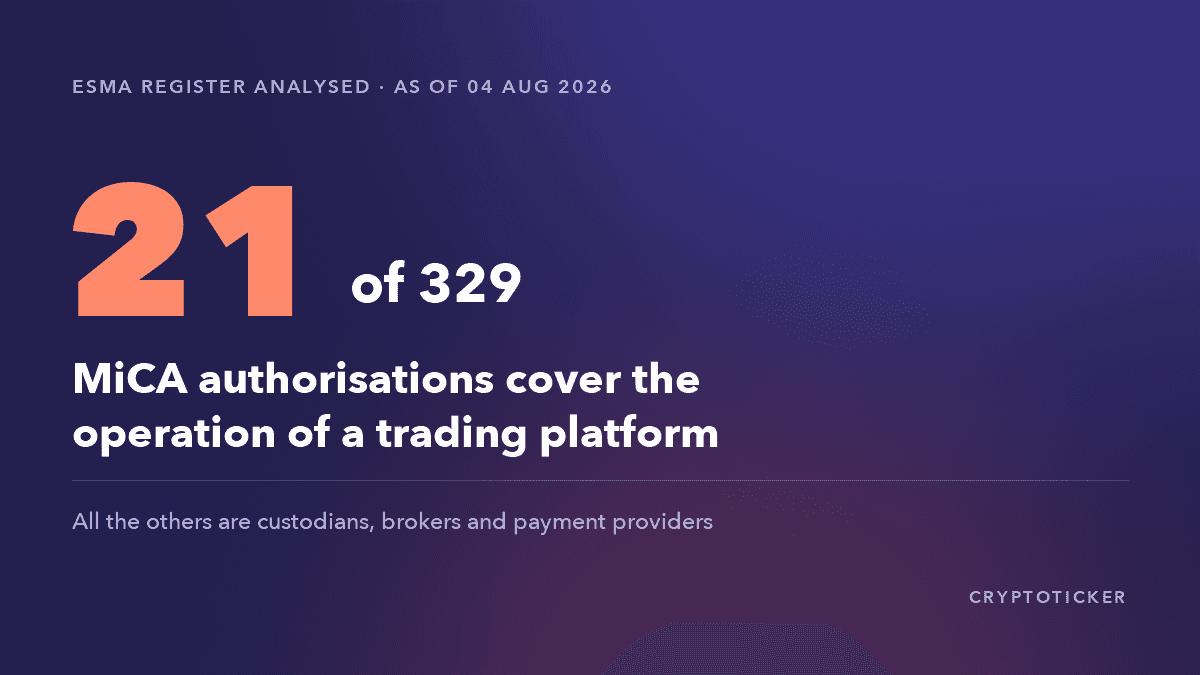
MiCA Register 2026: Only 21 of 329 Licences Are Real Exchanges
ESMA publishes the register of MiCA-authorised providers as an open file. We worked through all of it — and the result is not what the phrase “licensed crypto exchange” suggests.

November 7, 2025 3:36 PM
Top 5 Privacy Tokens to Watch Before 2026
Zcash jumps 78% in a week, leading a major rally in privacy coins. Here are the top 5 privacy tokens by market cap in 2025.
October 6, 2026 4:32 AM
Bitcoin for a gift card: what paying with crypto means for your holding period
Paying for a gift card with Bitcoin is a sale for tax purposes. What counts as the disposal proceeds, when the twelve-month holding period bites, and the four records the tax office expects.
October 6, 2026 1:23 AM
50 euros a month in Bitcoin, 118 instalments since 2017: savings plan vs lump sum
118 monthly instalments of 50 euros since January 2017 add up to €5,900 paid in and around €54,500 today. The same instalment since January 2024 is up only 14.5 percent, and since October 2025 the savings plan beats the lump sum by almost 39 percentage points.
September 27, 2026 4:32 AM
Hester Peirce Leaves the SEC: What Now Applies to Your Custody in Germany
The most crypto-friendly voice at the US securities regulator goes on October 2, 2026, and the commission shrinks to two members. For investors in Germany it is still the European rulebook that decides, and there a deadline falls in July 2027.
September 24, 2026 1:11 PM
Stellar Becomes a Payment Rail at Mastercard's BVNK: What XLM Holders Should Check on Buying Route, Memo and Holding Period
BVNK has switched on Stellar as a payment rail for business customers in more than 130 countries. On the same trading day XLM falls by around seven percent — we separate what the news means from what the pullback means for your portfolio.

September 22, 2026 4:12 PM

Nearly $1 Billion Into Bitcoin ETFs: What to Check on ETNs, Portfolio and Holding Period
US spot bitcoin ETFs took in a net $999 million on September 21, the third consecutive day of inflows. German investors cannot reach these funds: what ETNs, the holding period and your buying route mean for you.
October 6, 2026 10:32 AM

FinCEN drops the reporting duty for withdrawals to private wallets: what matters now for European investors
The US anti-money-laundering agency FinCEN withdrew two proposals on October 5, 2026 covering the reporting duty for self-custodied wallets and for mixers. In the EU the development runs in exactly the opposite direction: proof of ownership from 1,000 euros today, a ban on anonymous accounts from July 2027.
September 8, 2026 10:21 PM

Crypto Holding Period and Grandfathering: Why December 31, 2026 Becomes the Cut-Off in Germany's Draft Bill
A ministerial draft bill from Germany's finance ministry names a cut-off date for the first time: crypto assets acquired after December 31, 2026 are to fall under the flat-rate withholding tax. What that means for legacy holdings, running savings plans and staking income, and why nothing has been decided yet.
October 9, 2026 7:21 AM

Ethereum savings plan: twelve instalments averaged 1,981 euros, the lump sum 3,318
Twelve monthly instalments of 100 euros in Ether worked out at an average price of 1,981 euros, while a lump sum on the starting day cost 3,318 euros. The twelve-month calculation, the two quirks that set it apart from a Bitcoin savings plan, and the tax consequences of twelve separate purchases a year.
October 5, 2026 4:26 PM

Shiba Inu price up 4.4 percent: outperforms the market, but 88 trillion SHIB sit on exchanges
Shiba Inu adds 4.4 percent on Monday, making it the strongest of the six big names. At the same time 88.08 trillion SHIB worth $525 million sit on trading venues, almost five times a single day of turnover.
October 1, 2026 7:38 AM

Buying Ethereum with PayPal: a 72-hour withdrawal lock is the real price of the convenience
PayPal does not trade crypto-assets in Germany, yet it still works as a deposit route at a crypto exchange. What arrives in ether out of 100 euros, why the fee appears only on the final page and what the 72-hour lock means for your ETH.
September 27, 2026 4:12 AM
Bitcoin ETF Inflows Turn 2026 Positive: How to Tell If the Demand Holds
US spot Bitcoin ETFs took in roughly $2.4 billion in the week to September 25, the strongest week since October 2025, and that turns the 2026 year-to-date balance positive. Why the daily inflow fell 87 percent within the same week, and what to check on buying route, holding period and custody.
September 25, 2026 7:14 PM

Chainlink Above the September High: What Open Interest, Funding Rate and Liquidation Risk Mean for LINK
Chainlink stands at $13.86, 11.2 percent higher than 24 hours ago. Our own query at OKX and Hyperliquid shows funding at the baseline rate, and what that means for leverage, buying route and tax.
September 25, 2026 4:23 PM
Chainlink Jumps 12 Percent to $13.93: What to Check on Buying Route, Holding Period and Staking
Chainlink trades at $13.93 on September 25, 12.21 percent above the previous day; the trigger is the launch of the Paxos token PAXGy, which uses Chainlink's cross-chain rail CCIP as its only route between networks. This piece places the drivers and shows what to check on buying route, holding period, staking, custody and leverage.
September 24, 2026 4:11 PM

Bitcoin Cash Falls 5.5 Percent After a 50 Percent Week: Check Your Buy Route, Leverage and Holding Period
Bitcoin Cash fell to $335.19 on September 24, 2026, after gaining almost 50 percent in seven days. The rally was set off by CME's announcement of September 22; what that means for buy route, leverage, holding period and custody is set out here.
September 22, 2026 1:15 AM

Memecoin Rally: Why Memecoins Are Rising and What to Check Before You Buy
The memecoin sector stands 9.01 percent higher, the overall market only 2.90 percent. The arithmetic behind it shows that two tokens carry three quarters of the move and that the sector has no occasion of its own.
September 21, 2026 4:15 PM

Sui Jumps 26 Percent: The Strongest Coin In The Top 30
Sui gains around 26 percent within 24 hours and beats every other asset in the top 30. Behind the move sit a prominent bet on the AI economy, a new bitcoin protocol and a rotation into layer 1 chains.
September 18, 2026 10:14 PM

Bitcoin Back Above $80,000: Buy More, Hold or Take Profits? What to Check Now
Bitcoin is back above $80,000, for the first time since September 7. Whether you buy more, hold or take profits depends less on the daily price than on three things you can check yourself: your holding period, the way you buy, and where your coins are kept.
August 24, 2026 10:29 AM
Buying More Bitcoin at $77,000: Savings Plan or Lump Sum
Bitcoin stands at $77,256 after gaining 22.78 percent in a week. This guide shows you how to buy more cleanly at this price and which method fits which starting position.

February 8, 2019 8:25 AM
Litecoin To Implement Mimblewimble
Litecoin Foundation has approached Beam for plausible agreement to perform Mimblewimble via Extension Blocks on Litecoin. According to the official Blog of Beam, teams behind Litecoin (LTC) and new privacy coin Beam have commenced research towards combining privacy and fungibility […]
More from CryptoTicker