
Buying Trading Cards in 2026: TCG Cards Live, in Stores and Tokenised
Pokémon turns 30, Cyberpunk TCG launches, live auctions are booming and real cards are getting digital twins. How to buy trading cards in 2026, and how the platforms make money.

Which topics should we dive deeper into?
Select what genuinely interests you. Your picks feed directly into our editorial planning.
Crypto news that's actually worth your time.
Weekly. 60 seconds. Carefully curated by our editors: no hype, no promo flood, no spam.
In 2026 there are four ways to buy trading cards: in stores and on marketplaces such as Cardmarket, in live auctions such as those on SLABHIT, as vaulted cards with a digital twin from providers such as Courtyard or Collector Crypt, and in new games that combine printed and digital cards, such as Mudwater from the Bored Ape Yacht Club. The choice has rarely been this wide: Pokémon is celebrating 30 years, the crowdfunded Cyberpunk TCG reaches stores in early November, and live shows have become the main venue for pack openings. Here you will find which route suits you, which games and products exist, how the platforms make money and what to watch out for when buying.
Key points at a glance
- Pokémon turned thirty on February 27, 2026, and the anniversary year is driving demand and prices.
- Cyberpunk TCG raised almost $27 million on Kickstarter, more than $28 million including late pledges; the retail launch is announced for early November 2026.
- Live auctions are the place for pack openings and singles in 2026; SLABHIT brings them to Europe, in the browser and in the iPhone app, with Android coming soon.
- Vaulted cards pair a real, graded card in a vault with a digital proof of ownership; according to industry reports, Courtyard reached around $78 million in monthly volume in August 2025.
- Hybrid games such as Mudwater give every card a printed and a digital form, with 10,000 boxes of 24 packs each in the first set.
- Graded cards from PSA, CGC or Beckett are the currency for expensive singles across every channel.
- The major trading card games are Pokémon, Magic: The Gathering, One Piece, Disney Lorcana, Yu-Gi-Oh! and Riftbound; people buy boosters, booster boxes, singles and decks.
TCG trends 2026: what is moving collectors right now
Pokémon turns 30. The first Pokémon games came out in Japan on February 27, 1996, which makes 2026 an anniversary year. New sets, special products and plenty of attention are bringing lapsed collectors back into the hobby. What to buy to get started is shown in our Pokémon buying guide for Pokémon Day.
Crowdfunding makes games big. Cyberpunk TCG from WeirdCo, licensed by CD Projekt Red, is the example of the year: the Kickstarter goal was $100,000, and the campaign closed in April 2026 at $26.95 million from 47,676 backers, more than $28 million including late pledges. The retail launch is announced for early November.
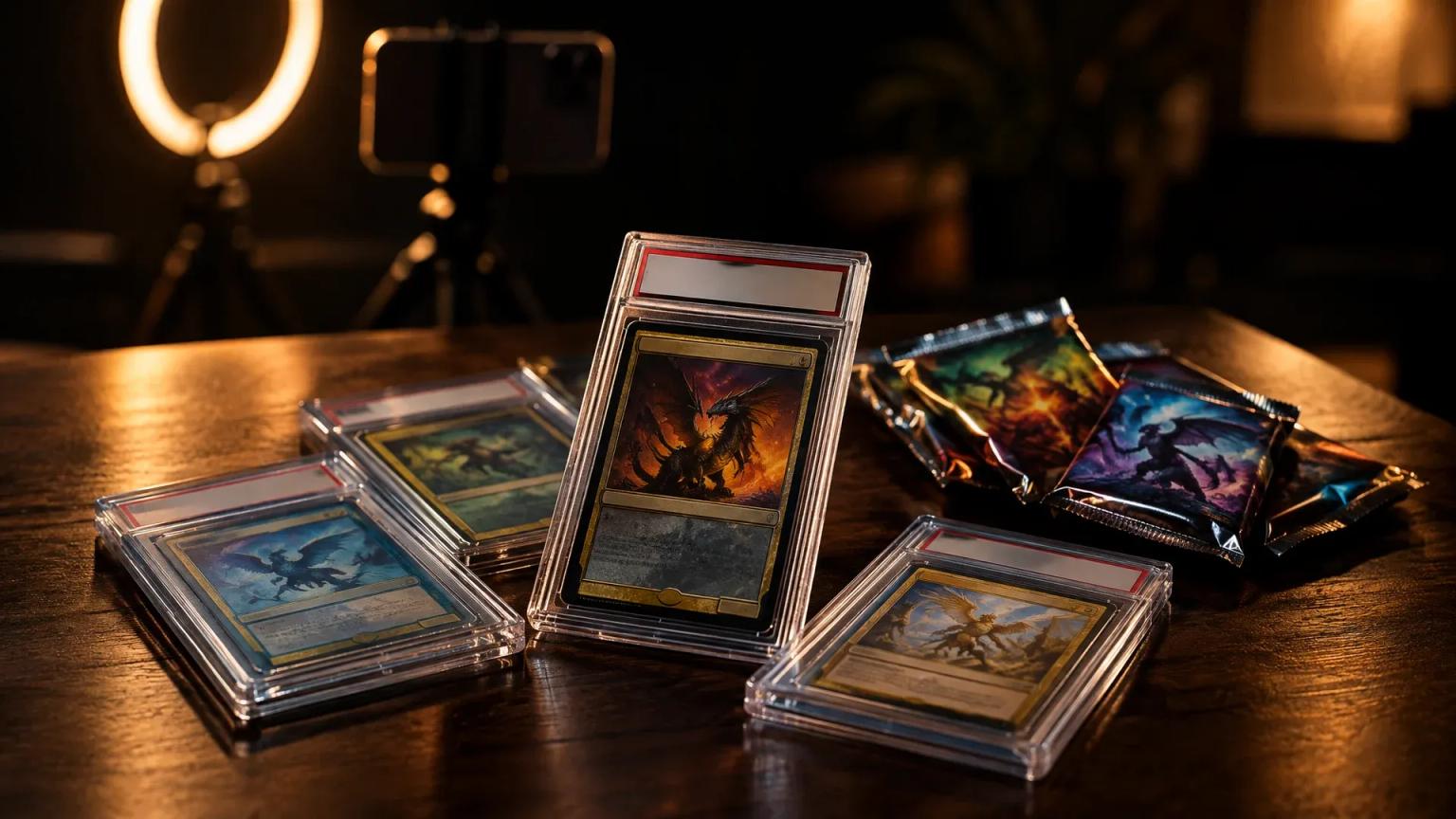
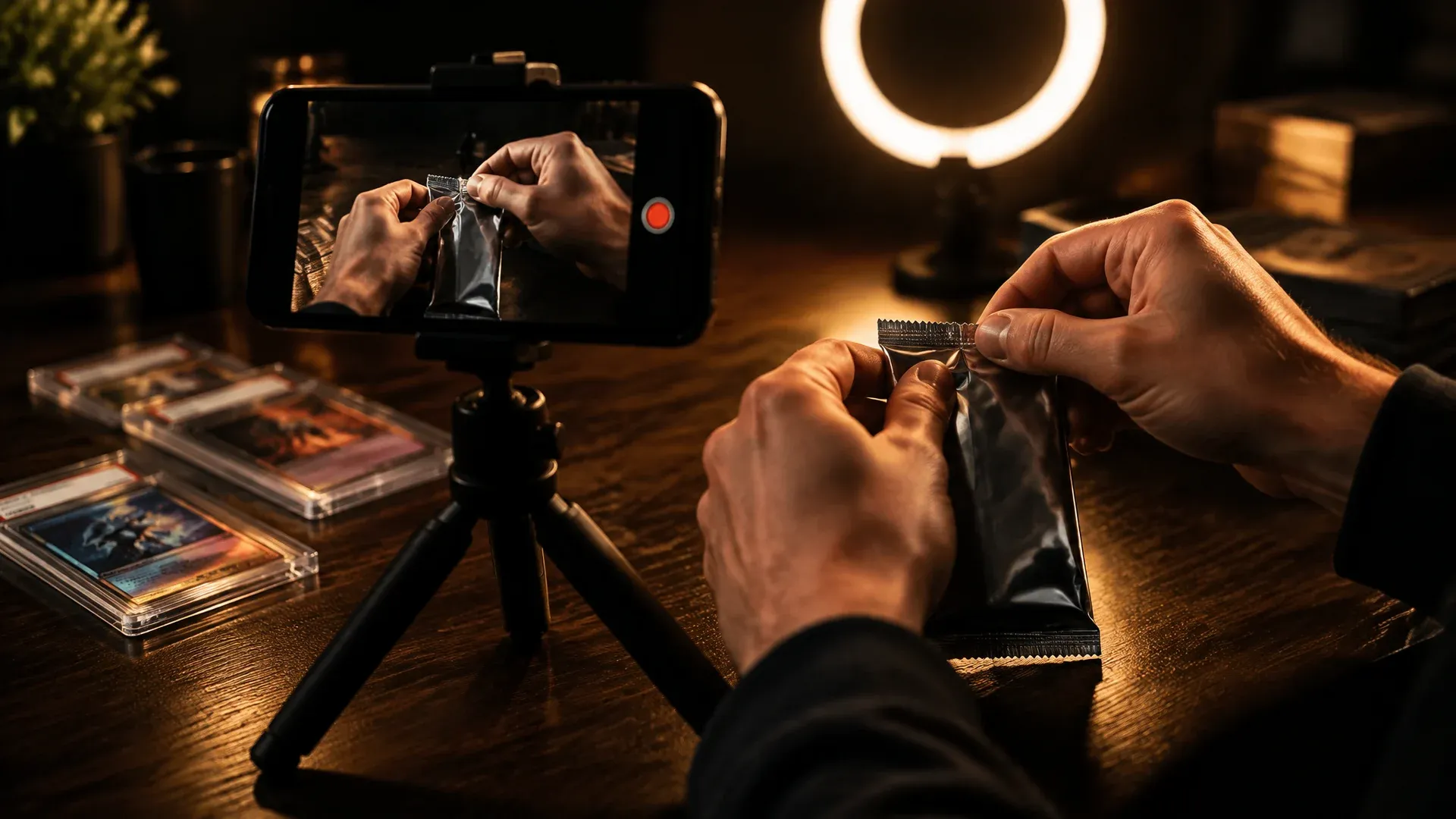
Live shows are replacing the local store. Packs are opened on camera, singles and booster boxes are auctioned live, and the community comments along. For collectors it is entertainment and shopping at once; for sellers it is a way to become visible without a shop of their own.
Real cards are getting digital twins. Graded cards sit in a vault while the digital proof of ownership is traded. That saves shipping and inspection with every resale.
New brands from the crypto world. With Mudwater, the Bored Ape Yacht Club launched its first trading card game in October 2026; every card exists as an NFT on Solana and in print. How holders claim their free packs is explained in our guide to the Mudwater claim.
Which trading cards you can buy: the major trading card games
Most trading cards belong to a trading card game, or TCG for short. You will find these games and series in almost every online store:
| Game | What sets it apart |
|---|---|
| Pokémon | The best-known trading card game, featuring the characters from the Pokémon video games, beginner-friendly and with a huge collector community. |
| Magic: The Gathering (MTG) | The classic from Wizards of the Coast, with great strategic depth, many formats and special editions tied to well-known brands. |
| One Piece Card Game | Bandai's game based on the One Piece manga and anime series, sought after by collectors for its alternate-art cards. |
| Disney Lorcana | The trading card game from German publisher Ravensburger featuring characters from Disney films, easy to learn and a good starting point. |
| Yu-Gi-Oh! | Konami's game based on the manga of the same name, fast and rich in combos, with a large tournament scene. |
| Riftbound | Riot Games' trading card game set in the world of League of Legends, and the youngest game on this list. |
| Sports cards | Topps with Match Attax for football, Panini with sticker albums and Adrenalyn XL, plus collector series with autographs and numbered cards. |
New games such as Cyberpunk TCG and Mudwater are growing alongside them. To get started, pick a game that people around you already play: that way you have opponents and trading partners for your duplicates.
Booster, booster box, Elite Trainer Box: what you are actually buying
Online and in stores, almost every trading card game comes in the same product formats. Knowing them helps you buy with more purpose:
- Booster: a sealed pack with a random selection of cards from a set, usually including at least one rare card. How many cards it contains depends on the game.
- Display or booster box: a sealed box containing many boosters from the same set; the number varies by game and product. Booster boxes are popular with collectors who keep them sealed, and for pack openings in live shows.
- Play Boosters in Magic: in Magic: The Gathering the standard boosters are called Play Boosters, designed for playing and collecting at the same time. Collectors can also buy Collector Boosters with an especially high number of foil and special cards.
- Elite Trainer Box in Pokémon: several boosters plus accessories such as sleeves, dice, card dividers and a sturdy storage box.
- Singles: you buy exactly the card you are missing, for example on Cardmarket or in a live auction. If you are after a specific card, this is usually a more predictable route than opening lots of boosters.
- Starter and theme decks: ready-made decks you can play with straight away, such as Commander decks in Magic or Structure Decks in Yu-Gi-Oh!.
Many stores let you pre-order new sets. A pre-order secures stock from the first shipment, but depending on the store you pay when you order and then wait until release day.
German, English or Japanese?
For playing, the best choice is the language you and your opponents read; anyone playing tournaments should check in advance which languages the organiser allows. For collecting and reselling, English cards are usually the easiest to trade internationally because they are in demand worldwide. Japanese cards for Pokémon and One Piece usually come out earlier than the Western editions and are considered carefully produced by many collectors. German editions are mainly sought after in German-speaking countries. Because language affects the price, marketplaces list it with every offer, so always compare cards in the same language.
Buying trading cards: the four routes at a glance
| Route | Examples | Strength | What to watch |
|---|---|---|---|
| Stores and marketplaces | Specialist stores, Cardmarket, eBay | wide selection, fixed prices, easy comparison | condition and authenticity of the goods, shipping costs |
| Live auctions | SLABHIT (Europe), Whatnot (USA) | live pack openings, auctions from low starting prices, community | fees, shipping region, seller ratings |
| Vaulted cards with a digital twin | Courtyard, Collector Crypt, Beezie | trading without shipping, verified grading, around the clock | redemption fees, wallet, provider's terms |
| Hybrid games | Mudwater | printed and digital, free packs for holders | fees for opening and converting, blockchain |
 Compare NFT marketplaces
Buying trading cards live: live auctions and live shopping
In a live auction, a seller shows cards on a stream, viewers bid in real time and the hammer falls after a few seconds. What would be a quiet purchase in a store becomes a show: boosters are opened live, rare cards are auctioned again on the spot, and the community follows along in the chat.
SLABHIT is a live auction platform for trading cards based in Germany. You bid in the browser on any device or in the iPhone app, with the Android app coming soon. It trades Pokémon, One Piece and other games, sealed booster boxes, boosters and graded cards. Sellers and collectors can become sellers themselves and set up their own shows, which run at European times with shipping within the EU. The next show is scheduled for November 7.
In the United States, Whatnot is the best-known live shopping platform. Since November 6, US time, the Bored Ape Yacht Club has also been selling there in its own shows, a sign of how strongly brands from the crypto world are discovering live commerce.
Disclosure: SLABHIT belongs to the group of companies of Cryptoticker founder Dennis Weidner.
Vaulted cards: real trading cards with a digital twin
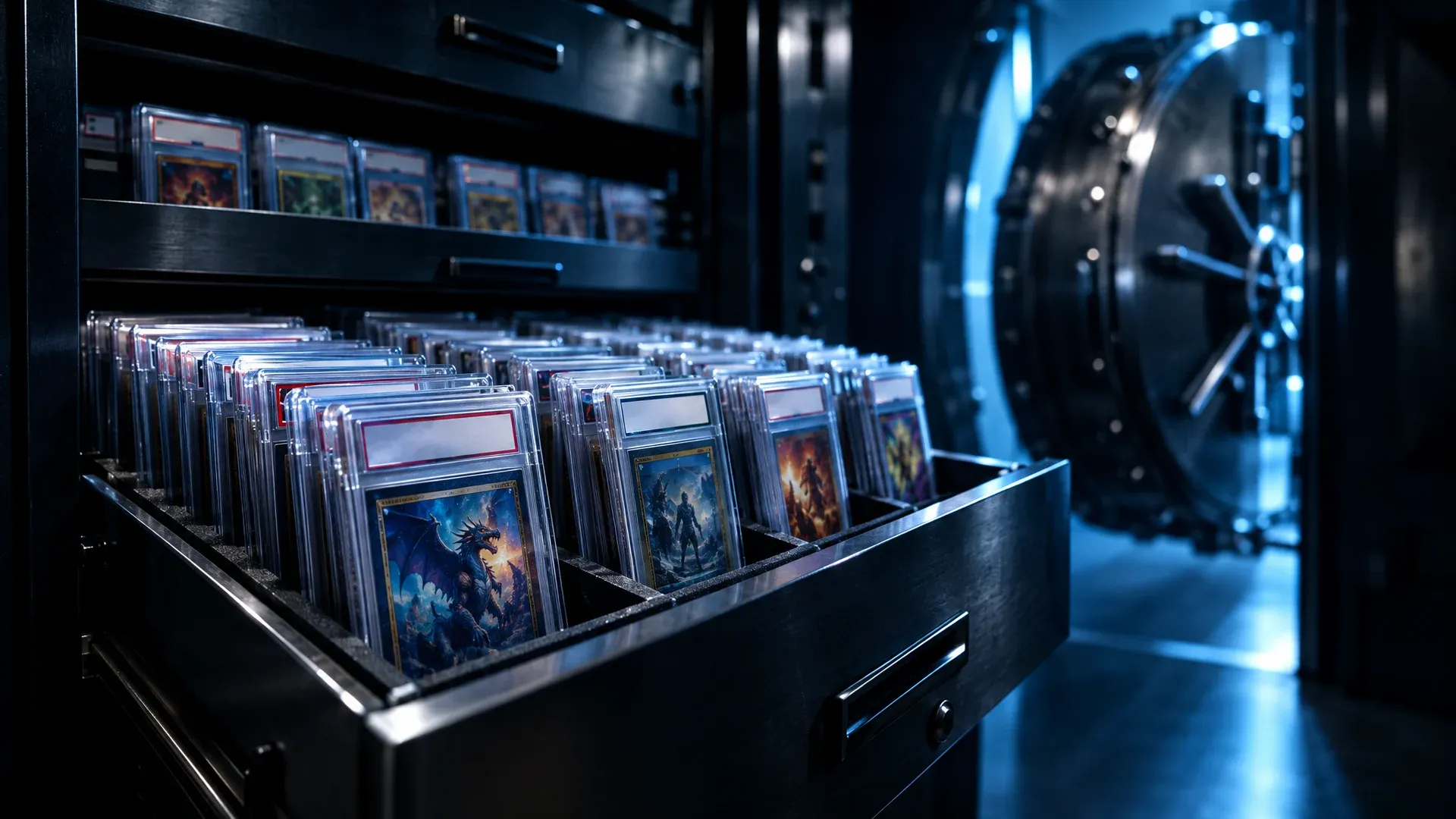
A vaulted card is a real, usually graded card held by a custodian. You receive a digital proof of ownership on a blockchain. When you sell the card, only the proof changes hands and the card stays in the vault. If you want to hold it, you have it shipped to you.
| Provider | Blockchain | Model | Status |
|---|---|---|---|
| Courtyard | Polygon | graded cards in a vault, trading of the proof of ownership | around $78 million in monthly volume in August 2025 |
| Collector Crypt | Solana | vaulted cards and random packs at 50 USDC, own token CARDS | $44 million in volume in August 2025, according to Messari |
| Beezie | Flow and Base, also Solana since 2026 | vaulted cards and marketplace |
Source: provider information and industry reports (Messari, Bankless, CryptoSlate), figures for August 2025.
The advantage is speed: a card can change hands several times on the same day, without shipping and without being inspected again. It is important to know the provider's terms: what does redemption cost, how is the card insured, and what happens to the cards if the provider shuts down? Where you can trade NFTs and which fees apply is shown in our NFT marketplace comparison. You need a wallet for the proof of ownership; anyone holding larger amounts should keep it on a hardware wallet.
 Compare hardware wallets
Business models: how trading card platforms make money
Every platform runs on its own model, and it pays to understand it because it affects prices:
- Commission per sale: marketplaces and live auctions keep a share of the sale price, plus payment fees.
- Packs and gacha: providers such as Collector Crypt sell random packs at a fixed price; the contents can be worth more or less than the purchase price.
- Custody and redemption: vault providers earn fees for storage, grading and shipping.
- In-game fees: in Mudwater, every trade carries a 2.5 percent licence fee and 2.5 percent for ApeCoin purchases; opening a digital pack costs 8 USDC.
- Own brands: publishers such as The Pokémon Company or Bandai earn on the first sale, while the secondary market belongs to dealers and platforms.
Graded cards: why PSA, CGC and Beckett set the pace
Above a certain value, a card is traded almost exclusively in graded form. Grading companies such as PSA, CGC or Beckett check authenticity and condition, assign a grade from 1 to 10 and seal the card in a plastic case known as a slab. A PSA 10 can cost many times as much as the same card without a grade. Live auctions, marketplaces and vault providers therefore all rely on graded cards: the grade replaces the trust that is missing when you buy from a distance.
What to watch when buying trading cards in 2026
- Check sealed products: compare wrapping, seals and weight, and buy expensive booster boxes only from sellers with ratings.
- Check the online store: good stores source their stock from official distributors and give clear information on shipping, payment methods and pre-orders, including the delivery date.
- Calculate fees in advance: commission, shipping, customs duties for purchases from outside the EU, and redemption for vaulted cards.
- Bid live with a limit: in auctions the moment decides, so set yourself a ceiling beforehand.
- Verify graded cards: the certificate number can be looked up online at PSA, CGC and Beckett.
- Buy accessories at the same time: sleeves, toploaders and deck boxes protect singles from day one.
- Collect rather than speculate: card prices fluctuate like any market. Buy what you like and do not count on profits.
Frequently asked questions about buying trading cards
Transparency note: This article was produced with the assistance of artificial intelligence and reviewed by our editorial team before publication. All figures and claims were checked against the primary sources linked in the text. The feature image was generated with AI.
Related articles
- Pokémon Day 2026: Why Collectors are Rushing to Buy Cards Today
- Is Solana a Good Buy in 2026? SOL Price Analysis and Potential ROI
- Mudwater TCG: Rules, Cards, Prices and Criticism of the Bored Ape Yacht Club's Card Game
- Will Dogwifhat (WIF) Price Still Go Up To Reach $5?
- Is the Bitcoin price soon going to reach an all-time high? Here’s the easiest way to buy Bitcoin!
Which topics should we dive deeper into?
Select what genuinely interests you. Your picks feed directly into our editorial planning.
Crypto news that's actually worth your time.
Weekly. 60 seconds. Carefully curated by our editors: no hype, no promo flood, no spam.

January 28, 2024 8:43 AM

3 Cryptocurrencies To buy in February 2024!
It's been a wild ride in the crypto world this week, especially for Bitcoin as it dipped. Let's take a look at the 3 cryptocurrencies to buy

September 7, 2023 1:50 PM

Top 5 BIG Crypto Predictions: Buy Cryptos Today?
There are various patterns and trends that are visible in the crypto market. Here are our top 5 big crypto predictions over the next years.
January 6, 2023 5:10 PM

Crypto Millionaire: Buy THESE Cryptos before they BOOM in 2023?
Which cryptocurrencies should you buy now that the new year is here? Here are 3 picks that can make you a crypto millionaire in 2023.
July 31, 2022 9:48 AM
Why is Ethereum Classic UP? The Answer might NOT Shock You!
Why is Ethereum classic up? Is it a good idea to buy ETC? Here's everything you need to know about Ethereum Classic.
April 8, 2022 7:14 PM

Terra LUNA Price reaching $150 soon?? THIS Chart confirms it…
Should you BUY LUNA? We at CryptoTicker are giving you a new Terra Luna price prediction to assess the current situation. Check it out.

October 12, 2021 7:33 PM

Why Traders Should Buy The Wojak Token
The Wojak token recently made a 2500% jump in the market. Find out in this article if you can still buy the token despite the jump.
May 30, 2024 2:46 PM
How to Buy Ethereum (ETH) on eToro: A Comprehensive Guide
How to buy Ether (ETH) on eToro is made simple, with our step-by-step guide. From account creation to making your first purchase, we cover all you need to know...

April 8, 2026 11:46 PM

BXB Market Review 2026: Platform, Pricing, and What Traders Should Know
Considering using BXB Market? Here's a detailed look at their platform, account tiers, spread discounts, and trading conditions as of 2026.

July 22, 2021 3:25 PM

Splinterlands Guide: an NFT game
Splinterlands, founded in 2018, is one of the first digital trading card games to use blockchain technology. Their trading cards are NFTs. This means the
October 29, 2026 9:08 PM

Best Crypto to Buy Now: 5 Coins to Watch in November 2026
The best crypto to buy now, updated every month: five coins for November 2026 with price, catalyst and main risk, how we pick them and how last month's list performed.
April 9, 2026 2:22 PM
Is XRP Coin Worth it in 2026? Portfolio Analysis and Price Outlook
XRP trades at $1.33 as Q2 2026 begins. We analyze its portfolio value, distance from ATH, and if Ripple’s legal clarity makes it a buy.
April 19, 2026 11:46 AM
Top 5 High-Cap Altcoins Outperforming the Market in 2026
Here are the top 5 cryptocurrencies with market caps over $1 billion leading the 2026 market. Do you own any in your crypto portfolio?
June 17, 2024 10:59 AM
TOP 3 DEX for June 2024
What are the best DEXs to use in 2024? Here are the top 3 for June 2024!
October 12, 2026 10:27 AM
Is Bitcoin Still a Good Investment in October 2026?
Spot ETFs have changed who sets the Bitcoin price, and the easy repricing is behind us. What still supports BTC, what could break it, and how much belongs in a portfolio today.

September 22, 2026 4:33 PM

Three of the 25 Largest Coins Have No Euro Pair: How to Check Your Buying Route Before the Order
Our own survey of five trading venues active in the EU, taken on September 22, 2026, shows that three of the 25 largest cryptocurrencies have no euro pair there at all, and four more only one. What that means for your next order and what the detours cost.
More from CryptoTicker