
Luno closes EU accounts: what customers should know now the 31 August deadline has passed
Recap as of 27 September 2026: Luno had announced it was winding down its service in affected European markets. Selling and euro withdrawals ended on 31 August 2026, accounts were due to close on 1 September, and remaining balances attract fees of up to $52 a month. This article describes the situation before the deadline and the MiCA-licensed alternatives.



Which topics should we dive deeper into?
Select what genuinely interests you. Your picks feed directly into our editorial planning.
Crypto news that's actually worth your time.
Weekly. 60 seconds. Carefully curated by our editors: no hype, no promo flood, no spam.
Anyone still holding euros or crypto with Luno needs to act now. The exchange with South African roots is winding down its service in the affected European markets. Selling and withdrawing money to a bank account is only possible until 31 August 2026. Accounts close on 1 September, and remaining balances then attract monthly fees that rise to as much as $52 from December. The route of withdrawing crypto to your own wallet has been shut since late June. This article sets out the deadlines, the steps that remain and how to pick a successor platform with a MiCA licence.
Luno account closure: the timetable up to 1 September 2026
The wind-down has been running in stages for weeks, and the most consequential stage is already in the past. This is the timetable as Luno has communicated it to customers and as several trade publications consistently report:
- 29 June 2026: last day for crypto transfers to external wallets. Since then, crypto withdrawals have been permanently disabled.
- 31 August 2026: last day to sell holdings and withdraw the euro proceeds to a bank account.
- 1 September 2026: Luno closes accounts in the affected regions for good.
- From September 2026: a $2 monthly inactivity fee on remaining balances.
- From December 2026: an additional $50 dormancy fee, taking the total to as much as $52 a month.
The dates come from Luno's customer guidance and from consistent reporting in the trade press, including CryptoSlate (as of 8 August 2026). Luno has not publicly named the individual countries affected; its help pages refer generally to regions where service is being discontinued. If you can still log in and see those notices in your app, you are in scope.
Crypto transfers blocked since 29 June: why selling for euros is the only route left
For those affected, the most restrictive change took effect weeks ago. Since 29 June 2026 it has been impossible to move coins to an external wallet or to another exchange. Anyone who wanted to keep their bitcoin or ether had to act before that date. What remains is a single path: sell the holdings on Luno, withdraw the euro proceeds, and buy back at another provider.
That detour has side effects worth planning for. Between the sale and the repurchase you are out of the market, and the price can move either way. There are trading fees on both legs, and depending on how long you have held the coins there may be a tax effect, covered further down. The earlier you start the sale, the more buffer you keep for bank queries, verification loops or a support reply. Nobody should leave this to the last day.
Deadline 31 August 2026: how to get your money out of Luno
Step 1: check the bank account linked to Luno
Withdrawals go to a bank account in your own name registered with Luno. Check first that the IBAN on file is still correct. An outdated bank connection is the most common reason withdrawals get stuck in review queues, and time for that is exactly what the deadline does not leave.
Step 2: sell all holdings
Sell every position for euros, including small change and dust in minor tokens. Whatever is still sitting in the account as crypto on 1 September can no longer be traded by you. Mind the floor: balances below the equivalent of $10 will not be paid out, according to the available reporting, because they sit under the minimum withdrawal threshold.
Step 3: withdraw the euros and confirm receipt
Trigger the euro withdrawal and confirm the money has arrived in your bank account before the deadline passes. Anyone who misses 31 August can only reach their money through customer support afterwards and must provide a bank statement no older than three months. That works, but it is slower, and from September the fees start eating into the balance.
Fees from September 2026: $2 at first, then $52 a month on remaining Luno balances
Luno reserves the right to charge ongoing fees on balances that remain after account closure. From September 2026 that is a $2 monthly inactivity fee; from December a $50 dormancy fee comes on top, for a combined total of up to $52 a month. A residual balance of 200 euros would, at that rate, be gone in roughly four months; the arithmetic is our own, the fee levels come from the CryptoSlate and crypto.news reports of 3 August 2026. Delaying the withdrawal therefore costs twice, in waiting time and in a shrinking balance.
No MiCA licence in the ESMA register: the regulatory backdrop to Luno's EU exit
The transition period of the EU's MiCA regulation expired on 1 July 2026. Since then, anyone offering crypto services to clients in the European Economic Area needs authorisation as a crypto-asset service provider, a CASP in the regulation's jargon. The EU securities watchdog ESMA publishes the authorisations granted in a public register that anyone can consult without a login. Luno does not appear in the register file of 329 authorisations, nor in the accompanying list of firms reported as non-compliant (retrieved 8 August 2026).
Luno itself does not publicly attribute the withdrawal to regulation. The company says it wants to concentrate on its core markets in Africa and South East Asia, naming Kenya, Nigeria, South Africa, Indonesia and Malaysia. Both things can be true at once: without a register entry, serving EEA customers has not been permissible since July, and Luno is winding down its European business. The case joins a wider pattern, as several international platforms had already given up the European market around the MiCA cut-off. How things looked for Luno customers most recently is also documented in our Luno review, which flags the account closure explicitly.
MiCA-licensed Luno alternatives: Bitpanda, Bitvavo, Kraken and Coinbase in the register check
Anyone planning to re-enter the market after the sale should look the prospective provider up in the ESMA register first. Four widely used alternatives hold granted authorisations there (retrieved 8 August 2026):
- Bitpanda: authorised through Bitpanda GmbH in Austria (notification of 9 April 2025), with further register entries in Germany and Malta.
- Bitvavo: authorised as Bitvavo B.V. in the Netherlands (notification of 26 June 2025).
- Kraken: listed in the register through the Irish entity Payward Europe Solutions Limited (notification of 25 June 2025).
- Coinbase: authorised as Coinbase Luxembourg S.A. in Luxembourg (notification of 20 June 2025).
One detail helps when searching: the register lists the legal entity, not always the brand. Kraken appears there as Payward, and behind some apps sits a company whose name never appears on the landing page. So check the provider's legal notice against the register entry. Fees, deposit methods and savings-plan terms differ considerably between providers; our continuously maintained exchange comparison gives the overview, and if you want to filter by supervisory status specifically, the candidates are in our comparison of regulated crypto exchanges.
Tax on the forced Luno sale: holding periods and local rules to keep in view
A forced sale is, for tax purposes, an ordinary sale, and the treatment depends on where you are tax resident. In Germany, for example, disposals of privately held crypto count as private sales transactions: gains are income-tax-free once the coins have been held for more than a year, while gains on shorter holdings become taxable once all private sales gains in a calendar year together reach the 1,000 euro threshold. Selling before the year is up because of Luno's deadline forfeits that exemption, and the holding period starts from zero when you buy back elsewhere. Other member states draw the lines differently, so check your local rules.
One step follows from this in every jurisdiction and is easily forgotten: export your full transaction history from the Luno account while you still have access. After the closure on 1 September, reconstructing acquisition dates and prices becomes far harder, and you will need them for your tax return. None of this replaces individual tax advice.
Lessons from the Luno exit: choose a platform by MiCA licence, not by app polish
After the summer of 2026, the register check is in our view the most important criterion when choosing a crypto exchange, ahead of fees and user experience. The Luno case shows what awaits customers of a provider without EU authorisation: first blocked crypto transfers, then a sale deadline, and finally fees on whatever is left behind. That is no reproach to individual users, since the trajectory was hard to foresee from the outside. But it is repeatable for anyone trading on a platform that is missing from the ESMA register. The look-up takes a minute and is the only evidence that holds.
What to take away
- Sell and withdraw before 31 August 2026. Check the bank account on file first, then sell all holdings for euros and confirm the money has arrived. After the deadline the only route is support, with a recent bank statement and fees running in the background.
- Export your transaction history before 1 September. Save trades, dates and prices for your tax records while you can still log in. Once the account is closed, every documentation question becomes tedious.
- Pick your next platform by register entry. The candidates with a MiCA licence are in our exchange comparison; larger balances belong in your own wallet afterwards, and we compare the devices in our hardware wallet comparison.
Disclosure: some of the providers named work with us through partner programmes. This has no bearing on the licensing assessment; every register finding in this article comes from the public ESMA file and can be reproduced from it. Luno is not a partner of ours.
(As of 8 August 2026. This article is not investment advice and not tax advice. Deadlines and fees can change; the binding information is what Luno communicates to its customers.)
Transparency note: This article was produced with the assistance of artificial intelligence and reviewed by our editorial team before publication. All figures and claims were checked against the primary sources linked in the text.
Related articles
- Crypto Exchange Closure: What Happens to Your Residual Balance and When the Fee Starts
- Binance Funding Account Becomes Stocks Account: What to Check Before September 29
- MiCA Wiped Out 92% of Europe's Crypto Firms: Here's Who Survived and Who's Cashing In
- Binance Withdrawal Deadline September 9: What ALCX, ARDR, NFP and POND Holders Should Know Now It Has Passed
- Crypto Exchange Deadlines in August: What Still Applies Now the Seven Cut-Off Dates to August 31 Have Passed
Which topics should we dive deeper into?
Select what genuinely interests you. Your picks feed directly into our editorial planning.
Crypto news that's actually worth your time.
Weekly. 60 seconds. Carefully curated by our editors: no hype, no promo flood, no spam.

July 1, 2026 10:47 AM

Crypto News Today: Binance Exits the EU, Circle Craters, and Bitcoin Slides Below $59K
MiCA reshapes the market as Binance leaves the EU, a 140-firm stablecoin rocks Circle, and Bitcoin sags near multi-year lows. Here's what's moving crypto today.
July 2, 2026 8:59 PM
Binance Is Out of the EU: How to Move to a MiCA-Regulated Exchange
Binance has left the EU market. Which exchanges hold a MiCA licence, how to verify an authorisation is real, and how to move your holdings across step by step.

August 6, 2026 3:05 PM
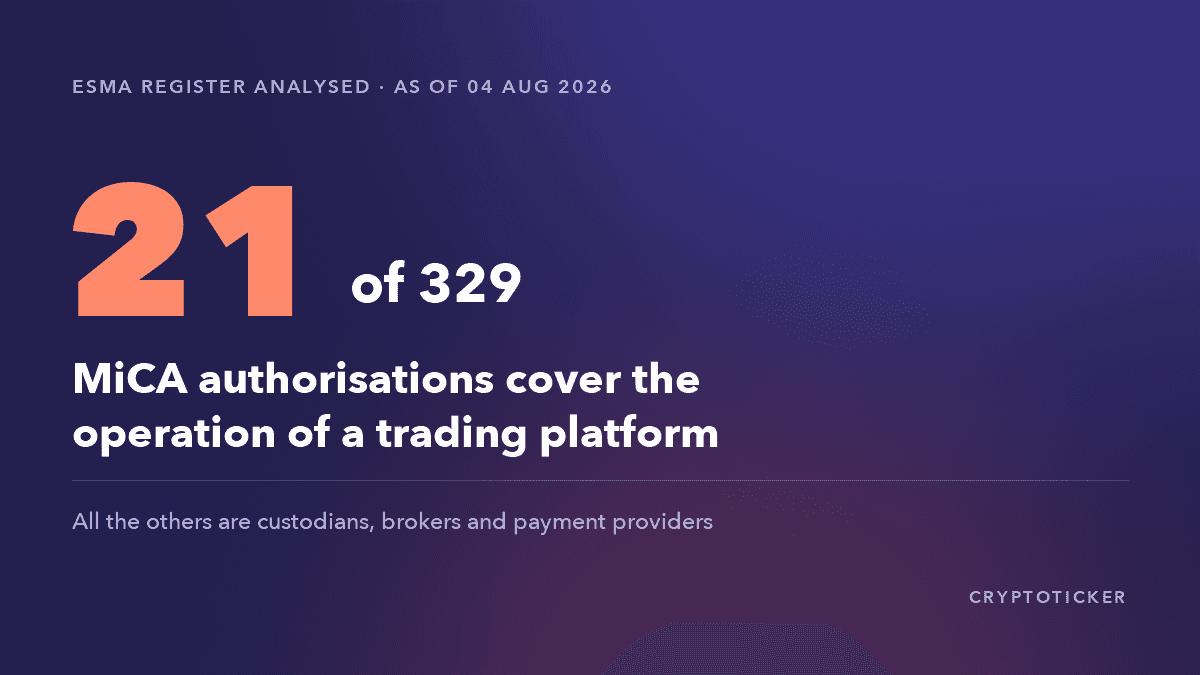
MiCA Register 2026: Only 21 of 329 Licences Are Real Exchanges
ESMA publishes the register of MiCA-authorised providers as an open file. We worked through all of it — and the result is not what the phrase “licensed crypto exchange” suggests.

June 30, 2026 11:20 PM

How to Switch from Binance to a MiCA Regulated Crypto Exchange
Binance is winding down EU services after missing the MiCA deadline. Here's why it's happening and how to move your funds to a regulated platform safely.
September 19, 2026 4:11 PM
MiCA Consultation Closes September 30: What to Check and Submit Before Then
The European Commission is reviewing the MiCA crypto regulation and will accept submissions until September 30, 2026 at 23:59 CEST. Staking, DeFi, lending, stablecoins and custody are all under examination, and you can take part without a lawyer.
September 12, 2026 4:31 AM

After the BitMEX Closure on September 23: How to Check Whether Your Remaining Balance Can Be Withdrawn at All
As of September 27, 2026: trading on BitMEX ended for good on September 23 at 04:00 UTC. According to the operator, withdrawals remain possible via the website, and an account fee of 1 percent a year, or at least $50, applies to remaining balances. Our own review of the wallet interface on September 11 showed that on 14 of 62 withdrawal routes the network fee reached or exceeded the minimum amount.
June 26, 2026 5:35 PM
Binance Is Leaving the EU on July 1 — What It Means for Your Funds
Binance will stop serving EU customers from July 1 after failing to secure a MiCA licence. Here's what it means for your funds and your next move.
September 4, 2026 10:32 AM

Crypto Deadlines This Autumn: Nine Cut-Off Dates Checked, and Only Three Leave You Time After Trading Ends
Nine running crypto deadlines, eleven provider pages, one query date: we counted how much time really lies between the end of trading and the withdrawal cut-off. In six of nine cases the stated date is the end of the line.
September 30, 2026 10:40 PM

ESMA Calls for Advertising Rules on Crypto Influencers: Six Changes Now Sitting With the EU Commission
The EU securities watchdog filed its response to the MiCA review on the final day of the consultation. Among the demands are disclosure on staking, a licensable DeFi gateway and the power to freeze crypto assets.
September 29, 2026 10:33 AM
ESMA puts reverse solicitation on its 2027 watch list: what investors need to know about exchanges without an EU licence
ESMA presented its work programme for 2027 on September 28, 2026 and made reverse solicitation a supervisory priority. What that means if your coins sit with a provider without EU authorisation, and which three steps make sense now.
September 26, 2026 4:14 PM
Bitget Withdrawals Resume on September 28: What to Check on a Residual Balance Now
Bitget is releasing the withdrawals frozen after the September 24 incident in four stages from September 28. For a residual balance held from Germany that is a deadline, not a reason to wait.
September 15, 2026 10:12 AM
CoinEx Is Shutting Down: The Deadline to Withdraw Your Balance
Crypto exchange CoinEx is winding down and the withdrawal channel closes on December 22, 2026. Our own measurement on the day of the first wind-down stage shows which 37 currencies cannot be withdrawn right now and why the chain you pick decides a double-digit percentage of your residual balance.
June 25, 2026 11:19 AM

Binance Pulls Its EU Licence Bid: What It Means for Your Crypto
Binance just withdrew its MiCA licence application in Greece days before the EU deadline. Here's what it means for users, your funds, and the crypto market.
October 12, 2026 7:32 PM

WhiteBIT Coin (WBT): Lightning Brings Bitcoin Withdrawals at 0.15 Percent, What You Can Do Now
The crypto exchange WhiteBIT has accepted Bitcoin over the Lightning Network since October 8 and pays it out the same way, for 0.25 and 0.15 percent respectively. Because both rates are percentages, the size of your withdrawal decides whether the new route is cheaper than the main chain.
September 29, 2026 7:12 PM
MEXC Refunds $340,000: The Attacker's API Key Survived the Account Freeze
During an account takeover at MEXC, an attacker created an API key with withdrawal rights that the exchange did not revoke when it restored the account. Twenty-seven minutes after the withdrawal freeze expired, roughly $340,000 was gone.
September 20, 2026 10:11 PM
Kraken Review: Fees, MiCA Licence and Withdrawals in Euro
A purchase through Kraken's standard interface costs 1 percent plus spread; on Kraken Pro it is 0.40 to 0.80 percent. What deposits, trading, withdrawals and tax records really cost at the crypto exchange, with the numbers from the official fee schedule.
September 10, 2026 7:17 PM
Binance Delists USDP: You Have Until November 24 to Withdraw Your Pax Dollar
Binance is removing the Pax Dollar stablecoin from its platform altogether. For holders in the European Economic Area the date that counts is the withdrawal deadline on November 24, 2026, well after the trading halt on September 24.
August 15, 2026 9:31 PM

Crypto Exchange Shutting Down: What to Do Before the Deadline Passes
Binance, BitMart, Luno and Revolut have ended or cut back their European business within seven weeks. This guide shows which deadline expires first, how a forced sale is treated for tax, and what to secure before the account closes.
August 11, 2026 9:18 AM

Your Crypto Exchange Is Telling You to Withdraw: How to Spot Phishing After the MiCA Deadline
Unauthorised crypto providers now have to tell their EU customers to withdraw, which leaves fraudsters an easy run with faked requests. Here is how to check in two minutes whether the message is genuine.
July 26, 2026 7:57 AM
BitMart Shuts Down: Second Major Crypto Exchange to Announce Closure in One Week
BitMart is winding down just three days after BitMEX. Here are the withdrawal deadlines, what triggered the closures, and what it means for CEX users.
August 20, 2026 10:24 PM

MiCA Review: What the European Commission Could Change About the EU Crypto Rules
The European Commission has reopened MiCA for review after barely two years and is asking 86 questions covering the stablecoin interest ban, staking, lending and DeFi. Brussels is taking responses until September 30, 2026.
September 9, 2026 1:14 PM

OKX Delists GODS, PRCL and DUCK: You Can Still Withdraw the Tokens Until November 7, 2026
OKX ended trading in GODS, PRCL and DUCK in August, but withdrawals stay open until November 7, 2026. What to do in those three months, where the tokens now sit in your account, and why the exchange leaves open what happens to them afterwards.
August 20, 2026 1:18 PM

Kraken Liquidates Rain (RAIN): What Holders Should Know Now the September 15 Withdrawal Deadline Has Passed
Recap as of September 27, 2026: Kraken had announced it would switch off withdrawals for Rain (RAIN) on September 15, 2026 at 14:00 UTC and then sell any remaining balances itself. This article describes the situation before the deadline and our own measurement of the trading venues, which shows how narrow the alternative route was.
June 17, 2026 7:21 PM
Binance EU Access at Risk: What MiCA Could Mean for BNB and Crypto Users
Binance is facing one of its biggest regulatory tests in Europe as the MiCA deadline approaches. Could this put BNB and EU crypto users under pressure?
August 23, 2026 4:43 AM
Withdrawal Hold and Minimum Amount: Why Your Balance Will Not Leave Before the Deadline
A withdrawal hold pins your balance down for days after certain deposits, and a minimum withdrawal amount blocks small residual holdings entirely. On August 22, 2026 we checked which trading venues name these two rules publicly at all.
September 22, 2026 10:15 PM

Stablecoin Reserves: Why the ECB Wants the Bank Deposit Rule Scrapped
The European System of Central Banks filed its response to the MiCA review on September 22 and calls in it for an end to the requirement to hold 30 to 60 percent of stablecoin reserves as a bank deposit. What lies behind it, and what you can check on your own token.
September 11, 2026 1:40 PM

Inactivity Fees at Crypto Exchanges: How to Check Whether Your Dormant Account Loses Money Every Month
Two providers have just raised their rates for dormant accounts, one of them to as much as 52 US dollars a month. Our own survey of 15 fee pages shows why you will almost never find the answer for your account without logging in.
More from CryptoTicker