
Crypto Gains and Health Insurance: When the Contribution Rises
A disposal gain from bitcoin can raise your health insurance contribution, but it does not have to. What decides it is your insurance status and the one-year holding period, which works for tax and social insurance at the same time.





Which topics should we dive deeper into?
Select what genuinely interests you. Your picks feed directly into our editorial planning.
Crypto news that's actually worth your time.
Weekly. 60 seconds. Carefully curated by our editors: no hype, no promo flood, no spam.
Whether a crypto gain raises your health insurance contribution hangs on a single question: how are you insured? If you are compulsorily insured as an employee, a private disposal gain has no effect on the contribution. If you are voluntarily insured, as a self-employed person or as a high earner above the compulsory insurance threshold, it counts. And if you are covered without contributions through your partner's family insurance, a single gain can tip that cover over for months.
This article sorts the three cases, gives the 2026 thresholds from the reference values ordinance, and shows which distinction moves the most money: the one between a taxable and a tax-free gain.
The decisive lever: what counts as income for social insurance purposes
Social insurance does not invent an income concept of its own; it borrows one from tax law. Under section 16 of Book Four of the German Social Code, total income is the sum of the income within the meaning of income tax law. That one sentence decides almost everything that follows.
For Bitcoin and other coins, section 23 subsection 1 sentence 1 number 2 of the Income Tax Act applies for tax purposes. If you sell within one year of buying, the gain is a private disposal and therefore taxable income. If you sell after a year has passed, the transaction is not taxable at all. It appears in no category of income, and it therefore does not raise total income within the meaning of section 16 SGB IV either.
From this follows the most important rule of thumb in this article: the holding period works twice over. That single period decides your income tax and, in many constellations, your health insurance contribution along with it. A gain of 6,000 euros after fourteen months is tax-free and, as a rule, irrelevant for social insurance. The same gain after ten months is neither.
A second point up front, because it often gets muddled: what matters is the realised gain, not the value of your holding. A portfolio that has risen in price without your having sold generates no income and moves no contribution. Health insurance contributions are assessed on receipts, not on assets. That sets them apart from procedures in which the holding itself is precisely what matters, such as the seizure of coins.
Case 1: compulsorily insured as an employee
Anyone compulsorily insured in the statutory health insurance scheme as an employee pays contributions on their employment earnings. That is the pay from the employment relationship, and only that. Income from capital, from letting property or from private disposals does not belong to it.
A crypto gain therefore does not raise your contribution in this case, not even when it is large and not even when it arises within the one-year period. You still have to declare it for tax as soon as the sum of all private disposal gains reaches the threshold in section 23 EStG. Where that belongs in the forms is set out in the article on where to enter crypto in your tax return.
Two qualifications are worth knowing. If your trading becomes a commercial activity, through its scale, its organisation and the use of borrowed capital for instance, the picture changes completely, because earned income from self-employment then arises. Where that line runs is covered in our article on the difference between private and commercial trading. And anyone who becomes self-employed on a full-time basis alongside the job may lose compulsory insurance as an employee.

Case 2: voluntarily insured, and why total economic capacity counts here
Voluntarily insured means anyone who is not subject to compulsory insurance and nevertheless stays in the statutory fund. That mainly concerns the full-time self-employed and employees whose pay exceeds the compulsory insurance threshold. Section 240 SGB V applies to this group, and its subsection 1 sets a markedly wider yardstick than employment earnings: it must be ensured that the contribution burden takes account of the member's total economic capacity.
The details are set uniformly by the National Association of Statutory Health Insurance Funds. The underlying idea: all receipts that cover the cost of living are drawn on, irrespective of their classification for tax. A taxable gain from a private disposal falls under this. With a tax-free gain after the one-year period the position is less clear-cut, because no point of connection in tax law exists there. Where in doubt, clarify this with your fund beforehand and have the answer given to you in writing rather than fighting it out afterwards.
The 2026 figures
The Social Insurance Reference Values Ordinance 2026 sets the limits between which all of this plays out:
| Figure | 2026 value |
|---|---|
| Reference value | 3,955 euros a month (47,460 euros a year) |
| Contribution assessment ceiling for health and long-term care insurance | 5,812.50 euros a month (69,750 euros a year) |
| Compulsory insurance threshold | 6,450 euros a month (77,400 euros a year) |
| Minimum assessment basis for voluntary members | around 1,318 euros a month |
The contribution assessment ceiling is the cap here. Anyone whose contributory receipts already sit above it pays not a cent more because of an additional crypto gain. The minimum assessment basis follows from section 240 subsection 4 SGB V, under which at least a ninetieth of the monthly reference value is to be applied for each calendar day.
What a gain actually costs
Reckon with the general contribution rate of 14.6 percent, the fund's own supplementary contribution and the long-term care insurance contribution. Voluntary members without an employer bear the total alone. With a taxable gain of 10,000 euros and a combined rate of roughly twenty percent, you end up in the order of some 2,000 euros in additional contributions, provided you stay below the contribution assessment ceiling with it. The exact figure depends on your fund and your other receipts, but the order of magnitude shows what is at stake.
The provisional assessment and the recalculation
For the self-employed, the fund initially assesses contributions provisionally under section 240 subsection 4a SGB V, on the basis of the most recent income tax assessment. The final calculation only happens once the assessment for the year in question is available. A crypto gain from 2026 may therefore only catch up with you in 2027 or 2028, but then retrospectively for the whole year. Anyone who has spent the gain by then faces a back payment with nothing to set against it.
 Crypto tax software compared
Case 3: covered by family insurance, and why the smallest limit applies here
Family insurance under section 10 SGB V is free of contributions. It is open to spouses, civil partners and children, as long as several conditions are met at the same time. Crypto gains regularly breach one of them: the family member must have no total income that regularly exceeds a seventh of the monthly reference value in a month.
For 2026 that means, concretely: 3,955 euros divided by seven gives 565 euros a month. Anyone in marginal employment may instead earn up to the marginal earnings threshold. And because total income under section 16 SGB IV is the sum of income within the meaning of tax law, a taxable crypto gain counts here in full, while a tax-free gain after the one-year period stays outside the reckoning.
The word regularly is the reason so many underestimate this threshold. A one-off gain is not simply added to the month it was received and forgotten about afterwards. One-off receipts are customarily looked at spread over twelve months. A taxable gain of 8,000 euros comes to roughly 667 euros a month when apportioned, and therefore sits above the limit, even though it arose on a single day.

What happens when it falls away
If family insurance falls away, no gap in cover arises, but a liability to pay contributions does. As a rule you become a voluntary member and pay at least the contribution on the minimum assessment basis. The retrospective effect is what makes it critical: funds check the conditions on a regular cycle with a questionnaire, and if it turns out months later that the limit was exceeded, the account is settled retrospectively. That is why a larger realised gain should be reported to the fund before it asks.
What happens with staking, lending and airdrops
Income from staking and lending is for tax purposes usually other income under section 22 number 3 EStG and therefore income within the meaning of tax law. This income flows continuously rather than once, which makes it trickier for the family insurance regularity test than a single disposal gain. For voluntary members it raises contributory receipts like any other income.
A widespread misconception concerns the valuation: what is taxed, and therefore also captured for social insurance, is the inflow in euros at the price on the day of receipt, not the later sale. Anyone drawing rewards in coins and leaving them where they are has income without having seen a single euro. For airdrops it depends on whether you provided something in return. Where that is entirely absent, there is often no taxable receipt at the time of the inflow.
In all three cases you need a robust record with the date, the quantity and the euro price for each inflow. A portfolio tracker with tax reporting takes this work off your hands and supplies the statement you can put before both the tax office and the insurance fund.
Evidence: what happens if you do not supply it
Section 240 subsection 1 SGB V contains a rule that gets expensive if you overlook it. If a member does not produce the requested evidence of their contributory receipts, a thirtieth of the monthly contribution assessment ceiling counts as the contributory receipt for each calendar day. You are then classified as though you had 5,812.50 euros a month, regardless of what you actually had.
The law allows a correction. If you apply for a fresh assessment within twelve months of that assessment being notified and submit the evidence subsequently, the contributions for the periods concerned are to be recalculated. That twelve-month period works as a cut-off in everyday practice: anyone who lets it pass stays stuck with the maximum classification.
The comparison with private health insurance
Privately insured people pay risk-based premiums according to tariff, age and state of health. Income plays no part there in the size of the premium, so a crypto gain does not move it. Income is relevant at only one point, namely the employer's subsidy for employees, and when switching back to the statutory fund, which is tied to the compulsory insurance threshold of 77,400 euros in 2026.
Anyone weighing the two systems as a self-employed person should factor in that fluctuating crypto income feeds straight through to the contribution in the statutory fund and does not in the private one. That is not an argument for switching, because switching is as a rule a one-way street with considerable consequences in old age. It is an argument for building the contribution effect into the planning of a sale.
 Hardware wallets compared
How to keep the contribution effect small before a sale
The most effective lever sits before the sale, not after it. Four points are worth a look.
Wait out the one-year period wherever you can. A sale after more than twelve months of holding is tax-free and as a rule generates no total income. If your position is just short of the period and you do not absolutely need the liquidity, waiting is by far the cheapest measure. Check the period for each tranche, because it runs separately for each acquisition.
Choose the order of the tranches. If you have to sell, dispose first of the units that already have the one-year period behind them. Which selling routes are available and what fees they carry is something you decide independently of that, but you should be able to document how the tranches were allocated.
Keep the contribution assessment ceiling in view. If as a voluntary member your other receipts already put you above 5,812.50 euros a month, the contribution effect of an additional gain is zero. That check costs five minutes and may spare you an unnecessary postponement.
With family insurance, do the arithmetic beforehand. The 565-euro monthly limit is low, and a one-off gain is apportioned. If the sale can be stretched across several years, the cover may well be preserved. Have your fund confirm the method of calculation before you rely on it.
Crypto gains and health insurance: what to take away
- Establish your insurance status first, everything else second. As a compulsorily insured employee, a private crypto gain leaves your contribution untouched. As a voluntary member it counts through section 240 SGB V; as a family member the 565-euro monthly limit decides whether contribution-free cover survives. Without that classification, every further calculation is worthless.
- Keep a complete record of your inflows and sales with the date and the euro price. You need it for your tax return and for any evidence put to the fund, and without it voluntary membership risks classification at the contribution assessment ceiling. A portfolio tracker with tax reporting handles that as you go instead of once a year under time pressure.
- Check the holding period for each tranche before any larger sale. Above the one-year mark the gain is tax-free and usually stays free of contributions; below it, it may hit you twice. If you want to keep your holdings cleanly separated for that purpose, orderly custody helps, for instance on a hardware wallet of your own with separate accounts for each acquisition period.
Sources in the text of the law: section 240 SGB V on the contributory receipts of voluntary members and the Social Insurance Reference Values Ordinance 2026.
(As of September 24, 2026. This article is not investment advice and not legal or tax advice. Contribution rates, reference values and fee structures change; check the terms with the provider before you buy, and have your individual case examined by your health insurance fund or a tax adviser.)
Transparency note: This article was produced with the assistance of artificial intelligence and reviewed by our editorial team before publication. All figures and claims were checked against the primary sources linked in the text. The feature image was generated with AI.
Related articles
- Paid in Bitcoin: How to Tax Crypto Income as a Self-Employed Freelancer
- Bitcoin Tax: One Year Past the $126,080 Peak, Losses No Longer Count
- Donating bitcoin: when does the full market value count, when only the purchase price?
- Germany's Crypto Holding Period Faces Abolition: What Petition 201716 and the Draft Bill Mean for Your Tax
- Bürgergeld and Bitcoin: How Much Crypto Can You Keep?
Which topics should we dive deeper into?
Select what genuinely interests you. Your picks feed directly into our editorial planning.
Crypto news that's actually worth your time.
Weekly. 60 seconds. Carefully curated by our editors: no hype, no promo flood, no spam.

September 17, 2026 10:22 PM

Selling Bitcoin at a Loss and Buying It Straight Back: What That Does to Your Holding Period
Germany has no wash sale rule: the loss stays deductible even if you buy back immediately. The buyback, however, restarts the one-year period for every new unit.
September 16, 2026 7:12 PM

Borrowing Against Bitcoin Instead of Selling: When German Tax Still Applies
Posting Bitcoin as collateral for a loan is not a sale in Germany, because section 39 of the Fiscal Code keeps the coins attributed to you for tax purposes. Tax arises only when the collateral is liquidated, and then the one thing that decides the bill is how long you held the coins beforehand.
August 10, 2026 5:15 PM

Bitcoin Lending in Austria: When Tax Falls Due
Lending Bitcoin and earning interest: when lending income is taxed at 27.5 percent in Austria and which exchange rate counts.

July 1, 2025 2:12 PM

Germany’s Banking Giants Go Crypto: Deutsche Bank and Sparkassen, the 2026 Launch Status
Deutsche Bank plans crypto custody for institutional clients by the end of 2026, the Sparkassen want to offer crypto trading in their app from mid-October. Where both plans stand.

July 23, 2025 11:00 PM
Limited-Time Offer: Explore OKX and Earn up to 100€ in Bitcoin!
OKX is now live in Germany and Austria! New users can earn up to 100€ in Bitcoin by completing simple tasks. Here's how to claim your bonus.
August 16, 2026 9:11 PM
Swapping Bitcoin for Stablecoins: Does Austria Charge Tax?
Anyone swapping bitcoin for USDT or another stablecoin usually pays no tax in Austria yet. When the swap does become taxable after all.
June 30, 2025 10:44 PM

Bitcoin Price USD in June 2025: Musk’s Debt Bill Attack and the Sparkassen Crypto Plan
Snapshot from 30 June 2025: Musk attacked Trump’s $5T debt bill and Germany’s Sparkassen announced crypto trading. What Bitcoin did next, updated September 2026.
September 26, 2026 1:19 AM

Germany’s Crypto Holding Period Is Wobbling: What to Check Before December 31
A CDU member of the Bundestag makes it plain: the coalition agreement does not guarantee that the one-year holding period for crypto assets will survive. What that means for purchases made before the planned cutoff date of December 31, 2026.
September 9, 2026 4:22 PM
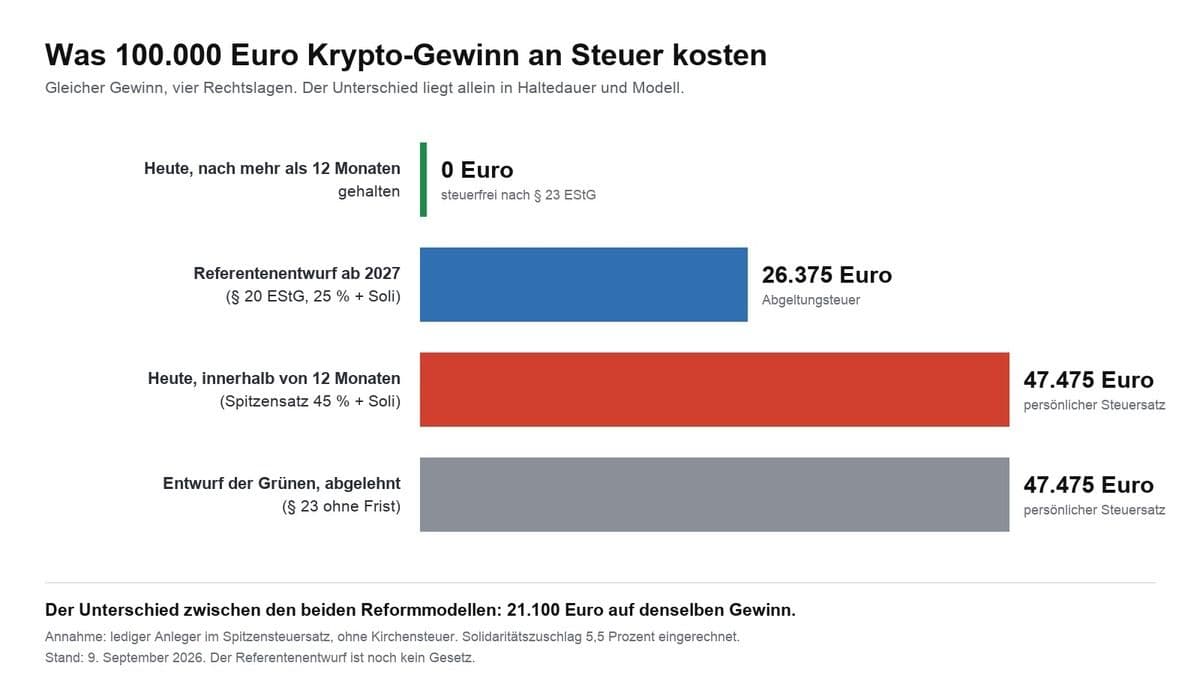
Crypto Tax in Germany: What Applies in 2026 and What Is Set to Change in 2027
Crypto gains are tax-free after twelve months; before that your personal tax rate of up to 45 percent applies. What triggers tax, how the holding period is calculated, what happens with staking and losses, and what the draft bill would change from 2027.
October 5, 2026 1:40 AM

Crypto at comdirect: 29 certificates with no order fee in a savings plan, but not a single coin
comdirect puts crypto into your securities account as a certificate, not as a coin. Our count of October 4, 2026 shows 29 securities from five issuers on 12 cryptocurrencies. On a one-off purchase the minimum fee of 9.90 euros amounts to 9.90 percent on 100 euros invested; in a savings plan the 1.5 percent is waived until the end of 2027.
September 25, 2026 10:14 PM

Sequans sells its last 314 bitcoin: what to check if you hold a treasury stock
Semiconductor maker Sequans has wound down its bitcoin reserve completely, 15 months after setting a target of one hundred thousand coins. What the case reveals about treasury stocks, and which tax rule applies to the share and to the coin.
September 19, 2026 7:12 PM

Bitcoin Sold Without Austrian Tax Withheld: What to Do Next
Sold Bitcoin but no Austrian capital gains tax was withheld? That does not make the sale tax free. When investors have to declare the gain themselves at 27.5 percent.
October 6, 2026 4:32 AM
Bitcoin for a gift card: what paying with crypto means for your holding period
Paying for a gift card with Bitcoin is a sale for tax purposes. What counts as the disposal proceeds, when the twelve-month holding period bites, and the four records the tax office expects.
September 25, 2026 10:26 PM

Selling bitcoin privately: the tax in Germany and the records you need
A direct sale to a private individual falls under the same one-year rule as an exchange sale, but there is no tax report to go with it. This guide walks through the calculation, the 1,000 euro threshold and the records the tax office wants to see.
September 22, 2026 1:12 PM

Buying Bitcoin With PayPal in Germany: What Really Works and What It Costs
PayPal runs no crypto service of its own in Germany, but it works as a deposit route at regulated exchanges. What the detour costs, which withdrawal hold follows it and why buyer protection does not apply here.

September 19, 2026 4:19 AM

Bitcoin Cash Jumps by Double Digits: What the Grayscale ETF Filing Really Means for You in Germany
Bitcoin Cash gained double digits on September 18 because Grayscale wants to convert its BCH trust into an exchange-traded product. The filing itself, however, states that the basis for it has not been approved at all.
September 7, 2026 10:24 AM

Gifting Bitcoin to Children: Tax Rules in Austria
Giving bitcoin to your children? When a gift notification is required in Austria, and which acquisition costs the child takes over.
August 31, 2026 10:23 AM

Bitcoin Abroad: The Tax Duty Austrian Investors Carry Themselves
Sold bitcoin through a foreign platform? When Austrian investors have to declare gains themselves and account for the 27.5 percent tax rate.
September 22, 2026 10:13 AM

Circle Lends Against Bitcoin via cirBTC: Why the Wrapper Can Cost You the German Holding Period
Circle launched loans against deposited bitcoin on September 21, 2026. In Germany, the detour through the cirBTC token is very likely a swap, and a swap restarts your one-year holding period.
September 17, 2026 7:12 PM

Gifting Bitcoin to Children: Allowance, Holding Period and the Tax Office Report
Transferring Bitcoin to your child hands over your holding period and your entry price along with the coins. This guide sets out what really applies in Germany on the allowance, the reporting deadline, representation and custody.
September 8, 2026 1:25 PM

Bitcoin Mining in Austria: How Mining Rewards Are Taxed
Bitcoin mining in Austria: when mining rewards are taxed at 27.5 percent, and when a commercial activity brings the progressive income tax rate into play.
August 14, 2026 6:23 AM

Bitcoin Savings Plan and Tax: How the Holding Period, FIFO and the Exemption Limit Interact on Monthly Buys
Every savings plan instalment is a separate acquisition for tax purposes, with a holding period of its own. How the exemption limit, the order of disposal and record-keeping duties interact on monthly Bitcoin buys, with the sources from the statute and the Ministry of Finance circular.
September 24, 2026 10:28 PM

Can Bitcoin Be Seized? What Creditors and Insolvency Administrators May Do with Crypto Assets
Crypto assets can be seized in Germany, and the Berlin Higher Regional Court has confirmed it at appellate level. What matters is the route of access: if the coins sit with a provider, an attachment order suffices; with self-custody the law reaches for the debtor in person.
September 9, 2026 7:18 PM
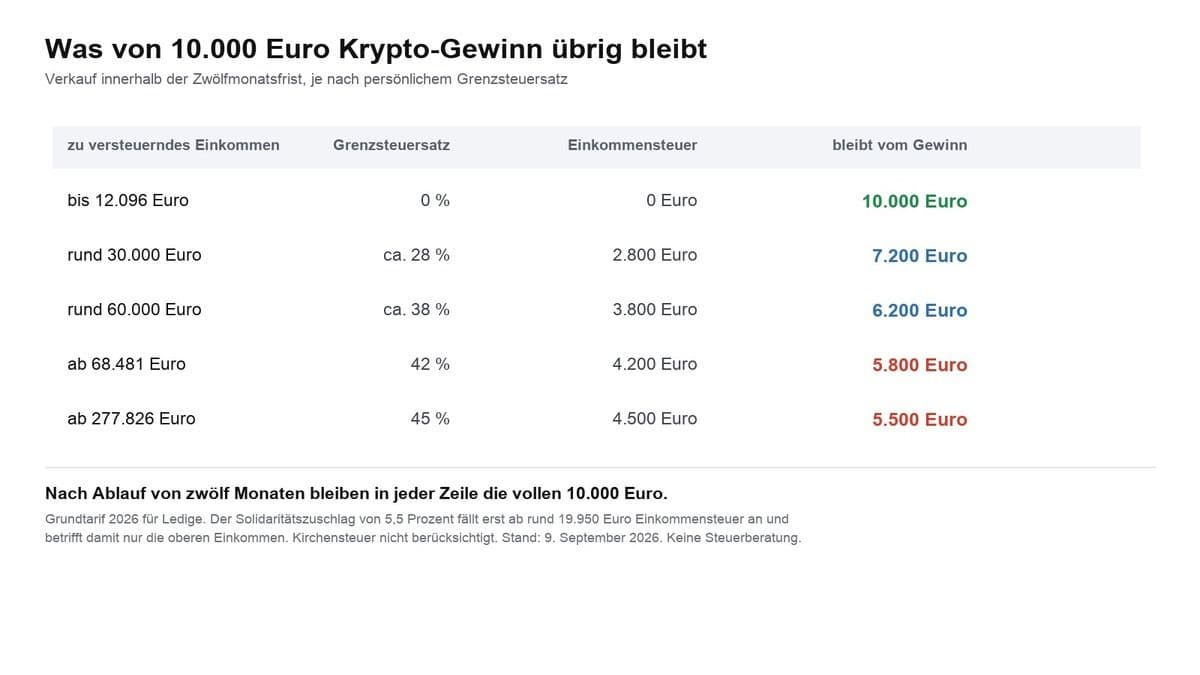
Calculating Crypto Tax: Formula, Worked Example and Tax Table
Disposal proceeds minus acquisition cost minus fees: the formula is simple, the consumption order is not. With a worked example, a tax table for the usual income brackets and the points at which every calculator loses precision.
August 21, 2026 1:42 PM

Writing Off a Total Crypto Loss: When the Tax Office Recognises Worthless Coins
A token that has collapsed only reduces your tax once you actually dispose of it. What applies to delisting, exchange insolvency and worthless holdings under Section 23 of the German Income Tax Act, and how you offset losses.
July 31, 2022 7:06 PM

Top 3 BEST Ways to Earn Bitcoin in 2022 – ANYONE can do it!
What are the best ways to earn Bitcoin in 2022? In this article, we talk about the 3 best ways to earn Bitcoin easily and safely in 2022.
October 9, 2026 10:50 AM

Crypto holding period: the Bundestag rejects abolition by 445 votes to 132: what investors need to know
On 8 October the Bundestag rejected the Greens' bill to abolish the crypto holding period in a recorded vote, and the Left's motion fell too. The result by parliamentary group, the official speech from the media centre, and why it was the SPD that gave investors the real signal in the debate.
More from CryptoTicker