
MoonPay Fees: Up to 4.5 Percent, a Partner Margin on Top, and a Markup You Never See as a Fee
MoonPay is the buy button built into many crypto wallets. The European price list names four layers of cost, and only three of them show up as line items. What the provider is allowed to do, and what it expressly is not.



Which topics should we dive deeper into?
Select what genuinely interests you. Your picks feed directly into our editorial planning.
Crypto news that's actually worth your time.
Weekly. 60 seconds. Carefully curated by our editors: no hype, no promo flood, no spam.
The information provided in this article is for informational purposes only and does not constitute financial advice. Investing in cryptocurrencies carries a high level of risk.
When you tap “Buy” inside a crypto wallet, in many cases you are not buying from the wallet at all. You are buying from MoonPay. The service is built into a large number of applications as a buy button, which is exactly why most users never see a price list before they pay.
One exists, and it is public. The MoonPay Europe Pricing Disclosure applies to customers in the European Economic Area and puts numbers on the page. The most important one first: up to 4.5 percent on card payments, up to 1 percent on bank transfers, and a minimum of €3.99 if your amount falls below a certain threshold.
That is only the first of four layers. This article is an assessment rather than a news report. All figures come from MoonPay’s own price list, and from the MiCA register kept by the European securities regulator ESMA. Sources are written out at the end.
What MoonPay is, and why you may never have read the name
MoonPay is what the industry calls an on-ramp and off-ramp: a service that exchanges euros for crypto assets and back again. It rarely appears under its own name. It sits embedded in someone else’s interface instead. Wallet providers and platforms integrate it so their users can buy without the detour of an exchange. The company itself claims a presence in more than 160 countries and more than 300 integrated applications.
Names that can be documented include Ledger, which runs a dedicated product page for buying via MoonPay, and Trust Wallet, which lists the service alongside other providers in its purchase screen. At MetaMask, MoonPay appears expressly only in the list for users in the United States; MetaMask publishes no equivalent list for the EU. One formerly common use case has gone: NFT Checkout, the card payment option on NFT platforms, was discontinued on May 1, 2026.
For you as a user, that embedding means two things. First, your contractual counterparty is MoonPay Europe B.V. and not the wallet. Second, the operator of the wallet may be earning on your purchase through a fee layer of its own, which MoonPay collects on its behalf. More on that in a moment.
One note on the price list itself, because it bears on how long this article stays accurate: it carries no date and no version number. Every value here therefore applies as of the retrieval date of September 5, 2026, and can change without any visible announcement.
MoonPay fees: the four cost layers
The price list names four types of fee, in its own words “a network fee; a MoonPay fee; an Iron fee; and/or an ecosystem fee”. On top of those sits the spread. The first four appear as line items. The spread does not.
Layer 1, the MoonPay fee. It depends on how you arrived at the platform, and that is the detail most readers skim past.
If you buy directly through MoonPay’s website or app, this table applies:
| Payment method | on purchases | on sales |
|---|---|---|
| Cards and alternative payment methods | up to 4.5 percent | up to 4.5 percent |
| Bank transfer | up to 1 percent | up to 1 percent |
Across the board, the price list quotes a range of “between 0 and 5 percent” for direct access. If you arrive through a partner, meaning the buy button inside a wallet, the wording is “up to 4.5 percent”, with a minimum fee that “will never be more than €4.50”. For that route, MoonPay publishes no breakdown by payment method.
In both cases there is also a minimum fee of €3.99 if your amount falls below a threshold. How high that threshold is does not appear in the price list. If you pay in a currency other than euros, dollars or pounds, the document says the minimum fee rises “by 0.25 to 10 percent”.
Layer 2, the ecosystem fee. This is the partner’s margin. The price list says it is charged “by MoonPay Europe on behalf of some, but not all, of our partners”, that it is “set by each partner individually”, and that it may not exceed 10 percent, though it typically runs between 0 and 2 percent.
Translated: the operator of the wallet in which you have just tapped Buy can add up to ten percent. This fee is shown to you as a separate line item when you confirm the order, so it is visible. But it depends on which app you are using, rather than on what you are buying.
Layer 3, the transaction fee. According to the price list it sits “between 0 and 10 percent, typically around 1 percent”. It is disclosed at account opening and appears as a line item on the email receipt.
Layer 4, the spread. And this is the one that matters. The price list puts it like this: for all transactions, the rate displayed to you corresponds to the base price “inclusive of any spread”. And further: “All spreads are included in the price of the crypto asset displayed to you during the checkout process.”
A markup baked into the rate is not a line on the invoice. It is not hidden in the sense of being improper, since MoonPay discloses it. It simply cannot be quantified before you buy, and it stacks on top of the other three layers.
What MoonPay fees mean in euros
Work it through once for a typical case, using the values from the price list and leaving out the spread, which nobody knows in advance.
You buy €200 of bitcoin by card, through the buy button in a wallet:
- MoonPay fee, up to 4.5 percent: up to €9.00
- Ecosystem fee charged by the partner, typically 0 to 2 percent: up to €4.00
- Transaction fee, typically around 1 percent: roughly €2.00
- Spread: unknown, contained in the rate
In the unfavourable case that leaves you at around €15 on a €200 outlay, or roughly 7.5 percent, before the spread has even been counted. Paying by bank transfer instead of card cuts the largest layer from up to 4.5 percent to up to 1 percent.
The comparison that follows from this is straightforward. A regulated exchange with a published order fee or a published spread is almost always cheaper on the same €200. The providers and their terms are set out in our comparison of the best crypto exchanges. If you are looking to start through an app, the candidates are in the comparison of buying bitcoin by app.
What MoonPay is allowed to do in Europe, and what it expressly is not
Here it pays to look at the register, because it corrects a widespread assumption.
MoonPay Europe B.V., registered at Herengracht 420, 1017BZ Amsterdam, appears in ESMA’s MiCA register. The competent authority is the Dutch financial markets regulator AFM, and the date of authorisation is December 30, 2024. MoonPay itself gives the reference number 41000002 in its footer.
The register lists exactly three authorised services:
- exchange of crypto assets for funds
- exchange of crypto assets for other crypto assets
- provision of transfer services for crypto assets
Custody of crypto assets on behalf of clients is not among them. That is the service listed under letter a in the register, and MoonPay Europe does not hold it. The service is designed so that whatever you buy goes straight to an address you supply. Leaving holdings there is not what it was built for.
The authorisation is passported into 30 states of the European Economic Area, Germany included. In BaFin’s company database MoonPay Europe therefore appears under the category “cross-border service providers (Art. 65 MiCA-R)”, with three inbound permissions and an issue date of March 26, 2026. They match the three services from the Dutch register exactly. The service needs no German licence of its own; market access runs through the European passport.
One discrepancy you may run into while reading up: in a help article, MoonPay describes the scope of its own MiCA authorisation more broadly than the registers do, naming custody and the issuance of stablecoins as well. Neither service appears in the Dutch AFM register or in the BaFin database. In case of doubt, the supervisory authority’s register governs, and not the provider’s own description.
When reading the small print, watch which company you are dealing with. The US footer names MoonPay USA LLC as a registered money transmitter with an NMLS number. For a user in Germany, MoonPay Europe B.V. with company number 93501153 and the European price list apply, not the American one. Dutch law governs, the place of jurisdiction is Amsterdam, and where the language versions conflict, the English version of the terms of use prevails.
MoonPay Balance: the credit is not a deposit, and Germany has a special rule
The service offers an internal balance, MoonPay Balance. Two points about it sit in the terms of use and are worth knowing.
First, this credit is expressly neither e-money nor a bank account nor a deposit, and under the terms it is “not protected by any deposit guarantee scheme or investor compensation scheme”. It pays no interest.
Second, a separate clause applies to Germany. The balance may not exceed your average monthly trading volume or €1,000, whichever is higher, and it should not be held for longer than 30 calendar days. If it stays above €20 for more than 30 days, MoonPay may terminate access to this service after giving notice.
Together with the missing custody permission, that paints a clear picture. The service is built as a point of transit. Storage was never part of the design.
When MoonPay is still the right choice
The criticism of the costs would be incomplete without the reason the service is so widespread.
It is fast. It requires no account opening at an exchange, no transfer and no second app. And it delivers the crypto assets straight to an address of your choosing, which at an exchange would be an extra step carrying its own withdrawal fee.
That makes it sensible in three situations: small, infrequent amounts, where the effort of opening an account eats up the price difference. An urgent purchase, where verification at an exchange would take too long. And the case where you want the assets in your own custody anyway and can skip the exchange as an intermediate stop. Suitable devices are listed in our hardware wallet comparison.
It makes less sense for regular purchases, for savings plans and for larger amounts. There, every percentage point bites, and the saving at an exchange quickly outweighs the effort.
Three things to check before you tap
First: pay by bank transfer rather than by card, if you have the time. The difference according to the price list is up to 4.5 percent against up to 1 percent. On €500 that comes to as much as €17.50 for a few working days of waiting.
Second: look at the breakdown before you confirm. MoonPay shows its own fee, the partner’s ecosystem fee and the transaction fee as separate line items. What you do not see as a line item is the spread. The only reliable check is therefore to compare the displayed rate with the market rate before you confirm.
Third: measure the total against the amount of crypto that actually arrives. Do not add up the fee lines. Look afterwards at how much bitcoin your €200 left on the address, and divide that by the market rate. That is the only figure that contains all four layers.
For tax purposes, every MoonPay purchase counts as normal
A purchase through MoonPay is an acquisition for tax purposes like any other. What matters is that you document it: date, quantity, euro amount paid. Since MoonPay offers no custody, the assets land directly in your own wallet, and there is no automatic statement there.
Anyone buying through several routes, partly through an exchange and partly through an embedded buy button, has acquisition data sitting in more than one place. For the holding period and the FIFO ordering they have to be brought together. Which programs manage that is set out in our comparison of crypto tax tools.
MoonPay: what to take away
- Switch the payment method; that is the biggest lever. Card up to 4.5 percent, bank transfer up to 1 percent. Everything else is fine-tuning by comparison.
- Compare the displayed rate with the market rate before you confirm. The spread is the only layer that never appears as a line item, and the price list says expressly that it is contained in the rate you are shown.
- Use MoonPay for the rare, small or urgent purchase, not for a savings plan. For recurring purchases, opening an account with a provider that publishes its terms almost always pays off.
Frequently asked questions
How high are the fees at MoonPay? On a purchase made directly through MoonPay, the European price list names up to 4.5 percent for cards and alternative payment methods and up to 1 percent for bank transfer, in each case on both purchases and sales. If you arrive through a partner, “up to 4.5 percent” applies with no breakdown by payment method. On top of that comes a minimum fee of €3.99 below a certain amount. Retrieved on September 5, 2026; the price list is undated.
What is the minimum I have to buy? MoonPay names a minimum amount of 20 US dollars or the equivalent. On small amounts the minimum fee of €3.99 bites particularly hard: on €20 it works out at roughly 20 percent.
Why do I pay more in my wallet than on the MoonPay website? Because a purchase through a partner can attract an additional ecosystem fee. It is set by the partner, may not exceed 10 percent and, according to MoonPay, typically runs between 0 and 2 percent.
Is MoonPay regulated in Germany? Yes. MoonPay Europe B.V. has been authorised under MiCA by the Dutch regulator AFM since December 30, 2024, and is passported into 30 states of the European Economic Area, Germany included.
Does MoonPay hold my cryptocurrencies in custody? No. The MiCA register records only exchange for funds, exchange for other crypto assets and transfer services for MoonPay Europe. Custody on behalf of clients is expressly not part of it. Whatever you buy goes to an address you supply.
What is the spread at MoonPay and where do I see it? The spread is a markup contained in the rate you are shown, and it never appears as a fee line of its own. MoonPay writes itself that all spreads are included in the price of the crypto asset displayed during checkout. It becomes visible only in a comparison with the market rate.
Is MoonPay worth it compared with an exchange? On small, infrequent or urgent purchases, the effort saved can outweigh the higher costs, especially where the assets are headed straight into your own wallet anyway. On regular purchases and larger amounts, a provider with published terms is generally cheaper.
The price lists of on-ramp providers change without notice, and MiCA authorisations keep being added or altered in scope. We follow both and summarise the changes, in German and in English. The current picture is on the front page of cryptoticker.io.
Sources
- MoonPay, Europe Pricing Disclosure, undated and without a version number: https://www.moonpay.com/legal/europe_pricing_disclosure
- MoonPay, terms of use for Europe, German version: https://www.moonpay.com/de/legal/terms_of_use
- MoonPay, risk disclosures: https://www.moonpay.com/legal/risk
- MoonPay, overview of legal documents: https://www.moonpay.com/legal
- AFM, register of authorised crypto asset service providers, file register-cryptopartijen.xlsx, as of August 25, 2026, entry MoonPay Europe B.V. with number 41000002: https://www.afm.nl/~/profmedia/files/registers/register-cryptopartijen.xlsx
- BaFin, company database, entry “Moonpay Europe B.V.”, category cross-border service providers under Article 65 MiCA-R: https://portal.mvp.bafin.de/database/InstInfo/
- Ledger, product page for buying via MoonPay: https://www.ledger.com/buy-moonpay
- ESMA, interim MiCA register of crypto asset service providers, file CASPS.csv, entry MoonPay Europe B.V., LEI 254900KXWAZ3B1340G26: https://www.esma.europa.eu/sites/default/files/2024-12/CASPS.csv
- ESMA, landing page on the MiCA regulation: https://www.esma.europa.eu/esmas-activities/digital-finance-and-innovation/markets-crypto-assets-regulation-mica
- Regulation (EU) 2023/1114 on markets in crypto assets (MiCAR), Articles 3 and 59: https://eur-lex.europa.eu/eli/reg/2023/1114/oj
(As of September 5, 2026. This article is not investment advice. Prices and fee structures change; check the terms with the provider before you buy.)
Transparency note: This article was produced with the assistance of artificial intelligence and reviewed by our editorial team before publication. All figures and claims were checked against the primary sources linked in the text. The feature image was generated with AI.
Related articles
- Bison App: a 1.25 Percent Spread, 27 Percent of the Staking Rewards and Trading Without an Order Book
- 25 cents to trade, 1.31 euros to withdraw: the Bitvavo fees on 100 euros of Bitcoin
- Kraken Review: Fees, MiCA Licence and Withdrawals in Euro
- How to Buy Ethereum (ETH) on eToro: A Comprehensive Guide
- Binance fees: 0.1 percent to trade, and one drawback compared with MiCA-licensed exchanges
Which topics should we dive deeper into?
Select what genuinely interests you. Your picks feed directly into our editorial planning.
Crypto news that's actually worth your time.
Weekly. 60 seconds. Carefully curated by our editors: no hype, no promo flood, no spam.

October 5, 2026 1:29 AM

Chainalysis attributes $387 million from the Bitget hack to North Korea: what matters now for investors in Germany
The analytics firm Chainalysis attributes the theft of around $387 million at Bitget to actors with ties to the DPRK and puts the annual total above one billion dollars. What that means for custody, choice of exchange and record-keeping in Germany.
September 10, 2026 1:21 AM

Crypto Exchanges Head to Head: Which Pairing Is Cheaper Where
Before opening an account, the question is rarely which exchange is best overall, but whether it should be this one or that one. This article sorts through the most searched head-to-heads, puts the cost per 1,000 euros side by side and explains the most expensive mix-up: one provider with two interfaces and a factor of seventeen between them.
September 30, 2026 10:40 PM

ESMA Calls for Advertising Rules on Crypto Influencers: Six Changes Now Sitting With the EU Commission
The EU securities watchdog filed its response to the MiCA review on the final day of the consultation. Among the demands are disclosure on staking, a licensable DeFi gateway and the power to freeze crypto assets.

May 15, 2026 9:47 AM
Top 10 Altcoins to Buy in May 2026 as Bitcoin Recovers
Here are the top 10 altcoins to buy in May 2026 as Bitcoin rebounds near $80K and market momentum shifts.
May 6, 2024 12:55 PM

Top 5 Reasons Why To Buy Crypto Today?
Staying bullish on crypto makes sense amid current market challenges. And here are the reasons...
October 11, 2026 10:39 PM
Buying Dogecoin: instant buy at one percent or the order book at 0.8?
Seven cents per €100 separated the best asks of three authorised exchanges on Sunday evening. Between instant buy and order book at the same provider lie 75 cents.
September 15, 2026 4:12 AM

Using Hyperliquid from Germany: What Applies to Your Funds Without a MiCA Licence
Hyperliquid is not entered in any EU register as an authorised crypto-asset service provider, and for perpetual futures a MiCA licence would be the wrong paperwork anyway. Here is what that means in concrete terms for your funds, your keys and your tax return.
August 6, 2026 3:05 PM
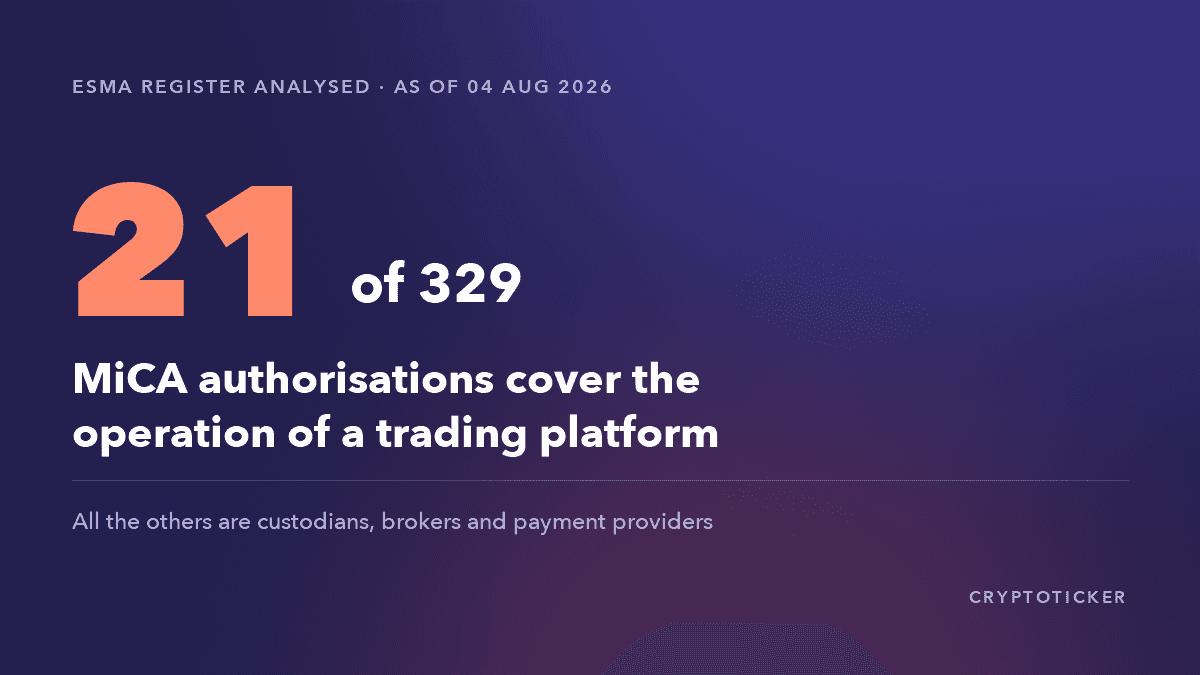
MiCA Register 2026: Only 21 of 329 Licences Are Real Exchanges
ESMA publishes the register of MiCA-authorised providers as an open file. We worked through all of it — and the result is not what the phrase “licensed crypto exchange” suggests.
September 19, 2026 4:11 PM
MiCA Consultation Closes September 30: What to Check and Submit Before Then
The European Commission is reviewing the MiCA crypto regulation and will accept submissions until September 30, 2026 at 23:59 CEST. Staking, DeFi, lending, stablecoins and custody are all under examination, and you can take part without a lawyer.

June 30, 2026 11:20 PM
How to Switch from Binance to a MiCA Regulated Crypto Exchange
Binance is winding down EU services after missing the MiCA deadline. Here's why it's happening and how to move your funds to a regulated platform safely.
August 21, 2026 4:27 PM

Wallet App Without BaFin Authorisation: When Holding Crypto-Assets Requires a Licence
On 19 August 2026 BaFin published two consumer notices on wallet offerings. Who controls the means of access decides whether an authorisation is needed.
July 2, 2026 8:59 PM
Binance Is Out of the EU: How to Move to a MiCA-Regulated Exchange
Binance has left the EU market. Which exchanges hold a MiCA licence, how to verify an authorisation is real, and how to move your holdings across step by step.
April 11, 2025 4:00 AM
Buy the Dip with These Top 3 Altcoins
The US-China tariff war triggered a harsh market correction despite the 90-day pause that briefly reignited momentum. Still, savvy investors are spotting a buy-the-dip opportunity in three standout altcoins. Can you guess which tokens made the list?
November 27, 2024 7:01 PM

Uniswap Bug Bounty: The 'Largest Bug Bounty in History' ahead of v4 Core Contracts Release
Uniswap Labs has launched the largest bug bounty in crypto history, a groundbreaking $15.5 million bug bounty program to secure its upcoming v4 core contracts. Full details here...
August 20, 2026 10:24 PM

MiCA Review: What the European Commission Could Change About the EU Crypto Rules
The European Commission has reopened MiCA for review after barely two years and is asking 86 questions covering the stablecoin interest ban, staking, lending and DeFi. Brussels is taking responses until September 30, 2026.
June 7, 2026 12:37 PM
Top 5 Altcoins to Buy in June 2026: Best Picks by Crypto Category
Looking for the best crypto to accumulate? Discover the top 5 altcoins to buy in June 2026 across Layer-1, AI, RWA, and Layer-2 sectors.
October 14, 2026 1:29 AM

South Korea blocks 27 unregistered exchanges, KuCoin and MEXC are on the list
South Korea's anti-money-laundering unit blocked access to 27 websites of unregistered foreign exchanges on October 13, 2026, KuCoin, MEXC and BingX among them. In Germany the grandfathering for legacy providers lapsed back on December 31, 2025, and at KuCoin a granted EU licence stands against an order that still prohibits the commencement of business.
October 10, 2026 7:15 AM
Sparkasse Crypto Fees: 99 Cents per Order, but Your Own Hardware Wallet Is Blocked as a Destination
DekaBank has published the contractual documents for “Krypto – powered by Deka”. That puts a 0.99 euro transaction fee, a 250,000 euro order ceiling and five minimum delivery amounts on the record at source for the first time. Your own hardware wallet remains excluded as a recipient address.
September 29, 2026 10:33 AM
ESMA puts reverse solicitation on its 2027 watch list: what investors need to know about exchanges without an EU licence
ESMA presented its work programme for 2027 on September 28, 2026 and made reverse solicitation a supervisory priority. What that means if your coins sit with a provider without EU authorisation, and which three steps make sense now.
June 25, 2026 11:19 AM
Binance Pulls Its EU Licence Bid: What It Means for Your Crypto
Binance just withdrew its MiCA licence application in Greece days before the EU deadline. Here's what it means for users, your funds, and the crypto market.
June 7, 2026 11:00 AM
How to Buy Bitcoin with No KYC in 2026: 3 Ways to Do It
Protect your data and maintain privacy. Here are the three most secure ways to buy Bitcoin without identity verification (KYC) in 2026.
September 5, 2024 10:00 PM

Toncoin Price Drop Below Its $4.70 Support Level Warns Of A Major Crash On The Horizon
Can Toncoin recover from its shaky position, or is a 45% price drop looming? Analysts weigh in on the crypto’s critical support level amid legal troubles at Telegram...
May 19, 2024 1:23 PM
Will Tether (USDT) Get Delisted In Europe?
With growing concerns revolving around the reliability and compliance regulations of stablecoins, some crypto exchanges opt to delist some of them. Will this be the case for Tether in Europe?
December 4, 2021 4:13 PM
Looking to Buy the Dip? Here’s a Quick Guide on How to Buy ETH post-Crash
Is it the right time to Buy Ether after the crypto crash? In this article, we're going to quickly recap how to Buy Ether from Kraken.
May 23, 2024 2:22 PM

How To Manage Crypto Market Volatility: Strategies & Key Factors
Traders, Analysts, Financial Institutions, Investors... as Beginners or Experts, this is for you! A full guide into the crypto market volatility: strategies, key factors, FAQs...
May 18, 2026 8:15 AM
Bitget Review 2026: Fees, Safety After the $388M Hack and Who Can Use It
Bitget review for October 2026: fees, the $388 million hack, withdrawals, Proof of Reserves and the countries where Bitget cannot be used.
October 9, 2026 7:29 AM
Exodus Wallet: 71.5 percent of revenue comes from swaps, the spread vs the exchange fee
The Exodus Wallet is free to download, yet 71.5 percent of the provider's revenue in the second quarter of 2026 came from swaps inside the app. What the spread costs, how custody works and from what point a device of your own pays off.
More from CryptoTicker