
Iran's Rial Collapse: Why Iranians Turned to Bitcoin and USDT
The Iranian rial fell to about 1.47 million per dollar in January 2026 and has since passed 2.3 million. How protests, war and sanctions shaped Iran's crypto use.





Which topics should we dive deeper into?
Select what genuinely interests you. Your picks feed directly into our editorial planning.
Crypto news that's actually worth your time.
Weekly. 60 seconds. Carefully curated by our editors: no hype, no promo flood, no spam.
Update 25 September 2026: The first version of this article said the rial had lost 96% of its value in a single month. That was wrong. The free-market rate went from about 817,500 rials per dollar at the start of 2025 to roughly 1.47 million in January 2026. Since then the collapse has deepened: after the US-Israeli strikes of 28 February 2026 and a US naval blockade reimposed in July, the dollar broke through 2.1 million rials on 2 September 2026 and traded at around 2.3 million in late September. The January report follows below as a dated snapshot, corrected where needed.
How far has the Iranian rial fallen?
Measured from the start of 2025 to late September 2026, the rial has lost about two thirds of its value against the US dollar. The steepest phase came with the war: since the start of the Iranian year in March 2026, the currency has lost roughly 60% of its value, Euronews reported on 2 September 2026. The Iranian exchange-rate tracker Alanchand listed the dollar at 2,330,000 rials on 25 September 2026. Iran's central bank has promised a $2 billion injection to stabilise the currency.
Iran runs a two-tier system: an official rate for state transactions and subsidised imports, and the free-market rate that ordinary Iranians pay. The figures in this article refer to the free market.
What happened in January 2026: the original report
This section was written on 13 January 2026.
The Iranian Rial (IRR) was in freefall. A rollback of currency subsidies had pushed the dollar rate to about 1.47 million rials, up from 1.42 million in December 2025, and the black-market rate was heading towards 1.5 million. The population was in a race to preserve its savings, and the traditional financial system in Tehran was effectively paralysed.
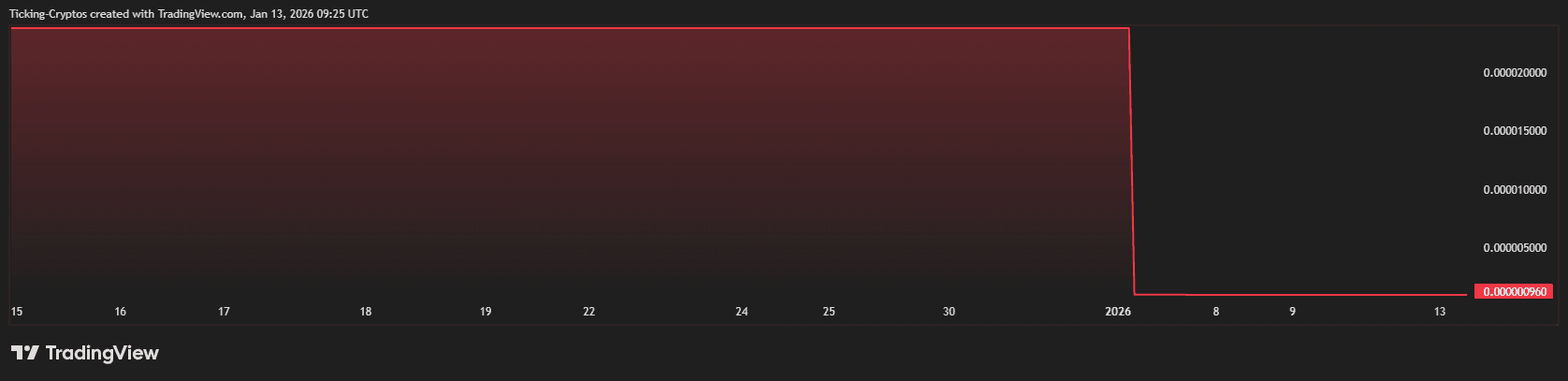
IRR/USD, 13 January 2026, TradingView
The Perfect Storm: Protests, Sanctions and Inflation
The economic collapse did not happen in a vacuum. Iran was gripped by some of the most intense anti-government protests in decades. A nationwide internet blackout and a brutal crackdown had failed to silence a population pushed to the brink by soaring food prices and the removal of currency subsidies.
Geopolitics added another layer of uncertainty. US President Donald Trump had announced that countries doing business with Iran would face 25% tariffs. At the same time, he said on Truth Social that Iranian officials had reached out to "make a deal". Six weeks later, on 28 February 2026, the US and Israel struck Iran instead.
At the time, viral posts on X went as far as claiming that the currency had gone to zero. That overstated it, but it captured the mood:
Why Iranians Are Leaving the Rial for Crypto
With the national currency losing value faster than many speculative tokens, Iranians increasingly treat Bitcoin and stablecoins as savings accounts. When a fiat currency loses a large share of its value within months, the volatility of the crypto market can look tolerable by comparison.
The data support this, with limits. According to Chainalysis, Bitcoin withdrawals from Iranian exchanges to personal wallets rose during the protest wave. Activity then flatlined during the internet blackout from 8 January 2026 and picked up again once access returned. For many families, Tether (USDT) works as an unofficial digital dollar. Unlike the rial, which depends on a sanctioned central bank, crypto held in a personal wallet cannot easily be frozen by local authorities.
What changed after the strikes of February 2026?
The war turned the crypto question from savings into survival. In the hours after the US-Israeli strikes of 28 February 2026, hourly outflows from Iranian crypto exchanges were 873% above their 2026 average, and about $10.3 million left the exchanges between 28 February and 2 March, Chainalysis reported. Analysts disagree on how much of that was capital flight and how much was exchanges moving funds into cold storage.
Washington then targeted the infrastructure itself. On 2 June 2026 the US Treasury's sanctions office OFAC designated Nobitex, Iran's largest crypto exchange, together with Wallex, Bitpin and Ramzinex, according to Chainalysis. For ordinary users, that makes the step from rial to crypto harder and pushes activity towards peer-to-peer trading. How the state itself uses crypto is the subject of our analysis Is Iran using crypto to bypass US sanctions?
A New Era of Financial Sovereignty?
Iran is a real-world stress test for cryptocurrencies in a failing economy. The test is harsher than the January version of this article suggested: blackouts cut people off from the network, sanctions hit the exchanges, and war dominates everything else. What remains is the core argument. A person who holds the keys to a hardware wallet keeps control of the asset, whatever happens to the local currency or the local banks.
If you want to secure your own assets, compare the safest platforms in our exchange comparison. How the war affects oil and crypto prices is covered in what an end to the Iran war would mean for crypto.
FAQ
How much is the Iranian rial worth today?
On 25 September 2026 the Iranian exchange-rate tracker Alanchand listed one US dollar at 2,330,000 rials. The dollar first broke through 2.1 million rials on the free market on 2 September 2026.
Did the rial really lose 96% in one month?
No. That figure, which appeared in the first version of this article, was wrong. In January 2026 the free-market rate stood at about 1.47 million rials per dollar, compared with 1.42 million in December 2025 and about 817,500 at the start of 2025.
Do Iranians use Bitcoin to protect their savings?
Yes, within limits. Chainalysis data show rising Bitcoin withdrawals to personal wallets during the protests of January 2026, but internet blackouts and sanctions against Iranian exchanges restrict access.
Which Iranian crypto exchanges are under US sanctions?
On 2 June 2026 OFAC designated Nobitex, Wallex, Bitpin and Ramzinex.
Transparency note: This article was produced with the assistance of artificial intelligence and reviewed by our editorial team before publication. All figures and claims were checked against the primary sources linked in the text. The feature image was generated with AI.
More on Bitcoin: All Bitcoin news at a glance
Related articles
- Bitcoin Price Explodes Past $77,000 as Trump Discloses Near-Final Iran Peace Deal
- Crypto Market Crash: Why Prices Plummeted After Trump’s Iran Oil Threat
- $900 Billion Surge — But Markets May Be Pricing a Peace That Doesn’t Exist
- Iran-Israel War Escalation: Why the Crypto Market is Crashing Today
- US Stablecoin Deal Reached Amid Iran Ground War Fears
Which topics should we dive deeper into?
Select what genuinely interests you. Your picks feed directly into our editorial planning.
Crypto news that's actually worth your time.
Weekly. 60 seconds. Carefully curated by our editors: no hype, no promo flood, no spam.

May 20, 2026 4:47 PM

Bitcoin Price Poised for $82,000 as Trump Signals "Final Stages" of Iran Peace Talks
President Trump reveals the US is in the final stages of talks with Iran, sparking a major market relief rally as Bitcoin eyes a fast breakout past $80,000.

August 10, 2026 6:52 PM

Why Is Crypto Down Today? Iran Shuts the Door on US Talks Until 2029
Crypto gave back its morning gains after Iran ruled out talks with Washington until 2029. Bitcoin lost $65,000, oil jumped 5% and altcoins bled again.
July 23, 2026 6:19 PM

Oil Hits $100 as Iran Tensions Escalate — Why Bitcoin and Altcoins Are Falling
Oil surged above $100 as US-Iran tensions intensified, pushing Bitcoin below $65,000 and triggering losses across the crypto market.
May 6, 2026 3:16 PM

Trump Warns Iran: Bitcoin Price Dips to $81,600 as Geopolitical Tensions Flare
Bitcoin drops from $82,800 to $81,600 following Trump’s latest Iran warning. Is this a trend reversal or just a healthy market correction?
January 20, 2026 3:46 PM

Crypto Crash of 20 January 2026: Bitcoin Slipped Toward $90K on Greenland Tariff Fears
On 20 January 2026 Bitcoin slid toward $90,000 as Trump threatened tariffs over Greenland. The threat was dropped a day later, yet BTC fell to about $58,600 by July.
February 20, 2026 6:00 AM
Top 3 Reasons Why Cryptos Might Crash Hard Soon: Geopolitics and Macro Risks
Is a crypto crash coming? Explore the top 3 reasons why Bitcoin and altcoins could face a major sell-off, from Middle East tensions to Fed policy.
June 15, 2026 5:00 AM
Trump Says US-Iran Deal Is Days Away: What It Means for Crypto
Trump says a US-Iran deal is set to be signed within days, reopening the Strait of Hormuz. Here's what an easing of the conflict could mean for Bitcoin and crypto.
April 26, 2026 12:04 PM
Crypto News Today: Bitcoin Stabilizes at $78,000 Despite Geopolitical Stalemate
Bitcoin hits $78,000 as investors digest the latest crypto news today, including US-Iran diplomatic shifts and a massive $344M seizure of linked assets.
March 26, 2026 1:23 PM
Crypto Ignores Bullish News as War Risk Takes Over — Why Bitcoin and Ethereum Are Falling Anyway
Bitcoin and Ethereum fall despite bullish crypto news as war risks, oil spikes, and macro pressure dominate market sentiment.
June 18, 2026 9:43 AM

Oil Crashes 38% to a 3.5-Month Low — Why This Is Bullish for Crypto
Oil crashed 38% to $74, near pre-war levels. Lower oil means lower inflation and more rate-cut odds — and that's a tailwind for Bitcoin and crypto.
March 30, 2026 7:18 AM

Bitcoin $65K Bounce: The Real Reason BTC Price Flipped Green Within Minutes
Bitcoin price staged a massive recovery from $65,000 as macro signals flipped green. Will the BTC monthly candle end its five-month red streak?
March 25, 2026 4:24 PM

Markets Are Pricing Peace — But Crypto Is Sending a Different Signal
Bitcoin holds $70K as markets rally on Iran ceasefire hopes, but weak altcoins signal caution. Is crypto doubting the peace narrative?
June 5, 2025 9:20 PM

BREAKING: Elon and Trump CLASH as Bitcoin Price Crash
Elon Musk and Donald Trump’s public feud on X has sent shockwaves through the crypto market, causing a 3% drop while Bitcoin falls 1.7% to $102,000.
September 29, 2026 10:38 AM
Bitcoin Falls Toward $83,000 as Trump Rejects Iran Ceasefire Deal
Bitcoin slipped toward $83,000 after Trump rejected Iran's Hormuz proposal, sending oil above $100 and wiping out $478 million in crypto liquidations.
March 21, 2026 9:14 AM

Why is Crypto Crashing Today? 3 Reasons Behind the Bitcoin Crash
Bitcoin and altcoins are facing a sharp sell-off today. From Middle East tensions to hot PPI data, here is why the crypto market is crashing.
June 24, 2024 8:16 PM

Bitcoin News Today: Bitcoin CRASH OVER or MORE Down To Go?
Bitcoin Price Crash below 60k, and the crypto market follows. Why this decline and how low can it go?
July 1, 2024 9:20 AM

Bitcoin News Today: Why Is Bitcoin Price Up Starting July?
Starting July, recent market movements, political debates, and court rulings are shaping the future of Bitcoin and the broader crypto market. Here are the latest insights and analysis...
April 12, 2026 11:07 AM
Bitcoin Price Drops to $71,500 as US-Iran Peace Talks Collapse in Islamabad
Bitcoin retraces to $71,500 after failed US-Iran peace talks in Pakistan. Geopolitical tensions resurface, impacting the global crypto market sentiment.
July 8, 2024 7:51 AM

Crypto Market Crash News As BTC Price Crash Back To 56K
With the crypto market crash, and Bitcoin price drop to below 56k with recent dormant BTC whales activity, what comes next: a correction or further crash soon?
April 21, 2026 4:33 PM

Crypto News: Trump Pressures the Fed as Iran Risks Rise — What It Means for Bitcoin
Trump pressures the Fed while Iran risks keep markets on edge. Here is why both could shape Bitcoin’s next move.
February 28, 2026 10:20 AM

BREAKING NEWS: Crypto Crash as US and Israel Strike Iran
Crypto markets crashed as the US and Israel launched joint strikes on Iran. Bitcoin fell below $64,000 amid mass liquidations and rising geopolitical tension.
February 25, 2026 3:25 PM

Will Crypto Prices Rise if the USA Attacks Iran? A Historical Analysis
Analyzing Bitcoin and crypto price reactions to USA-Iran tensions. Will BTC rise as a hedge or fall during geopolitical conflict?
February 23, 2026 4:46 PM

Crypto Market Watch: Volatility Returns as Trump’s Tariff Jolts Bitcoin Below $65,000
Bitcoin drops below $65,000 on Feb 23, 2026, as President Trump’s 15% tariff hike sparks market volatility. Discover the latest on BTC, ETH, and institutional moves.
January 21, 2026 9:58 AM

Why Is Crypto Crashing? 3 Top Reasons Behind the Crypto Crash
The crypto market is facing a sharp correction. We analyze the top 3 reasons why Bitcoin and altcoins are crashing right now, from geopolitics to liquidations.
July 28, 2025 9:27 AM

Trump–EU Trade War is OVER: What It Means for Bitcoin and Altcoins
President Trump just struck a $1.3 trillion trade framework with the EU, aimed at stability, zero tariffs, and massive energy deals. Here’s how this could shape Bitcoin’s next move.


More from CryptoTicker