
Euro Deposit to a Crypto Exchange Rejected: Why the Transfer Fails and What You Can Do
Since October 9, 2025 your payment service provider matches the payee name against the IBAN on every euro transfer. On deposits to an exchange account that is precisely where the payment most often comes to a halt.




Which topics should we dive deeper into?
Select what genuinely interests you. Your picks feed directly into our editorial planning.
Crypto news that's actually worth your time.
Weekly. 60 seconds. Carefully curated by our editors: no hype, no promo flood, no spam.
A euro transfer to an account at a crypto exchange looked like any other payment for years: enter the IBAN, enter the amount, authorise it, wait one or two business days. Since October 9, 2025 the very same transfer runs through an additional checkpoint. Many investors notice this for the first time when their banking app shows a warning before authorisation, or refuses to accept the order at all.
The trigger sits neither with the exchange nor with your own bank. It sits in an EU regulation that has rebuilt euro payments. Anyone who knows which check applies at which point avoids most returned payments before they arise. This is not a question of convenience. A deposit that spends three days in transit misses the price you transferred for, and in the worse case a deadline the exchange has set.
Why a euro deposit to a crypto exchange fails even though the IBAN is correct
Until the end of 2024 a bank checked essentially two things on a SEPA transfer: does the IBAN exist, and does the account have funds. The payee name was a free-text field that in practice nobody in payments evaluated. If you mistyped the name, your money still arrived as long as the IBAN was right.
That principle was abolished in the autumn of 2025. The payee name is now matched against the IBAN before authorisation, and the receiving bank carries out the check. On a transfer to a friend it barely shows, because name and account belong together there. At a crypto exchange they regularly do not, and the reason for that is entirely legitimate.
The name on the account is rarely the name of the exchange
Trading venues as a rule hold client money separately from their own assets. The account you transfer to therefore often runs in the name of a settlement company, of a payment service provider working in the background, or of a partner bank in another member state. The deposit screen then shows a designation that has little to do with the exchange's brand name.
Precisely this constellation produces a discrepancy in the name check. The payment is not addressed incorrectly; it only looks that way to the verification procedure. Anyone who enters the exchange's brand name instead of the payee designation given in the deposit screen creates the discrepancy themselves.
Verification of Payee: what the four results match, close match, no match and other mean
Official German calls the procedure Empfängerüberprüfung; in payments it goes by Verification of Payee. The European Central Bank describes it on its Instant Payments Regulation page as follows: the service informs the payer about discrepancies between the account identifier provided and the name of the intended payee. Before the payment is initiated, the payer receives one of four results.
- match – name and IBAN belong together, and the payment continues without any additional notice.
- close match – the details lie close to each other, for instance where a legal form is abbreviated or a name suffix is missing. In this case you are usually shown the name on record and decide for yourself.
- no match – the details do not belong together. This is the result that hits deposits to exchange accounts most often.
- other – the match was technically impossible, for example because the payee's bank did not respond.
The ECB also points out that the Eurosystem offers the matching service on the basis of solutions developed by Banco de Portugal and Latvijas Banka. That changes nothing in the process for you as the payer, but it explains why the service became available in every euro country at the same moment.
Two official pages, two wordings: warning or hard rejection of the payment
A closer look pays off here, because the two responsible European bodies describe the effect differently. The ECB presents the match as information: the payer receives a result before initiating the payment. The European Commission puts it more firmly in its communication of October 10, 2025 and writes that the payee's name must match the IBAN provided for the payment to be executed.
Both statements come from official pages, and both were accessible on August 18, 2026. The difference can be resolved only in your own banking app. Some institutions let you click through after a warning, others abort the process. In practice this means you should not rely on a discrepancy being without consequence. Check the payee name as carefully as the IBAN.
Which trading venues in Germany are supervised in Europe at all, and how their deposit routes differ, is shown in our comparison of regulated crypto exchanges. The detour via a provider without European authorisation is exactly the case in which a euro transfer comes back particularly often.
Instant credit transfers have been mandatory since October 9, 2025, but not for every provider
The basis for all of this is the Instant Payments Regulation, adopted by the European Parliament and the Council on March 13, 2024 according to the ECB. The regulation amends the SEPA Regulation and adds requirements for instant credit transfers in euro. Four obligations sit at its centre, and each carries its own deadline.
Article 5a obliges payment service providers that offer credit transfers to send and receive instant credit transfers as well. Article 5b requires that instant credit transfers cost no more than comparable ordinary credit transfers. Article 5c governs verification of payee and stipulates that the service is free of charge for the payer. Article 5d obliges providers of instant credit transfers to check at least daily whether any of their users is subject to targeted financial sanctions.
Two dates are decisive for investors in the euro area: since January 9, 2025 payment service providers in the euro area have had to be able to receive instant credit transfers, and since October 9, 2025 to send them as well. On that same October 9, 2025 verification of payee became binding in the euro area. Later deadlines apply outside the euro area, in each case July 9, 2027 for sending and for verification of payee.
 Regulated Crypto Exchanges Compared
Electronic money institutions and payment institutions have until April 9, 2027
Here lies the point almost nobody has on their radar, and it bears directly on deposits to exchange accounts. The deadlines in the regulation do not apply to every provider on the same date. According to the ECB's overview, electronic money institutions and payment institutions in the euro area have to be able to send and receive instant credit transfers only from April 9, 2027, while banks have been under that obligation since January and October 2025 respectively. Outside the euro area the date for these institutions shifts once more, to July 9, 2027.
Crypto trading venues very often settle euro payments through exactly such institutions. An asymmetry follows from that, and it is plainly visible in everyday use: your bank sends the money within seconds, yet on the other side there may sit a provider still working to the old rhythm, booking the credit in the next processing run. The money is then visible neither in your account nor in the exchange account, and both sides are right when they say everything is in order with them.
What this means for planning
When you make a deposit, rely less on your bank's promise of seconds than on the information in the exchange's deposit screen. If it mentions one business day, plan for one business day. Anyone transferring on a Friday afternoon in order to buy on Saturday is planning against the counterparty's processing times. In the same communication, incidentally, the European Commission announced that payment and electronic money institutions will in future be able to participate directly in payment systems. That is precisely what is meant to close the gap that still exists today.
Equal charges under Article 5b: why an urgent credit transfer must not cost extra
One side effect of the regulation is worth real money to investors and usually gets lost in the debate about fraud protection. Under Article 5b a payment service provider may not charge more for sending and receiving instant credit transfers than for ordinary credit transfers of a corresponding kind. In the euro area this rule has applied since January 9, 2025.
Anyone who still holds an account on which the instant credit transfer carries a separate charge should check the price and services list. The old surcharge for an urgent transfer, which many institutions worked with for years, is no longer envisaged for euro transfers under this requirement. It is the cheapest way to speed up a deposit without switching accounts.
The same calculation is worthwhile on the other side of the trade. What the move from the exchange to your own wallet costs, we broke down on August 17, 2026 in our overview of withdrawal fees at crypto exchanges. Equal charges apply on the euro side; on the crypto side they do not.
Sanctions screening under Article 5d: the daily check nobody notices
Article 5d obliges providers of instant credit transfers to check at least once a day whether their users are covered by targeted financial sanctions. The ECB calls this simplified sanctions screening, and its purpose is explicitly to replace the individual check on every transaction that would have slowed an instant credit transfer down.
For the vast majority of investors nothing visible happens here. What matters is the reverse conclusion: when a euro payment to a trading venue stalls, the cause normally lies in one of the other points in this text and hardly ever in a sanctions check on the individual payment. Anyone who opens with the keyword sanctions list at customer service is usually looking in the wrong place.
The payment reference as the matching key on pooled exchange accounts
Many trading venues run a pooled account that receives the payments of all customers rather than a dedicated IBAN for each customer. The individual deposit is then assigned via an identifier in the payment reference. If that identifier drops out or is altered, the money sits on the pooled account without being assigned to any customer account.
Three sources of error come up again and again, and all three can be avoided:
- The identifier is copied from the browser and picks up a space along the way that the banking app swallows.
- The payment order is repeated from an old template holding an expired identifier. Some providers generate a fresh one for every deposit.
- The payment reference also carries a note of your own, which makes the identifier unreadable for automated processing.
A dedicated IBAN for each customer is the more comfortable route, because the payment reference then no longer matters. Whether a provider offers this is stated in the deposit screen, and it is a sensible selection criterion if you deposit regularly.
Third-party payers and a differing account holder: the most common returned deposit
The second large block has to do with anti-money-laundering law. Trading venues under European supervision have to know where the money comes from. A deposit from an account running under a different name than the exchange account cannot be reconciled with that duty and is generally sent back.
This happens more often than it sounds. Joint accounts on which only one partner is listed as the first account holder are affected, as are payments from a business account to a private exchange account and transfers from an account that still runs under a previous name after a marriage. The return often takes longer than the outbound payment, because someone has to trigger it by hand.
Caution is also called for when an email arrives after a failed attempt and names new bank details. How genuine requests can be told apart from forged ones we set out on August 8, 2026 in our piece on phishing after the MiCA deadline. A changed payee bank is one of the classic hallmarks of an attempted fraud.
 Hardware Wallets Compared
Source of funds: which documents end a query from your bank
With larger amounts your own institution may ask about the origin of the money and hold the payment until the matter is settled. This is no accusation. It is a duty to cooperate under anti-money-laundering law, and it covers property purchases just as much as crypto deposits. Trouble almost always arises because the answer only comes days later.
What ends such a query quickly can be assembled in advance: proof of where the amount comes from, meaning a payslip, a sales contract, a certificate of inheritance or a securities account statement; evidence of where the money is going, meaning a printout of the deposit screen with the payee designation and the payment reference; and, where available, the provider's proof of authorisation. Anyone who files these documents in the same folder that holds the tax paperwork saves the search twice over.
Announcing it helps, but only with your own institution
A short message through the bank's mailbox before an unusually large amount goes out is the simplest way to avoid a delay. The exchange, by contrast, cannot clear a payment in advance. There, all that counts is that the account holder, the payee designation and the payment reference are correct.
Before your first deposit: six details the exchange deposit screen should show
The deposit screen is the only binding source for the details you transfer with. Six points can be checked there in two minutes before the first euro is on its way.
- The exact payee designation, character for character. It belongs in the name field unchanged, even where it looks unfamiliar.
- The IBAN including the country code. An account in another member state is permissible and no warning sign.
- Whether an identifier is required in the payment reference and whether it is generated afresh for each deposit.
- Whether payments are accepted only from the account holder's own account.
- The stated crediting time, separately for ordinary and instant credit transfers.
- The minimum and maximum amount per deposit, as well as any daily limit.
Anyone who deposits regularly, for a monthly purchase for instance, should work through these points once with care and then save the order as a template. The effort then arises exactly once, and the template also guards against the expired identifier from the previous section.
Euro transfers to a crypto exchange: what to take away
- Check the payee name as closely as the IBAN. Since October 9, 2025 your institution matches both details, and at trading venues the designation in the deposit screen almost always differs from the brand name. Choose a provider whose deposit route you can follow; the exchange comparison sorts the common trading venues by fees and access routes.
- Plan the credit around the slower side. For electronic money and payment institutions in the euro area the instant obligation bites only on April 9, 2027. With recurring purchases you take the sting out of the delay by automating them; which providers offer that is set out in the savings plan comparison.
- Do not leave a balance on the exchange longer than trading requires. Every deposit you do not have to retrieve later is one checkpoint fewer. For amounts meant to sit still, self-custody is the quieter route; the devices for it are listed in the hardware wallet comparison.
Sources and status of the information
The deadlines, the article numbers and the four results of verification of payee come from the European Central Bank's presentation of the Instant Payments Regulation. The classification of the October 9, 2025 deadline and the note on the future direct participation of payment and electronic money institutions come from the European Commission communication of October 10, 2025. Both pages were accessible on August 18, 2026. The description of the deposit routes rests on no survey of individual providers of our own; only the deposit screen of the respective trading venue is binding.
(As of August 18, 2026. This article is not investment advice. Prices and fee structures change; check the terms with the provider before you buy.)
Transparency note: This article was produced with the assistance of artificial intelligence and reviewed by our editorial team before publication. All figures and claims were checked against the primary sources linked in the text. The feature image was generated with AI.
Related articles
- Crypto Withdrawal to Your Own Wallet: Ten Providers Checked, Three Will Not Let Your Coins Out
- Euro balances on a crypto exchange: what to watch after the ESMA answer on MiCA article 70
- Crypto Exchange Protection Funds Recalculated: What Really Covers Your Balance After the Bitget Hack
- Banks Are READY Yet Awaiting Crypto Regulations Under Trump's Pro-Crypto Administration, Says Bank of America CEO
- FinCEN drops the reporting duty for withdrawals to private wallets: what matters now for European investors
Which topics should we dive deeper into?
Select what genuinely interests you. Your picks feed directly into our editorial planning.
Crypto news that's actually worth your time.
Weekly. 60 seconds. Carefully curated by our editors: no hype, no promo flood, no spam.

September 4, 2026 4:39 AM

Source of Funds at a Crypto Exchange: Why a Deposit Can Freeze Your Account for 15 Days
OKX chief Star Xu described on September 2 what an unusual deposit sets off: reviews of 15 days and longer, during which balances and account functions can be restricted. What that means for investors in Germany, and which documents you should keep to hand.
August 21, 2026 4:17 PM

Crypto Withdrawals to Your Own Wallet: Why Exchanges Demand Proof of Address Ownership Above €1,000
Above €1,000 your provider has to establish whether the destination address really belongs to you. Article 14(5) of the transfer of funds regulation, five permitted methods, and the reason a withdrawal stalls without this step.

June 7, 2026 11:00 AM

How to Buy Bitcoin with No KYC in 2026: 3 Ways to Do It
Protect your data and maintain privacy. Here are the three most secure ways to buy Bitcoin without identity verification (KYC) in 2026.
August 21, 2026 1:26 PM

Crypto Exchange Account Frozen: Why Nobody Tells You Why, and What Actually Helps
If you get no explanation after a freeze, it feels like arbitrary treatment. In fact the German Money Laundering Act forbids the provider from telling you. What happens in that time, which deadlines apply and which documents shorten the process.
August 19, 2026 4:45 PM

E-Evidence From August 18: Which User Data Investigators Can Request From Crypto Exchanges
From August 18, 2026 public prosecutors can request user data directly from service providers in other EU states, without the detour through mutual legal assistance. Article 2 of the regulation, however, contains a sector exemption for financial services, and the German implementing act limits the role of the tax authorities to criminal tax proceedings.
August 14, 2026 6:18 PM

Bitcoin From a Foreign Exchange to Austria: Which Tax Data You Need
Transferring Bitcoin from a foreign exchange to an Austrian platform: which tax data can be missing for the withholding tax. And what investors need to watch out for.
June 26, 2025 1:54 PM

Barclaycard to Block All Crypto Purchases – Here's What It Means for You
Barclaycard has announced it will block all cryptocurrency purchases made with its credit cards starting June 27, 2025. The bank warns users of potential debt and lack of consumer protections.
July 2, 2026 8:59 PM
Binance Is Out of the EU: How to Move to a MiCA-Regulated Exchange
Binance has left the EU market. Which exchanges hold a MiCA licence, how to verify an authorisation is real, and how to move your holdings across step by step.
May 18, 2026 8:15 AM
Bitget Review 2026: Fees, Safety After the $388M Hack and Who Can Use It
Bitget review for October 2026: fees, the $388 million hack, withdrawals, Proof of Reserves and the countries where Bitget cannot be used.

May 26, 2025 11:00 PM
Inside Bitget: How COO Vugar Usi Zade Is Shaping the Future of Crypto Trading
From Bitget Seed and AI-powered tools to regulatory strategy and mass adoption, COO Vugar Usi Zade reveals how Bitget is building the next era of crypto trading.
January 25, 2025 11:46 AM

Wall Street News under Musk Influence: Crypto Integration and X Debt Offload
Wall Street banks are navigating a transformative moment. Here's how traditional finance and blockchain are converging under a pro-crypto administration and Musk's influence.
September 8, 2026 7:23 AM
Compensation After an Exchange Hack: What Twelve Crypto Providers Really Promise German Customers
After $322 million in losses in a single September week, the question is who replaces stolen coins. On September 8, 2026 we retrieved the security and legal pages of twelve providers and evaluated what is promised there.
May 11, 2026 6:16 PM

Dubai Makes it a Reality to Pay Government Fees with Crypto
Dubai officially integrates cryptocurrency for government fee payments via Crypto.com, marking a major step for the UAE's cashless and digital economy strategy.
October 12, 2026 6:50 PM
Kraken Lands Full Dubai Licence: Dirham Trading Goes Live for UAE Crypto Investors
Kraken has won full VARA approval in Dubai, clearing the way for dirham trading, margin, staking and tokenized stocks. Here is what UAE traders get.
September 22, 2026 1:12 PM

Buying Bitcoin With PayPal in Germany: What Really Works and What It Costs
PayPal runs no crypto service of its own in Germany, but it works as a deposit route at regulated exchanges. What the detour costs, which withdrawal hold follows it and why buyer protection does not apply here.
March 17, 2026 4:41 PM
Vietnam to Ban Foreign Crypto Exchanges as Local Banks Race for First Licenses
Vietnam is launching a pilot for local crypto exchanges while planning a ban on foreign platforms like Binance to control capital flows and boost adoption.
October 24, 2025 8:23 AM

Crypto 2025: Why Blockchain Became Mainstream
2025 marks crypto’s mainstream breakthrough as institutions adopt blockchain, stablecoins rival Visa, and regulation finally clears the path.
October 15, 2026 4:24 AM

Philippines VASP regulation: BSP draft would pause new payment operator applications for twelve months
A BSP draft could suspend OPS applications for twelve months and apply stricter checks to payment relationships with VASP-adjacent firms. What applies to providers and customers.
September 22, 2026 4:33 PM

Three of the 25 Largest Coins Have No Euro Pair: How to Check Your Buying Route Before the Order
Our own survey of five trading venues active in the EU, taken on September 22, 2026, shows that three of the 25 largest cryptocurrencies have no euro pair there at all, and four more only one. What that means for your next order and what the detours cost.
September 23, 2026 10:32 AM
Switching crypto exchange: what happens to the holding period and the tax when you transfer
A transfer to another exchange or to your own wallet triggers no tax and does not reset the one-year period. What does get lost is the acquisition data, and that is exactly what you need later as evidence.
October 4, 2026 4:24 PM
Bitcoin by credit card: the surcharge runs up to 9.94 euros per 100 euros
Anyone buying Bitcoin with a credit card pays two fees instead of one: the trading venue's, and their own bank's, which often settles the purchase like a cash withdrawal. On 100 euros of card spending up to 9.94 euros add up, while the SEPA transfer costs nothing at the same providers.
August 21, 2026 10:27 AM

Complaining About a Crypto Exchange: the Deadlines Article 71 MiCAR Sets and Why BaFin Will Not Decide Your Case
Authorised crypto providers have to run a formal complaints procedure, and Delegated Regulation (EU) 2025/294 sets a hard limit of two months for it. Our own analysis of the ESMA list shows at the same time that no complaints link is on file for Germany to this day.
August 20, 2026 4:29 AM

Euro Trading Pairs at Crypto Exchanges: At Coinbase Exchange 34 of 399 Assets Have a Euro Order Book
On August 17, 2026 we counted the market directories of four crypto exchanges: 2,629 active trading pairs, 821 base assets. Where the euro pair is missing, one purchase turns into a chain of two trades, and the intermediate step is a separate transaction for tax.
August 11, 2026 4:35 PM
Russia Clears Bitcoin, Ethereum and USDT for Public Trading: What It Means for Prices
The Bank of Russia named BTC, ETH and USDT for public circulation on exchanges. Retail buyers face a $3,690 annual cap. Bitcoin barely moved.
August 6, 2026 3:05 PM
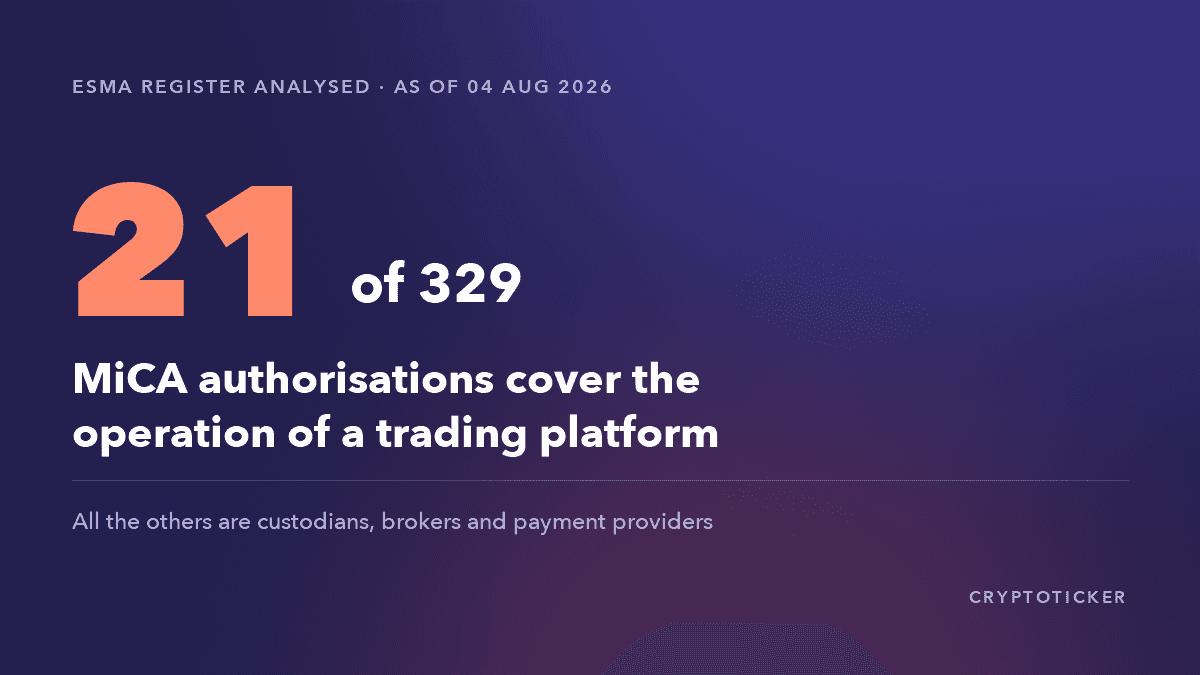
MiCA Register 2026: Only 21 of 329 Licences Are Real Exchanges
ESMA publishes the register of MiCA-authorised providers as an open file. We worked through all of it — and the result is not what the phrase “licensed crypto exchange” suggests.


More from CryptoTicker