
Arkham Intelligence: who does this wallet address really belong to?
The analytics platform attaches names to blockchain addresses and has been paying bounties for unmasking wallets since July 2023. What comes out of it, where the assignment goes wrong, and how you keep your own trail shorter.



Which topics should we dive deeper into?
Select what genuinely interests you. Your picks feed directly into our editorial planning.
Crypto news that's actually worth your time.
Weekly. 60 seconds. Carefully curated by our editors: no hype, no promo flood, no spam.
Arkham Intelligence is an analytics platform that assigns names to blockchain addresses. Enter an address there and you see not only balances and transactions but often a label as well: an exchange, a fund, a project, sometimes an individual. That is exactly what sets the platform apart from an ordinary block explorer, and exactly what makes it useful and uncomfortable for investors at the same time.
Useful, because before a transfer you can look up where an address belongs, and because after a theft the route of the loot can be followed. Uncomfortable, because the same technique points at your own wallet. An assignment is always a claim by the platform and never proof of ownership. This article sets out what the analysis achieves, where its limits lie, and which habits keep your own trail shorter.
Arkham Intelligence explained: the blockchain analysis behind the entity pages
Arkham Intelligence was founded in January 2020 in San Francisco by Miguel Morel. Its early backers include the venture capitalist Tim Draper, the Palantir co-founder Joe Lonsdale and the OpenAI chief Sam Altman. The company describes its product as a tool for analysing blockchain and crypto activity, and says it uses machine learning to determine and catalogue the owners of blockchain addresses.
The core term is entity. An entity is an actor to which the platform attributes several addresses, for instance an exchange with hundreds of deposit addresses. Individual addresses thereby turn into a profile with balances, inflows and outflows. The platform advertises that it translates raw transactions into clear network maps and provides a searchable database of crypto users whose transactions can be filtered.
The large networks are covered. The provider's product page lists Polygon, Arbitrum, Avalanche, Base and BNB Chain among others, alongside Ethereum and Bitcoin. To get started, the address you already have in hand is enough.
From the address to the entity: how the assignment comes about technically
The assignment arises from two ingredients. The first is behaviour on the chain itself, the second is knowledge from outside.
Traces on the chain
Addresses appearing together as senders in one transaction belong with high probability to the same actor; this procedure is called clustering. Added to it are recurring patterns: always the same counterparty, always the same amount, always the same time of day. Each of these points says little on its own. Together they make a profile.
Knowledge from outside
The second ingredient comes from public sources: annual reports, mandatory disclosures, posts on social networks in which someone names an address, and tips from users. Only this linking turns a string of characters into a name.
From that follows a rule of thumb that counts for your own wallet: the blockchain itself never gives away your name. It is given away at the crossings where the chain meets the real world, so at exchanges, with payments to known recipients, and with every public mention of an address of your own. How little a bare list of addresses says about the real spread of a holding is something we showed using the example of correlation in a crypto portfolio.
Intel Exchange since July 2023: bounties in ARKM for unmasking wallets
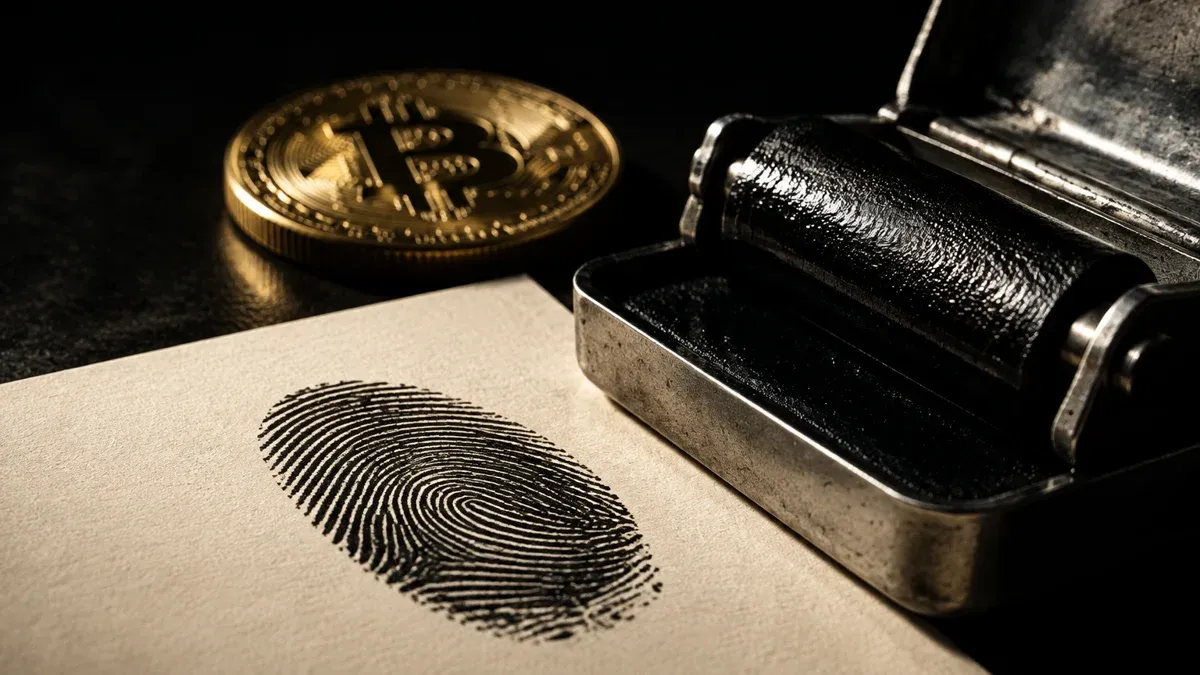
In July 2023 Arkham launched the Intel Exchange, a marketplace for tips. There users post bounties for someone to disclose the identity behind a particular address, or they offer such information themselves. Payment is in ARKM, the platform's token, which was issued in the same month through Binance's launchpad at an issue price of $0.05.
The model was contested from the outset. The business magazine Forbes ran a headline in July 2023 saying the company wanted to de-anonymise the blockchain and that privacy advocates were outraged. The critics' objection can be summed up in one sentence: a market that pays for the unmasking of pseudonyms turns a basic promise of open networks on its head.
The other side points to investigative work. The platform's data played a role in criminal proceedings, among them the case against the FTX founder Sam Bankman-Fried, and helped in describing money laundering patterns. Both readings describe the same capability. Which of them one weights is a judgement and not a question of fact.
 Compare crypto analytics platforms
Network map, entity search and alerts: the platform's tools
Four building blocks make up everyday work on the platform, and for each there is an occasion on which it pays off for you.
The network map
This view draws which addresses are connected with which others, as a mesh of nodes and links. Anyone wanting to know whether a project wallet and a supposed partner address in truth serve the same counterparty sees it here faster than in a transaction list.
The entity search
Instead of an address you enter a name and get the addresses attributed to the entity together with their holdings. For investors that is interesting above all when looking at exchange and project treasuries.
The alerts
You store an address and a condition and get a notification when something moves. The provider describes this function as customisable notifications about activity on the chain, whose history can be displayed alongside price charts.
The explorer
Added to that is an explorer spanning several chains, including checks on individual transaction identifiers. It does not replace the classic block explorer; it supplements it with the layer of names. How to read the raw transaction view, place fees in context and check approvals is set out in our guide to Ethereum gas and Etherscan. Anyone needing several such tools side by side is best off comparing them before the first piece of research.
Tracing stolen coins: the route of the loot across bridges and exchanges
After a theft, analysis is the only tool a victim has left at all. The sequence is the same in almost every case, and it can be read along.
- The first move. The stolen funds leave the victim's wallet for a fresh address that has never appeared before.
- The splitting. The amount is broken into many small parts and spread across numerous addresses, to make clustering harder.
- The chain switch. Via a bridge the funds move to another network, because every switch makes tracing more laborious.
- The exit. At the end there is almost always an exchange or a swap service, because somewhere the loot has to become money. That is exactly where anonymity ends, because this service holds customer data.
For you as a victim that means: the transaction identifier of the first outflow is the most important piece of evidence. With it the route can be drawn, and it belongs in every police report and in every notification to the exchange where the funds land. How such a theft comes about technically, usually through a signed approval rather than through a cracked key, is something we took apart in our piece on wallet drainers and their signatures.
An assignment is a claim, not an extract from the land register: the limits of the analysis
Here lies the most important reservation of the whole subject. A label on an address is the result of an inference, and inferences can be wrong.
Three sources of error are common. First the pooled address: an exchange keeps the holdings of many customers on a few addresses, so the label names the custodian and not the beneficial owner. Second the change of owner: an address may have been passed on, and the label stays attached to the old name. Third the misassignment through clustering, when two actors sign a transaction together.
From that follow two rules for handling such data. First: a label is an indication that bears a second, independent confirmation before anyone turns it into a statement about a person. Second: anyone passing an assignment on publicly, where it is wrong, carries the consequences. In Germany personality rights and defamation are not theoretical quantities, and a screenshot of an analytics platform is not evidence.
Travel Rule since December 30, 2024: what exchanges record about sender and recipient
Blockchain analysis would be considerably weaker if nobody had to collect data at the crossings. That is precisely what has changed in the EU. Regulation (EU) 2023/1113 on information accompanying transfers of funds and certain crypto-assets, the Travel Rule for short, has applied directly in all member states since December 30, 2024, at the same time as the provider regime of the MiCA regulation.
The core in one sentence: providers of crypto-asset services have to collect, store, pass on and make accessible to the authorities on request the details of the originator and the beneficiary on every transfer. Unlike with classic bank transfers there is no de minimis threshold for this; the complete data set is transmitted regardless of the amount. The accompanying guidelines of the European Banking Authority describe how providers are to spot missing details and what then has to happen. The earlier German crypto-asset transfer ordinance lapsed when the EU rule took effect.
In practice that means for you: every withdrawal from an exchange authorised in the EU to an address of your own links that address with your name in the provider's records. That is the law in force and no failing on the exchange's part. Which providers are under this supervision is shown by our comparison of crypto exchanges.
 Compare the best hardware wallets
Separating addresses and not linking names: what to watch with your own trail
Nothing can be done about the analysis itself, but a great deal can be done about your own findability. The following habits cost nothing and take effect immediately.
- One address per purpose. One address for withdrawals from the exchange, one for the long-term holding, one for dealing with applications on the chain. If everything flows over a single address, clustering produces a seamless picture.
- No consolidation. Anyone merging balances from several addresses in one transaction thereby declares publicly that all of them belong to the same actor. That is the most frequent self-inflicted mistake.
- Never name your own address publicly. Not in a profile, not under a post, not in an appeal for donations. A single public mention links the name permanently with everything that has ever happened at that address.
- Do not make amounts recognisable. Always the same round amount at always the same time of day is a pattern a machine spots more easily than a person.
- Know your own situation. Enter your main address into an analytics platform yourself once and see what a stranger could assemble about you. That is the only honest test.
One limit belongs with this: these habits make assignment harder, they do not abolish it. As soon as an amount comes from a supervised exchange or goes to one, the link exists anyway, only in the provider's records instead of on the chain. Anyone not wanting even that cannot avoid self-custody, and that begins with the choice of software wallet.
Arkham as an exchange: what the provider's dual role tells you
One point is rarely stressed in product descriptions: Arkham by now runs a trading platform for crypto-assets of its own alongside the analytics platform. The same company thereby sits at two levers that are normally separate, namely the analysis of market movements and trading in the same assets.
No accusation follows from that. What does follow is a sober appraisal for you as a reader: anyone reading an analysis should know which business model stands behind it. That applies to this platform as to every provider that publishes data and earns from trading at the same time. In case of doubt, check whether a second, independent source reaches the same conclusion before you adopt a statement about the market.
For investors in Germany there is the additional point that a trading platform without authorisation under the MiCA regulation may not offer services here. Before you open an account anywhere, a look at the supervisor's register is part of the duty and not of the extras.
Arkham Intelligence: the key points for your decision
The platform makes visible what is public on open networks anyway, and sets names at the places where the chain and the real world touch. For you it is a tool and a warning at once. Three steps draw the consequence from it.
- Look it up before your next transfer. Enter the destination address into an analytics platform and check whether the label matches what someone has told you. Which tools do that and what they cost is set out in our overview of crypto analytics platforms.
- Shorten your own trail. Separate addresses by purpose, do not merge balances and never name an address of your own publicly. Where your holding sits and which exchange it came through decides more about your visibility than any technical setting; the exchange comparison shows who is supervised in the EU.
- Move the long-term holding out of reach. Anyone holding their own keys has no account whose customer data someone can request. The devices for that are in the hardware wallet comparison.
(As of October 2, 2026. This article is not investment advice. Prices and fee structures change; check the terms with the provider before you buy.)
Frequently asked questions about Arkham Intelligence
Transparency note: This article was produced with the assistance of artificial intelligence and reviewed by our editorial team before publication. All figures and claims were checked against the primary sources linked in the text. The feature image was generated with AI.
Related articles
- Crypto Withdrawals to Your Own Wallet: Why Exchanges Demand Proof of Address Ownership Above €1,000
- Shielded Bitcoin: what the privacy proposal means for your Bitcoin addresses
- BREAKING: Israeli-Linked Hackers Allegedly Wipe Out Nobitex Exchange
- How To Purchase Ethereum On Kraken
- Bakkt Digital Asset Wallet Coming Soon
Which topics should we dive deeper into?
Select what genuinely interests you. Your picks feed directly into our editorial planning.
Crypto news that's actually worth your time.
Weekly. 60 seconds. Carefully curated by our editors: no hype, no promo flood, no spam.

September 4, 2026 10:26 PM
Pocket Bitcoin Data Breach: When Name, Home Address and Bitcoin Address Circulate Together
The Swiss Bitcoin service Pocket Bitcoin closed its investigation on September 3, 2026: 5,411 people affected, and for 291 of them the Bitcoin addresses they used along with copies of identity documents. Why this one data pairing has lasting effect, and what you should check with your own provider.

January 9, 2024 5:59 AM
27 Bitcoins Sent to Satoshi Nakamoto Address – What’s Behind This Cryptic Move?
The transfer of 27 Bitcoins to the wallet associated with Bitcoin's creator, Satoshi Nakamoto, has caught attention.

November 16, 2021 9:39 AM
How to Buy Ethereum on KuCoin? Step by Step Guide
KuCoin is an emerging exchange known for its simple UI and high-end security. Let's show you a step-by-step guide how to buy Ethereum on KuCoin.

June 3, 2021 10:31 PM
Easy Guide: How to Buy Bitcoin on Binance!
This article will be the easiest guide on how to Buy Bitcoin on Binance. But before we go over the step-by-step guide, we need to understand some basics.

January 20, 2020 7:34 PM
What Is a Bitcoin Mixer and How Does It Work? The Legal Status in 2026
A Bitcoin mixer pools coins from many users to break the visible link between sender and receiver. How the technique works, why people use it, and where courts and lawmakers in the US and the EU stand in 2026.
November 8, 2018 11:23 AM
The Three Easiest Ways To Buy Bitcoin
Buying Bitcoin can be simple and smooth. Users should always remember that they should never expect to make a million dollars overnight.
May 15, 2024 12:04 PM

Crypto Scams: How to Protect Your Cryptos?
With the rise of crypto scams, and while international efforts are still working to combat these threats and protect investors, some recent tactics have been identified, and here is your full guide.
August 11, 2026 9:18 AM

Your Crypto Exchange Is Telling You to Withdraw: How to Spot Phishing After the MiCA Deadline
Unauthorised crypto providers now have to tell their EU customers to withdraw, which leaves fraudsters an easy run with faked requests. Here is how to check in two minutes whether the message is genuine.
July 2, 2026 8:59 PM
Binance Is Out of the EU: How to Move to a MiCA-Regulated Exchange
Binance has left the EU market. Which exchanges hold a MiCA licence, how to verify an authorisation is real, and how to move your holdings across step by step.
September 8, 2026 7:33 AM
Withdrawal Whitelist at the Crypto Exchange: How to Lock the Withdrawal Path Against Foreign Addresses
A withdrawal whitelist lets balances leave only to addresses approved in advance, and it works even when password and second factor are compromised. On September 8, 2026 we checked which of thirteen providers document the function publicly.
September 16, 2026 1:28 PM
Crypto Withdrawal to Your Own Wallet: Ten Providers Checked, Three Will Not Let Your Coins Out
Seven of ten providers available in Germany offer a payout to a wallet address you control yourself; three do not. Our survey of September 16, 2026, shows how to spot the difference before you buy, and why the question matters right now.
April 25, 2024 11:44 AM
Beware of New Ethereum Node Scam: USDT Fraud Exposed
Crypto Scammers exploit Ethereum nodes and USDT to deceive crypto users. How are they pulling it off and what essential tips can help you protect yourself against these crypto scams?
August 23, 2026 1:16 PM
Address Poisoning: Why Seven of Forty Characters Were Enough to Divert $2 Million
A fake wallet address matched the real one in just seven of forty characters and still intercepted 2 million USDC. Our own count of the affected wallet shows that a third of all counterparties in its history belong to such look-alikes.
September 20, 2026 4:15 PM
Crypto Phishing After a Data Breach: The Warning Signs in a Fake Exchange Email
After every major data breach, the number of phishing emails sent in the name of crypto exchanges and wallet manufacturers rises. This article shows you how to recognise such a message, which data a reputable provider never requests by email, and what to do in the first hour after a click.
September 1, 2026 7:27 AM
Clipboard Attack: How Malware Swaps the Wallet Address You Copied
A clipper replaces the receiving address between copying and pasting with the attacker’s, and your wallet’s checksum notices nothing. What Microsoft and the Federal Office for Cybersecurity have documented, and which check really makes the attack come to nothing.
August 31, 2026 10:12 AM
Fake AML Checks for Crypto Wallets: How to Spot the Scam Sites
Fraudulent websites pose as money-laundering screening services for crypto addresses and ask you to connect your wallet. A genuine check needs only the public address, and three of the domains named by Malwarebytes still respond twelve days later.
June 7, 2026 11:00 AM

How to Buy Bitcoin with No KYC in 2026: 3 Ways to Do It
Protect your data and maintain privacy. Here are the three most secure ways to buy Bitcoin without identity verification (KYC) in 2026.
December 31, 2023 8:11 AM
Ultimate Guide To Rainbow Wallet Airdrop
Rainbow has unveiled its Rainbow Points rewards initiative. This article is all about the simple guide on Rainbow wallet airdrop
March 3, 2021 7:07 PM
Breaking News – LiteBit exchange was HACKED, here’s what you Need to Know
In an email sent to its users, LiteBit announced that they were hacked. Repercussions were not very harsh, and the company reassured its users.
December 22, 2020 3:49 PM

Crypto Wallet Provider Ledger Hacked: Data Leak Results in Phishing Scams
Ledger, a cryptocurrency wallet provider has encountered a data breach. The official Twitter account of the hardware wallet tweeted that they have been alerted to the dump of a client database.
September 23, 2026 10:32 AM
Switching crypto exchange: what happens to the holding period and the tax when you transfer
A transfer to another exchange or to your own wallet triggers no tax and does not reset the one-year period. What does get lost is the acquisition data, and that is exactly what you need later as evidence.
September 26, 2026 4:21 AM
Operation Herakles disconnects 13,888 phone numbers: what to check on crypto investment calls
Six authorities have disconnected 13,888 phone numbers used by investment fraudsters to call their victims in Operation Herakles, 9,304 of them in the past three months alone. What the Federal Network Agency now requires of telecoms providers and which three checks protect you from the scheme.

September 28, 2023 5:36 AM
Kraken’s Growth in Europe
Explore Kraken's latest strides in Europe as they secure crucial licenses in Ireland and Spain. Dive into the implications for EU crypto enthusiasts and Kraken's strategic vision for the future.
March 12, 2020 1:12 PM

What Is A Cold Wallet? And Why Is It Important?
A cold wallet is a wallet which is completely offline and used for storing cryptocurrencies. It is also known as cold storage.
October 19, 2026 1:32 AM
Crypto audits after $1.18 billion in losses: “The problem is always scope”
Hacken counts losses of $1.18 billion across 107 incidents for the third quarter of 2026. 77 percent of that fell on components that were not examined at all in the last audit.
October 5, 2026 1:29 AM

Chainalysis attributes $387 million from the Bitget hack to North Korea: what matters now for investors in Germany
The analytics firm Chainalysis attributes the theft of around $387 million at Bitget to actors with ties to the DPRK and puts the annual total above one billion dollars. What that means for custody, choice of exchange and record-keeping in Germany.
September 22, 2026 4:33 PM

Three of the 25 Largest Coins Have No Euro Pair: How to Check Your Buying Route Before the Order
Our own survey of five trading venues active in the EU, taken on September 22, 2026, shows that three of the 25 largest cryptocurrencies have no euro pair there at all, and four more only one. What that means for your next order and what the detours cost.
More from CryptoTicker