
Why Crypto Prices Were Down on 8 January 2026: The Top Reasons, and What Came Next
On 8 January 2026 Bitcoin slipped toward $90,000 on liquidations, regulatory uncertainty and macro caution. The risks named then shaped the whole year: BTC hit about $58,600 in July.





Which topics should we dive deeper into?
Select what genuinely interests you. Your picks feed directly into our editorial planning.
Crypto news that's actually worth your time.
Weekly. 60 seconds. Carefully curated by our editors: no hype, no promo flood, no spam.
Update 26 September 2026: The pullback of 8 January was the prelude, not the end. According to CoinGecko daily data, Bitcoin recovered to about $96,900 by 15 January, then fell to its 2026 low of about $58,600 on 1 July. On 26 September 2026 it trades at about $84,200. The three risks named below all played out. The January report follows as a dated snapshot.
Our comparison of regulated crypto exchanges shows which platforms hold a licence.
What became of the risks named on 8 January?
| Risk in January | Outcome by 26 September 2026 |
|---|---|
| Regulatory uncertainty in the Senate | the Senate Agriculture Committee advanced its part on 29 January; the combined Clarity Act failed a procedural vote on 15 September |
| Supreme Court ruling on tariffs | ruling on 20 February: IEEPA does not allow the tariffs |
| Macro caution, jobs data, rates | no rate cut in 2026; the Fed raised its target range to 3.75% to 4% on 16 September |
| Bitcoin back toward $90,000 | 2026 low of about $58,600 on 1 July, about $84,200 now |
What the failed Clarity Act means for investors is explained in Clarity Act fails: which rules apply now, the court decision in our analysis of the tariff ruling. Current levels are in our Bitcoin price prediction.
The report from 8 January 2026
Crypto Market Faces Pressure from Multiple Fronts
After a strong weekly rally, the crypto market faced renewed selling pressure over the past 24 hours. Bitcoin led the move lower as several overlapping factors weighed on sentiment, including large liquidations, regulatory uncertainty in the US, institutional developments, and growing macroeconomic caution.
Rather than a single catalyst, the pullback reflects a stacking of risks that pushed traders into a more defensive stance.
Bitcoin Rejected at Resistance Triggers Liquidations
$Bitcoin failed to break above the $94,500 resistance zone, a level closely watched by traders. The rejection sparked aggressive selling, which quickly escalated into forced liquidations across leveraged positions.
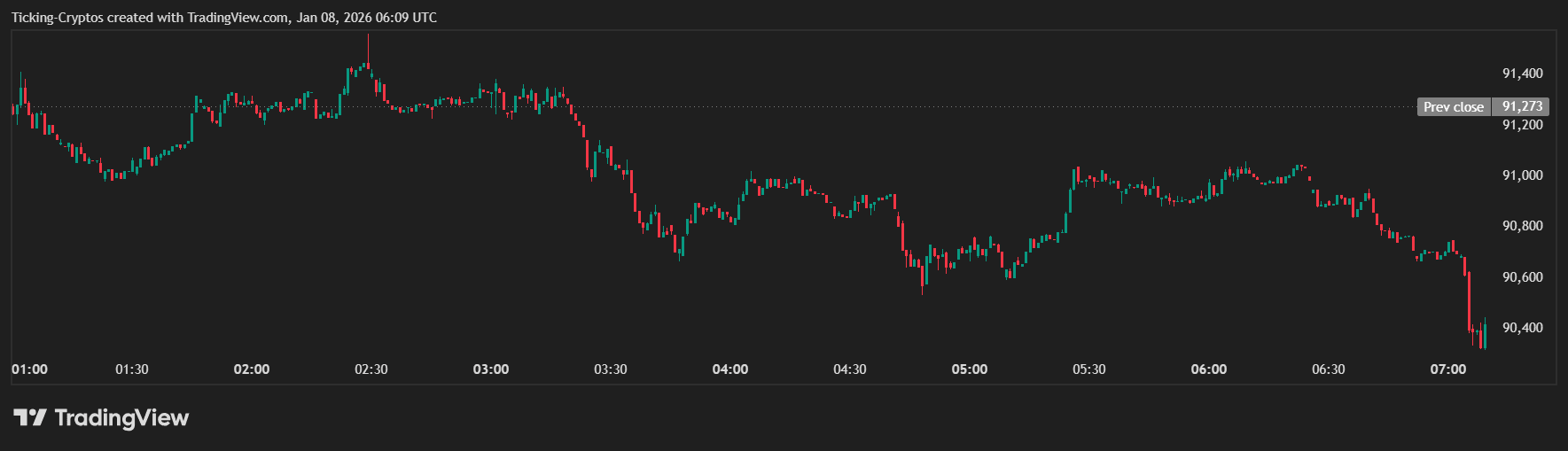
Bitcoin price in USD over the past 24 hours - TradingView
As stop-losses and margin calls were triggered, downside momentum accelerated, dragging Bitcoin back toward the $90,000 area and amplifying losses across altcoins.
This technical rejection and liquidation cascade played a major role in the sharp short-term correction.
Regulatory Uncertainty Returns to the Spotlight
Adding pressure to the market, renewed attention turned toward US regulatory developments, with reports that the Senate Agriculture Committee is preparing to advance crypto-related oversight discussions following recent banking panel activity.
While no immediate decisions were announced, the prospect of tighter regulation or expanded oversight introduced uncertainty, often enough to prompt traders to reduce exposure in the short term.
Regulatory risk remains one of the most sensitive variables for crypto pricing, especially during periods of elevated leverage.
JPMorgan Stablecoin News Fuels Sector Rotation
On the institutional side, JPMorgan announced plans to issue its own stablecoin directly on a privacy-focused blockchain network. While the news highlights continued institutional adoption of blockchain technology, it also triggered capital rotation within the crypto market.
Such announcements often lead traders to reposition across sectors, temporarily increasing volatility as liquidity shifts between assets rather than expanding the overall market.
Macro Events Push Traders Into Risk-Off Mode
Broader macroeconomic uncertainty also contributed to the pullback. Traders are closely watching upcoming US jobs data and a potential Supreme Court ruling on global tariffs, both of which could influence inflation expectations, interest rate outlooks, and risk appetite.
As a result, some investors opted to reduce exposure to high-volatility assets like crypto until greater clarity emerges on the macro front.
 Regulated Crypto Exchanges Compared
Transparency note: This article was produced with the assistance of artificial intelligence and reviewed by our editorial team before publication. All figures and claims were checked against the primary sources linked in the text. The feature image was generated with AI.
Related articles
- After Bitcoin Crash, Will Altcoins Gains Reach 500%?
- Crypto Ignores Bullish News as War Risk Takes Over — Why Bitcoin and Ethereum Are Falling Anyway
- Crypto Markets Turn Cold as U.S. Freezes Hit — Is This a Chill or a Reset?
- Bitcoin Price Crashes Below $66,000 as Liquidations Pass $50M
- Russia Bans Oil Export: Are Crypto Prices Affected?
Which topics should we dive deeper into?
Select what genuinely interests you. Your picks feed directly into our editorial planning.
Crypto news that's actually worth your time.
Weekly. 60 seconds. Carefully curated by our editors: no hype, no promo flood, no spam.

November 5, 2025 1:16 PM

$1 Trillion Wiped: Risk-Off Storm Engulfs Stocks & Crypto
Global markets plunge as tech stocks and crypto crash, wiping over $1 trillion in value amid AI bubble fears and investor risk-off panic.
April 2, 2026 8:04 PM

Crypto Is Ignoring Bullish News — Why Bitcoin and Altcoins Are Still Falling
Crypto is falling despite bullish macro news, IMF adoption signals, and market rallies. Why is Bitcoin ignoring good news?
March 31, 2026 7:57 PM

What Threat Could Crash the Crypto Market? War-End Rally Faces Hidden Risk
Crypto markets surge on war-end hopes, but threats to US companies and rising oil prices could trigger a sudden crash.
April 6, 2026 11:23 AM

Bitcoin Breaks $70K as War Headlines Clash — What Happens Next?
Bitcoin breaks $70K on ceasefire hopes, but war risks remain. Will BTC rally continue or reverse as oil and inflation pressures return?
January 24, 2026 9:42 AM
Bitcoin Briefly Reclaims $91K as Markets Digest Regulatory, Macro, and Institutional Signals
Bitcoin briefly reclaimed $91,000 before pulling back as markets digest US regulation signals, dollar weakness, ETF expansion, and institutional activity.
July 1, 2024 9:20 AM

Bitcoin News Today: Why Is Bitcoin Price Up Starting July?
Starting July, recent market movements, political debates, and court rulings are shaping the future of Bitcoin and the broader crypto market. Here are the latest insights and analysis...
May 28, 2026 10:40 AM

Crypto Crash Reason: Why Are Crypto Prices Down Today?
The crypto market faces a sharp correction as geopolitical tensions near the Strait of Hormuz trigger a massive leverage unwind and record Bitcoin ETF outflows.
March 27, 2026 9:48 PM

$900 Billion Surge — But Markets May Be Pricing a Peace That Doesn’t Exist
$900B added to US stocks as Bitcoin surges and oil crashes after Trump’s Iran statement—but is the market pricing a false peace?

February 28, 2026 2:54 PM

5 Cryptos That Lost the Most during the Iran War
Rising Middle East tensions rattle markets as five major cryptos post double-digit 24h losses amid global risk-off sentiment.
September 13, 2024 12:23 PM

Ripple, SEC, and Grayscale: The Ripple Effect on XRP Price
This is how Ripple’s legal battles and Grayscale’s XRP Trust launch are shaping the future of XRP and the crypto market...
September 29, 2026 10:38 AM
Bitcoin Falls Toward $83,000 as Trump Rejects Iran Ceasefire Deal
Bitcoin slipped toward $83,000 after Trump rejected Iran's Hormuz proposal, sending oil above $100 and wiping out $478 million in crypto liquidations.
January 14, 2026 2:47 PM

Crypto Markets on Edge on 14 January 2026: US PPI Surprise Ahead of the Tariff Ruling
Hot US producer prices and a pending Supreme Court tariff ruling kept crypto on edge on 14 January 2026. The ruling came on 20 February, and the Fed later raised rates.
November 11, 2025 10:25 AM

US Government Reopens After 41 Days – What It Means for Bitcoin, Crypto, and Global Markets
The US government reopens after a record 41-day shutdown. Rate cuts, QT ending, and new crypto laws could reshape markets—here’s what investors must know.
January 12, 2026 12:25 PM

Is This Crypto Cycle Like 2021? The January 2026 Analysis in Hindsight
In January 2026 much spoke against a repeat of 2021. It turned out harsher: Bitcoin lost more than half of its value from the cycle high near $124,700 by July 2026.
April 8, 2026 8:53 AM

Bitcoin Price Hits $71,000 as Trump Announces Two-Week Ceasefire
Bitcoin price surged past $71,000 following President Trump’s announcement of a two-week ceasefire with Iran, sparking a major relief rally across global markets.
January 18, 2026 9:54 AM

Jim Cramer's Bearish Call of 18 January 2026: Dump or Inverse Cramer Effect? What Happened
On 18 January 2026 Jim Cramer warned of a bad market open, and crypto traders bet on the inverse Cramer effect. This time the warning held: Bitcoin fell about 7% in three days.
June 24, 2024 8:16 PM

Bitcoin News Today: Bitcoin CRASH OVER or MORE Down To Go?
Bitcoin Price Crash below 60k, and the crypto market follows. Why this decline and how low can it go?
January 30, 2026 7:20 PM

Copper Price Slides as Gold and Silver Crash — What It Signals for Crypto and Markets
Copper prices are sliding as gold and silver suffer a historic selloff. What copper’s weakness reveals about growth, rates, and crypto.
May 2, 2026 7:00 PM

Crypto Regulation News: Stablecoin Yield Rules Could Trigger the Next Bitcoin Move
New US stablecoin yield rules could reshape crypto regulation, stablecoin adoption, and Bitcoin’s next major market move.
June 5, 2024 5:03 PM

Crypto Market Up: Bitcoin Breaches $71K, Altcoins Follow Suit, Eyes on New Highs
Cryptocurrencies are experiencing a surge, with Bitcoin leading the charge by surpassing $71,000. This bullish trend extends to altcoins, igniting optimism across the market. Will Bitcoin reach new highs?
October 21, 2025 4:17 PM

Bitcoin Surges Past $112,000 as the Fed Opens Doors to Crypto: What’s Next?
Bitcoin jumps above $112,000 after the U.S. Federal Reserve hinted at granting crypto firms access to its payment network. Here’s what this means for BTC and the broader market.
January 5, 2026 8:39 AM

Crypto News Today: Bitcoin, Ethereum, and XRP Extend Gains for a Fifth Day
The crypto market remains in positive territory today, with Bitcoin holding above $92,000 and most top cryptocurrencies posting gains over the past 24 hours.
March 16, 2026 4:13 PM

Trump Speech Today as Oil Drops and Stocks Surge — Will Bitcoin Be the Next Market Mover?
Oil falls and U.S. stocks surge ahead of President Trump’s speech on the Strait of Hormuz. Could Bitcoin become the next market mover?
April 17, 2026 9:21 AM

Bitcoin News Today: BTC Coin Hits $75,000 as US Treasury Injects $15B Liquidity
Bitcoin price breaks $75,000 for the first time in 73 days. Read why the massive US Treasury buyback and BlackRock inflows are fueling this historic BTC rally.
August 17, 2026 11:36 AM

Crypto News Today: White House Crypto Summit Collides With Collapsing CLARITY Act Odds
Crypto news today: Trump's White House crypto summit, CLARITY Act odds crashing to 10 percent and 390 million dollars in Bitcoin ETF outflows.


More from CryptoTicker