
Bitcoin Hit $90,000 on 3 January 2026 Amid Venezuela Tensions: What Happened Next
On 3 January 2026 the US struck Venezuela and captured Nicolás Maduro. Bitcoin briefly dipped below $90,000 and recovered. Here is what followed.





Which topics should we dive deeper into?
Select what genuinely interests you. Your picks feed directly into our editorial planning.
Crypto news that's actually worth your time.
Weekly. 60 seconds. Carefully curated by our editors: no hype, no promo flood, no spam.
Update 26 September 2026: The tensions described below turned into a military intervention the same day: on 3 January 2026 the US struck Venezuela and captured President Nicolás Maduro, who was flown to New York and indicted in federal court. Bitcoin lost $90,000 only briefly. According to CoinGecko daily data, it peaked at about $96,900 on 15 January, then fell to its 2026 low of about $58,600 on 1 July; it trades at about $84,200 on 26 September 2026. The January report follows as a dated snapshot.
If you want to buy Bitcoin today, our comparison of Bitcoin providers shows where and at what cost.
What happened after 3 January?
| Date | Bitcoin (CoinGecko, daily) |
|---|---|
| 3 January 2026 | brief dip below $90,000, then back above |
| 15 January 2026 (2026 high) | about $96,900 |
| 1 July 2026 (2026 low) | about $58,600 |
| 26 September 2026 | about $84,200 |
The slide in late January came from another front: US tariff threats against European countries over Greenland, covered in our report on the crypto crash of 20 January. How the year started is covered in crypto prices at the start of 2026, and current levels are in our Bitcoin price prediction.
The report from 3 January 2026
The crypto market continues to move higher, with $Bitcoin reaching the $90,000 level and pushing total crypto market capitalization upward. The broader market tone remains risk-on, supported by strong momentum and renewed capital inflows with the new year.
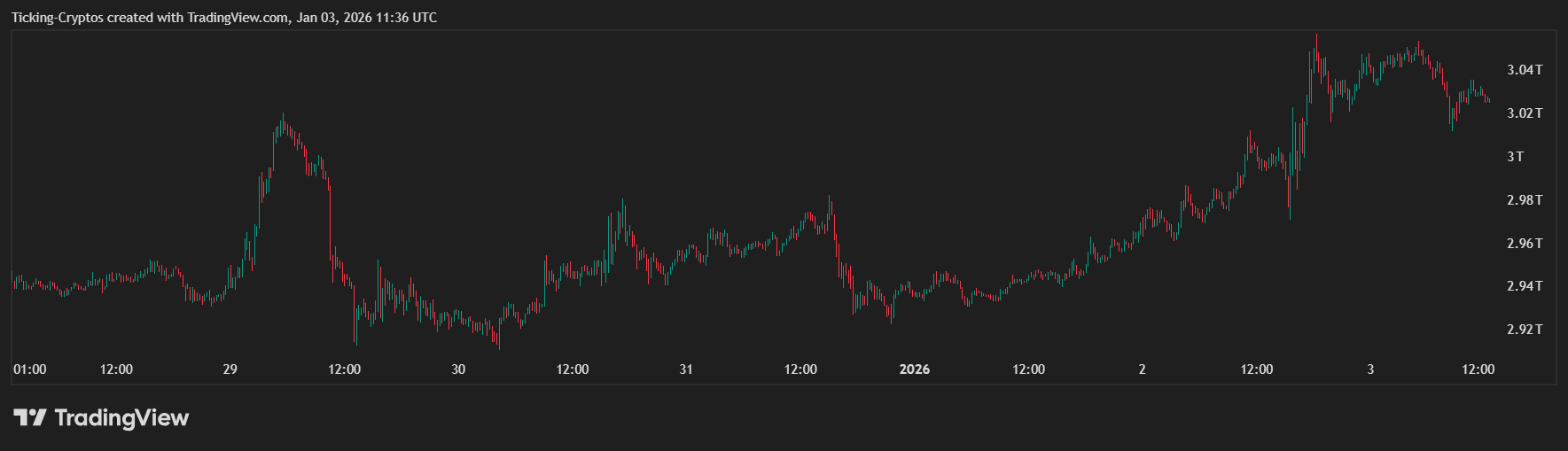
Crypto market cap in USD over the past week - TradingView
At the same time, geopolitical developments are adding another layer of uncertainty to global markets.
Venezuela War Adds a Geopolitical Catalyst
According to statements from Donald Trump, the United States has captured Nicolás Maduro and his wife and launched what were described as large-scale strikes against Venezuela. If tensions continue or escalate further, markets could increasingly price in geopolitical risk.
Historically, periods of conflict and capital controls have pushed individuals and businesses toward alternative financial systems. In such environments, cryptocurrencies are often viewed as a hedge against instability, currency restrictions, and disrupted banking access.
How Markets Could React Next
If the situation in Venezuela worsens:
- Crypto demand could increase, particularly in regions facing currency or banking stress
- Bitcoin may benefit as a neutral, borderless asset, especially during heightened uncertainty
- Volatility is likely to rise, with fast reactions across risk assets
Combined with already strong momentum, geopolitical stress could act as an additional short-term tailwind for crypto prices.
 Buy Bitcoin: Providers Compared
Transparency note: This article was produced with the assistance of artificial intelligence and reviewed by our editorial team before publication. All figures and claims were checked against the primary sources linked in the text. The feature image was generated with AI.
More on Bitcoin: All Bitcoin news at a glance
Related articles
- EU–US Economic Conflict Sparks Sharp Crypto Market Sell-Off
- War in the Middle East: Stock Market Bleeds $2.4 Trillion While Crypto Gains Ground
- Crypto Prices on Edge as Iran Claims Strait of Hormuz Closure — Again
- $900 Billion Surge — But Markets May Be Pricing a Peace That Doesn’t Exist
- Why Is Crypto Holding Steady as US-Iran Strikes Escalate?
Which topics should we dive deeper into?
Select what genuinely interests you. Your picks feed directly into our editorial planning.
Crypto news that's actually worth your time.
Weekly. 60 seconds. Carefully curated by our editors: no hype, no promo flood, no spam.

June 8, 2026 10:12 AM

Why Bitcoin Lagged the Nasdaq Since the US-Iran Conflict Began
Since the US-Iran war began, Bitcoin is down 3% while the Nasdaq rallied 20%, exposing a massive rift between crypto and equities.

July 17, 2026 3:24 PM

$1 Trillion Wiped From US Stocks at Open as Iran Strikes US Bases — Is Crypto Next?
US equities shed ~$1T at the open as Iran hits US bases across the Gulf. Oil is surging, Bitcoin already slipped — here's what it means for crypto.
March 4, 2026 4:57 PM
Bitcoin Breaks $73K as Global Markets Shake: Is Crypto Becoming the World’s Crisis Hedge?
Bitcoin breaks $73K while global markets drop amid geopolitical tensions. Is crypto emerging as the world's crisis hedge during global instability?
February 25, 2026 3:25 PM

Will Crypto Prices Rise if the USA Attacks Iran? A Historical Analysis
Analyzing Bitcoin and crypto price reactions to USA-Iran tensions. Will BTC rise as a hedge or fall during geopolitical conflict?
September 9, 2026 10:21 AM

Bitcoin Price Frozen Near $79,000 as Oil and War Risk Rewrite the Macro Playbook
Bitcoin price is consolidating near $79,000 while crude oil surges, Hormuz tensions escalate and a Fed rate hike moves into play. Here is what matters.
March 29, 2026 7:02 PM

Is This the First Real Global Liquidity Crisis of the Crypto Era?
War, oil shocks, and tightening liquidity are hitting crypto markets. Is this the first real global liquidity crisis of the crypto era?
January 19, 2026 3:18 PM

Crypto Markets Slid on 19 January 2026 as Trump Tariff Fears Triggered Panic Selling
On 19 January 2026 about $100 billion left the crypto market within hours as Trump's tariff threats against the EU sparked panic. The tariffs were withdrawn two days later, the slide went on.
November 5, 2025 1:16 PM

$1 Trillion Wiped: Risk-Off Storm Engulfs Stocks & Crypto
Global markets plunge as tech stocks and crypto crash, wiping over $1 trillion in value amid AI bubble fears and investor risk-off panic.
March 21, 2026 7:32 PM

Why Bitcoin Is Ignoring the Iran War — Markets Are Sending a Strange Signal
Bitcoin holds steady despite Iran war tensions and rising oil prices. Why is crypto ignoring geopolitical risk?
March 15, 2026 4:39 PM

Why Bitcoin Is Ignoring the Iran War?
Bitcoin holds near $70K despite rising tensions between Iran, the US, and Israel. Why is crypto showing resilience during geopolitical instability?
March 31, 2026 7:57 PM

What Threat Could Crash the Crypto Market? War-End Rally Faces Hidden Risk
Crypto markets surge on war-end hopes, but threats to US companies and rising oil prices could trigger a sudden crash.
March 25, 2026 4:24 PM

Markets Are Pricing Peace — But Crypto Is Sending a Different Signal
Bitcoin holds $70K as markets rally on Iran ceasefire hopes, but weak altcoins signal caution. Is crypto doubting the peace narrative?
March 6, 2026 5:36 PM

Is a Global Liquidity Shock Starting? Oil Surge, War Tensions, and Bitcoin Volatility Explained
Oil surges above $90 as geopolitical tensions rise. Are global markets entering a liquidity shock that could drive volatility in Bitcoin and crypto?
January 23, 2026 1:00 PM

Gold Hits New All-Time Highs as Crypto Struggles — Is Capital Bracing for a Global Shock?
Gold and silver hit new all-time highs as crypto struggles to hold support. Is rising geopolitical risk pushing markets into defensive mode?
July 27, 2024 2:34 PM

Why Is The Crypto Market Up TODAY?
With the Bitcoin 2024 Conference taking place now in Nashville, the crypto market is showing bullish signals, intriguing traders around the future of Bitcoin and Altcoins.
March 26, 2026 1:23 PM
Crypto Ignores Bullish News as War Risk Takes Over — Why Bitcoin and Ethereum Are Falling Anyway
Bitcoin and Ethereum fall despite bullish crypto news as war risks, oil spikes, and macro pressure dominate market sentiment.
July 8, 2026 6:22 PM
Why Is Crypto Crashing Today: US Strikes on Iran and a Collapsing Ceasefire
Fresh US airstrikes on Iran and a ceasefire declared "over" sent crypto into the red today. Here's why Bitcoin, Ethereum and altcoins are bleeding.
January 23, 2026 6:32 PM

Silver Leads, Gold Nears $5K, Crypto Reacts: The Cross-Asset Signal Markets Are Missing
Silver Leads, Gold Nears $5K, Crypto Reacts: The Cross-Asset Signal Markets Are Missing
June 24, 2024 8:16 PM

Bitcoin News Today: Bitcoin CRASH OVER or MORE Down To Go?
Bitcoin Price Crash below 60k, and the crypto market follows. Why this decline and how low can it go?
August 15, 2026 2:02 PM

Crypto Prices Today: Oil Prices Cap the Bitcoin Rally as Chainlink Slips
Bitcoin trades near $78,600 and the crypto market cap is back above $2.68 trillion, but oil near $100 a barrel is keeping a lid on the September move.
June 30, 2026 5:20 PM

Stablecoin War Begins: Visa, Mastercard and Coinbase Launch Open USD as Bitcoin Crashes
Open USD launches with Visa, Mastercard and Coinbase as Bitcoin falls below $59K. Is this the real crypto story now?
May 23, 2026 2:50 PM

Rising US and Israel Tensions with Iran Signal Potential Conflict Escalation and Crypto Volatility
Severe friction in the US-Iran ceasefire talks and ongoing Strait of Hormuz maritime standoffs raise warning signs of a renewed military escalation.
January 30, 2026 7:20 PM

Copper Price Slides as Gold and Silver Crash — What It Signals for Crypto and Markets
Copper prices are sliding as gold and silver suffer a historic selloff. What copper’s weakness reveals about growth, rates, and crypto.
November 6, 2025 8:00 PM

Why Is the Crypto Market Flat Today? November 6, 2025
Crypto prices remain steady as Bitcoin holds above $101K and Ethereum slips below $3.4K. Whales keep buying ETH while ETF outflows weigh on BTC.
June 5, 2024 5:03 PM

Crypto Market Up: Bitcoin Breaches $71K, Altcoins Follow Suit, Eyes on New Highs
Cryptocurrencies are experiencing a surge, with Bitcoin leading the charge by surpassing $71,000. This bullish trend extends to altcoins, igniting optimism across the market. Will Bitcoin reach new highs?

More from CryptoTicker