
Solana Is Outperforming Bitcoin: What the SOL/BTC Breakout Actually Shows
SOL just cleared $109 as Solana's first governance vote closed. The outperformance is real, but the reason matters more than the ratio.




Which topics should we dive deeper into?
Select what genuinely interests you. Your picks feed directly into our editorial planning.
Crypto news that's actually worth your time.
Weekly. 60 seconds. Carefully curated by our editors: no hype, no promo flood, no spam.
Solana traded at $109.41 on 27 August, its highest level of the year. Bitcoin was hovering just below $80,000 at the same time. For the first sustained stretch in months, the larger asset is not setting the pace. The timing is not a coincidence. Solana's first formal on-chain governance vote closed at roughly 15:30 UTC on 27 August, at the end of epoch 1023. SOL cleared $109 within about two hours of that deadline, taking out the $102.70 level that had rejected it a day earlier.
How far has Solana actually run?
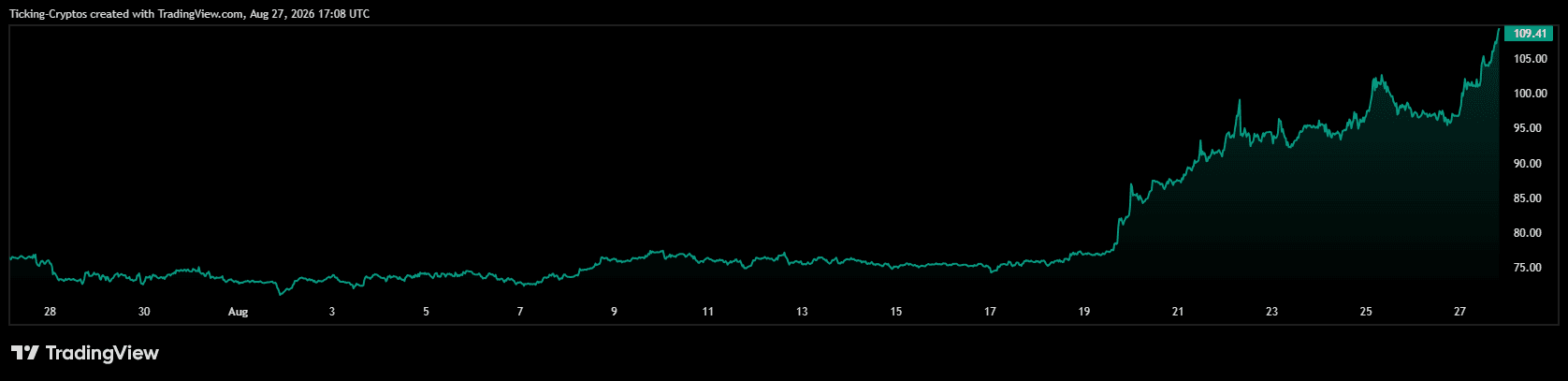
$SOL has gained roughly 46% since mid-August, rising from near $75 to above $109.
The move has three distinct phases visible on the chart. Through late July and the first half of August, SOL held a tight range around $75, drifting slightly lower into the 7 August low. From 9 to 18 August it ground upward to about $78, still without much conviction. Then on 19 August the character of the move changed completely: an almost vertical leg carried SOL from the high $70s into the $90s within days.
That third phase is what most traders are reacting to. The 7-day gain sat at 31.87% as of 25 August, with a 30-day move near 35.6%. Both figures are now higher after today's push.
It is worth being precise about what got broken. SOL briefly touched $102.88 on 26 August and was immediately rejected, falling back to the mid-$90s while leveraged longs took $17.51 million in liquidations in a single day. Resistance around $102.70 marked a 13-week high. Today's move through $109 is the second attempt at that level, and this time it held.
Is Solana really outperforming Bitcoin?
Yes, on both the weekly and monthly view, though the gap is narrower than it feels.
Over the seven days to 25 August, Solana rose about 27% against Bitcoin's 23%. On 26 August, SOL gained 1.5% while $Bitcoin lost 0.2% and slipped back below $79,000. Today's move widens that spread further.
The nuance worth holding onto is that this is not capital leaving Bitcoin for Solana. On 24 August, US-listed Bitcoin, Ether, Solana and Hyperliquid products drew nearly $192.6 million in combined demand. Bitcoin ETFs alone took $208.9 million that day, following roughly $1.6 billion the previous week. Both assets are absorbing inflows at the same time.
That distinction matters for how you read the ratio. A genuine rotation means money moving out of one asset and into another. What is happening here looks more like fresh capital arriving across the board, with Solana capturing a disproportionate share of it relative to its size. The outperformance is real. The rotation framing is not, at least not yet.
What did the governance vote actually decide?
Three proposals went to a stake-weighted vote between 22 and 27 August, two of which would tighten SOL supply meaningfully.
This is the substance behind the price move, and it is the part most of the commentary is skipping.
- SGP-0001, the Solana Constitution. Ratifies a canonical governance framework and activates Solana's on-chain governance system, svmgov.
- SGP-0002, faster disinflation. Doubles the annual disinflation rate from 15% to 30%. Under SIMD-0550, this would cut future issuance by roughly 18.9 million SOL over six years, worth around $1.7 billion at current prices.
- SGP-0003, fee restructuring. SIMD-0553 proposes a fixed inclusion fee of 2,500 lamports per transaction, with a resource component scaling to computational demand and burned rather than paid out. This could lift daily burns from roughly 648 SOL toward 9,000, close to a fourteenfold increase.
Two caveats deserve more weight than they are getting. First, an approving vote only green-lights development. Technical implementation, testing and on-chain activation all follow separately through the SIMD process, so nothing changes about SOL's supply the moment the vote closes. Second, Solana Company, listed on Nasdaq as HSDT, backed the constitution but voted against both the faster disinflation and the fee changes. When a major stakeholder splits its vote that way, the supply-shock narrative is less unanimous than the price action suggests.
 Compare the top crypto exchanges
 Store your SOL on a hardware wallet
Do the three technical claims hold up?
Partly, and one of them cuts both ways.
Three claims are circulating alongside this move: that SOL/BTC hit a seven-month high, that RSI broke out of a five-year downtrend, and that SOL bounced from support held since 2021. All three come from chart reading rather than reported data, so treat them as one analyst's interpretation rather than established fact.
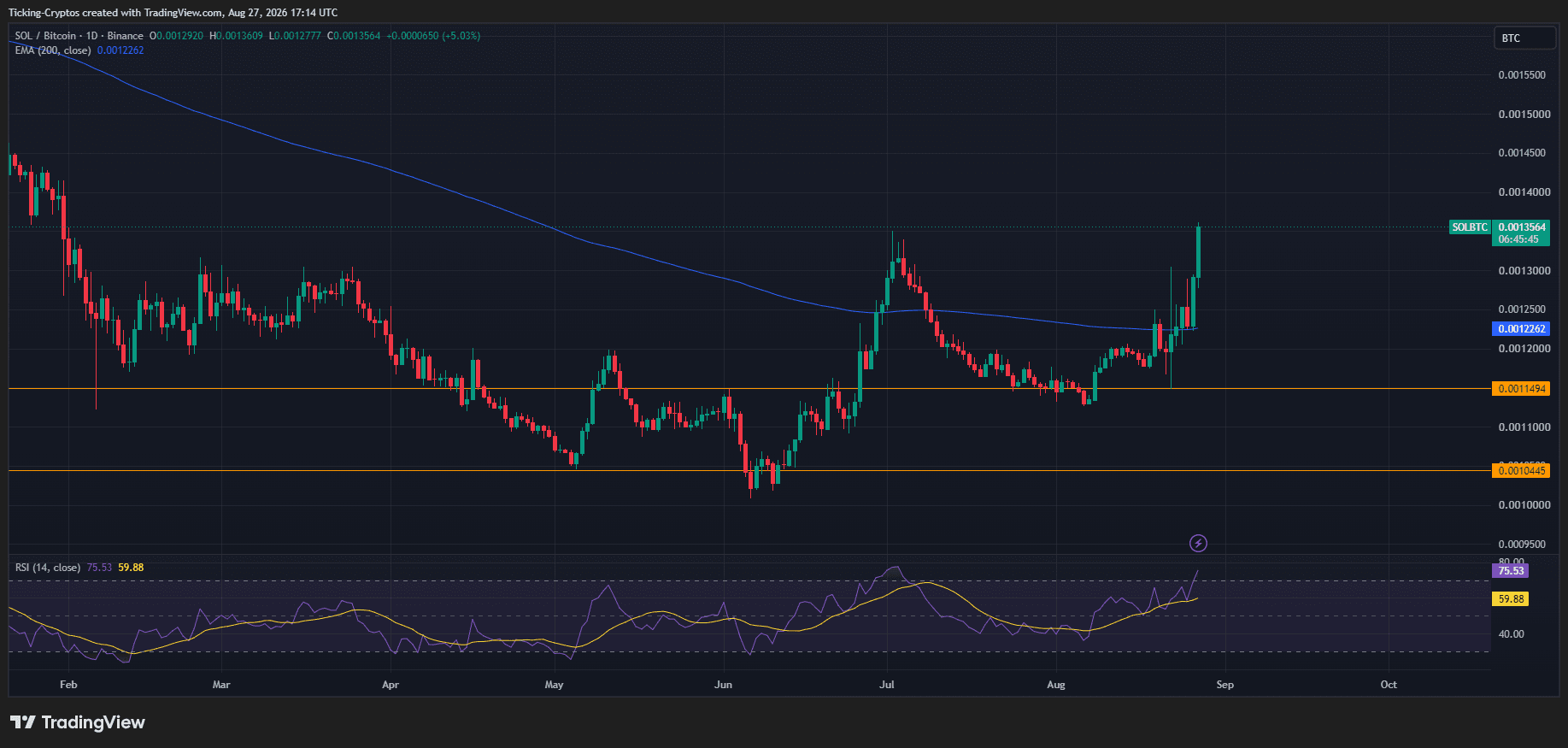
The SOL/BTC observation is directionally consistent with the price data. At $109.41 against Bitcoin near $79,000, the ratio sits around 0.00138, and SOL last traded above $100 in February 2026. Whether that constitutes a clean seven-month high depends on where you measure Bitcoin, and we have not independently verified the exact reading.
The support claim rests on a trendline drawn from 2021. SOL/BTC has been in a broad downtrend since mid-2021, so a bounce from a level with that much history would be meaningful if it holds. It also cannot be confirmed from reported data, and trendlines drawn across five years are unusually sensitive to where you place them.
The RSI claim is the one that needs care, because it points in two directions at once. A breakout from a long-term RSI downtrend is a momentum signal. But the same indicator on the 14-day timeframe recently read 84.31, and touched roughly 79 during the 26 August rejection. Both readings are deep in overbought territory. Anyone citing RSI as evidence of strength here should also be citing it as evidence of exhaustion, because it is the same number.
Is the ETF bid real money?
This is the most solid part of the case, because it is reported rather than inferred.
US spot Solana ETFs took $33.5 million on 24 August, the largest single-day inflow since December 2025 and the biggest of the year to date. That extended the streak to five consecutive sessions and pushed cumulative net inflows to a record $1.22 billion.
The on-chain picture supports it. Solana processed 4.2 billion transactions in July. Stablecoins on the network sit around $15.94 billion, with weekly DEX volume near $19.74 billion, and tokenized assets on Solana are approaching $4 billion. Galaxy Digital launched SOL-backed lending on 26 August, letting holders borrow against staked SOL without selling, which adds a channel for holding rather than rotating out.
Corporate treasury demand is present too. Forward Industries holds over 6.9 million SOL and runs its own validator.
What could break this?
The overbought reading, the gap between voting and shipping, and Bitcoin itself.
The most immediate risk is positioning. An RSI in the 80s after a 46% run is the textbook setup for a sharp unwind, and yesterday's $17.51 million in long liquidations showed how quickly it happens when a breakout fails. The first attempt at $102.88 was rejected within hours.
The second risk is the gap between a vote passing and supply actually changing. If traders bought a supply shock that will not touch circulating SOL for months, the catalyst is spent while the fundamentals are unchanged. Votes that only authorise development are the easiest kind to overprice.
On the downside, the levels to watch are $94.42, the 23.6% Fibonacci retracement, then $88.18, and the 200-day EMA near $81.15 below that.
The third risk is the one nobody controls. Bitcoin needs to hold the $75,000 to $76,000 zone. High-beta assets that have run 46% do not fall proportionally when the market turns, they fall harder, and SOL currently carries elevated funding. Fed Chair Kevin Warsh delivers his first Jackson Hole keynote on 28 August, which puts a macro event directly in front of a heavily positioned market.
Solana is outperforming Bitcoin, and unlike most claims of that kind this month, it has identifiable reasons behind it: record ETF demand, genuine network usage, and a credible supply argument. Whether the outperformance survives contact with an overbought chart and a governance process that has only just begun is a separate question.
Frequently asked questions about the Solana breakout in August 2026
More on Bitcoin: All Bitcoin news at a glance
More on Solana: All Solana news at a glance
Related articles
- Solana Price Eyes $100 Breakout as Bitcoin Solidifies Gains Above $80k
- Crypto Market Up: Bitcoin Breaches $71K, Altcoins Follow Suit, Eyes on New Highs
- Bitcoin Price Prediction: After Breaking The $60k Mark, Can BTC Price Surpass $70k Next?
- Bitcoin Reclaims $70,000: Why is BTC Price Surging Despite Middle East Tensions?
- Solana Price Prediction: Why SOL Is Setting Up for $120
Which topics should we dive deeper into?
Select what genuinely interests you. Your picks feed directly into our editorial planning.
Crypto news that's actually worth your time.
Weekly. 60 seconds. Carefully curated by our editors: no hype, no promo flood, no spam.

August 8, 2024 3:57 PM

Solana Major News: Solana Back To The 4th Rank Amid SOL ETF Approval
Solana and its memecoins are under the spotlight with SOL performance leading it to surpass BNB to the 4th rank as well as getting Solana ETF approval. What's more to expect?
March 23, 2026 10:41 AM

SOL Price Prediction: Key Levels to Watch in late March 2026
Solana (SOL) battles $90 resistance as institutional ETF inflows hit $1.45B. Explore key support levels and the impact of the Alpenglow upgrade on SOL price.
July 8, 2024 7:51 AM

Crypto Market Crash News As BTC Price Crash Back To 56K
With the crypto market crash, and Bitcoin price drop to below 56k with recent dormant BTC whales activity, what comes next: a correction or further crash soon?
March 26, 2025 4:00 AM

BlackRock NEWS: BUIDL Fund Live on Solana and Bitcoin ETP Launch in Europe
BlackRock's dual crypto push—expanding its BUIDL fund to Solana and launching a Bitcoin ETP in Europe—has ignited market interest. Solana price surged to its best performance this week; so what's next?
August 25, 2026 3:56 PM

Bitcoin Price Cracks $80,000 Then Cools While Altcoins Push Higher
Bitcoin cleared 80,000 dollars for the first time since May, then slipped to 79,100. Chart analysis, upside targets and key support levels.
June 25, 2024 6:26 PM

Solana Price Prediction: Will SOL Surpass 200$?
Why Solana, Shiba Inu, and Cardano are poised for a major rebound, according to the latest market analysis. Can Solana capitalize on the buy signals and reach a new price target?
July 31, 2024 10:08 AM

SOL Price Prediction: Did Solana Rank Drop Back to 5 Due To The SEC Recent Update?
Solana's rank dropped back to 5th position despite last week's surge in market cap leading it to the 4th position. Did SEC's recent updates lead to this drop?
April 30, 2024 2:52 PM

What Bitcoin Strategy yields $400M in Profits?
A Bitcoin Strategy adopted by a major company's co-founder reported to have earned him $400M in profits: Fact or Fiction?
July 30, 2024 11:18 AM

Bitcoin Price Crash: Did FOMC Meeting Drive $2B Transfer & ETF Outflows?
The $2 billion Bitcoin transfer and recent ETF outflows have influenced the cryptocurrency market negatively. What is next for the BTC price?
June 28, 2024 12:25 PM

Solana News Today: Why is Solana Price up 10%?
Why is Solana's price up by 10%, despite the downtrend in the market? And what's behind the current optimism breaking key resistance levels?
July 25, 2024 12:35 PM
Ethereum Price Analysis: Why is Ethereum Price Down?
Here is the impact of the recent Ethereum ETF launch on the crypto market, leading to a significant sell-off and a $300 million liquidation event. Not what was expected?
September 21, 2026 10:40 AM

Bitcoin Price Explodes Past $84,000: Here Is What Is Driving BTC
Bitcoin just ripped through months of resistance in a single session. Here are the real reasons behind the BTC rally and the level that matters next.
September 6, 2026 11:19 AM
Bitcoin Price Today: BTC Holds Firm Before The Biggest Week Of The Month
Bitcoin sits near $80,000 after a jobs report killed a four-month high. CPI, the Fed and a Senate vote all land in the next ten days.
March 1, 2025 2:14 PM
Bitcoin March 2025 Price Prediction: After the WORST February for BTC Price in 11 years - How Will March Unfold?
February 2025 saw Bitcoin's sharpest decline in over a decade. Explore the factors behind this downturn and the potential for a market rebound.
January 9, 2026 9:31 AM

Bitcoin Price Analysis: First Week of 2026 Saw Sideways Action as ETF Outflows Hit, and What Came Next
In the first week of 2026 Bitcoin moved sideways near $90,000 while ETFs sold. The range broke lower: the $85,300 and $80,000 supports gave way in February.
September 2, 2024 9:13 AM

Solana Price Analysis: What Will Happen To SOL Price This September 2024?
With Solana facing significant bearish pressure, what can investors expect in September 2024? Here are the key support and resistance levels that could determine SOL’s next move...
June 25, 2024 12:18 PM

After Bitcoin Crash, Will Altcoins Gains Reach 500%?
In the latest Bitcoin News today, and mainly after the Bitcoin Crash, crypto analysts predict a major shift towards altcoins with market corrections near the end and BTC dominance drop. Will the altcoins gain reach 500%?
October 26, 2026 7:36 AM

Bitcoin Price Crash: Top 3 Reasons Why BTC Price Dropped Below $80,000
Bitcoin price crashed below $80,000 over the weekend. Oil, ETF outflows and a wave of liquidations explain the move, and the Fed decides this week.

October 3, 2026 10:16 AM

Bitcoin Price Prediction: ETFs Pull In $2.65 Billion in September While the Price Stalls
The US spot ETFs channelled $2.65 billion into Bitcoin in September, and October has opened with inflows as well. The price has nonetheless moved only between $83,500 and $86,600 for twelve days, so here is what the inflows mean and which levels now count.
June 18, 2024 10:15 PM

WHY Is Bitcoin (BTC) DOWN: Top 3 Reasons
Why is Bitcoin (BTC) down, is what everyone is concerned with. After market analysis, here are the top 3 reasons behind it...

July 15, 2026 7:50 AM
Bitcoin Breaks $65,000: Why BTC Is Ripping Higher and Where It Goes Next
Bitcoin just smashed through $65,000 on cooling US inflation. Here's the price analysis, macro triggers and what ETH, XRP, SOL and DOGE are doing.
October 14, 2024 12:38 PM

Today's Top Performers: Solana, Bitcoin and Ethereum
Today marks a positive day for most cryptocurrencies, with Solana, Bitcoin, and Ethereum leading the top 10 with impressive surges. But what to expect from each?
July 1, 2024 9:20 AM

Bitcoin News Today: Why Is Bitcoin Price Up Starting July?
Starting July, recent market movements, political debates, and court rulings are shaping the future of Bitcoin and the broader crypto market. Here are the latest insights and analysis...
July 28, 2024 4:04 PM
Solana Crypto Surge: How Did Solana Take Over BNB?
How did Solana (SOL) grow so fast and surge past Binance Coin (BNB) to become the fourth largest cryptocurrency? Here is how it happened...
December 24, 2025 5:30 PM

Crypto Market Analysis: Top 10 Cryptos Go Sideways During Christmas
Crypto prices remain largely flat as Bitcoin, Ethereum, and altcoins drift sideways during the Christmas holidays and low trading activity.


More from CryptoTicker