
CFTC Advisory Committee Meets on August 20: 43 Members and 50 Minutes for Prediction Markets
For the first time the US derivatives regulator sits down with 43 industry representatives, among them the chief executives of Coinbase, Ripple, Kraken and Gemini. A third of the meeting belongs to prediction markets, precisely the subject on which the same authority issued an emergency order nine days earlier.





Which topics should we dive deeper into?
Select what genuinely interests you. Your picks feed directly into our editorial planning.
Crypto news that's actually worth your time.
Weekly. 60 seconds. Carefully curated by our editors: no hype, no promo flood, no spam.

The information provided in this article is for information purposes only and does not constitute financial advice. Investments in cryptocurrencies carry a high level of risk.
On Thursday, August 20, 2026, the Innovation Advisory Committee of the US derivatives regulator CFTC meets in Washington for the first time. The body has 43 members, among them the chief executives of Coinbase, Ripple, Kraken, Gemini, OKX and Solana Labs, plus the heads of CME, Nasdaq and Intercontinental Exchange.
What stands out is not the guest list but the agenda. Of the three hours, 50 minutes go to prediction markets, expressly including the ongoing proceedings with the states. Nine days before the meeting the same authority issued an emergency order on exactly this subject. And sitting on the committee are the chief executives of the two venues concerned.
What this meeting means for you depends above all on what such a committee is allowed to do at all. The answer comes further down, and it is more sober than the line-up suggests.
The Key Points at a Glance
- August 20, 2026, 1:00 pm to 4:00 pm Washington local time, which is 7:00 pm to 10:00 pm CEST. The meeting will be livestreamed on cftc.gov.
- 43 members sit on the body, 23 of them from crypto companies and eleven from traditional market infrastructure.
- 50 minutes go to prediction markets, the same again to crypto regulation, 35 minutes to artificial intelligence.
- August 11, 2026: the CFTC invoked its emergency authority to let the venue KalshiEX keep operating despite the lawsuit brought by the State of New York.
- Nine states have been sued by the authority in turn, among them New York, Illinois and Arizona.
- August 27, 2026 is the deadline for written submissions from the public.
What Is Coming Up in Washington on August 20, 2026
The Innovation Advisory Committee is not a new body but a renamed one. It replaces the former Technology Advisory Committee and was established in this form in January 2026. August 20 is its first meeting.
The chair is Walt Lukken, head of the derivatives association FIA. CFTC Chairman Michael S. Selig acts as sponsor of the meeting; organisational leadership sits with Michael J. Passalacqua as designated federal officer. The meeting takes place at the authority's headquarters at Three Lafayette Centre in Washington.
For members it is an in-person meeting; the public can attend virtually. The Federal Register notice of August 11, 2026 gives a window of 1:00 pm to 4:00 pm for this and the option of submitting written statements until August 27, 2026.
Who Sits on the Innovation Advisory Committee
The CFTC's membership list carries 43 names. Sorted by the origin of their companies, a clear picture emerges: with 23 members the crypto industry supplies more than half the body, represented among others by Brian Armstrong (Coinbase), Brad Garlinghouse (Ripple), Arjun Sethi (Kraken), Tyler Winklevoss (Gemini), Hayden Adams (Uniswap Labs) and Anatoly Yakovenko (Solana Labs).
Eleven members come from traditional market infrastructure, among them Terry Duffy (CME Group), Adena Friedman (Nasdaq), Jeff Sprecher (Intercontinental Exchange) and David Schwimmer (LSEG). Two seats go to academia.
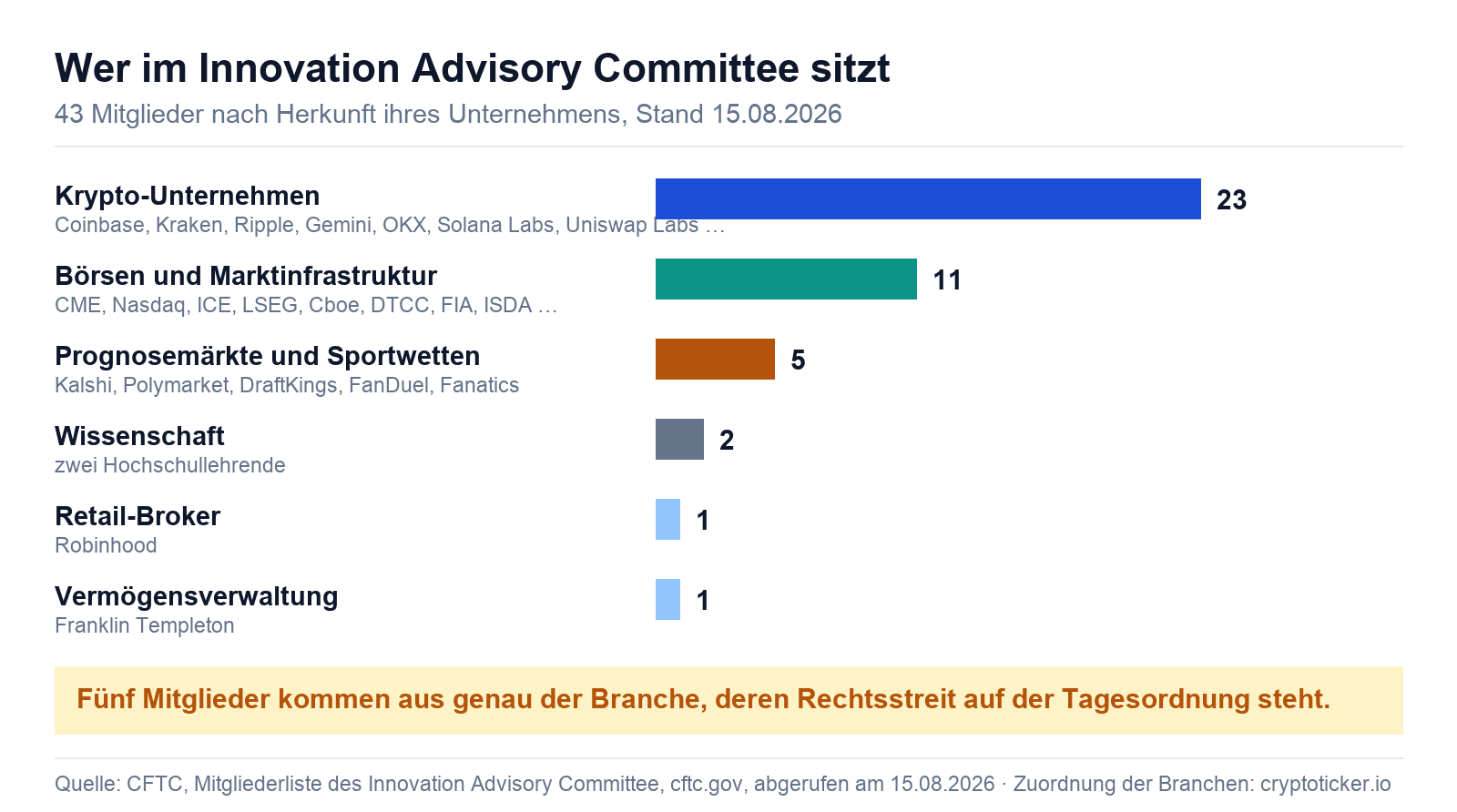
The most interesting group is the smallest. Five members come from the world of prediction markets and sports betting: Tarek Mansour (Kalshi), Shayne Coplan (Polymarket), Jason Robins (DraftKings), Christian Genetski (FanDuel) and Matt King (Fanatics). They are therefore advising on a regulatory area in which their own companies are parties. That is customary with committees of this kind and is contained by federal advisory committee law, but it belongs in the picture.
How the CFTC Splits Its Three Hours
The authority published the agenda on August 13, 2026 with release 9283-26. It is divided into three thematic sessions.
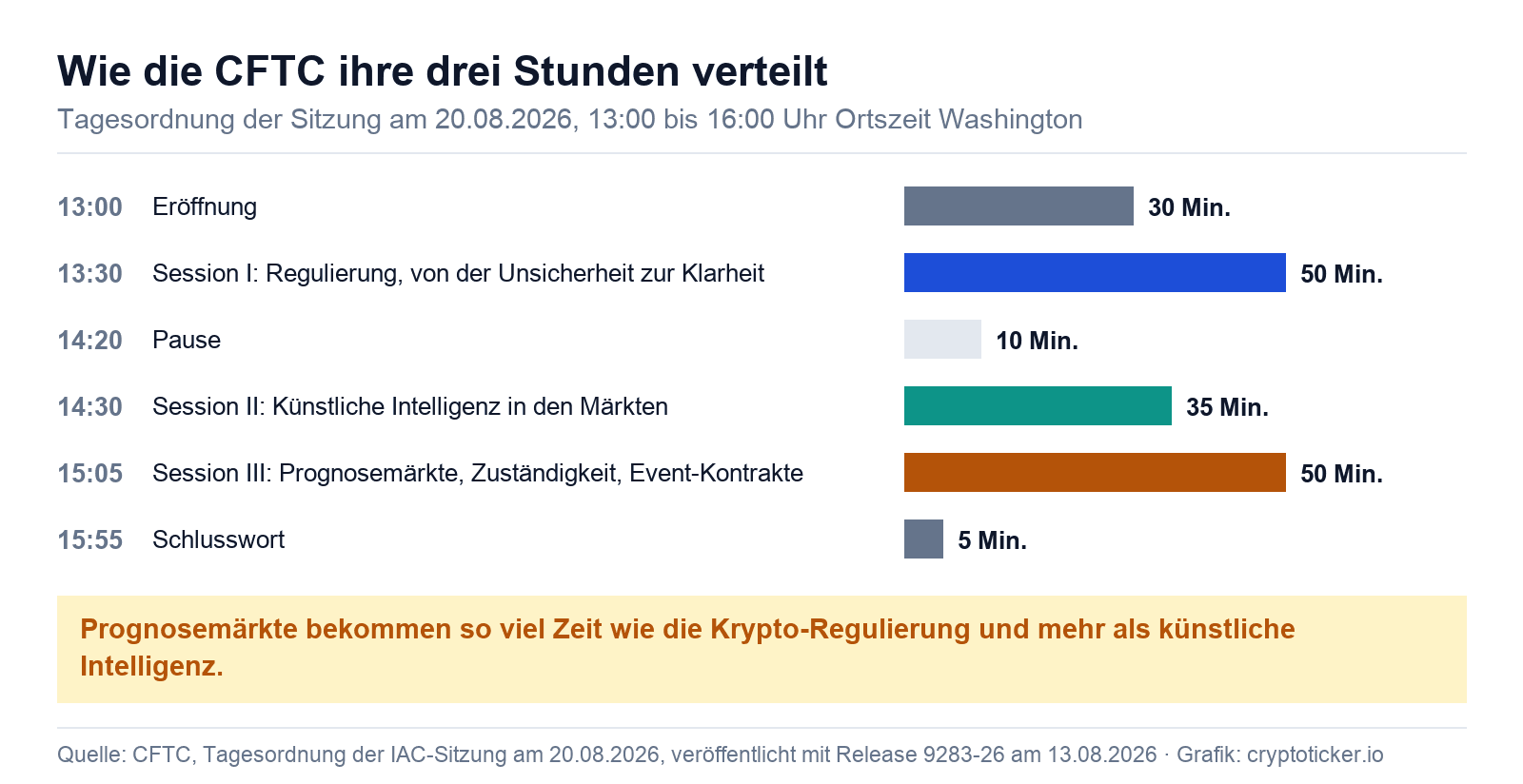
Session I is titled "Regulatory Evolution: From Uncertainty to Clarity" and covers, in 50 minutes, the emergence of the crypto markets, the patchwork of state licensing regimes and the absence of a nationwide framework for market structure.
Session II devotes 35 minutes to artificial intelligence in the markets, with a block of its own on autonomous agents that execute transactions and manage portfolios. Session III finally covers prediction markets, jurisdiction and the future of event contracts, again 50 minutes.
Why Session III Is the Real Point of Contention
The topic list for Session III contains an item that sets the meeting apart from a debate of principle: "Recent state litigation and enforcement actions", meaning the states' latest proceedings and enforcement measures. That puts an ongoing conflict on the agenda.
The sequence of events: the New York Attorney General filed suit against KalshiEX on July 31, 2026. It accuses the company of breaching the state's gambling law with prediction contracts on sporting events, and applied for a statewide injunction plus damages of more than $36 billion. On August 11, 2026 the CFTC responded by invoking its emergency authority and ordered that KalshiEX may continue trading in New York.
The authority takes the view that event contracts are financial instruments regulated under federal law and fall within its jurisdiction. Chairman Selig summed this up with the line that Congress had not intended to subject derivatives exchanges to a patchwork of state gambling laws. Several states see it differently and treat prediction markets close to sports betting as unlicensed gambling. The CFTC in turn has sued nine states: Arizona, Connecticut, Illinois, Kentucky, Minnesota, New Mexico, New York, Rhode Island and Wisconsin.
None of this is decided. These are ongoing proceedings, and both sides are set out here alongside each other because they cannot yet be resolved in law. How quickly this field also generates practical risks was shown by the attack on Polymarket with $3.1 million in damage. That the CFTC is dealing with the sector is not new either: back in early 2025 it served a subpoena on Coinbase in the Polymarket proceedings.
The Time Zone the Authority Contradicts Itself On
A detail that counts for diary planning and is reproduced incorrectly in several reports. The CFTC press release of August 10, 2026 states "1 p.m. EST", and the agenda PDF also carries "Eastern Standard Time". In August, however, Washington runs on Eastern Daylight Time, meaning summer time.
The official notice in the Federal Register of August 11, 2026 consistently states EDT. Since that notice is the legally authoritative one, the position is: 1:00 pm EDT corresponds to 5:00 pm UTC and therefore 7:00 pm CEST. Anyone taking the press release literally would arrive at 8:00 pm CEST and be an hour late.
What Such a Committee May Do and What It May Not
Sobriety is in order here. An advisory committee advises, it does not decide. It issues no rules, it changes no provision and it settles no proceedings. Its recommendations do not bind the commission.
What a meeting like this achieves is something else: it shows publicly which questions the authority considers to need regulation and whom it consults on them. Allocating 50 minutes to prediction markets is a statement in that sense, even if no decision comes out of it in the end.
For assessment purposes that means a remark in this meeting is not a decision by the authority, and an agenda item is not an announced rule. Anyone reading reports after August 20 that turn a spoken contribution into imminent regulation should read that distinction alongside them.
What This Means for Investors in Germany
Directly, the MiCA regulation applies in the EU, and a US supervisory authority decides nothing about German securities accounts. The matter is relevant all the same, for two reasons.
First, the body includes the companies through which German investors also trade. Coinbase, Kraken and Robinhood operate entities regulated in the EU, and their product policy is not decided in Europe alone. Second, the question of whether event contracts are financial instruments or gambling is no American peculiarity. It arises in every jurisdiction in which such products are offered, and how it is answered in the United States shapes the arguments elsewhere too. The rapprochement between the SEC and the CFTC on crypto regulation that began in March 2026 belongs in the same context.
None of this is legal advice for an individual case. Anyone trading prediction contracts should establish separately whether they are permitted at their place of residence. The position is as of August 15, 2026.
What to Keep an Eye On at the CFTC Meeting
Three points that make the difference between news and context:
- Session III from 3:05 pm local time, meaning 9:05 pm CEST. That is where it will be settled how forcefully the authority defends its jurisdiction against the states, rhetorically at least.
- The distinction between advice and decision. If a recommendation comes out of the meeting, that is still not a rule. Only a rulemaking procedure with a comment deadline would be one.
- The deadline of August 27, 2026. Until then the authority accepts written submissions. What arrives there is often more revealing than the meeting itself.
Frequently Asked Questions
What is the CFTC Innovation Advisory Committee? An advisory body of the US derivatives regulator with 43 members. It emerged from the former Technology Advisory Committee in January 2026 and advises the commission on technology, legal and market questions. It passes no resolutions.
When exactly does the body meet and can I watch? On August 20, 2026 from 1:00 pm to 4:00 pm Washington local time, which is 7:00 pm to 10:00 pm CEST. The CFTC livestreams the meeting on cftc.gov.
Why do some reports say 8:00 pm CEST? Because the authority's press release writes "EST", while Washington is on summer time in August. The Federal Register states EDT, and on that basis the meeting starts at 7:00 pm CEST.
What does the meeting have to do with Kalshi? The agenda for Session III expressly lists the states' latest proceedings. On August 11, 2026 the CFTC had permitted by emergency order that KalshiEX continue trading in New York after the state had sued. Kalshi's chief executive is at the same time a member of the committee.
Will new rules for crypto be adopted there? No. The body has no rulemaking power. New rules would arise only in a formal procedure of the commission.
Can I submit something as a private individual? Yes. Following the Federal Register notice, the authority accepts written submissions on the meeting until August 27, 2026.
August 20 is an interim step, not a conclusion: the proceedings against nine states continue, the deadline for submissions does not close until August 27, and whether the recommendations turn into a formal rulemaking procedure will be settled at the earliest after that. We are following the individual stages and setting out what of it is legally binding and what remains rhetoric. The ongoing coverage is on cryptoticker.io.
Sources
- CFTC: Release 9279-26, announcement of the first IAC meeting (10.08.2026, date, livestream, webinar access)
- CFTC: Release 9283-26, agenda of the IAC meeting (13.08.2026, sessions and times)
- Federal Register: Innovation Advisory Committee, notice of 11.08.2026 (window in EDT, topics, deadline for submissions)
- CFTC: Membership list of the Innovation Advisory Committee (43 members, chair, designated federal officer)
- CFTC: Release 9281-26, exercise of emergency authority (11.08.2026, KalshiEX, lawsuit by the State of New York, proceedings against nine states)
As of August 15, 2026. This article is neither investment advice nor legal advice.
Transparency note: This article was produced with the assistance of artificial intelligence and reviewed by our editorial team before publication. All figures and claims were checked against the primary sources linked in the text. The feature image was generated with AI.
Related articles
- Who Regulates Crypto in the US? CFTC and SEC Compared
- SEC and CFTC Unite on Crypto Regulation: What It Means for Bitcoin and Altcoins
- CLARITY Act 2.0: What Happens to US Crypto Regulation After the Senate Defeat?
- Senate Banking Committee Unveils 309-Page Crypto Clarity Act Draft
- Ripple, SEC, and Grayscale: The Ripple Effect on XRP Price
Which topics should we dive deeper into?
Select what genuinely interests you. Your picks feed directly into our editorial planning.
Crypto news that's actually worth your time.
Weekly. 60 seconds. Carefully curated by our editors: no hype, no promo flood, no spam.

April 6, 2025 12:47 PM

Big Win for Crypto: SEC Says Dollar-Backed Stablecoins Are Not Securities
The U.S. SEC just made a game-changing move. Stablecoins backed by actual dollars and easily converted to cash are officially not securities. What does that mean for the crypto industry in the USA? Let’s break it down.
July 6, 2024 11:45 AM

XRP Price Prediction: Can XRP Reach $1 in July Amid Ripple's SEC Battle?
Many factors could drive XRP to $1 this July amid Ripple's ongoing legal battle with the SEC, and significant whale activity in the market. What is there to know?
June 1, 2024 12:17 PM
XRP SEC Lawsuit Update: A "Fire Gensler" Campaign & A Biden Veto
Ripple CEO Brad Garlinghouse calls on President Biden to replace SEC Chair Gary Gensler...Biden uses his veto right to the latest standalone legislation... Is Biden's veto decision good for Ripple?
May 14, 2024 12:51 PM

SEC Decision on Spot Ethereum ETF in 9 Days: What to Expect?
In anticipation of the SEC's decision on Ethereum ETFs, here is the unique trading strategy proposed by a crypto hedge fund...
August 29, 2026 5:02 PM

CLARITY Act Senate Vote of September 15: Failed 49 to 50, and What the Bill Would Have Done
The US Senate rejected the CLARITY Act 49 to 50 on September 15, 2026. Here is what the bill would have done and why the market had bet against it.
March 13, 2025 6:00 AM
SEC vs. Ripple Case Nears Conclusion: Impact on XRP and Crypto Regulation
The Ripple SEC lawsuit is reportedly nearing its conclusion. How will this impact the XRP price and the crypto market?
May 22, 2024 11:41 AM

New Crypto Law: How Will It Reshape The Crypto Market?
The U.S. Congress has made a historic move by passing its first standalone crypto legislation, targeting the controversial SEC SAB 121. Here is a full understanding of this new legislation and its impact on the Crypto Market.

September 18, 2026 10:24 PM
CLARITY Act Fails, the CFTC Takes Over: What the New US Crypto Rules Change for Investors in Germany
The CLARITY Act has failed in the US Senate, yet regulation moves on: the CFTC has filed two rule proposals of its own and the SEC has opened trading in tokenised stocks. What that means for Bitcoin, XRP and the rest, and what you should check as an investor in Germany.
September 15, 2026 5:00 PM

What Happens If the CLARITY Act Fails Today: Will Crypto Still Win?
The Senate votes on the CLARITY Act today. Even if it fails, US crypto keeps its rules, its regulators and its president. Here is why.
September 12, 2026 1:29 AM

Is Polymarket Allowed in Germany? What the ESMA Report Says About Prediction Markets
ESMA has given prediction markets a chapter of their own in its risk report for the first time. It writes that event contracts require an authorisation in the EU that the large platforms do not hold.
August 7, 2026 1:08 PM

The Crypto Bill Washington Promised Just Got Pushed Back Again
The Senate walked away from the CLARITY Act before recess. Here is what stalled the crypto market structure bill and what happens in September.
August 5, 2026 11:20 AM
CLARITY Act Countdown: The Senate Has Days Left to Move Crypto's Biggest Bill
The Senate breaks for recess on Friday and the CLARITY Act still has no cloture motion filed. Galaxy just cut its 2026 passage odds from 50 to 30 percent.
April 30, 2026 11:29 AM

Bitcoin ETF Inflows Hit $2.44B in April: Is the Bull Market Back?
Bitcoin spot ETFs recorded $2.44 billion in net inflows this April, signaling a massive return of institutional interest and a potential market shift for 2026.
March 13, 2026 10:50 AM

Bitcoin Price Hits $72,500 as Joint SEC-CFTC Regulatory Framework Sparks Bullish Momentum
Bitcoin surges to $72,500 as the SEC and CFTC announce a joint regulatory framework, while BlackRock’s new ETHB ETF records a strong $15.5M debut.
February 12, 2026 4:35 PM

Bitcoin Price Crashes Below $66,000 as Liquidations Pass $50M
Bitcoin falls below $66,000 following a massive liquidation cascade and a bearish report from Standard Chartered. Regulatory hurdles further dampen the mood.
July 10, 2025 8:16 AM

Trump vs. Powell: Can Crypto Survive the US Economic Power Struggle?
Trump attacks the Fed, announces trade moves—can crypto hold steady, or will US tensions shake Bitcoin and altcoins in 2025?
May 12, 2025 9:05 PM

US-EU Trade Tensions Rise as US-China Conflict Cools Down
Just as the long-standing US-China trade war appears to ease, new tensions are emerging between the United States and the European Union. With Trump calling Europe “nastier than China,” are we about to witness a new transatlantic trade conflict?
March 25, 2025 3:00 AM

BREAKING NEWS: Visa and OpenAI to Partner for Stablecoin Payments
With the Fed pivoting, the SEC softening its stance, and Visa exploring crypto wallets with Sam Altman, could Bitcoin hit $250K?
February 9, 2025 4:31 PM

Ripple CEO Brad Garlinghouse’s Potential Role in Trump’s Crypto Advisory Council – Impact on XRP and Market Outlook
Ripple CEO Brad Garlinghouse is reportedly being considered for a seat on Donald Trump’s newly formed Crypto Advisory Council. Will XRP reach new highs in 2025?
July 1, 2024 9:20 AM

Bitcoin News Today: Why Is Bitcoin Price Up Starting July?
Starting July, recent market movements, political debates, and court rulings are shaping the future of Bitcoin and the broader crypto market. Here are the latest insights and analysis...
September 24, 2024 9:59 AM

Ripple Price Prediction: How High will XRP reach in 2050?
Now that things are starting to get resolved for Ripple, the main question comes back to mind: how high can XRP reach by 2050?
January 16, 2025 12:01 PM

Ripple SEC Lawsuit Updates and Outlook under Trump’s Pro Crypto SEC
The Ripple SEC lawsuit updates on the appeal filed by the SEC, the cross-appeal by Ripple, and what to expect soon under Trump's pro-crypto administration with the new SEC leadership, all in this article!
February 28, 2025 7:00 AM
SEC News: SEC Drops 5 Crypto Investigations in 5 Days – What It Means for the Market
The U.S. SEC has dropped investigations into 5 crypto-related companies within 5 days. What led to this sudden shift, and how does it impact the crypto market?
July 29, 2024 10:29 AM

XRP Price Prediction: Will XRP Break Its Next Resistance Level Today?
With the current market uptrend, all cryptos are showing bullish signals. With XRP struggling to surpass the $0.60 resistance level, could this market surge help do it?
June 14, 2024 7:05 PM

XRP Price Prediction: Will XRP Crash in June 2024?
With the current Ripple-SEC lawsuit ending soon, XRP price prediction is highly anticipated. Will it reach new highs this June or could it reach new lows?

May 9, 2026 10:16 AM
Crypto Clarity Act Vote: Could May 14 Finally Push US Crypto Regulation Forward?
The Crypto Clarity Act heads to a May 14 Senate Banking vote as banks, Coinbase, and lawmakers clash over stablecoin rewards.
January 21, 2025 8:21 PM
SEC Launches Crypto Task Force Under Trump's Administration to Develop Clear Regulations
The SEC has created a dedicated crypto task force under Trump's administration to establish clear regulations for the crypto industry, signaling a new era of regulatory clarity in 2025.
More from CryptoTicker