Robinhood Built a Blockchain for Stocks. The Cat Memecoins Took It Over.
$13 million in tokenised equities, memecoins worth ten times that: what Robinhood Chain is, why CASHCAT flooded it, and how investors actually get access.


Updated 20 August 2026: new figures for value locked, the stablecoin share and the share held by tokenised assets (as of 17 August), plus current CASHCAT metrics. The section on the 6 August Robinhood listing still stands.
Robinhood brought its own blockchain online this summer so that European customers could trade American stocks around the clock. Six weeks later more than 420,000 wallets hold tokenised assets on the chain — and the largest cat memecoin on it was still briefly worth more than the tokenised equities combined. On 6 August, Robinhood took that very memecoin into its own app.
You can dismiss that as a curiosity. The more useful question is why it happened, because the pattern has repeated on every new chain for years. This guide explains what Robinhood Chain technically is, how the memecoin wave came about, how investors get access, and what to watch for.
What Robinhood Chain technically is
The public mainnet went live on 1 July 2026. Technically it is an Ethereum layer-2 built on the Arbitrum Orbit stack: security comes from Ethereum, transaction fees are paid in ETH, and execution runs on a dedicated chain operated by Robinhood. Arbitrum documented the launch itself.
The purpose was known from the outset: tokenised stocks and ETFs. Robinhood began issuing more than 200 US stock and ETF tokens to EU customers in 2025, initially on Arbitrum One, intending to migrate them to its own chain later. The appeal for European investors is straightforward — trading well beyond US market hours, dividends handled, and a security that can be moved technically like a token.
The numbers after seven weeks
| Metric | Value |
|---|---|
| Mainnet launch | 1 July 2026 |
| Total value locked | around $536 million on 17 August (The Coin Republic, 18 August), up more than 45 percent month to date (The Block, 17 August). Other providers put it near $775 million in early August. The spread is real, not rounding — the providers count different things. |
| Daily transactions (average) | 11.6 million in the week of 3–9 August, about 30 percent above the prior week |
| Wallets holding tokenised assets (RWAs) | more than 420,000 after six weeks (as of early August) |
| Value of tokenised assets (RWAs) | around $32 million on the narrow measure, up 120 percent month over month. Their share of value locked fell from nearly a third on 7 July to 6 percent in mid-August. DeFiLlama, counting more broadly, shows $124.8 million. |
| Stablecoins on the chain | around $640 million, up more than 22 percent month to date. USDG accounts for $350.8 million (54.8 percent) and USDe for $287.7 million — up roughly 167 percent over 30 days. |
| DEX volume | around $878 million on 12 July, $500–700 million in early August |
| CASHCAT: all-time high / 20 August | around $0.2288 (11 July) / around $0.121, market capitalisation about $119 million (CoinGecko, 20 August) |
The actual finding shifted again in the second half of August. In absolute terms tokenised assets are growing: around $32 million on the narrow measure, up 120 percent month over month, held across more than 420,000 wallets, with Nvidia and Apple among the most-held positions. Everything else is simply growing faster. Their share of value locked fell from nearly a third on 7 July to six percent, while stablecoins on the chain climbed to roughly $640 million (The Block, 17 August). The growth is therefore not coming from the product the chain was built for but from parked dollar balances, USDe above all. It fits that active addresses sit eleven percent below the 16 July peak while transaction counts set records: it is not more people trading, it is the same people trading more often. For a chain that justifies itself through adoption, that is the less comfortable of the two readings.
The CASHCAT case
Attention was triggered by a token called CASHCAT. It launched days after mainnet, has a fixed supply of one billion units, no product, no revenue and no named team. The name alludes to a company name discarded in 2010: Vlad Tenev and Baiju Bhatt first intended to call their startup "CashCat" before settling on Robinhood.
Robinhood did not issue, commission or endorse the token, and the project's own site explicitly denies any connection to the company — it describes itself as fan fiction with a ticker. Since 6 August 2026, however, CASHCAT is tradable in the Robinhood app. Why that is something other than an endorsement is set out below; it is the single most important distinction in this article.
The sequence:
- In the first 24 hours the price rose by more than 1,700 percent.
- Over the first week it was more than 2,100 percent. The peak valuation on 8 July was around $156 million. Some data providers show above $220 million for 12 July — that the sources diverge this far says a good deal about data quality in this segment.
- On 13 July the token lost over 30 percent after the Noxa launchpad ceased operations.
- In early August CASHCAT traded at roughly $0.08 to $0.09, about 60 percent below the high, with large addresses continuing to accumulate.
- On 6 August, Robinhood opened the token for spot trading in its own US app. The price rose around 90 percent within 24 hours to $0.1483, volume climbed more than 250 percent to $109 million, and the valuation passed $150 million (Cryptonews).
- The timing of some positions stood out: several wallets went long hours before the announcement. That does not establish insider trading — it does call for an explanation.
- Since then the price has swung between roughly $0.11 and $0.20. On 20 August CASHCAT trades near $0.121 at a market capitalisation of about $119 million, down some 26 percent on the week (CoinGecko). That leaves it just under 47 percent below the all-time high of around $0.2288 set on 11 July. The Robinhood listing carried the price briefly; it did not turn it.
The trading pool is considerably smaller than the market capitalisation suggests. At peak, some $98 million of daily volume ran through this single token, around 17 percent of the chain's entire DEX volume. Cash Dog and Hoodrat followed the same pattern alongside it.
 Prefer to buy crypto where it is regulated? Every exchange with a MiCA licence in Europe, compared
Why memecoins and not the stock tokens?
The obvious explanation — that investors are irrational — falls short. There are four structural reasons, and they appear on new chains in the same order every time.
1. Regulation takes time; a memecoin does not
A tokenised Apple share is a regulated financial instrument. It requires an issuer, a custodian, prospectus obligations, KYC and authorisation in each jurisdiction. A cat token requires a wallet and a few minutes. On a new chain, the first visible activity is therefore almost always the unregulated kind.
 FOMO FamilySponsored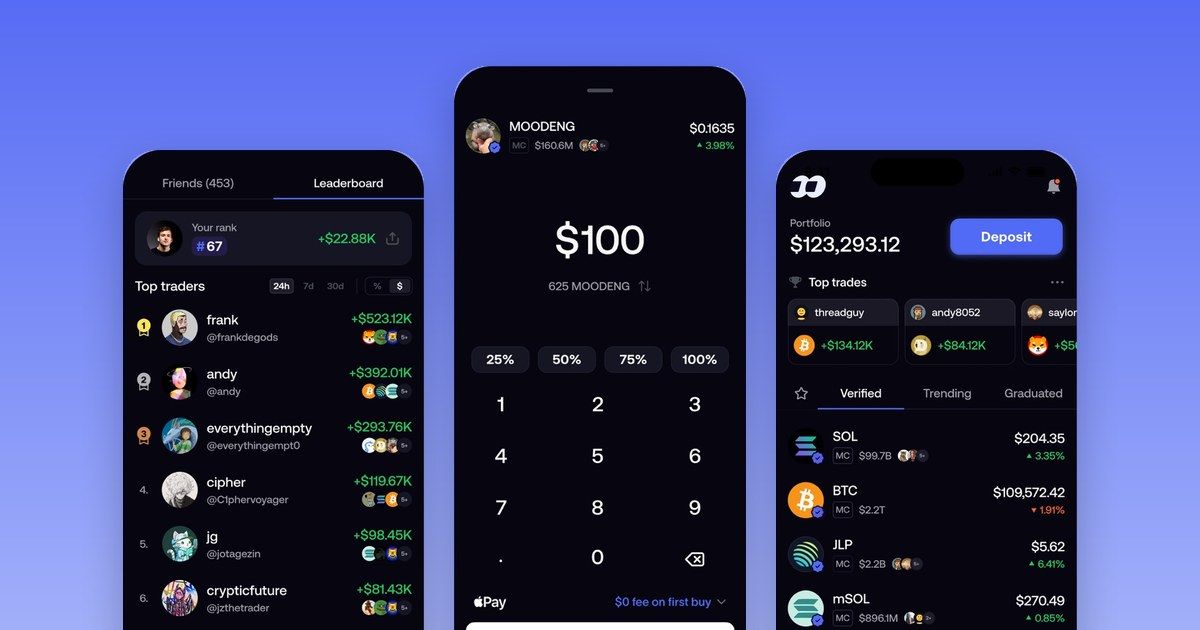
Buy meme tokens straight from your phone
We used FOMO Family ourselves and bought meme tokens with it, Robinhood Chain included. Deposit, find the token, buy: it takes seconds. Our link gets you ten percent off the fees.
Get the app and 10% off fees →Memecoins are high risk, a total loss is possible. Partner link.
2. Thin markets move sharply
When only a few million sit in the pool, even small buys trigger triple-digit percentage moves. Those moves produce screenshots, screenshots attract new buyers, and the inflow produces the next move. This is not specific to Robinhood Chain; it applies to any thin market.
3. The brand name is mistaken for vetting
"Robinhood Chain" sounds like Robinhood. The company operates the chain but neither vets nor stands behind any token on it, no more than Ethereum is liable for tokens on Ethereum. That confusion is likely a substantial part of the inflow, and it costs people money regularly.
Since 6 August this point needs more explaining, because Robinhood has now actually opened CASHCAT for trading. A listing is a decision about what a broker offers its customers — it is not a statement that a token has a team, a product or a future. The same app has carried Dogecoin for years without anyone reading that as a quality check. Nothing about the token itself has changed: no product, no revenue, anonymous developers, and a project site that still denies any connection to the company. The fallacy this section is about has not been refuted by the listing. It has only become more expensive, because it now sounds more plausible.
4. The stock tokens are too unexciting for this audience
If you can already invest inside the Robinhood app, there is little reason to set up a wallet, bridge funds and pay gas in ETH. The added value of tokenisation — longer trading hours and combination with DeFi applications — only arrives once such products exist. So far they do not.
Getting access
Two entirely different routes are routinely confused here.
The stock tokens run through Robinhood itself and are available to EU customers within that product. This is a regulated route with an account, identity verification and tax reporting.
The memecoins run on the chain and belong to nobody. The route involves an EVM wallet, adding Robinhood Chain as a network, ETH for gas and a swap on a DEX on the chain. There is no support, no reversal and no counterparty. With the wrong contract address the money is gone, and nobody is responsible.
This is also where the difference between watching and trading becomes obvious: Dexscreener and TradingView give you charts, not execution. One mobile alternative is the trading app FOMO Family, which lets you discover, swipe through and trade meme and low-cap tokens directly in the app, with a fast deposit flow. Download the app through the link and you get ten percent off trading fees. There is also community speculation about a possible airdrop for active users — that is unconfirmed, the provider has promised nothing, and it is not a reason to deposit money. None of this changes the risk: meme and low-cap trading stays highly volatile, and losing the entire position is possible at any time.
Four checks before buying
- Verify the contract address against two independent sources. Do not take it from a Telegram post. Clones with identical names and logos are common on new chains.
- Look at liquidity rather than market capitalisation. What matters is how much sits in the pool and whether it is locked. At a $90 million valuation with $4 million of pool liquidity, exiting at the quoted price is effectively impossible.
- Check holder distribution. If 40 percent of supply sits on ten addresses, you are helping to fund their exit.
- Size the position as a total loss. The question is not how much you want to make, but what amount you could write off entirely without it changing your plans.
The tax side
Rules differ by jurisdiction, and European readers should take care here. In Germany, memecoin gains fall under private disposals (§ 23 EStG): sold within a year they are taxed at your personal income tax rate, with a €1,000 annual threshold rather than an allowance, so one euro above it makes the entire gain taxable. In the UK and most other markets, capital gains rules apply from the first disposal.
The more relevant point in practice is the same everywhere: every token-to-token swap is a taxable event. Thirty swaps across an active weekend on a DEX mean thirty disposals to document, on a chain many tax tools do not yet recognise. It is worth exporting your transaction history early, while the addresses can still be attributed. Which tools handle exotic chains is covered in our crypto tax software comparison.
Three things to measure the project by
- Does stock-token volume actually move onto the chain? By mid-August the answer got clearer and less flattering: tokenised assets are growing in absolute terms, but their share of value locked has fallen from nearly a third to six percent. More than 420,000 wallets hold such positions — their weight on the chain has shrunk, not grown. That does not pass the test.
- Do applications emerge that use the stock tokens? Lending against tokenised equities, hedging strategies, automated portfolios — only that justifies the detour through a blockchain.
- Does memecoin activity survive the loss of infrastructure? The Noxa shutdown on 13 July showed how quickly the foundation under these tokens can disappear.
 Every token swap is a taxable event. Which tools cover exotic chains is in our tax software comparison
What to take away
Robinhood Chain is the most serious attempt yet by a large broker to move equities onto its own blockchain. At the same time, this summer shows that infrastructure cannot dictate what it gets used for.
For investors, one distinction matters more than any price forecast:
- The stock tokens are a regulated product with a legible use case and an open adoption question. Whether you need them is debatable, but they do not carry the risk of losing everything overnight.
- The memecoins on top are a zero-sum game. Early buyers' gains come out of later buyers' losses. That is not a moral judgement but arithmetic. CASHCAT falling 60 percent below its high in July, rising around 90 percent after the August Robinhood listing and still trading just under 47 percent below its all-time high later that month is the norm in this segment, not the exception.
Anyone who blends the two because both say "Robinhood" is missing the most important difference.
In practical terms: decide what share of your crypto holdings you deliberately allocate to speculation. Experience suggests a single-digit percentage is sustainable. The rest belongs in a savings plan into the large caps and on a hardware wallet. What that looks like in practice: our guide to buying bitcoin and the hardware wallet comparison.
One conclusion outlives this summer: a memecoin season is not a market cycle but a sentiment indicator. It shows where liquidity is looking for quick moves, not where long-term value is being created.
Disclosure: some of the providers named in this article work with us through partner programmes. This has no influence on our editorial assessment.
(As of 20 August 2026. This article is not investment advice. Prices and fee structures change; check the terms with the provider before you buy. Memecoins can lose their entire value; invest only amounts whose total loss you can absorb.)
Transparency note: This article was produced with the assistance of artificial intelligence and reviewed by our editorial team before publication. All figures and claims were checked against the primary sources linked in the text. The feature image was generated with AI.