
Ethereum Price Analysis as ETH risks Crashing below the $2,000 Support
Ethereum struggles to stay above key support levels. Technical charts and rising exchange inflows indicate that ETH could drop below $2,000 soon.





Which topics should we dive deeper into?
Select what genuinely interests you. Your picks feed directly into our editorial planning.
Crypto news that's actually worth your time.
Weekly. 60 seconds. Carefully curated by our editors: no hype, no promo flood, no spam.
Ethereum ($ETH) has found itself under intense selling pressure over the past few weeks. Despite several attempts by bulls to push the asset back into higher trading tiers, market dynamics have shifted drastically in favor of the bears.
Is Ethereum Crashing Below $2,000?
According to current technical structures on the chart and broader market indicators, there is a substantial risk that the Ethereum price could break below $2,000. The asset is currently facing strong overhead resistance and a lack of immediate buy walls. Market data confirms that whale distribution has accelerated, heavily impacting spot market liquidity.
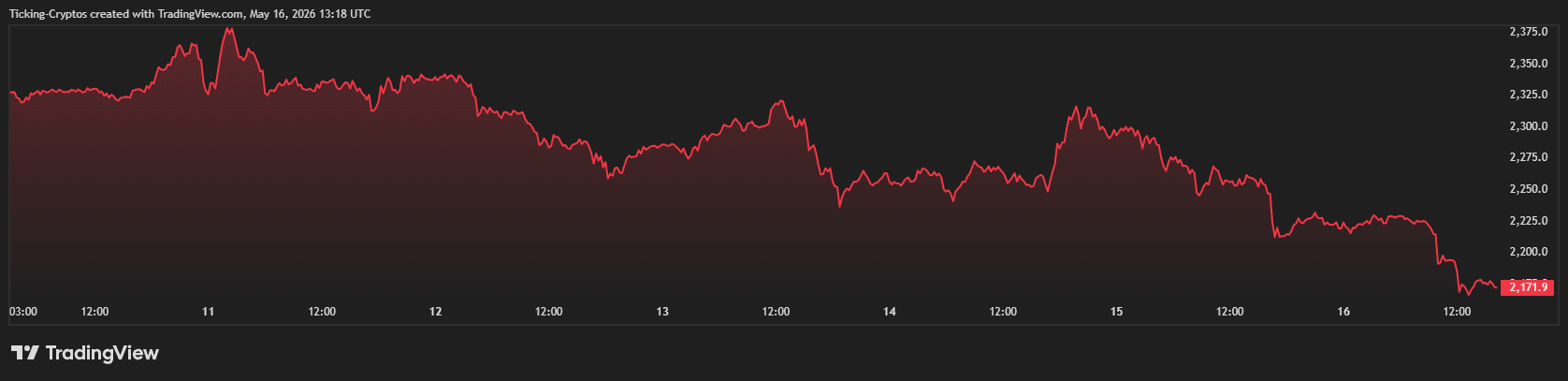
While short-term relief bounces are always possible in derivatives-driven markets, the overarching multi-week trend highlights a series of lower highs and lower lows. If the current support zones fail to hold back the bears, a continuation toward the next major demand zone below $2,000 appears highly probable before the end of the second quarter.
Ethereum Price Analysis in May 2026
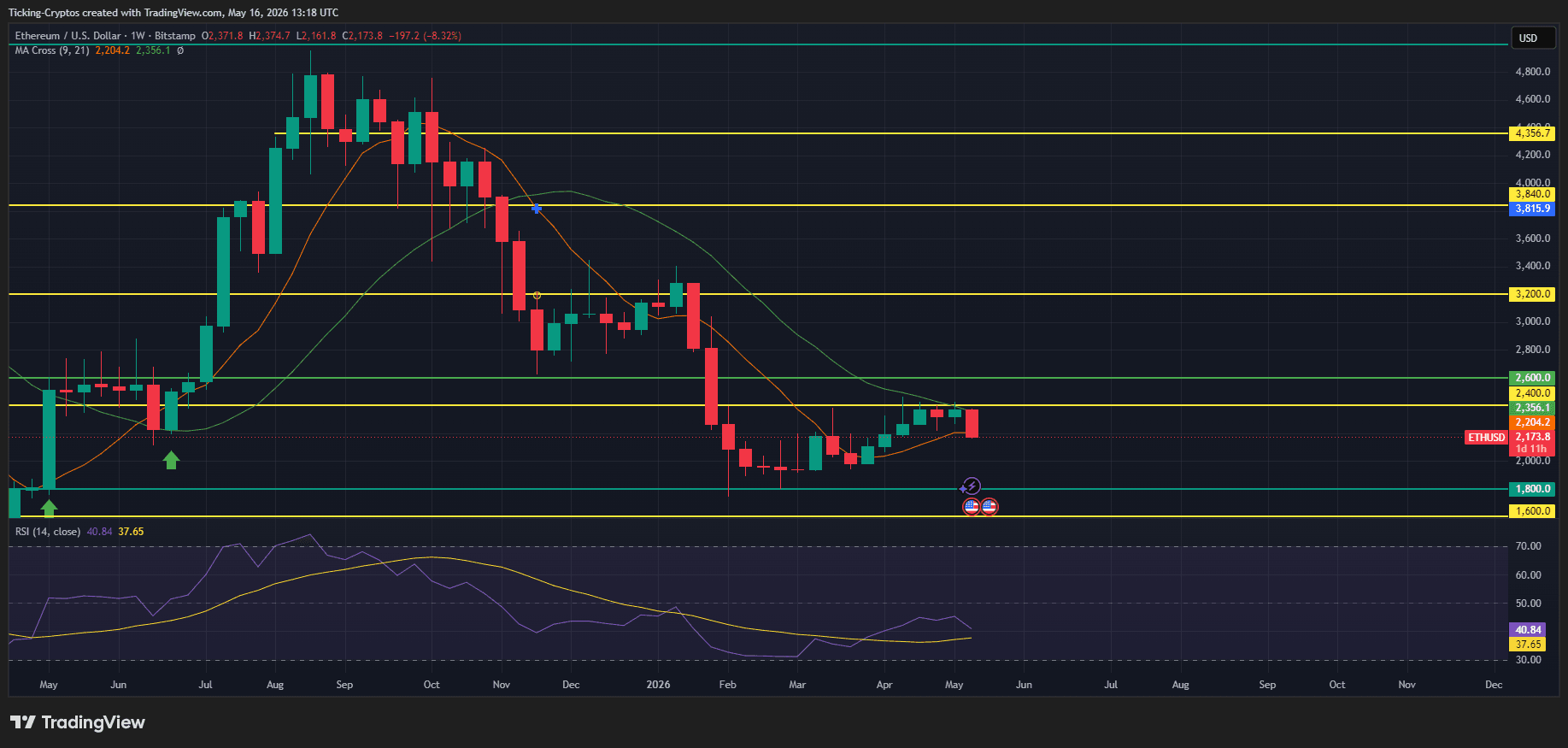
A detailed examination of the weekly ETH/USD chart reveals a distinct breakdown of the mid-term bullish structure.
The Moving Average Crossover and Bearish Sentiment
- The chart shows the 9-period and 21-period Moving Averages (MA Cross) tracking above the current price action. The 9-period MA sits at $2,204.3, while the 21-period MA hovers higher at $2,356.1.
- The fact that the current price is trading at $2,174.5—well below both short-term moving averages—proves that the immediate momentum is firmly controlled by sellers. A sustained position below these lines often transforms previous support areas into firm overhead supply walls.
Horizontal Support and Resistance Levels
Several key horizontal zones are mapped out on this weekly timeframe:
- The Overhead Ceilings: Strong resistance lines are established at $2,400, $2,600, and $3,200. These levels previously acted as consolidation floors before the major distribution phase began.
- The Current Battleground: The immediate line of defense for buyers is situated around the green support band between $2,161 and $2,180. The current weekly candle is testing the very bottom of this range, registering a net loss of over 8.29% for the current period.
- The Sub-$2,000 Floors: If the $2,161 floor crumbles, the chart reveals a massive liquidity void. The next structured support bands wait lower at the $1,800 green line and the ultimate macro support level of $1,600.
RSI Indicator Overview
At the bottom of the chart, the Relative Strength Index (RSI) with a 14-period setting is currently printing at 40.86, with its signal line at 37.66. While an RSI reading near 40 shows that the asset is approaching an oversold territory, it has not yet hit the traditional extreme oversold threshold of 30. This implies that there is still ample room for a downward extension before the market forces a structural, momentum-based trend reversal.
Why Is Ethereum Crashing?
Accelerated Whale Distribution and Exchange Inflows
Data from blockchain analytics platforms highlights a worrying trend for Ethereum bulls. Over the past two weeks, exchange reserves for ETH have risen dramatically. Hundreds of thousands of ETH have been transferred onto centralized trading venues, heavily noting an intent to liquidate assets.
This distribution is primarily led by large-scale institutional wallets and "whales" holding between 10,000 and 100,000 ETH. When large entities transfer their holdings onto exchanges, it floods the order books with supply that retail buyers struggle to absorb.
Declining Institutional Inflows
The institutional narrative that pushed Ethereum upward throughout the previous quarters has cooled down. Net outflows from US spot $Ethereum ETFs have added pressure onto the market, dampening overall spot demand. Concurrently, major treasury firms have reported lower staking rewards and decreased yield revenue due to compressed network valuations, pushing institutional players to adjust their portfolios for maximum capital flexibility rather than long-term holding.


What Can Save the Bulls?
To invalidate this highly bearish scenario, Ethereum buyers need to step up immediately and force a daily close back above the 9-period moving average at $2,204. Reclaiming this minor level would signal that local demand is active. However, a full macro trend invalidation requires a strong push past the $2,335–$2,400 resistance cluster. Only a weekly close above $2,400 would reliably turn the structural bias back to neutral or bullish.
As macro asset trends undergo these aggressive distribution phases, securing digital assets off centralized exchanges becomes highly recommended. Utilizing cold storage options, which can be explored in detail through our hardware wallets comparison, guarantees that market volatility won't affect asset custody.
More on Ethereum: All Ethereum news at a glance
Related articles
- Ethereum Price Crash: What Next Support Levels For ETH Price Below $3K?
- Ethereum Price Breaks $2,000 Support While Bearish Sentiment Drives ETH to Lower Targets
- BREAKING: Ethereum Price Crashes Below $3,000 as Bitcoin Triggers Market Meltdown
- Bitcoin Price Drops Below $100K – Is a Bigger Crash Coming?
- Ethereum Price Prediction 2026: Technical Analysis of ETH Coin During the Crypto Crash
Which topics should we dive deeper into?
Select what genuinely interests you. Your picks feed directly into our editorial planning.
Crypto news that's actually worth your time.
Weekly. 60 seconds. Carefully curated by our editors: no hype, no promo flood, no spam.

July 8, 2024 7:51 AM

Crypto Market Crash News As BTC Price Crash Back To 56K
With the crypto market crash, and Bitcoin price drop to below 56k with recent dormant BTC whales activity, what comes next: a correction or further crash soon?
February 28, 2025 10:10 AM

Ethereum Price Crash Below $2,200 – Will $2,000 Hold?
Ethereum is crashing hard! ETH is hovering around $2,150, dangerously close to the critical $2,000 support. If it breaks lower, bigger losses could follow!

February 24, 2026 10:30 AM

4 Altcoins Flashing Major Sell Signals: What Happens if Key Supports Break?
The crypto market is on edge as Bitcoin and major altcoins like ETH, SOL, and XRP approach "make-or-break" support levels. Is a deeper crash imminent?
April 19, 2026 6:34 PM

Ethereum Price Analysis: Key Levels Holding, Will ETH Crash or Bounce Toward $2,500?
Ethereum tests critical support near $2,330. Will ETH bounce toward $2,500 or break lower? Full price analysis and targets.
July 27, 2024 2:34 PM

Why Is The Crypto Market Up TODAY?
With the Bitcoin 2024 Conference taking place now in Nashville, the crypto market is showing bullish signals, intriguing traders around the future of Bitcoin and Altcoins.
June 12, 2024 2:17 PM

Ethereum (ETH) Price Prediction For BULLISH And BEARISH Scenarios
The latest analysis of Ethereum's price movements as of June 12, is divided between the 2 scenarios: bullish and bearish. But what drives each, and which is more likely to occur?
February 18, 2026 6:53 AM

Ethereum Price Prediction: Will the $2,000 Support Hold or Is a Deeper Correction Looming?
Ethereum price struggles to maintain the $2,000 psychological level. Analyze the latest ETH coin news and price predictions for 2026 amid market consolidation.
August 10, 2024 6:02 PM

Ethereum Price Prediction: Amid Mixed Signals What To Expect For ETH Price?
Ethereum faces volatility and competition, but signs of bullish activity and whale accumulation suggest potential recovery. How does it compare to Solana, and what does the future hold for ETH?
May 16, 2026 10:50 AM

Crypto Crash: Bitcoin Slips to 78k as Market Reverses Friday Pump
Crypto prices face a sharp downturn after a brief Friday pump. Bitcoin hovers at 78k, threatening a deeper crash if macro support breaks.
December 19, 2024 11:38 AM

Is an Ethereum Price Crash Imminent?
Ethereum price has dipped igniting fears of a potential price crash. Analysts highlight bearish signals, but some still predict a recovery. Which is it next?
January 30, 2026 10:12 AM

Crypto Crash Reason: Why is Bitcoin Crashing Today and Key Supports
The crypto market is facing a sharp correction. What are the crypto crash reasons today, and what are Bitcoin support levels, and how are macro factors hitting prices?
December 12, 2024 11:28 AM
Bitcoin Hits $100K Again – But a Crash to $60K Might Be Next
Bitcoin is back at $100K after dropping to $94K, but concerns are growing as BTC faces strong resistance at $104K. Will the bullrun continue, or is a major crash coming in January?
April 11, 2026 12:41 PM
Ethereum Price Analysis: Is ETH Gearing Up for a $2,400 Breakout?
Ethereum shows bullish momentum as ETH price eyes the $2,400 resistance. Discover key support levels and technical indicators in our latest analysis.
May 13, 2026 6:52 PM

Why Did Bitcoin Price Crash below 80k Today?
The crypto market is in turmoil as Bitcoin and Ethereum lose critical support levels. What triggered the sudden price collapse?
May 23, 2026 2:24 PM

ETH Price Prediction Amid Market Sell-off: Will Ethereum Crash Below $2,000?
Ethereum faces a critical breakdown test as the global crypto crash intensifies under escalating US-Iran tensions and a massive Chinese military deployment near Taiwan.
November 5, 2025 1:16 PM

$1 Trillion Wiped: Risk-Off Storm Engulfs Stocks & Crypto
Global markets plunge as tech stocks and crypto crash, wiping over $1 trillion in value amid AI bubble fears and investor risk-off panic.
January 20, 2026 6:09 PM

Ethereum Price Crash Below $3,000 in January 2026: What Happened Next
Ethereum fell below $3,000 on 20 January 2026. The slide went on to about $1,566 in June, and ETH trades near $2,690 in September 2026. The crash analysis, updated.
March 26, 2026 1:23 PM

Crypto Ignores Bullish News as War Risk Takes Over — Why Bitcoin and Ethereum Are Falling Anyway
Bitcoin and Ethereum fall despite bullish crypto news as war risks, oil spikes, and macro pressure dominate market sentiment.
February 9, 2026 6:30 PM

Ethereum Price Prediction: ETH Coin Might Sink Below $1,900 as Bitcoin Loses $70,000
Ethereum faces heavy pressure as Bitcoin drops below $70,000. Here are the key ETH support levels at $1,950 and $1,880 in our latest price prediction.
June 1, 2026 6:20 PM

Why is Bitcoin Crashing? BTC Hits $71K Despite Massive Michael Saylor Purchase
Bitcoin price tumbled sharply to $71,239, risking a drop below $70,000 despite massive institutional accumulation from Michael Saylor's Strategy.
May 20, 2026 10:40 AM

Bitcoin Price Stabilizes Above $77,000 as Daily Chart Shows Crucial Test
Bitcoin is trading at $77,371 following an $83,000 peak rejection, testing key daily moving average support zones amid macroeconomic friction.
March 4, 2026 10:29 AM
Ethereum Price Reclaims Crucial Levels as Institutional Rotation Accelerates
Ethereum price shows bullish resilience as it battles key resistance at $2,100. Analysts weigh in on the impact of Harvard’s latest portfolio rotation into ETH.
June 24, 2024 8:16 PM

Bitcoin News Today: Bitcoin CRASH OVER or MORE Down To Go?
Bitcoin Price Crash below 60k, and the crypto market follows. Why this decline and how low can it go?
June 2, 2026 12:13 PM
Ethereum Price Crashing Below $2,000 as Bitcoin Breaks Critical $70,000 Support
Ethereum has plunged below the psychological support level of $2,000 following a sharp market-wide correction triggered by Bitcoin breaking below $70,000.
August 22, 2024 9:00 PM

MAJOR Bitcoin News: Bitcoin Price SURGE Expected At This Level
Bitcoin and Ethereum are at critical junctures, with key resistance levels in sight. Are the markets poised for a breakout, or will bearish pressures prevail? Explore the latest analysis and insights.


More from CryptoTicker