
RAVE Token Crashes EXPLAINED: How $6 Billion Vanished in a Day
The RAVE token plummeted from $26 to $1 in 24 hours. On-chain data reveals a "paper tiger" valuation and extreme supply concentration.




Which topics should we dive deeper into?
Select what genuinely interests you. Your picks feed directly into our editorial planning.
Crypto news that's actually worth your time.
Weekly. 60 seconds. Carefully curated by our editors: no hype, no promo flood, no spam.
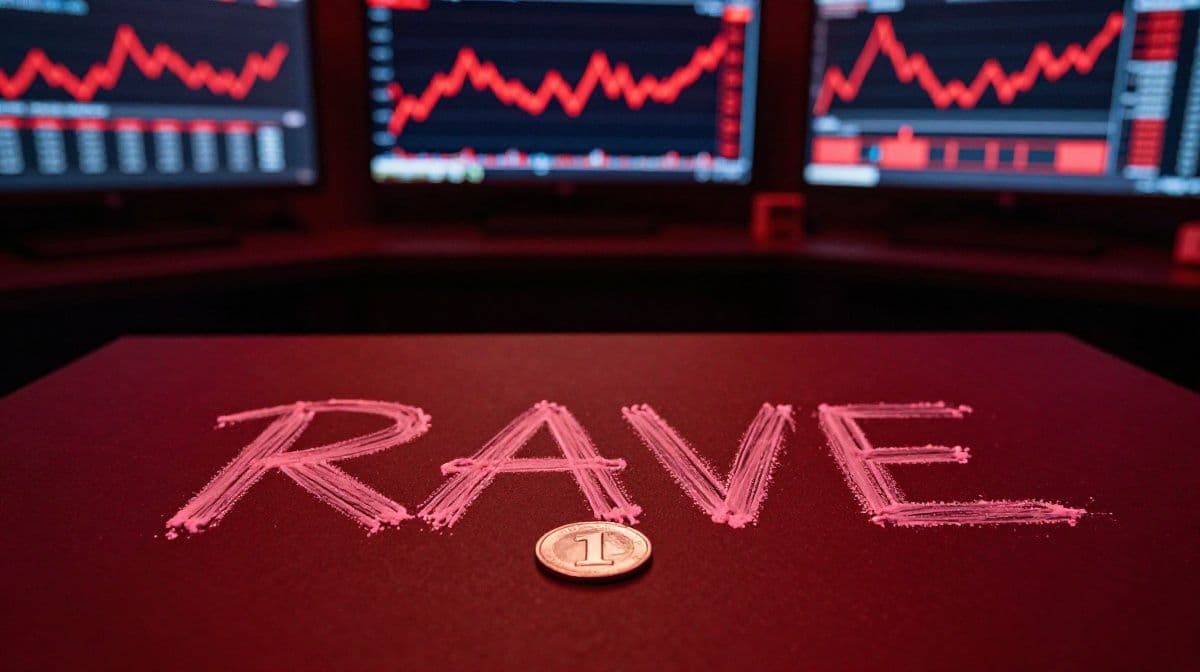
RAVE, the native token of the entertainment-focused RaveDAO, suffered a catastrophic 95% price collapse, falling from a peak of nearly $28 to approximately $1 in less than 24 hours. This move effectively wiped out over $6 billion in market capitalization, leaving retail investors reeling and raising urgent questions about the integrity of the project’s governance and supply distribution.
What Happened to RAVE?
The RAVE crash was not a slow bleed but a structural failure triggered by transparency concerns. On-chain investigator ZachXBT flagged suspicious activity, alleging a coordinated pump-and-dump scheme. The subsequent panic, fueled by exchange-led investigations from Binance, Bitget, and Gate.io, caused the token's valuation to evaporate. Despite a 3,700% rally in the preceding nine days, the lack of organic liquidity meant that even relatively small sell orders could—and did—cause a total price meltdown.
The "Paper Tiger" Valuation
In financial terms, RAVE was a "paper tiger." This refers to an asset that appears powerful and valuable on paper (high market cap) but lacks the underlying liquidity or volume to support that valuation during a sell-off. While the market cap sat at a staggering $6 billion, the collapse was triggered by just $52 million in liquidations. This massive disparity proves that the price was artificially inflated; there simply wasn't enough real money in the order books to support a multi-billion dollar valuation.
The Evidence: 95% Supply Held by 9 Wallets
The most damning evidence of risk was the extreme concentration of RAVE tokens. Investigation into the blockchain revealed that:
- Concentration: Approximately 95% of the total supply was controlled by only 9 addresses.
- Insider Links: On-chain data tracked transfers from these wallets to centralized exchanges just moments before the peak.
- Governance Risk: With such a high concentration, "community governance" was effectively an illusion, as the team or a small group of "whales" held absolute power over the market price.
RAVE Crash Timeline: From Rally to Ruin
The RAVE trajectory followed a classic, albeit extreme, Wyckoff accumulation-to-distribution pattern:
- Accumulation: The token traded flat for months at sub-$1 levels.
- Markup: A nine-day parabolic move took the price to $27.33, briefly placing RAVE in the top 20 cryptocurrencies by market cap, surpassing established projects like Litecoin.
- Distribution: Insiders began offloading tokens on Bitget and Gate.io.
- Markdown: Following ZachXBT’s public call for an investigation, the "house of cards" collapsed, leading to the 95% retracement.
| Metric | Peak Value | Post-Crash Value | Percentage Change |
|---|---|---|---|
| Token Price | ~$28.00 | ~$1.10 | -96% |
| Market Cap | $6.6 Billion | ~$150 Million | -97.7% |
| Liquidations | N/A | $52 Million | N/A |
Related articles
- RAVE Token Crash 95% in $6 Billion Wipeout: Insider Scam or Trader’s Paradise?
- MemeCore (M) Under Fire as Onchain Probe Reveals 90% Insider Control
- Crypto News: Will The Crypto Market Crash Further or Recover NEXT?
- Crypto Crash Reason: Why Bitcoin Fell Below $81,000 and Altcoins Bled Even Harder
- Crypto Market Crash News As BTC Price Crash Back To 56K
Which topics should we dive deeper into?
Select what genuinely interests you. Your picks feed directly into our editorial planning.
Crypto news that's actually worth your time.
Weekly. 60 seconds. Carefully curated by our editors: no hype, no promo flood, no spam.

June 3, 2026 11:05 AM

Crypto Price Today: Why is the Crypto Market Crashing? BTC, ETH, SOL and XRP Price Update
Total crypto market cap drops below $2.5 trillion as Bitcoin dips under $70,000. Discover the major macro and institutional reasons driving crypto down today.
October 8, 2026 4:38 AM

Crypto Market Slides: Bitcoin Loses 4.2 Percent and $651 Million of Long Bets Are Liquidated
Bitcoin has lost 4.2 percent since Tuesday afternoon, and ether and XRP more still. Three reasons can be documented: outflows from the US ETFs, $651 million of forcibly closed long bets and Fed minutes holding out the prospect of another rate rise. A crash it is not, and what to check before buying more is set out here.
July 8, 2026 6:22 PM

Why Is Crypto Crashing Today: US Strikes on Iran and a Collapsing Ceasefire
Fresh US airstrikes on Iran and a ceasefire declared "over" sent crypto into the red today. Here's why Bitcoin, Ethereum and altcoins are bleeding.
May 28, 2026 10:40 AM

Crypto Crash Reason: Why Are Crypto Prices Down Today?
The crypto market faces a sharp correction as geopolitical tensions near the Strait of Hormuz trigger a massive leverage unwind and record Bitcoin ETF outflows.
August 5, 2024 10:58 AM

What Are The Reasons Driving The CRYPTO MARKET CRASH?
The recent crypto market crash, starting with the major fall of Bitcoin and followed by major Altcoins has been fueled by multiple factors...Here are the major ones...

March 3, 2026 5:40 PM

US Stock Market Volatility: Will Crypto Prices Crash Next?
US markets face uncertainty as geopolitical tensions rise. Discover if a stock market correction will trigger the next major crypto price crash.
August 3, 2024 9:20 AM

Solana Price Crash: Why Is Solana Price Crashing Hard?
After the end of July meteoric rise of Solana price, closing in on $200, came August with a hard Solana price crash. So, why did SOL price crash so hard?
April 13, 2026 6:10 PM

RAVE Token Surges 4,000%: What is RaveDAO and How to Trade It?
RAVE token skyrocketed over 4,000% in 7 days. Learn what RaveDAO is and follow our guide to trade RAVE on Bitget today.
September 29, 2026 10:38 AM
Bitcoin Falls Toward $83,000 as Trump Rejects Iran Ceasefire Deal
Bitcoin slipped toward $83,000 after Trump rejected Iran's Hormuz proposal, sending oil above $100 and wiping out $478 million in crypto liquidations.
May 15, 2026 3:56 PM

Bitcoin Price Drops Below $80,000 as $700 Billion Wiped from US Stocks
Bitcoin plunges under $80,000 as US stock markets lose $700 billion at the open. Gold and silver see $1.5 trillion wiped in a massive global asset liquidation.
May 5, 2025 8:00 AM

Meme Coins Defy Market Downturn: May 2025 Outlook and Q2 Forecast
Find out which meme coins are defying the crypto downturn in May 2025, with fresh momentum, political hype, and what price predictions are shaping their Q2 forecasts.
October 20, 2026 10:38 AM
Crypto Crash Today: Why Is Bitcoin Stuck Below $82,000?
Bitcoin can't hold $82K, Ethereum is down 20% in 2026 and ETF money keeps leaving. Here is what is really behind the crypto crash today.
June 18, 2026 7:03 PM

Bitcoin Got the Wrong Crash: Oil Fell, But Crypto Took the Hit
Oil crashed after peace headlines, a move that should have helped Bitcoin. Instead, BTC fell below $63K, ETH dropped under $1,700, and crypto longs were wiped out.
May 23, 2026 5:28 PM

Crypto Market Crash Deepens as Bitcoin Breaks Below $75K
Crypto market crash deepens as Bitcoin falls below $75K, Ethereum nears $2K, and altcoins slide amid liquidations and macro fears.
May 8, 2026 9:32 AM

Crypto Crash Today: Why Is Bitcoin Crashing below 80K?
Bitcoin price has slipped below $80,000 as geopolitical tensions and profit-taking trigger a crypto crash today. Here are the market dynamics behind the BTC drop.
May 16, 2026 10:50 AM

Crypto Crash: Bitcoin Slips to 78k as Market Reverses Friday Pump
Crypto prices face a sharp downturn after a brief Friday pump. Bitcoin hovers at 78k, threatening a deeper crash if macro support breaks.
April 18, 2026 1:36 PM

Top 5 Crypto Losers in 2026: Why These Altcoins Are Crashing
5 cryptocurrencies are currently heavy in the red for 2026. We analyze the YTD losses of Midnight, Sei, Aptos, and more in this market update.

April 18, 2026 5:45 PM
RAVE Token Crash: 4,000% Rally Ends in Violent Dump – What Traders Got Right
RAVE token crashes after a 4,000% rally. Full chart analysis, key levels, and how traders can short or trade RAVE.
October 17, 2025 4:56 PM

Crypto Crash Alert: Billions Lost, Here Are the Top 5 Losers
The crypto crash wiped billions from the market in hours. From Aster to Aave, here are the top 5 tokens hit hardest — and what their stats reveal.
September 1, 2024 10:00 PM

Ripple Unlocks 1 Billion XRP Tokens: What's Next For XRP Price?
As Ripple unlocks 1 Billion XRP Tokens, eyes are now on the XRP price, will it surge or crash next?
April 7, 2025 11:06 AM

Why are Cryptos Crashing Today?
The cryptocurrency market experienced a significant downturn with Bitcoin falling to $76,300 and Ethereum plunging to $1,490. Here's why cryptos are crashing.
December 26, 2024 1:08 PM

BGB News: Bitget Token Reaches New ATH Amid Market Momentum
Bitget Token (BGB) defies the market downtrend, hitting a new ATH of $7.32. What's driving this 368% surge and what the future holds for this top-performing cryptocurrency?
June 5, 2026 3:00 PM

Zcash Crash: ZEC Coin Falls 40% After AI Bug Scare — Here Are the Next Supports
Zcash crashes over 40% as AI-linked bug fears, whale shorts, liquidations, and weak crypto sentiment hit $ZEC.
January 21, 2026 9:58 AM

Why Is Crypto Crashing? 3 Top Reasons Behind the Crypto Crash
The crypto market is facing a sharp correction. We analyze the top 3 reasons why Bitcoin and altcoins are crashing right now, from geopolitics to liquidations.
June 24, 2026 6:50 PM

Crypto Crash Reason: Why Bitcoin Just Smashed Below $60,000
Bitcoin has crashed below $60,000 and the entire market is bleeding red. Here's the real reason behind the crypto crash — and what's dragging everything down.

More from CryptoTicker