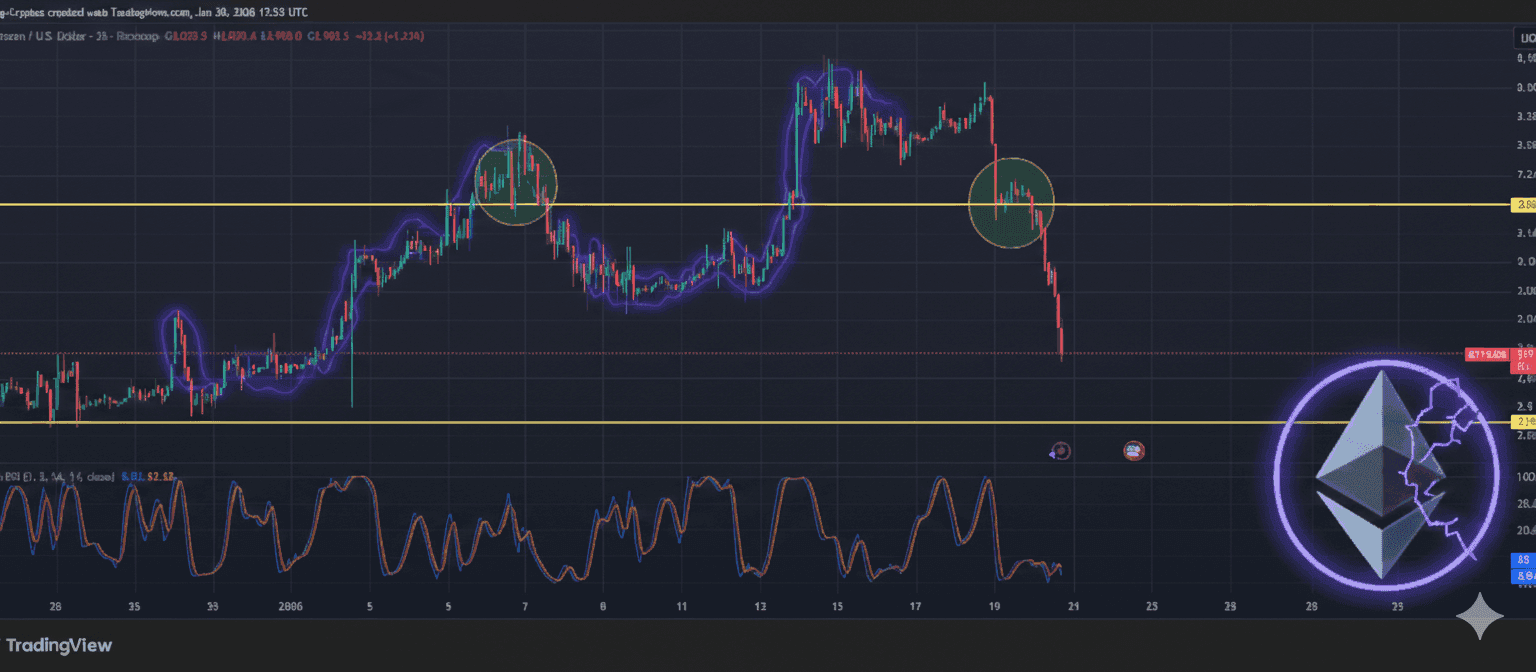
Major Security Breach: Ethereum Blockchain "Hacked" Following 2026 Roadmap Update
Reports of a fundamental compromise of the Ethereum blockchain sent shockwaves through the DeFi ecosystem today, sparking a massive sell-off before the truth emerged.


The Morning the "World Computer" Stood Still
Early this morning, things got tense fast. Several on-chain monitoring tools started flagging what looked like a serious issue on the Ethereum network—something as extreme as a “state-level” breach.
Within minutes, rumors spread across social media claiming that someone had taken control of the consensus layer, potentially allowing transactions to be reversed and $ETH to be double-spent. For about half an hour, the market reacted hard. Ethereum’s price swung wildly as panic selling kicked in across major decentralized exchanges.
Was the Ethereum Blockchain Actually Hacked?
If you are looking for confirmation of a total network collapse, you can rest easy. The Ethereum blockchain was not hacked. This "exploit" was an elaborate April Fools' Day scenario designed to test the community's response to misinformation and to highlight the recent "Quantum Readiness" upgrades in the 2026 Ethereum roadmap. While the data feeds on certain community dashboards were intentionally "glitched" to show a 51% attack in progress, the actual Ethereum blockchain remained perfectly secure and operational.
 Crypto taxes made simple: Compare the top-rated tools for 100% compliance and efficiency
Can a Blockchain Truly Be Hacked?
When people talk about "hacking a blockchain," they usually refer to one of two things:
- Protocol-Level Attacks (51% Attack): In a Proof of Stake (PoS) system like $Ethereum, an attacker would need to control more than half of all staked ETH. As of 2026, the cost to acquire enough ETH to do this would be in the hundreds of billions of dollars, making it economically irrational.
- Smart Contract Exploits: This is where most "hacks" actually happen. The blockchain itself is fine, but the code of a specific app (like a lending protocol) has a flaw.
Recent 2026 reports from Chainalysis confirm that while DeFi exploits continue to occur, the underlying Ethereum base layer has never been successfully "hacked" since its inception.
The Reality of Ethereum Security in 2026
Ethereum’s security model is currently at its strongest point in history. Following the 2022 "Merge," the network transitioned to Proof of Stake, and subsequent upgrades in 2025 and 2026 have focused on "Hardening the Layer 1 foundation."
Why a 51% Attack is Nearly Impossible
To compromise the network today, an attacker would face:
- Slashing: If a validator acts maliciously, their staked ETH is automatically destroyed by the protocol.
- Social Consensus: If a massive attack occurred, the community could coordinate a "hard fork" to ignore the attacker's chain, effectively vaporizing billions of dollars of the attacker's capital.
- Quantum Resistance: The 2026 roadmap explicitly introduced post-quantum cryptography to protect against future threats from advanced computing.

The "Hack" vs. Reality
| Feature | April Fools' Claim | Reality (2026 Status) |
|---|---|---|
| Network Status | Compromised / Hacked | Fully Functional |
| ETH Price | Crashing to Zero | Stable / Market Driven |
| Consensus | 51% Attack in Progress | 100% Decentralized Integrity |
| Transaction Finality | Reverted | Immutable |
Distinguishing Between Blockchain and Application Hacks
While the Ethereum blockchain is secure, users often confuse it with the applications running on top of it. For example, recent 2026 security audits have shown that 90% of "Ethereum hacks" are actually:
- Phishing: Users signing malicious permissions.
- Bridge Vulnerabilities: Flaws in the code that moves assets between different chains.
- Governance Attacks: Manipulating a DAO's voting system.
To stay safe, it is crucial to use secure hardware wallets and trade only on reputable exchange platforms that provide high-tier security features and insurance funds.