
AI Bubble Crash Warning: Could It Send Bitcoin to $20K?
The AI rotation already dragged crypto down — but analysts warn the real AI bubble crash is still ahead. Here's the bear case for Bitcoin at $20K, ETH at $800.





Which topics should we dive deeper into?
Select what genuinely interests you. Your picks feed directly into our editorial planning.
Crypto news that's actually worth your time.
Weekly. 60 seconds. Carefully curated by our editors: no hype, no promo flood, no spam.
The biggest fear hanging over markets right now isn't a crypto problem at all — it's artificial intelligence. A growing chorus of analysts is warning that the AI boom has inflated into a bubble, and that an AI bubble crash could send shockwaves straight into Bitcoin ($BTC) and the broader crypto market.
Here's the uncomfortable part: the early warning signs analysts flagged have already played out. Crypto has been bleeding for months as capital rotated out of digital assets and into AI stocks — Bitcoin has already fallen from above $100K to around $60K. So the real question now isn't "what if there's a small AI wobble." It's: what happens if the AI bubble actually crashes from here, on top of an already-weakened market?

What is the AI bubble — and why are analysts warning about it?
The "AI bubble" refers to the fear that valuations across AI stocks and infrastructure have inflated far beyond what the underlying economics justify. The warning signs are flashing in institutional surveys. In a Bank of America survey, 45% of fund managers flagged an "AI bubble" as the market's biggest tail risk, up from just 11% two months earlier, and more than half said they believe AI stocks are already trading in bubble territory due to huge spending and poor return on investment.
The core problem is a massive mismatch between spending and revenue. Financial analyst HedgieMarkets warned the AI boom risks a far harsher crash than the 2000s dot-com bubble, arguing the sector spent roughly $400 billion to generate just $60 billion in revenue in 2025, with most firms seeing no returns. Worse, the way it's been financed makes it fragile. Unlike the equity-funded dot-com era, today's AI expansion is debt-driven, raising the risk of cascading failures across private equity, banks, insurers and already-stressed consumers if growth expectations collapse.
The scale of the liquidity involved is staggering. Arthur Hayes estimates roughly $1.5 trillion in debt was issued by hyperscalers and AI infrastructure companies between November 2022 and mid-2026 — almost exactly matching the $1.5 trillion rise in M2 money supply over the same period — leading him to argue "AI sucked up all created dollars."

The correction analysts warned about has already started
This is the key context most coverage misses. Back in late 2025, when analysts first sounded the alarm, $Bitcoin was trading above $100K, and the warning was that an AI-driven risk-off move could drag it down toward $60K–$75K.
At the time, that was the bear case. Analysts warned Bitcoin could fall to the $60,000–$75,000 range if the AI bubble pops, with institutional support helping limit losses compared to past crashes. There was even a fundamental floor argument. Analyst Nomad Bullstreet suggested Bitcoin's price may not decline below its average production cost, estimated around $71,000–$75,000.
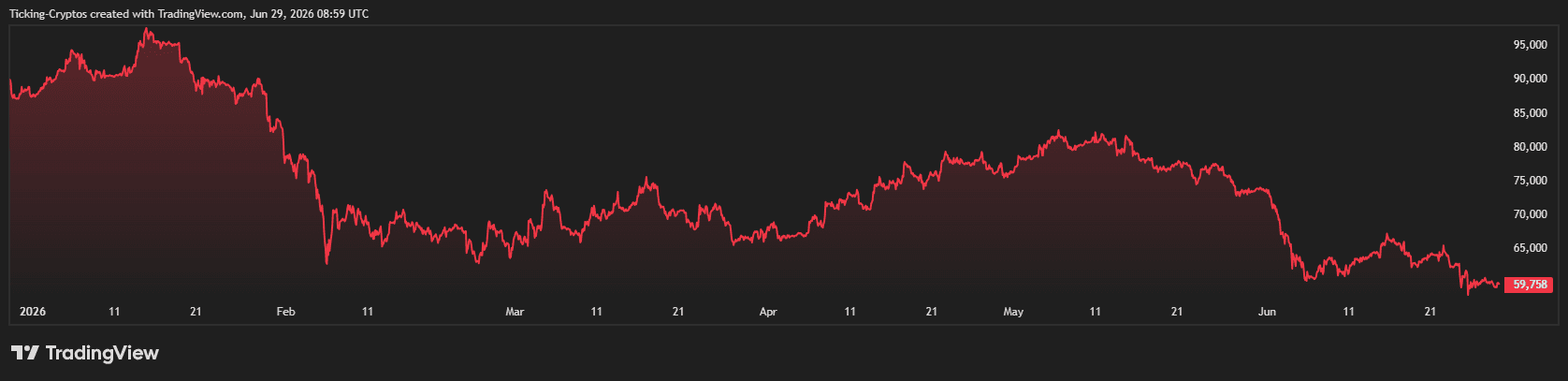
But here's the thing: the market has already fallen into that zone. Bitcoin slid from above $100K all the way to around $60K — and the driver was exactly the dynamic analysts described. The warning was never about AI directly attacking crypto code — it's about capital, the vast rivers of speculative money that have flowed into both sectors. A loss of faith in AI valuations would trigger a broad risk-off panic, and digital assets, sitting on the speculative end of the spectrum, often get sold first.
In other words, the mild correction the analysts forecast isn't a future risk — it's already happened. Capital has been rotating out of crypto and into AI infrastructure all year, and Bitcoin pre-emptively priced in a lot of that pain. The old $60K–$75K "production cost floor" has already broken.
That reframes everything. The relevant question is no longer "what if AI corrects" — it's "what if the bubble actually crashes now, from a starting point that's already deep in the red?"
How would a full AI bubble crash hit crypto from here?
If the warned-about rotation was phase one, an outright crash would be phase two — and it would land on a market with far less cushion than it had at $100K.
Crypto's behavior makes it especially vulnerable. The crypto market in 2026 continues to act as a high-beta risk asset, meaning it tends to amplify broader market sentiment, particularly in response to tech and AI-linked equity volatility — and a crash could trigger an outsized initial drop even if crypto fundamentals haven't changed.
There's also a forced-selling dimension that accelerates everything. Institutional funds and quantitative traders that allocate across both tech stocks and crypto may cut both simultaneously in times of stress, while leveraged positions in crypto futures and perpetuals can trigger cascading liquidations that accelerate the downward move. And the liquidity logic is brutal: if AI stocks collapse, no excess capital remains to flow into Bitcoin, and banks that lent against AI valuations would pull back credit, tightening conditions broadly.
It's not unanimously bearish, though. Some see a crash as ultimately bullish for Bitcoin further out. Arthur Hayes believes an AI bubble crash could create short-term pressure on Bitcoin, but his long-term outlook remains bullish because a major market shock could push governments and central banks back toward liquidity support, stimulus, and money printing — a "dump then pump" thesis.
The extreme bear case: Bitcoin at $20K, ETH at $800?
Here's the scenario circulating among the most aggressive bears — and a clear caveat upfront: these are worst-case, low-probability targets that would require a full systemic financial crisis, not just a sector correction.
But with Bitcoin already at ~$60K — having broken the old "floor" — a true AI bubble crash from current levels is what makes these deeper targets even thinkable. In a systemic unwind, where the AI bubble crashes violently, debt-driven contagion spreads to banks and credit markets, and crypto's high-beta nature plays out fully, the speculative cascade from here looks like:
- Bitcoin ($BTC) toward $20,000 — roughly another 65% down from current levels, requiring the institutional bid to evaporate entirely amid forced selling.
- Ethereum ($ETH) toward $800 — consistent with ETH's tendency to fall harder than BTC, amplified by relentless ETF outflows.
- XRP ($XRP) toward $0.30 — reflecting how altcoins typically lose multiples of Bitcoin's percentage in a deep flush.
- Solana ($SOL) toward $20 — among the most exposed, given its high-beta profile and reliance on speculative capital.
Be clear-eyed about what this requires: not just an AI correction (which has arguably already begun), but a full-blown global financial crisis with cascading credit failures. As one expert warned, economic historian Carlota Perez cautioned that an AI and crypto bust could lead to a global economic collapse of "unimaginable proportions." That's the tail risk these numbers reflect — a doomsday cascade, not the probable path.
Will the AI Bubble Affect Crypto Prices?
The framing that matters most: the correction analysts warned about has largely already happened — that's a big part of why Bitcoin fell from $100K to $60K as capital rotated into AI. What hasn't happened yet is a full AI bubble crash, and if it comes, it would hit a market that's already weakened and has far less cushion than it did six months ago.
That's what makes the extreme targets — BTC $20K, ETH $800, XRP $0.30, SOL $20 — worth knowing as a worst-case stress test. They're not a base-case forecast; they'd require systemic financial contagion, not just an AI sector wobble. But starting from $60K rather than $100K, the downside math is no longer as far-fetched as it once sounded.
The smart takeaway: respect the AI-correlation risk, keep your leverage in check, and watch the Nasdaq and AI-stock sentiment as closely as the crypto charts — because right now, that's where Bitcoin's next big move is being decided.
More on Bitcoin: All Bitcoin news at a glance
Related articles
- $1 Trillion Wiped: Risk-Off Storm Engulfs Stocks & Crypto
- Crypto Market Crash News As BTC Price Crash Back To 56K
- Bitcoin Hits $100K Again – But a Crash to $60K Might Be Next
- Bitcoin March 2025 Price Prediction: After the WORST February for BTC Price in 11 years - How Will March Unfold?
- Someone Asked Grok AI About the Bitcoin Crash - The Response Was Unexpected
Which topics should we dive deeper into?
Select what genuinely interests you. Your picks feed directly into our editorial planning.
Crypto news that's actually worth your time.
Weekly. 60 seconds. Carefully curated by our editors: no hype, no promo flood, no spam.

May 23, 2026 5:28 PM

Crypto Market Crash Deepens as Bitcoin Breaks Below $75K
Crypto market crash deepens as Bitcoin falls below $75K, Ethereum nears $2K, and altcoins slide amid liquidations and macro fears.
June 24, 2024 10:37 AM

Bitcoin Price Prediction: Can BTC Price Fall Below 50K?
The profitability of Bitcoin futures cash-and-carry trades has plummeted amid a significant crypto market selloff. What are the reasons behind the decline and what can traders expect next?
June 5, 2026 3:00 PM

Zcash Crash: ZEC Coin Falls 40% After AI Bug Scare — Here Are the Next Supports
Zcash crashes over 40% as AI-linked bug fears, whale shorts, liquidations, and weak crypto sentiment hit $ZEC.
February 3, 2025 3:00 PM

Crypto Crash Alert: Experts Warn of a Prolonged Bear Market
The crypto market is in freefall, with Bitcoin, Ethereum, and other major cryptocurrencies suffering heavy losses. As trade wars escalate and investors panic, the sell-off is intensifying.
June 2, 2026 6:13 PM

Bitcoin Crash to $67,400 as Google and Berkshire Team Up for Massive $80B AI Fund
Bitcoin fell 5.6% to $67,400 as a massive $80B AI capital raise backed by Berkshire Hathaway triggered an institutional capital rotation out of crypto.
June 9, 2026 6:39 PM

Crypto Market Crash Deepens as Stocks, Gold, and Bitcoin Sell Off Together
Crypto market crash deepens as Bitcoin, stocks, gold, silver, and oil fall together. Is this panic selling or a deeper market reset?
June 18, 2026 7:03 PM

Bitcoin Got the Wrong Crash: Oil Fell, But Crypto Took the Hit
Oil crashed after peace headlines, a move that should have helped Bitcoin. Instead, BTC fell below $63K, ETH dropped under $1,700, and crypto longs were wiped out.
April 7, 2026 3:54 PM

Crypto Market Prediction: Will Bitcoin Rally or Crash After US-Iran Decision?
Crypto markets await a key US-Iran decision. Will Bitcoin rally or crash next? Here are the 3 scenarios investors must watch.
June 24, 2026 7:05 PM

Bitcoin Crash: Will BTC Fall to $55K Next as Strategy Losses Deepen?
Bitcoin crashes below $60K as Strategy’s BTC losses deepen. Is $55K the next stop, or can the market recover?

March 3, 2026 5:40 PM

US Stock Market Volatility: Will Crypto Prices Crash Next?
US markets face uncertainty as geopolitical tensions rise. Discover if a stock market correction will trigger the next major crypto price crash.
February 12, 2026 4:35 PM

Bitcoin Price Crashes Below $66,000 as Liquidations Pass $50M
Bitcoin falls below $66,000 following a massive liquidation cascade and a bearish report from Standard Chartered. Regulatory hurdles further dampen the mood.
November 4, 2025 9:51 PM

BREAKING: Bitcoin Crashes Below $100K, Panic Grips the Crypto Market
Bitcoin just plunged below $100K for the first time in months, dragging the entire crypto market into a sea of red. Is this the start of the long-awaited correction?
April 7, 2025 11:06 AM

Why are Cryptos Crashing Today?
The cryptocurrency market experienced a significant downturn with Bitcoin falling to $76,300 and Ethereum plunging to $1,490. Here's why cryptos are crashing.
June 5, 2026 10:49 AM

Bitcoin Price Breaches $63,000 as Liquidations Deepen, But the Next Move is Worrisome
Bitcoin has breached the critical $63,000 mark as derivative liquidations deepen, signaling a potentially more worrisome structural breakdown ahead.
May 28, 2026 6:42 PM

Crypto Market Crash Deepens While S&P 500 Hits New All-Time High: Why Is Bitcoin Falling?
Crypto prices fall as Bitcoin, Ethereum, and Solana struggle while the S&P 500 hits a record high. Why is crypto not following stocks?
August 21, 2025 4:58 PM

Bitcoin Price About To CRASH as Fed Pushes Back on September Rate Cut
A Fed official dismissed the case for a September rate cut, sending shockwaves through markets. With Bitcoin showing a familiar topping pattern, is a crash next?
August 28, 2024 6:13 PM

Bitcoin Price CRASH: BTC Falls Below $60K, Eyes Support at $56.7K
BTC fails to breach the $66K level, crashing below $60K to around $58K. Can Bitcoin find support at $56.7K, or is another drop on the horizon?
February 5, 2026 8:53 PM
Can Bitcoin Crash to Zero? Analyzing Michael Burry’s Recent Warnings
With Michael Burry warning of a "death spiral" and Bitcoin falling below $64,000, we analyze if BTC could actually hit zero or if this is a market reset.
March 27, 2026 9:47 PM

Gold vs Bitcoin Analysis 2026: Why Both Are Dropping Despite Geopolitical Risks
Gold and Bitcoin prices are facing a sharp 2026 correction. Why is the correlation between XAU and BTC shifting amid Fed hawkishness and Middle East risks?

February 5, 2026 8:21 PM

Solana Price Crash: SOL coin Hits $81 as Bitcoin Drops Below $66K
Solana crashes to $81 as Bitcoin falls below $66,000. Discover the next SOL price targets and why the market is bleeding.
November 17, 2025 8:55 PM

BREAKING: Ethereum Price Crashes Below $3,000 as Bitcoin Triggers Market Meltdown
Ethereum drops under $3,000 after Bitcoin’s fall below 92K. Chart signals deeper weakness as key support levels fail.
February 9, 2026 11:00 AM

Bitcoin Price Today: BTC Coin Reclaims $71,000 After Historic Flash Crash to $60,000
Bitcoin price recovers to $71,000 following a volatile week. Institutional "buy the dip" activity offsets retail panic as BTC stabilizes post-flash crash.
September 29, 2026 10:38 AM

Bitcoin Falls Toward $83,000 as Trump Rejects Iran Ceasefire Deal
Bitcoin slipped toward $83,000 after Trump rejected Iran's Hormuz proposal, sending oil above $100 and wiping out $478 million in crypto liquidations.
March 15, 2025 5:40 PM

Bitcoin Price Prediction March 2025 with FOMC and TRUMP in Play
Bitcoin price prediction for March 2025 is one to expect, ahead of the upcoming FOMC meeting and Trump's strategic crypto reserve. What to expect for BTC price?
March 31, 2026 7:57 PM

What Threat Could Crash the Crypto Market? War-End Rally Faces Hidden Risk
Crypto markets surge on war-end hopes, but threats to US companies and rising oil prices could trigger a sudden crash.


More from CryptoTicker