
Bitcoin Crash: Will BTC Fall to $55K Next as Strategy Losses Deepen?
Bitcoin crashes below $60K as Strategy’s BTC losses deepen. Is $55K the next stop, or can the market recover?





Which topics should we dive deeper into?
Select what genuinely interests you. Your picks feed directly into our editorial planning.
Crypto news that's actually worth your time.
Weekly. 60 seconds. Carefully curated by our editors: no hype, no promo flood, no spam.
Bitcoin Crash Sends BTC Below $60K
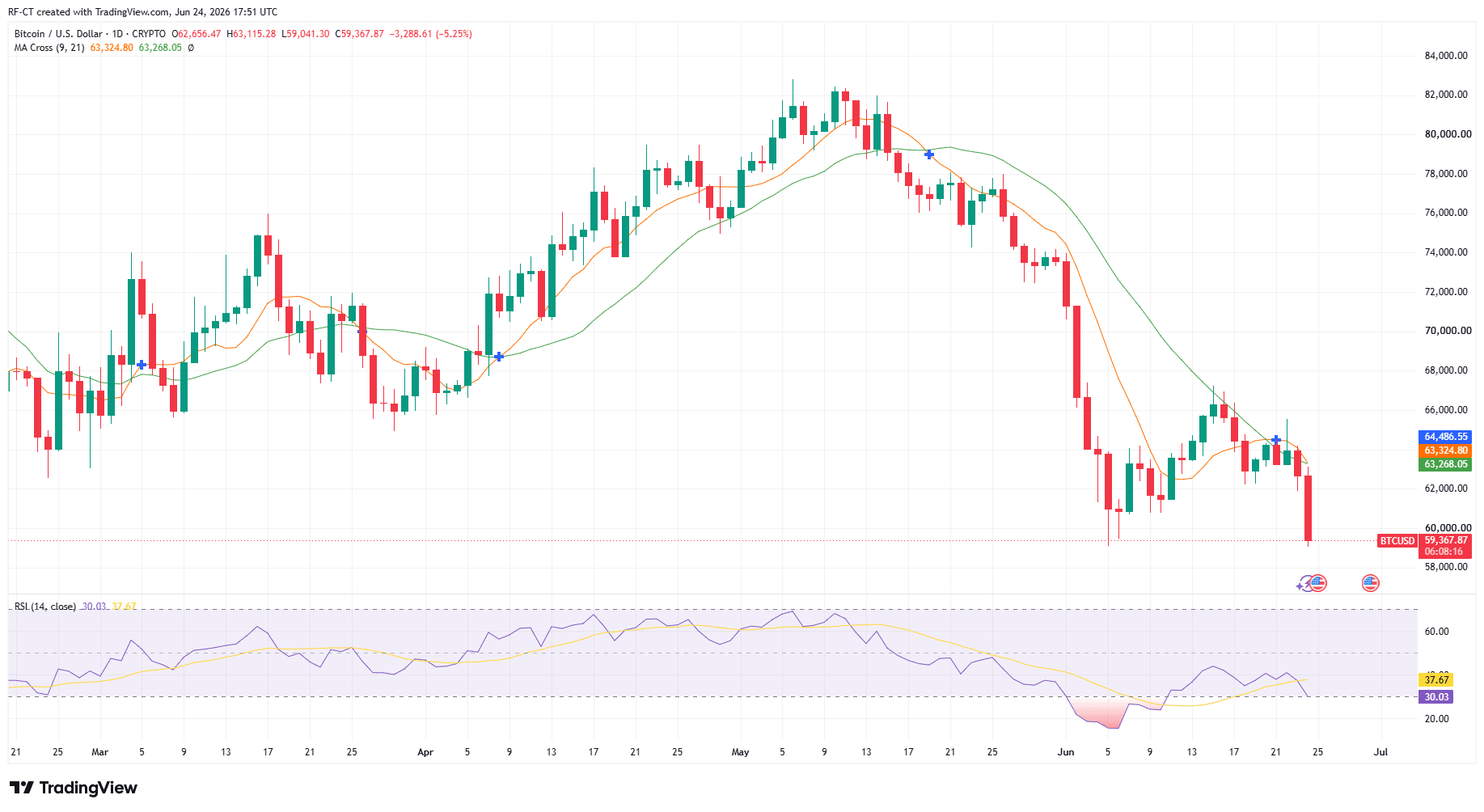
Bitcoin is back under pressure after falling below the key $60,000 level, triggering a fresh wave of fear across the crypto market. The move came as major cryptocurrencies turned red, with Ethereum slipping below $1,600 and several top altcoins posting sharp daily losses.
This is no longer just a normal pullback. Bitcoin has now broken one of the most important psychological levels in the market, and traders are asking whether BTC could be heading toward $55,000 next.
The crash also comes at a dangerous time for crypto sentiment. Recent articles and market reactions already focused on the broader sell-off across stocks, crypto, and metals. But the latest move adds another layer of pressure: Strategy, formerly MicroStrategy, is now becoming one of the biggest fear points in the Bitcoin market.
Why This Bitcoin Crash Feels Different
Bitcoin has corrected many times before. What makes this drop more sensitive is the combination of three factors happening at once.
First, BTC has lost the $60,000 level, which many traders were watching as a key short-term support zone. Once this level broke, selling pressure accelerated quickly.
Second, Ethereum also dropped below $1,600, confirming that the weakness is not limited to Bitcoin. The broader crypto market is bleeding, with major coins such as BNB, XRP, Solana, Dogecoin, Zcash, Chainlink, and others also trading in the red.
Third, Strategy’s stock is crashing alongside Bitcoin. That matters because Strategy is not just another crypto-related stock. It is the biggest corporate Bitcoin holder in the world, and its entire market story has become deeply tied to BTC.
When Bitcoin falls and MSTR falls at the same time, investors start asking a much bigger question: is the Bitcoin treasury trade now becoming a risk instead of a strength?
Strategy’s Bitcoin Losses Are Now the Market’s Big Fear
Strategy currently holds around 847,363 BTC, acquired at an average price of roughly $75,651 per Bitcoin. That puts the company’s total Bitcoin acquisition cost at around $64.1 billion.
With Bitcoin trading near $59,300, Strategy’s Bitcoin stack is worth roughly $50.2 billion. That means the company is sitting on an estimated paper loss of about $13.9 billion compared with its acquisition cost.
If Bitcoin falls to $55,000, the value of Strategy’s BTC holdings would drop to around $46.6 billion. In that scenario, the estimated paper loss would widen to nearly $17.5 billion.
That does not mean Strategy has lost this money in cash. These are unrealized losses unless the company sells Bitcoin. But the market does not always wait for realized losses. It prices fear, pressure, and risk before the actual event happens.
This is why MSTR is now becoming such a central part of the Bitcoin crash story.
Are Strategy’s Losses Real or Just Paper Losses?
For investors, the answer is both.
On one side, Strategy’s Bitcoin losses are mostly paper losses as long as the company continues holding its BTC. If it does not sell, there is no direct realized loss from selling coins at a lower price.
But accounting-wise, the situation is more complicated. Under the newer fair-value accounting rules for crypto assets, changes in the value of Bitcoin can affect reported earnings. That means a major Bitcoin decline can show up as a fair-value loss on the income statement, even if the company does not sell the coins.
So the market is not only watching whether Strategy sells Bitcoin. It is also watching how the decline affects its balance sheet, its stock price, its ability to raise money, and investor confidence in the entire Bitcoin treasury model.
Could Strategy Be Forced to Sell Bitcoin?
There is no evidence that Strategy is being forced to sell Bitcoin right now. That is important.
The danger is not that forced selling is confirmed. The danger is that the fear of forced selling starts to dominate the market.
Strategy built its Bitcoin strategy by using capital markets, including stock issuance, convertible debt, and preferred shares. That model works best when MSTR trades at a strong premium and investors are willing to finance more Bitcoin accumulation.
But when BTC falls and MSTR crashes, that model becomes more fragile. If the stock keeps dropping, raising new capital becomes harder. If raising capital becomes harder, investors may start worrying about dilution, debt pressure, dividend obligations, or even the possibility that Strategy may eventually need to sell Bitcoin to manage obligations.
Again, this does not mean a sale is happening now. But markets often sell first and ask questions later.
That is why Strategy’s stock crash matters so much for Bitcoin. MSTR has become a leveraged symbol of Bitcoin confidence. If that confidence breaks, it can increase panic across the entire crypto market.

Bitcoin Price Prediction: Is $55K Next?
The key level now is $60,000.
If Bitcoin fails to reclaim $60,000 quickly, the bearish scenario becomes stronger. In that case, BTC could continue sliding toward the next major support zone around $55,000.
A move to $55,000 would not be surprising if panic continues across crypto and if MSTR remains under pressure. It would also represent a deeper reset of the Bitcoin rally, forcing traders to question whether the market is entering a longer correction phase.
The bearish path looks like this:
Bitcoin fails to recover $60,000, sellers defend the $60,000 to $62,000 zone, MSTR continues falling, and market fear pushes BTC toward $55,000.
However, the bullish case is not dead yet.
If Bitcoin quickly reclaims $60,000 and then moves back above $62,000, the crash could turn into a sharp bear trap. In that case, traders may see the drop as panic selling rather than the start of a deeper collapse.
For now, BTC needs to recover $60,000 first. Without that, the $55,000 target becomes the main level to watch.
Is This the End of the Crypto Era?
No, this does not look like the end of crypto. But it may be the end of the easy crypto leverage era.
The last cycle was driven by ETF optimism, institutional buying, treasury companies, corporate Bitcoin accumulation, and the idea that Bitcoin could keep rising as long as new capital kept flowing in.
Now the market is testing that idea.
If Strategy, the most famous Bitcoin treasury company, is sitting on massive paper losses while its stock crashes, investors may become more cautious toward every company trying to copy the same model.
That does not kill Bitcoin. But it does change the market narrative.
Bitcoin is no longer only trading on ETF flows, macro news, or halving-cycle expectations. It is now also trading on whether the biggest corporate BTC holder can survive a major drawdown without triggering more fear.
What Happens Next?
The next few days are critical.
If Bitcoin stabilizes above $60,000, the market may calm down and treat this crash as a painful but temporary correction. If BTC loses momentum and fails to recover, $55,000 becomes the next major downside target.
The Strategy situation will also be important. If MSTR stabilizes, it could reduce panic around the Bitcoin treasury trade. But if MSTR continues crashing, Bitcoin may face even more pressure as investors start questioning whether corporate BTC accumulation has turned from a bullish narrative into a systemic market risk.
For now, the Bitcoin price prediction is simple: BTC must reclaim $60,000 to avoid a deeper drop. If it fails, $55,000 could be next.
More on Bitcoin: All Bitcoin news at a glance
Related articles
- Bitcoin Price Prediction: Has Saylor’s Strategy Lost Its BTC Premium?
- Bitcoin Got the Wrong Crash: Oil Fell, But Crypto Took the Hit
- Crypto Market Crash News As BTC Price Crash Back To 56K
- BREAKING: Bitcoin Crashes Below $100K, Panic Grips the Crypto Market
- Bitcoin Price Prediction: Can BTC Price Fall Below 50K?
Which topics should we dive deeper into?
Select what genuinely interests you. Your picks feed directly into our editorial planning.
Crypto news that's actually worth your time.
Weekly. 60 seconds. Carefully curated by our editors: no hype, no promo flood, no spam.

November 5, 2025 1:16 PM

$1 Trillion Wiped: Risk-Off Storm Engulfs Stocks & Crypto
Global markets plunge as tech stocks and crypto crash, wiping over $1 trillion in value amid AI bubble fears and investor risk-off panic.
January 11, 2026 7:34 PM

Saylor Teases New Bitcoin Buy as Strategy BTC Holdings Hit Record Highs
Michael Saylor hints at new Bitcoin buys as Strategy holdings hit 673,783 BTC. Here's the latest MSTR treasury updates and its market impact.
June 9, 2026 6:39 PM

Crypto Market Crash Deepens as Stocks, Gold, and Bitcoin Sell Off Together
Crypto market crash deepens as Bitcoin, stocks, gold, silver, and oil fall together. Is this panic selling or a deeper market reset?

March 3, 2026 5:40 PM

US Stock Market Volatility: Will Crypto Prices Crash Next?
US markets face uncertainty as geopolitical tensions rise. Discover if a stock market correction will trigger the next major crypto price crash.
February 12, 2026 4:35 PM

Bitcoin Price Crashes Below $66,000 as Liquidations Pass $50M
Bitcoin falls below $66,000 following a massive liquidation cascade and a bearish report from Standard Chartered. Regulatory hurdles further dampen the mood.
February 9, 2026 11:00 AM

Bitcoin Price Today: BTC Coin Reclaims $71,000 After Historic Flash Crash to $60,000
Bitcoin price recovers to $71,000 following a volatile week. Institutional "buy the dip" activity offsets retail panic as BTC stabilizes post-flash crash.
December 12, 2024 11:28 AM

Bitcoin Hits $100K Again – But a Crash to $60K Might Be Next
Bitcoin is back at $100K after dropping to $94K, but concerns are growing as BTC faces strong resistance at $104K. Will the bullrun continue, or is a major crash coming in January?
March 30, 2026 6:35 PM

Tech Giants Lose $5 Trillion: Why Crypto Is Holding Steady (For Now)
The Magnificent 7 tech giants have wiped out $5 trillion in market value. While crypto prices remain stable today, historical trends suggest a potential shift.
March 27, 2026 9:48 PM

$900 Billion Surge — But Markets May Be Pricing a Peace That Doesn’t Exist
$900B added to US stocks as Bitcoin surges and oil crashes after Trump’s Iran statement—but is the market pricing a false peace?
May 23, 2026 5:28 PM

Crypto Market Crash Deepens as Bitcoin Breaks Below $75K
Crypto market crash deepens as Bitcoin falls below $75K, Ethereum nears $2K, and altcoins slide amid liquidations and macro fears.
April 22, 2026 9:11 AM

Bitcoin Price Hits $78,000 as Ceasefire Extension Ignites Bullish Momentum
Bitcoin breaches $78,000 following the US-Iran ceasefire extension and a $2.5 billion MSTR purchase. Here is the weekly BTC chart for key 2026 price targets.
July 1, 2024 9:20 AM

Bitcoin News Today: Why Is Bitcoin Price Up Starting July?
Starting July, recent market movements, political debates, and court rulings are shaping the future of Bitcoin and the broader crypto market. Here are the latest insights and analysis...
March 31, 2026 7:57 PM

What Threat Could Crash the Crypto Market? War-End Rally Faces Hidden Risk
Crypto markets surge on war-end hopes, but threats to US companies and rising oil prices could trigger a sudden crash.
October 21, 2025 4:17 PM

Bitcoin Surges Past $112,000 as the Fed Opens Doors to Crypto: What’s Next?
Bitcoin jumps above $112,000 after the U.S. Federal Reserve hinted at granting crypto firms access to its payment network. Here’s what this means for BTC and the broader market.
March 4, 2025 9:17 PM

Bitcoin Price Prediction ahead of the Upcoming White House Crypto Summit
With the remarkable Bitcoin volatility, and after briefly surging earlier this week before dropping again. Is a Bitcoin price surge expected ahead of or after the upcoming White House Crypto Summit?
May 15, 2024 6:05 PM

Bitcoin Price Prediction: 60K CRITICAL LEVEL, What Next?
After a recent crash, the crypto market has shown resilience, with Bitcoin surging over 3% in the past day. What's next for BTC as it hovers around $60,000?
May 8, 2026 9:32 AM

Crypto Crash Today: Why Is Bitcoin Crashing below 80K?
Bitcoin price has slipped below $80,000 as geopolitical tensions and profit-taking trigger a crypto crash today. Here are the market dynamics behind the BTC drop.
April 27, 2026 6:09 PM

Crypto News Today: Why Bitcoin Dropped Below $77K After Pumping to $79K
Bitcoin dropped below $77K after briefly pumping to $79K, as failed breakout momentum, liquidations, and weak altcoins pressured crypto.
August 25, 2026 3:56 PM

Bitcoin Price Cracks $80,000 Then Cools While Altcoins Push Higher
Bitcoin cleared 80,000 dollars for the first time since May, then slipped to 79,100. Chart analysis, upside targets and key support levels.
June 5, 2026 10:49 AM

Bitcoin Price Breaches $63,000 as Liquidations Deepen, But the Next Move is Worrisome
Bitcoin has breached the critical $63,000 mark as derivative liquidations deepen, signaling a potentially more worrisome structural breakdown ahead.
February 8, 2026 5:42 PM

BREAKING: Michael Saylor Hints at Buying More Bitcoin
Michael Saylor sparks excitement with a new "More Orange" teaser on X. Explore Strategy's latest Bitcoin holdings and what these hints mean for the market.
June 25, 2024 12:18 PM

After Bitcoin Crash, Will Altcoins Gains Reach 500%?
In the latest Bitcoin News today, and mainly after the Bitcoin Crash, crypto analysts predict a major shift towards altcoins with market corrections near the end and BTC dominance drop. Will the altcoins gain reach 500%?
April 30, 2024 2:52 PM

What Bitcoin Strategy yields $400M in Profits?
A Bitcoin Strategy adopted by a major company's co-founder reported to have earned him $400M in profits: Fact or Fiction?
May 15, 2026 3:56 PM

Bitcoin Price Drops Below $80,000 as $700 Billion Wiped from US Stocks
Bitcoin plunges under $80,000 as US stock markets lose $700 billion at the open. Gold and silver see $1.5 trillion wiped in a massive global asset liquidation.
August 21, 2026 7:43 AM

Bitcoin Price Above $75,000: 3 Reasons Why BTC Is Exploding
Bitcoin cleared $75,000 for the first time since May and is up almost 20% this week. Here are the 3 reasons and the next target.


More from CryptoTicker