
Offensive Token on Binance Smart Chain: Should Binance Have Intervened?
In February 2021 an offensive token project launched on Binance Smart Chain and sparked calls for Binance to step in. Updated with what happened next.




Which topics should we dive deeper into?
Select what genuinely interests you. Your picks feed directly into our editorial planning.
Crypto news that's actually worth your time.
Weekly. 60 seconds. Carefully curated by our editors: no hype, no promo flood, no spam.
Update 25 September 2026: This commentary first appeared on 28 February 2021. Since then, Binance Smart Chain has been renamed BNB Smart Chain, the Slave.Finance website is no longer reachable, and the SEC case against Ripple ended in August 2025. The section "What has changed since 2021?" below covers what happened next.
Every now and then, we witness new coins arising. They usually run either on their own blockchain, or use other well-established ones to gain exposure, efficiency and use the already-in-use robust technology. In February 2021, an ugly case came to light: a racist token project surfaced on Twitter. It used Binance Smart Chain (BSC), the network developed by Binance. With Binance rising fast, the company suddenly faced two very hard choices.
What was going on with Binance?
Binance is a cryptocurrency exchange that launched in 2017. It later introduced its own cryptocurrency, Binance Coin (BNB), mainly used on the platform to pay fees and to trade. BNB started out as an ERC-20 token on Ethereum, but later moved to Binance's own networks, Binance Chain and then Binance Smart Chain. Where BNB trades today is tracked on our BNB price prediction page.
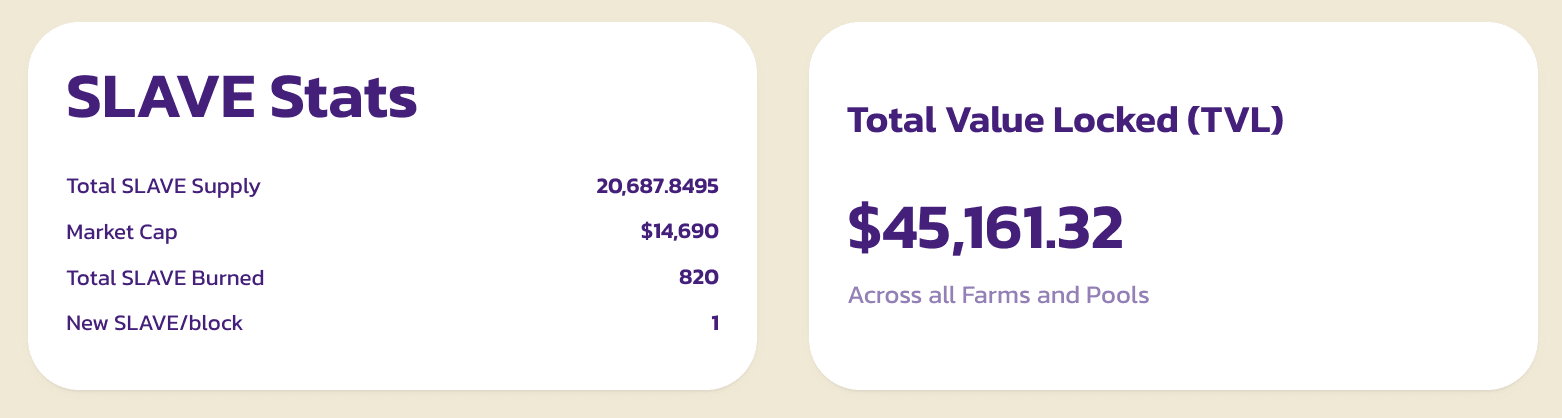
In late February 2021, word surfaced about a project that was built on racism, called Slave.Finance. It used Black people as its mascot. Twitter filled with angry users demanding the immediate removal of the project and reporting its social media channels. At the time, the project claimed a market capitalisation of USD 14,690 and a total value locked of USD 45,161 for APY farming.
Should Binance Interfere?
In order to correctly assess if Binance should interfere, we need to throw that same old concept again, decentralization. If Binance would interfere and stop this project, Binance would be seen as a centralized company, interfering in its decentralized blockchain. Most cryptocurrency enthusiasts support blockchain’s real-life applications. Let’s take two potential solutions ahead:
- Binance interferes, blocks the project, but becomes tainted with centralization.
- Binance doesn’t interfere, and in turn becomes known as the holder of “dark cryptos”, pretty much like the dark web, which is illegal and in turn, brings more problems with countries across the world.
Binance and Ripple similarities?
Ripple was always a controversial company in the crypto sphere. It is a centralized company with a board of directors, next to a decentralized blockchain, the XRP Ledger. Many investors flee centralization, because for them it goes directly against the core value of cryptocurrencies. Believers in Ripple, on the other hand, think that a balance between both is the better alternative.
Binance's critics might want the company to step in and block a racist project, but in 2021 many argued this would go against cryptocurrencies as a whole. It was also not the first controversy for Binance: at the time, the exchange faced heated criticism over allegedly inflated trading volumes.
What's the solution?
In 2021, our answer was simple: stop giving attention to such projects. Crypto projects take off when media attention is handed to them. Supply and demand is the main driver for cryptos, and cutting off the demand for such a token ends it. The people behind this project would probably stop once nobody paid attention anymore. That attention might even have been the only reason they started it.
Asking Binance to intervene in bad projects was, in our view back then, like asking Bitcoin miners to refuse money laundering transactions. Intervention in decentralized projects should not be an option. Maybe we will see decentralized projects in the future that offer this kind of intervention by design.
What has changed since 2021?
Five years later, several of the questions in this piece have been answered by events:
- New name, same question. On 15 February 2022, Binance Smart Chain was renamed BNB Smart Chain and Binance Chain became BNB Beacon Chain, together branded BNB Chain. Binance described itself as only one contributor among many, and the number of validators rose from 21 to 41.
- The network was stopped once. On 6 October 2022, attackers exploited the BSC Token Hub bridge and minted around 2 million BNB, worth roughly USD 566 million at the time. The validators coordinated to halt BNB Smart Chain for about eight hours and shipped a patch that stopped the attacker from moving more funds. The episode showed that a small validator set can pause a chain, which is exactly the kind of central lever this article discussed.
- Ripple's case is closed. In July 2023, Judge Analisa Torres ruled that XRP sold on public exchanges was not offered as a security, while Ripple's direct institutional sales were. The court imposed a USD 125 million penalty in 2024, and in August 2025 both Ripple and the SEC dropped their appeals, which ended the case. Current XRP levels are on our XRP price prediction page.
- Slave.Finance is gone. Its domain no longer resolves, and the project played no further role. The demand-side answer from 2021 largely played out.
The core dilemma stays: every chain with a small, identifiable validator set can act against a token or a transaction, and every time it does, it trades a bit of neutrality for protection. Anyone choosing where to trade can compare how exchanges handle listings and delistings in our exchange comparison.
Stay Ahead, Stay Updated
Rudy Fares
Transparency note: This article was produced with the assistance of artificial intelligence and reviewed by our editorial team before publication. All figures and claims were checked against the primary sources linked in the text. The feature image was generated with AI.
Related articles
- BNB Pasteur Hardfork of August 25, 2026: What Holders, Traders and Delegators Should Know Afterwards
- How to Add Binance Smart Chain to Metamask?
- Binance Smart Chain – Devs Are Worried About Blockchain’s Unsustainability
- Binance Smart Bridge Goes Down After $31M Suspected Rugpull
- XRP vs ADA in 2025: Which Crypto Will Lead the Next Bull Run?
Which topics should we dive deeper into?
Select what genuinely interests you. Your picks feed directly into our editorial planning.
Crypto news that's actually worth your time.
Weekly. 60 seconds. Carefully curated by our editors: no hype, no promo flood, no spam.

August 30, 2020 8:16 AM
What is Binance Smart Chain?
In April 2020, Binance announced its new Binance Smart Chain. This new blockchain will work in parallel with the exchange’s primary blockchain, the Binance Chain. Both chains are being improved at exceptional speed. This post will take you through a […]

September 27, 2026 7:25 PM

BNB Chain in Practice: BEP20, BscScan and the Fees
A BEP20 transfer on BNB Chain costs less than half a cent, yet the address format does not tell you whether you are on the right network. We measured eleven real transfers on the chain and show wallet, explorer, approvals and the trap in the decimal places.

November 17, 2022 12:01 AM

Binance Coin News Ticker – CryptoTicker
Binance Coin is the native coin of the world’s leading cryptocurrency exchange Binance. The coin is native on the Binance Chain, a centralized blockchain. The coin is also supported on the Binance Smart Chain, a new blockchain by Binance that […]

October 26, 2021 12:42 PM

Huobi HECO Chain: What You Should Know About It
The network's growth brought exchange chains like Binance Smart Chain (BSC) and Huobi ECO Chain (HECO). Let's talk about HECO.

October 21, 2026 10:21 PM
XRP price prediction: whale outflows from Binance fall to $49.7 million: twice as strong as Bitcoin
Analysis: XRP whale outflows at Binance have dropped to their lowest level since October 2021, and the price is rising twice as strongly as Bitcoin on Wednesday evening. The number is documented, the interpretation is open. What a drying-up outflow means for holders in Germany comes further down.

October 3, 2026 10:38 AM

44 Percent Below the Record: BNB's 37th Burn Follows in Mid-October
A year ago BNB stood at $1,370; today it is around $767. The price has been swinging between $750 and $800 for weeks, and the next quarterly burn is due around the anniversary of the record. Here are the levels that count and what the burn actually does.
September 20, 2026 7:10 PM

BNB Is Back Above $100 Billion: What Is Really Behind Binance Chain's Lead
BNB is back above $100 billion, and the reason doing the rounds is always the same figure: $3.6 billion of growth in real-world assets, more than on any other chain. The number is right. It just measures something other than what the headlines suggest.

June 1, 2026 1:17 PM
Binance Launches US Stock Trading with Upcoming bStocks Tokenization on BNB Chain
Binance has introduced zero-commission US stock and ETF trading for non-US users, with plans to launch tokenized on-chain equities via bStocks.
September 29, 2024 2:31 PM

How CZ Release Could Impact BNB Token and Boost Key Projects on BNB Chain
The CZ release, Binance CEO Changpeng Zhao, could signal positive developments for the BNB token and the wider BNB Chain ecosystem.
August 23, 2026 7:24 PM

SAND Bridge Exploit at The Sandbox: Why Not to Trade SAND on Base and BNB Chain Now
An attack on The Sandbox's cross-chain bridge created unbacked SAND tokens on Base and BNB Smart Chain on August 22, 2026. Bridging is halted; holdings on Ethereum and Polygon are unaffected, according to the studio.
April 2, 2025 10:13 AM

Breaking: BNB ETF Launch might be very BIG, here's why
VanEck Investment Company plans to launch a BNB exchange-traded fund (ETF). If approved, this would be the first BNB ETF listed in the U.S. Here’s what you need to know.
December 29, 2019 3:31 PM
Do Ripple validators get Paid?
Ripple is one of the oldest cryptocurrencies on the market. It was traded in 2013 and is now the third largest by market capitalization. The Ripple protocol was formed in 2004 by Ryan Fugger. From 2013 the company Ripple Labs took […]
January 16, 2025 12:01 PM

Ripple SEC Lawsuit Updates and Outlook under Trump’s Pro Crypto SEC
The Ripple SEC lawsuit updates on the appeal filed by the SEC, the cross-appeal by Ripple, and what to expect soon under Trump's pro-crypto administration with the new SEC leadership, all in this article!
September 13, 2024 12:23 PM
Ripple, SEC, and Grayscale: The Ripple Effect on XRP Price
This is how Ripple’s legal battles and Grayscale’s XRP Trust launch are shaping the future of XRP and the crypto market...
September 4, 2026 7:20 PM
SAND Compensation After the Bridge Exploit: How to Get Your Frozen Tokens Back
The Sandbox intends to compensate every holder whose bridged SAND on Base and BNB Smart Chain was frozen, one for one in SAND on Ethereum. Anyone whose balance sits at an exchange need do nothing; anyone self-custodying does.
January 1, 2025 10:30 AM

Top 5 Blockchains to Invest in for 2025
Looking to invest in the blockchain space? Here are the top 5 blockchains for 2025, featuring innovation, scalability, and promising opportunities. Explore their potential and key features in this guide.

February 2, 2024 1:30 PM
Binance Froze $4.2 million in XRP following a breach of Ripple co-founder’s wallet
Discover how Binance acted swiftly to secure $4.2M in XRP after a significant hacking incident targeting Ripple co-founder's personal wallet.
June 15, 2023 5:35 PM
SEC Binance Lawsuit – Does the Authority Know Ripple (XRP) Lost?
The XRP community is optimistic that Ripple will be acquitted in the lawsuit over illegal securities trading. What will happen next?
December 21, 2021 9:13 AM

3 Good Reasons why you should Invest in PancakeSwap Crypto
Let's talk in this article about why Pancakeswap crypto is a good investment option by laying 3 strong pillars in the Pancakeswap infrastructure.
September 21, 2021 9:58 AM
How To Trade And Make Profits On PancakeSwap
Pancakeswap crypto was created in September 2020 on Binance Smart Chain. In this article, we will be looking at How to use Pancakeswap.
February 20, 2021 11:14 PM
Binance Smart Chain Topped Up Ethereum’s Transaction – But Did It?
Binance Chief Changpeng Zhao surprised the crypto world on Feb 10, when he announced that the Binance Smart Chain has flipped the Ethereum daily transactions count or transactions volume. It was met with both enthusiasm and astonishment from the community. Then recently, it was claimed again that the BSC now does 3 times the transactions carried out on the Ethereum blockchain. Though, this isn’t apparent on charts detailing the value moving across networks. According to Money Movers website, the Binance’s blockchain doesn’t register in the top 5 blockchains by settled value.
December 16, 2024 9:47 PM
XRP’s RLUSD Stablecoin Launches Tomorrow – What You Need to Know
Ripple is set to disrupt the $140B stablecoin market with the launch of RLUSD, a fully-backed USD stablecoin. Backed by prominent industry figures, this launch could be a game-changer for the crypto world.
December 19, 2024 2:31 PM
XRP Crash: What Happened and What's Next for the Last Days of 2024?
XRP recent crash has left investors on edge as the crypto faces significant market turbulence. But what are the reasons behind the drop?
September 23, 2024 8:44 AM
Is it a Good Idea to Buy XRP below $0.60?
With recent XRP price drops positioning it below the $0.60 mark, investors are left pondering. Is it a good idea to buy XRP below $0.60?
October 7, 2024 6:01 PM
As Ripple vs SEC Deadline For Appeal Ends Today, What Comes Next For XRP Price?
What comes next for XRP price, as the Ripple and SEC legal battles continue, along with other major news for Ripple and its XRP Ledger? Let's find out...
More from CryptoTicker