
Fed Rate Decision: Every FOMC Date to 2027 and How Bitcoin Reacted
Analysis: The Fed held rates at 3.75% to 4.00% on 28 October 2026, and the next decision follows on 9 December at 2:00 p.m. ET. Here are all FOMC dates to the end of 2027, the current target range and how Bitcoin reacted to the last ten decisions.





Which topics should we dive deeper into?
Select what genuinely interests you. Your picks feed directly into our editorial planning.
Crypto news that's actually worth your time.
Weekly. 60 seconds. Carefully curated by our editors: no hype, no promo flood, no spam.
At its Fed rate decision on 28 October 2026 the Federal Open Market Committee held the target range for the federal funds rate at 3.75% to 4.00%, by a 10–2 vote. The next Fed rate decision is due on Wednesday, 9 December 2026, at 2:00 p.m. ET (19:00 UTC), the last meeting of the year and one with new projections. The record also shows how Bitcoin traded around the last ten decisions: the table further down lists the price at the hour of each announcement, 24 hours later and seven days later. Our assessment, set out in the section on Bitcoin's reaction, is that the direction of the rate move did not predict the direction of the price in this series.
Key points
- Next Fed decision: 9 December 2026, 2:00 p.m. ET, press conference at 2:30 p.m. In London that is 7:00 p.m. and in Frankfurt 8:00 p.m.
- Decision of 28 October: hold at 3.75% to 4.00% by a 10–2 vote. Lisa Cook and Beth Hammack wanted to hike already.
- Current rate: 3.75% to 4.00% since 16 September 2026, the first hike since July 2023.
- December expectations: traders on the prediction market Polymarket give a quarter-point hike on 9 December a 76.5% chance (as of 29 October 2026).
- Fed projection: the median official sees the policy rate at 4.1% at the end of 2026, one step above today's range.
- Bitcoin after ten decisions: higher after 24 hours five times and lower five times, up 0.1% after 28 October. A week later it was lower in six of nine cases and higher in three. The best week followed the September hike, a gain of 11.4%.
What Fed week means for Bitcoin's key levels over the coming days is covered in our Bitcoin price prediction for the Fed meeting and the options expiry. This page remains the reference: dates, decisions and market reactions, updated after every meeting.
 Compare exchanges before the next Fed meeting
Fed rate decision on 28 October 2026: hold at 3.75% to 4.00%
The committee kept the target range at 3.75% to 4.00% on 28 October by a 10–2 vote, according to the statement of 28 October. Lisa Cook and Beth Hammack dissented, preferring to raise the range by a quarter point at this meeting. The statement describes strong economic growth and inflation that remains elevated, and it does not commit to the next step: more information will help the committee determine the appropriate policy stance.
The hold arrived exactly as priced: on 25 October Polymarket had put 94.5% on no change. Bitcoin traded at $80,748 at the hour of the announcement and at $80,798 24 hours later, a gain of 0.1%. In the first three hours the gap between high and low was 1.4%, at the low end of our series. For the December meeting traders still put 76.5% on a hike and 21.5% on a hold (as of 29 October 2026).
The Fed releases its statement at 2:00 p.m. Washington time on the second day of the meeting, and Chair Kevin Warsh's press conference starts half an hour later, according to the Federal Reserve's October calendar. For most of the year that means 7:00 p.m. in London and 8:00 p.m. in Frankfurt. On 28 October Europe was an hour closer: the UK and the euro area turned their clocks back on 25 October, the United States only followed on 1 November. For one week the gap between London and Washington shrank to four hours.

The October meeting did not come with new economic projections, which the Fed publishes at only four of its eight meetings a year, next on 9 December. Markets traded the decision itself, the wording of the statement and the answers at the press conference.
Before the meeting, expectations were one-sided. On Polymarket, traders put 94.5% on no change and 4.5% on a hike of 25 basis points, while a cut is all but priced out (as of 25 October 2026). For December the picture was already reversed: 76.5% for a hike, 20.5% for a hold.
The case for another hike comes from the minutes of the September meeting, which state that "another increase in the target range for the federal funds rate would likely be appropriate by year end". We looked at that sentence and its effect on the market in our piece on the Fed minutes pointing to a hike by year-end.
One day later, on Thursday 29 October, the European Central Bank held its deposit rate at 2.50%. Investors holding euros have two decisions to watch in the same week: every ECB meeting date to 2027 and how Bitcoin reacted to each decision are in our overview of the ECB rate decision.
What the Fed decides at an FOMC meeting
The Federal Open Market Committee sets the target range for the federal funds rate, the rate at which US banks lend to each other overnight, and through it the cost of credit across the economy. Twelve members vote: the seven governors in Washington, the president of the New York Fed and four presidents of other regional reserve banks on an annual rotation. The range is a quarter of a percentage point wide and usually moves in steps of 25 basis points.
At four meetings a year, in March, June, September and December, the Fed also publishes its Summary of Economic Projections. It includes the dot plot, in which every participant marks anonymously where they see the policy rate at the end of the coming years. The median of those dots is the figure markets and analysts focus on, because it shows the path most officials consider appropriate.
FOMC meeting schedule 2026 and 2027 with times
The Fed holds eight two-day meetings a year and announces its decision on the second day at 2:00 p.m. ET. In UTC that is 18:00 during US daylight saving time and 19:00 in winter. Readers in Europe should note the weeks when only one side has changed its clocks: like the 28 October 2026 decision, the one on 17 March 2027 lands an hour earlier than usual in London, Paris and Berlin.
| Meeting | Decision | Time (ET) | Time (UTC) | New projections |
|---|---|---|---|---|
| 8–9 December 2026 | Wed, 9 Dec 2026 | 2:00 p.m. | 19:00 | yes |
| 26–27 January 2027 | Wed, 27 Jan 2027 | 2:00 p.m. | 19:00 | no |
| 16–17 March 2027 | Wed, 17 Mar 2027 | 2:00 p.m. | 18:00 | yes |
| 27–28 April 2027 | Wed, 28 Apr 2027 | 2:00 p.m. | 18:00 | no |
| 8–9 June 2027 | Wed, 9 Jun 2027 | 2:00 p.m. | 18:00 | yes |
| 27–28 July 2027 | Wed, 28 Jul 2027 | 2:00 p.m. | 18:00 | no |
| 14–15 September 2027 | Wed, 15 Sep 2027 | 2:00 p.m. | 18:00 | yes |
| 26–27 October 2027 | Wed, 27 Oct 2027 | 2:00 p.m. | 18:00 | no |
| 7–8 December 2027 | Wed, 8 Dec 2027 | 2:00 p.m. | 19:00 | yes |
The dates come from the FOMC meeting calendar, last updated on 7 October 2026. The Fed treats each date as tentative until it is confirmed at the preceding meeting. Minutes follow three weeks after each meeting, also at 2:00 p.m. ET.
Fed interest rate today: 3.75% to 4.00% since 16 September
On 16 September 2026 the Fed voted unanimously to raise the target range by 25 basis points to 3.75% to 4.00%. It was the first increase since July 2023, as the Fed's record of rate changes shows. The statement justified the move with inflation, saying it would support a timelier return to the 2% goal.
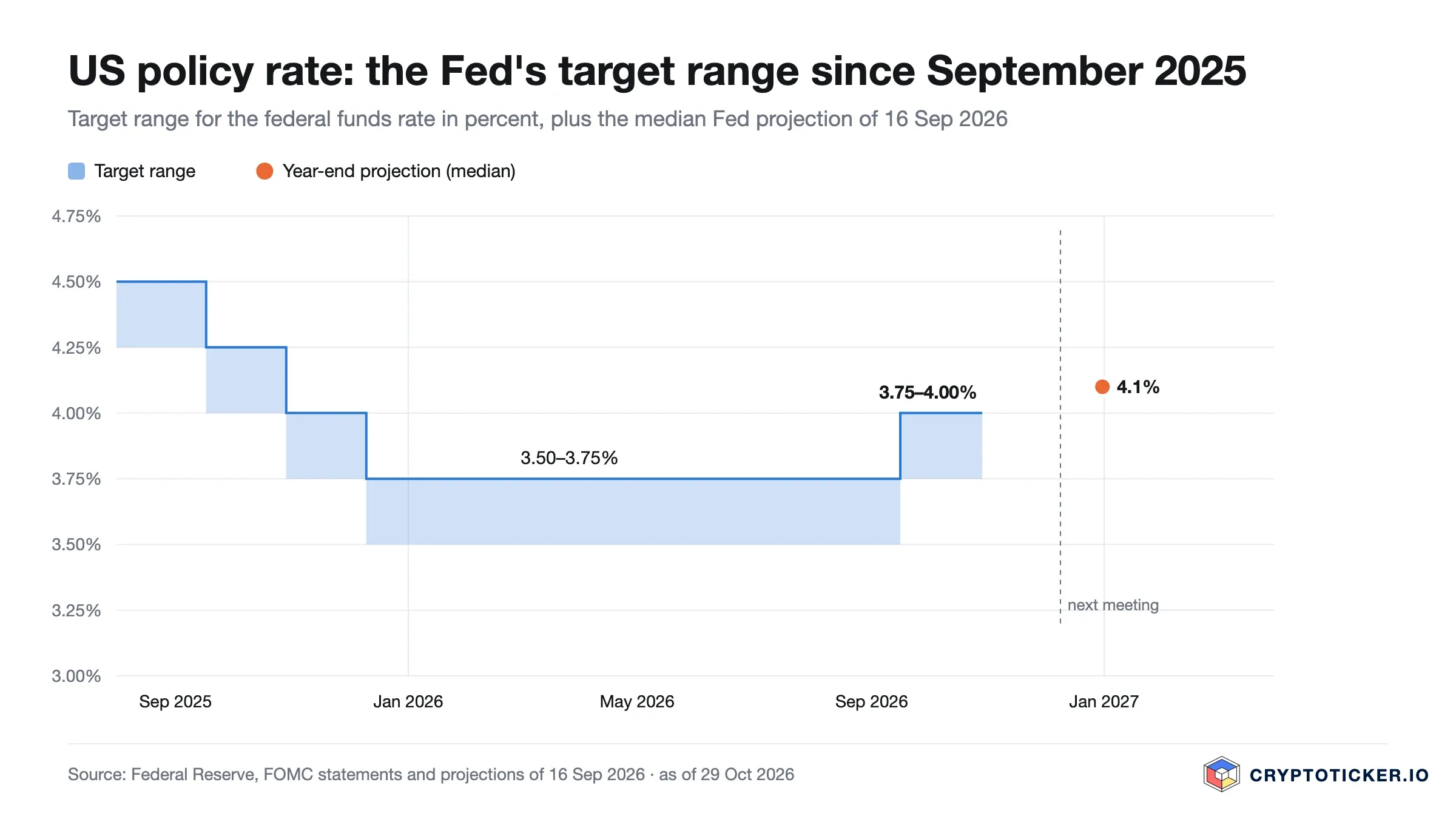
The year before split into two halves. Between September and December 2025 the Fed cut three times by a quarter point each, from 4.25%–4.50% to 3.50%–3.75%. It then held for five meetings while inflation picked up again, partly driven by higher energy prices, as the statements from April onwards note. They cite the conflict in the Middle East as a source of elevated uncertainty.
The projections of 16 September show where officials want to go. The median sees the policy rate at 4.1% at the end of 2026 and again at 4.1% at the end of 2027, falling to 3.9% only in 2028. In June the same figures were 3.8% and 3.6%. For PCE inflation the median expects 3.7% in 2026 and 2.3% in 2027.
Every Fed rate decision since September 2025 and how Bitcoin reacted
For each meeting we took the Bitcoin price at the hour of the announcement and compared it with the price 24 hours and seven days later, using Coinbase hourly prices for BTC-USD.
| Date | Decision | Range after | BTC at announcement | After 24 hours | After 7 days |
|---|---|---|---|---|---|
| 17 Sep 2025 | Cut by 25 bp | 4.00%–4.25% | $115,587 | +1.8% | −1.5% |
| 29 Oct 2025 | Cut by 25 bp | 3.75%–4.00% | $111,883 | −3.9% | −7.1% |
| 10 Dec 2025 | Cut by 25 bp | 3.50%–3.75% | $92,503 | −1.9% | −7.3% |
| 28 Jan 2026 | Hold | 3.50%–3.75% | $89,414 | −6.8% | −18.1% |
| 18 Mar 2026 | Hold | 3.50%–3.75% | $71,599 | −2.4% | −1.2% |
| 29 Apr 2026 | Hold | 3.50%–3.75% | $76,146 | +0.1% | +7.0% |
| 17 Jun 2026 | Hold | 3.50%–3.75% | $66,054 | −5.4% | −10.2% |
| 29 Jul 2026 | Hold | 3.50%–3.75% | $64,191 | +1.0% | +0.8% |
| 16 Sep 2026 | Hike by 25 bp | 3.75%–4.00% | $75,689 | +1.2% | +11.4% |
| 28 Oct 2026 | Hold | 3.75%–4.00% | $80,748 | +0.1% | coming on 4 November |
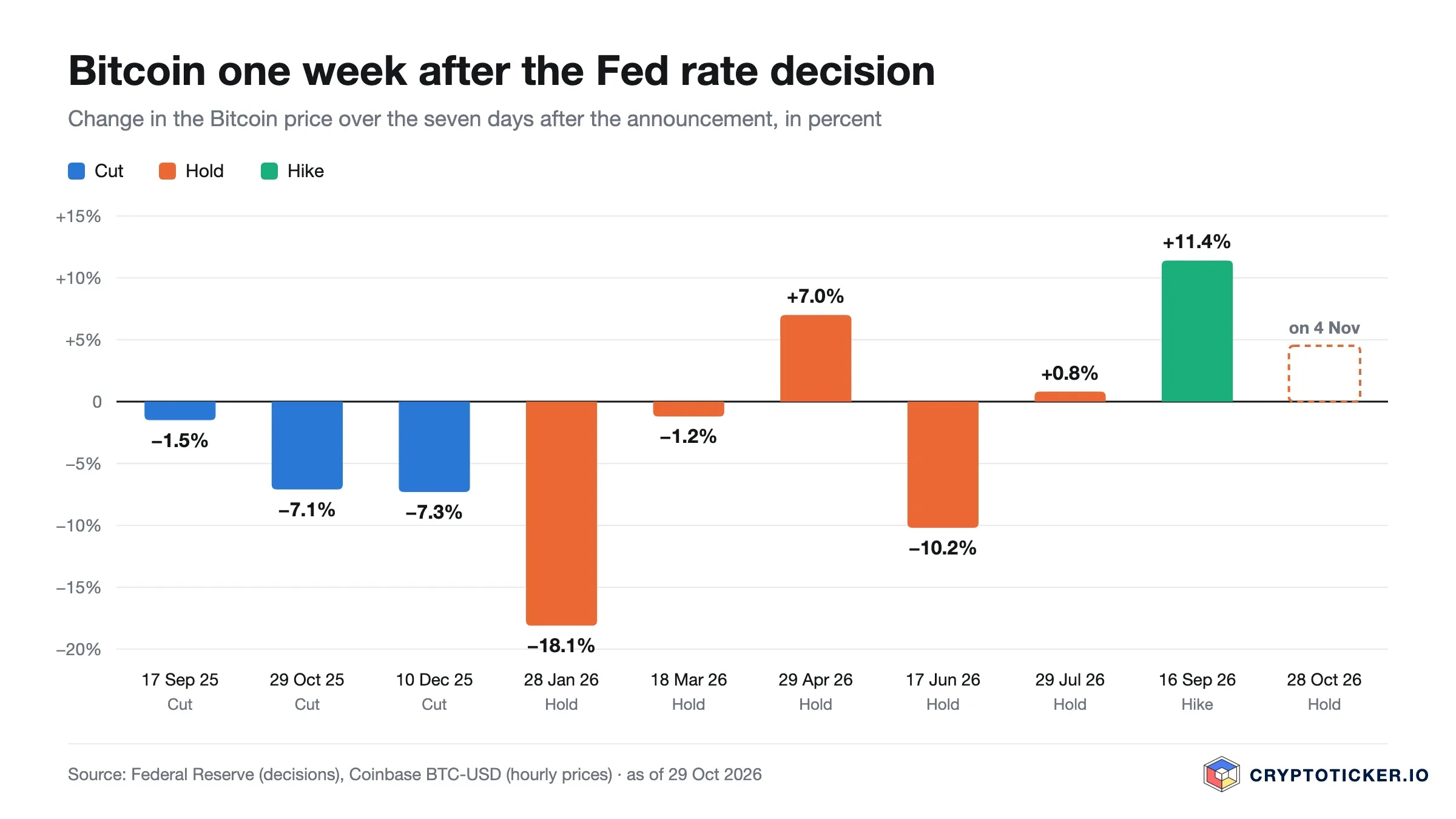
Three cuts, and three times Bitcoin was lower a week later. One hike, and Bitcoin gained 11.4% over the following week. After 24 hours the picture was balanced: five gains, five losses. The hold of 28 October barely moved the price, up 0.1%, and we will add the one-week figure on 4 November. In the first three hours after each decision, the gap between high and low ranged from 1.2% to 3.2%.
Part of the pattern is the broader trend. Between the September 2025 and July 2026 meetings, Bitcoin fell from $115,587 to $64,191 at the hour of the announcement. In a falling market most weeks end lower, Fed or no Fed. The best week in the series, by contrast, came during the recovery after the summer, and it started with the only tightening decision.
Our assessment: the rule of thumb that rate cuts are good for Bitcoin and hikes are bad does not survive this series. What moved the price was how the decision compared with expectations and where the wider market was already heading. The September hike was widely expected, with Polymarket at 87.5% on the morning of 16 September, so the decision removed uncertainty rather than adding it. The cuts in October and December 2025 came after the record high of 6 October 2025 at about $126,300. The counterargument: ten meetings are a small sample, and none of them delivered a genuine surprise against market pricing. For the longer view, our Bitcoin price prediction sets out the scenarios analysts are working with.

How the Fed rate decision feeds into the Bitcoin price
The policy rate reaches Bitcoin through three channels. The first is the yield on safe assets: when rates rise, cash and short-dated Treasuries pay more, and holding an asset with no income becomes relatively more expensive. The second is the dollar. Higher rates support the currency, and a stronger dollar weighs on the dollar price of many assets. The third is the cost of leverage. Pricier funding makes leveraged positions on derivatives exchanges more expensive and shrinks demand that relies on borrowed money.
All three work over weeks and months. On the evening of a decision, what matters is the gap to expectations. If the market prices a hold at 94.5% and the hold arrives, it is already in the price. Moves then come from the statement's wording, from dissents and from the press conference. In July, three members voted against the hold in favour of a hike, as the statement of 29 July records. In September the committee took exactly the step those three had asked for.
Fed decisions in 2026: from a long hold to the first hike under Warsh
This year's decisions read as a change of direction that built up over months.
- 28 January: hold at 3.50%–3.75%. Stephen Miran and Christopher Waller dissented in favour of another cut.
- 18 March: hold. Only Miran voted for a cut.
- 29 April: hold, Jerome Powell's last meeting as Chair. Four dissents: Miran wanted a cut, while Beth Hammack, Neel Kashkari and Lorie Logan objected to language that kept the door open to further easing.
- 17 June: unanimous hold, the first meeting under Kevin Warsh. The statement shrank from 348 to 138 words and pointed to energy supply shocks as a driver of inflation.
- 29 July: hold by a 9–3 vote. Hammack, Kashkari and Logan already wanted to raise rates.
- 16 September: unanimous hike of 25 basis points to 3.75%–4.00%.
- 28 October: hold at 3.75%–4.00% by a 10–2 vote. Lisa Cook and Beth Hammack wanted another hike.
If you were running a savings plan in September, our article on the Fed hike and the Bitcoin savings plan covers the impact. The table above gains a new row after every meeting.
Fed day and your crypto portfolio: leverage, timing and regular buying
A Fed evening is not an ordinary evening for Bitcoin. In our series the swing in the hours afterwards reached up to 3.2%. Three things matter more than usual.
- Leverage: a position at ten times leverage is down 30% after a 3% move against it. Tight stop-losses are often triggered on such evenings, even when the price recovers afterwards.
- Timing: 2:00 p.m. ET on 9 December 2026 and on 27 January 2027. Anyone with open orders on an exchange knows the moment and can decide beforehand whether to leave them in place.
- Regular buying instead of timing: buying at fixed intervals removes the need to call the Fed evening, and our series shows how poorly the decision predicted the direction. Providers that offer a Bitcoin savings plan are listed in our comparison, and trading fees in our exchange comparison.
Crypto assets are highly volatile and you can lose all of your money. This page explains dates and data and is not investment advice.
Fed in December: the projection points to 4.00% to 4.25%
If the Fed follows its own projection, the policy rate will end 2026 at 4.00% to 4.25%, a quarter point above today's range. On 28 October the Fed held, two members already wanted to hike, and the statement leaves the next step open. The market still places the hike in December, at 76.5% (as of 29 October 2026). The December meeting also brings new projections, and the median will show whether officials stick to 4.1% for 2027. This page will be updated with the new row, the price and the reaction after every decision.
Frequently asked questions about the Fed rate decision
Transparency note: This article was produced with the assistance of artificial intelligence and reviewed by our editorial team before publication. All figures and claims were checked against the primary sources linked in the text. The feature image was generated with AI.
Related articles
- Fed rate decision without a cut: “Inflation remains elevated”
- ECB rate decision: all dates to 2027 and how Bitcoin reacted
- FOMC and Crypto: How Can the First FOMC Meeting Under Trump Affect the Crypto Market?
- Fed Rate Decision of September 16: What It Means for Your Bitcoin Savings Plan
- Bitcoin Price $80,853: The Fed Statement Comes at 7 p.m. German Time This Week
Which topics should we dive deeper into?
Select what genuinely interests you. Your picks feed directly into our editorial planning.
Crypto news that's actually worth your time.
Weekly. 60 seconds. Carefully curated by our editors: no hype, no promo flood, no spam.

January 28, 2026 10:44 AM

FOMC Rate Decision: Bitcoin Braces for Volatility as Gold Hits $5,300
Bitcoin stays under $90k as the FOMC meeting approaches. With Gold hitting a record $5,300, traders expect major crypto market volatility after Powell's speech.

October 2, 2026 7:20 PM
Bitcoin after the US jobs report: 29,000 positions, and the Fed pause moves closer
The US labour market produced just 29,000 jobs in September, and July was revised after the fact to a loss of 10,000. What that means for the Fed meeting on October 27 and 28, for the levels on your chart and for leveraged positions.
October 21, 2026 7:19 AM

ETF inflows of $526.7 million meet a Bitcoin price of $82,708: the levels that decide before the Fed meeting
Bitcoin costs $82,708 on Wednesday morning after $526.7 million flowed into the US spot ETFs on Monday. October still leaves those funds in the red, and two moving averages frame the market until the Fed meets on October 28.
October 14, 2026 7:40 PM

US inflation rises to 3.7 percent, core rate above forecast: what matters now for Bitcoin
US consumer prices rose 3.7 percent in September, and the core rate 2.6 percent. Both figures came in above forecast, two weeks before the Fed decision on October 28.
September 24, 2026 10:11 PM

Bitcoin Price Prediction: What to Check on Levels, Holding Period and Leverage Before the October 28 Rate Decision
Bitcoin is trading at around $83,800, a third below its October 2025 high, while the sentiment index reads greed. Which dates, levels and deadlines over the coming weeks really decide your net gain, and which of them you steer yourself.
December 30, 2025 10:07 AM

Polymarket Traders Expect the Fed to Pause Rates in 2026: What That Usually Means for Crypto
Polymarket traders see the Fed holding rates in 2026. Here’s how rate pauses have historically affected crypto prices.
October 23, 2025 12:26 PM

Bitcoin Awaits FOMC Decision as Gold Cools Off: Will Crypto See an Inflow of Capital?
Bitcoin trades around $109K ahead of next week’s FOMC meeting. With gold slipping, will capital rotation favor crypto as markets brace for new Fed moves?
July 25, 2026 11:27 AM
Crypto Price Today: Market Slides Again as Bitcoin Fails at $67,000
Bitcoin slipped back under $64,000 after tapping $66,990. Oil, ETF outflows and Fed nerves are dragging the whole crypto market lower.
June 13, 2024 4:13 PM

Crypto Market DOWN As Bitcoin Price Slides, Ethereum Price Consolidates, And XRP Price Nears New Lows
The recent Federal Reserve decisions and market dynamics impact Bitcoin, Ethereum, and XRP. How to manage and what to monitor amid market volatility and uncertainty?
October 28, 2026 1:09 PM

Fed rate decision at 7 pm: rates at 3.75 to 4 percent after a hike
The US key rate stands at 3.75 to 4 percent, and it got there through a hike. What this evening's decision means for leverage, holding periods and the purchase route.
October 1, 2026 7:25 AM

US core inflation falls to 3.0 percent: what investors need to know before the Fed decision on October 28
US core inflation ran at 3.0 percent in August, clearly below the expected rate. That shifts expectations for the Fed meeting on October 28 and helps decide how much room the Bitcoin price gets in the fourth quarter.
September 5, 2026 12:57 PM
Top 5 Cryptos To Watch In September 2026
Bitcoin has climbed back near $80,000 from its June low. Here are the five cryptos worth watching this September, and the risks around them.
March 15, 2025 5:40 PM

Bitcoin Price Prediction March 2025 with FOMC and TRUMP in Play
Bitcoin price prediction for March 2025 is one to expect, ahead of the upcoming FOMC meeting and Trump's strategic crypto reserve. What to expect for BTC price?
September 14, 2024 12:01 PM
Bitcoin Surges Past $60K: The Start of a Major Rally or Just Another Bull Trap?
Bitcoin has surged past $60,000, sparking optimism among investors. But with looming market volatility and whale activity, is this the start of a new rally or just another bull trap?
September 9, 2024 8:00 AM
How Fed Rate Cuts Could Shake Global Markets and Boost Tokenized Treasuries
With looming Fed rate cuts, global markets are bracing for impact. Check how these changes could affect risk-on assets like Bitcoin and tokenized treasuries.
October 24, 2026 3:28 PM

Bitcoin Price Prediction: Fed on Wednesday, $11.1 Billion Expiry on Friday, Which Date Moves the Price?
Analysis: the Fed decides on October 28, and two days later more than $11.1 billion in bitcoin options expire. The market has moved the rate rise to December, and that shifts the levels for this week.
October 12, 2026 7:53 PM

Bitcoin Forecast: Last Inflation Print Before the Fed, and $82,500 Is the Level That Decides
Bitcoin trades at $82,663 on Monday evening, below its 20-day line but above its 50-day line. Wednesday brings the last US inflation print before the Fed decision of October 28, and it sets the range for the next two weeks.
October 23, 2026 7:15 AM

Bitcoin price $81,568 after $431 million in long liquidations: how to proceed now
The Nasdaq closed 2.6 percent lower, Bitcoin fell to $80,989 overnight and derivatives exchanges closed leveraged long positions worth several hundred million dollars. What is behind the wave, which levels apply today and what you can settle now on leverage, the holding period and the buying route.
October 29, 2026 9:33 AM
Bitcoin Cash falls below $286: the 200-day line that decides the trend
Bitcoin Cash loses almost 6 percent to $279.87 and slips below its 200-day line at $286.19. The trigger is the Fed rate pause of October 28, at which two members even voted for an increase.
October 28, 2026 9:18 AM

Bitcoin price $80,913: why ETF buyers are still in the red
Bitcoin trades at $80,913 on Wednesday morning, just below the average price at which the US spot ETFs bought their holdings. What this line at $81,500 means, and which levels count before the evening rate decision.
October 27, 2026 3:39 PM

Bitcoin price prediction: a 6 percent range in Fed week, what you can do now
Analysis: Bitcoin stands at $80,302 at Tuesday midday, and the range of the past 30 days has fallen to 10.2 percent, the tightest reading since mid-August. What the three comparable phases since November 2024 say about the next trading days, and which levels frame the corridor.
October 26, 2026 6:30 AM

Bitcoin at $79,978: what to watch at the lowest level since September
Analysis: Bitcoin slipped to $79,332 overnight into Monday, its lowest level since September 18. Wednesday's Fed decision, Thursday's mining adjustment and the German one-year holding period will decide what the setback means for you.
August 2, 2026 10:04 AM

Crypto News Today: Hawkish Fed, a $70M Wallet Hack and Bitcoin's Shaky Start to August
Crypto news today: the Fed split 9-3, a Coldcard flaw drained $70M in BTC, and ETFs turned red. Here is the full week and what lands next.
July 19, 2026 10:44 AM

Crypto Prices Today: Bitcoin Holds $64K as Ethereum Outperforms
Bitcoin holds $64K as ETF flows turn, Iran tensions cap the rally, and all eyes shift to the July 28–29 Fed meeting. Here's your weekly wrap.
January 25, 2026 11:55 AM
Crypto Ticker News Week 4: Bitcoin Stabilizes as Fed and Unlocks Loom
Bitcoin fights to hold $89k in Week 4 of 2026. Crypto news of the week includes the impact of the upcoming FOMC meeting and major token unlocks for JUP and BGB.
July 10, 2025 8:16 AM
Trump vs. Powell: Can Crypto Survive the US Economic Power Struggle?
Trump attacks the Fed, announces trade moves—can crypto hold steady, or will US tensions shake Bitcoin and altcoins in 2025?
October 16, 2026 1:32 AM

US producer prices at 6.3 percent: the $80,000 level decides the leverage question up to October 28
US producer prices rose 1.3 percent on the month and 6.3 percent on the year in September, running well above consumer prices. Bitcoin fell to just under $80,000 while the probability of a rate rise on October 28 jumped from 22 to 47 percent within a day and fell back to 26 percent.
More from CryptoTicker