Ethereum Price Prediction: Can ETH Hold the Critical $1,800 Support?
Ethereum is at a "make or break" point. With ETH testing the critical $1,800 support, find out if Vitalik Buterin’s sales will trigger a massive market crash.


Ethereum ($ETH) has reached a decisive "knife's edge" moment in late February 2026. After a sharp 6% decline over the last 24 hours, the second-largest cryptocurrency is currently fighting to maintain its position above the critical $1,800 support level. This price point is widely regarded by technical analysts as the final line of defense before a potential slide into the $1,500 territory. As selling pressure from the Ethereum Foundation intensifies, the market's focus has shifted entirely to whether the bulls can stage a defense at this psychological floor.
Can Ethereum Price Hold the $1,800 Support?
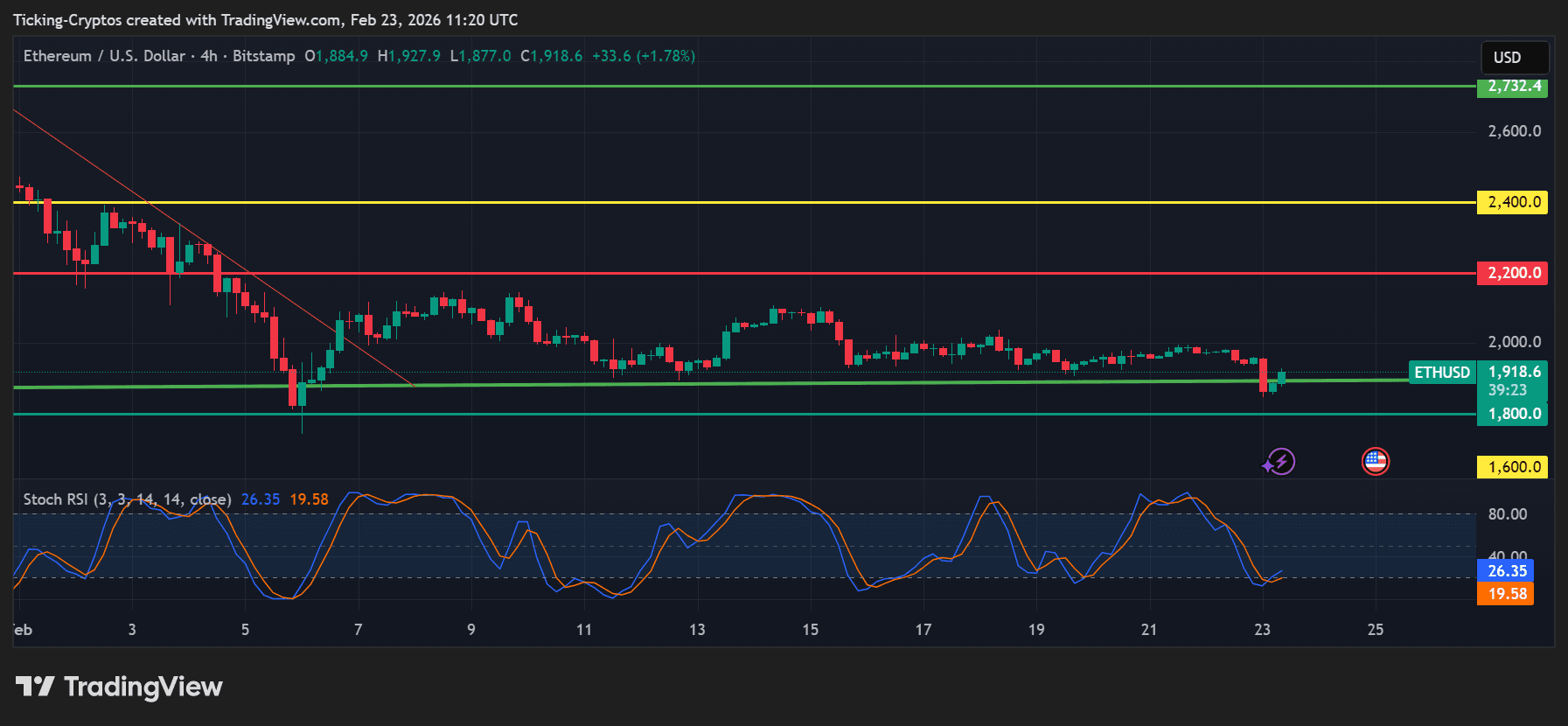
The short answer: It is under extreme threat. As of today, February 23, 2026, Ethereum is trading near $1,870, having briefly dipped to a low of $1,845. Technical indicators, including the ETH/USD price chart, suggest that a breach of $1,800 is highly probable if current sell volumes persist. A daily close below $1,800 would likely trigger automated stop-loss orders, potentially accelerating a move toward $1,570 or lower.
Defining "Support" in the Current Downtrend
In technical analysis, a support level is a price point where an asset tends to find buying interest, preventing the price from falling further. For Ethereum, $1,800 isn't just a number; it is a historical accumulation zone.
- Concept Clarity: If ETH holds $1,800, it confirms a "double bottom" or a consolidation phase.
- The Risk: If it fails, the "bear pennant" pattern observed on the weekly charts suggests a "measured move" downside target of $1,475.
Why $1,800 is the "Make-or-Break" Level
The significance of the $1,800 mark stems from several factors:
- Psychological Weight: Round numbers act as natural barriers for retail traders.
- On-chain Liquidations: Data indicates that a significant cluster of DeFi lending positions faces liquidation if ETH drops below $1,780.
- Institutional Sentiment: Major buyers often set "buy walls" at these structural levels to prevent a full-scale market reset.
Vitalik Buterin and the Foundation: The Source of Pressure
The primary catalyst for the current test of $1,800 is the ongoing distribution of ETH by the Ethereum Foundation and co-founder Vitalik Buterin. In February 2026 alone, Buterin has offloaded approximately $16 million worth of ETH to fund "Glamsterdam" and "Hegotá" roadmap developments. While these sales represent only a fraction of daily volume, they significantly dampen investor confidence and signal a "risk-off" environment.
Furthermore, whale wallets (holding 100k–1M ETH) have sold nearly 1.43 million ETH ($2.7 billion) in the past two weeks, shifting the supply-demand balance in favor of the bears.
 Crypto taxes made simple: Compare the top-rated tools for 100% compliance and efficiency
Ethereum Price Prediction: Support and Resistance Zones for ETH Coin
If you are looking to buy Ethereum or trade the volatility, keep these levels on your radar:
| Target | Price Level | Technical Context |
|---|---|---|
| Immediate Support | $1,850 | Hourly support being tested currently. |
| Critical Support | $1,800 | The "last stand" for bullish continuation. |
| Crash Target | $1,500 | Target if the bear pennant breaks down. |
| Key Resistance | $1,920 | Must be reclaimed to stabilize the price. |
The RSI is currently at 20, indicating Ethereum is oversold. While a relief bounce back toward $1,950 is possible, the overall trend remains firmly bearish until a "higher high" is formed above $2,085.
Summary: The Path Ahead
Ethereum is currently in a high-stakes battle. Holding the $1,800 support is essential to avoid a deeper correction that could see prices return to early 2024 levels. While the fundamental 2026 roadmap (Glamsterdam upgrade) remains promising for the long term, the short-term technicals favor the bears.
Investors should remain cautious and consider using secure hardware wallets to manage their holdings during this period of "genuine distress."