Gold Crash Today: Why Did Gold Price Plunge and Crypto Followed
Gold prices suffered a massive flash crash today after hitting $5,600. Here's why XAU/USD dropped 5% and how Bitcoin and altcoins are reacting to the volatility.


The global financial markets witnessed a historic "black swan" event today, January 29, 2026. After a relentless multi-week rally that saw Gold (XAU/USD) smash through psychological barriers, the market experienced a violent "flash crash." Within mere minutes, the precious metal erased gains that took days to build, sending shockwaves through both traditional finance and the crypto news sectors.
The Gold Flash Crash: From $5,600 to Chaos
Early trading on January 29 saw Gold reach a staggering all-time high of $5,597 per ounce. The rally was fueled by a "perfect storm" of a weakening US dollar, geopolitical tensions in the Middle East, and aggressive central bank accumulation. However, as the price approached the $5,600 mark, the market hit a wall of technical selling.
The XAU/USD price today (often compared to digital assets) plummeted nearly 5% in a vertical drop, bottoming out in the $5,100–$5,140 range. Analysts at major outlets like Bloomberg point to a massive "liquidation cascade" where automated stop-loss orders and high-leverage positions were forcibly closed, creating a liquidity vacuum. This volatility comes just as the Federal Reserve opted to hold interest rates steady at 3.50%-3.75%, a move that initially weakened the dollar but eventually led to a "sell the news" reaction in overbought commodities.
Why Cryptos are Crashing Alongside Gold
While Gold is often viewed as a "safe haven," today's crash proved that no asset is immune to a massive deleveraging event. As Gold plunged, Bitcoin ($BTC) and major altcoins like Ethereum and Solana also saw significant red candles.
The Bitcoin price today slid from its attempt at $90,000 down toward $84,000, a decline of over 5%. This synchronized drop suggests a broader "risk-off" sentiment where traders are exiting positions across all liquid assets to cover margin calls or move into cash.
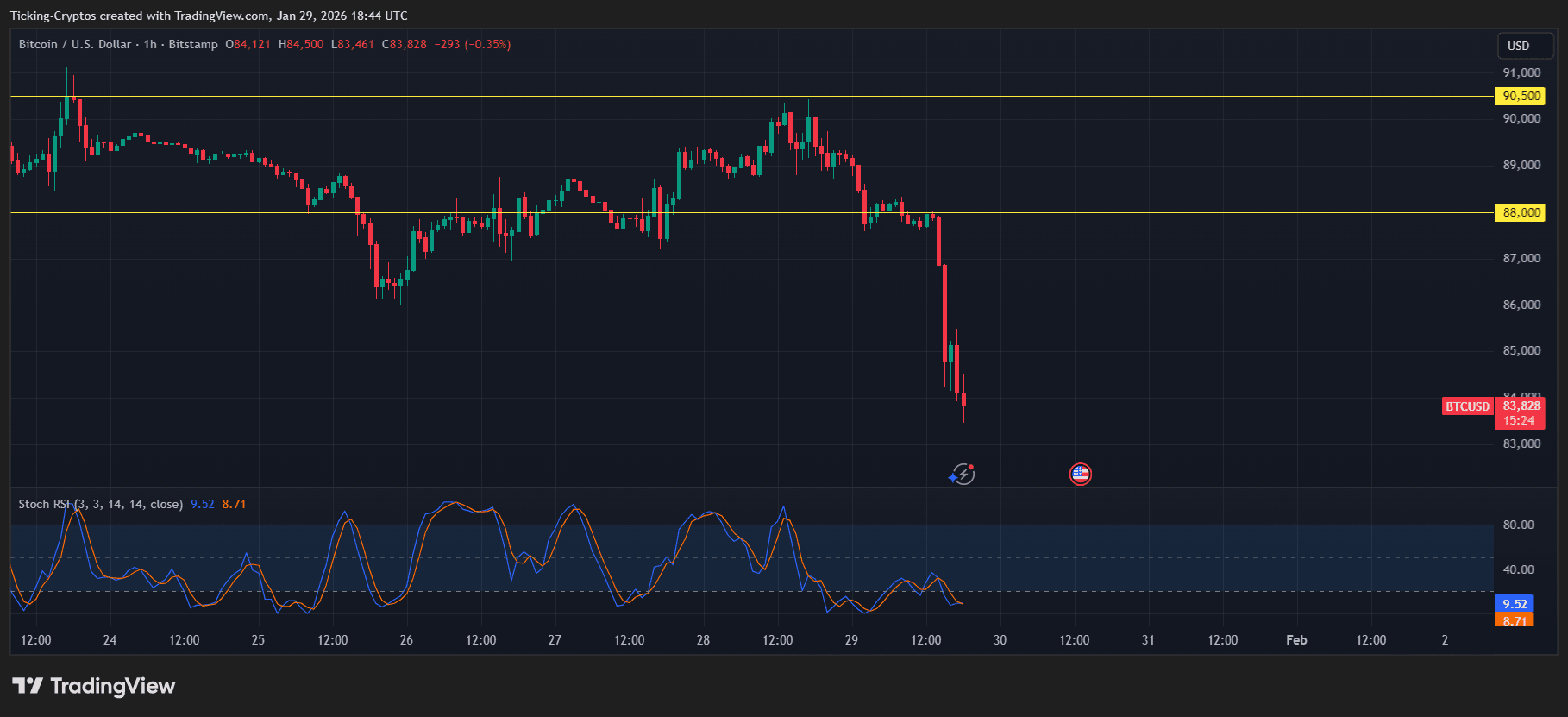
BTC/USD 1H - TradingView
- Liquidity Squeeze: When major assets like Gold flash crash, institutional players often sell their crypto holdings to maintain balance sheets.
- Correlation Shift: In early 2026, the correlation between Bitcoin and "hard assets" has tightened. When the "Gold bubble" shows signs of local exhaustion, crypto speculators quickly turn bearish.
- Profit Taking: After a bullish start to the year, many investors used the Gold volatility as a signal to lock in gains on their crypto exchanges.
Technical Outlook: Is the Bull Run Over?
Despite the severity of the crash, the long-term structure for Gold remains bullish, with many banks still forecasting $6,000 later this year. For crypto, the "flash" nature of the crash suggests it may be a healthy deleveraging of the market rather than a trend reversal.
Traders are now looking at key support levels. For Gold, staying above $5,000 is crucial. For Bitcoin, bulls need to defend the $80,000 zone to prevent a deeper slide. During such volatile times, moving assets to hardware wallets is often recommended for those looking to "HODL" through the turbulence.
Disclaimer: This article is for informational purposes only and does not constitute financial advice. Trading cryptocurrencies and commodities like Gold involves significant risk. Always conduct your own research or consult a professional financial advisor before making investment decisions.